# 1 position
Joliet Junior College - Interior Design.
associate

Audited and Verified:
Our Editorial and Data Verification Process
Research.com uses government datasets, official education statistics and primary institutional information to support its career and degree guides. Our review process checks factual accuracy, occupational definitions, source dates and the requirements associated with the credentials discussed.
How This Article Was Fact-Checked
Our editorial team verifies salary estimates, employment projections, education requirements and program information against original data providers and official organizations. Salary figures are checked against the relevant occupational definitions and reporting periods. Information about licensure, accreditation and required in-person training is reviewed separately.
Fact-checked and verified on:

Co-Founder and Chief Data Scientist

Reviewed by Karolina Broda
Fact-Checker and Data Verification
Choosing an affordable interior design program near Joliet means checking more than tuition: the credential, portfolio work, commuting costs, and Illinois title rules all affect its value. The Research.com team of data scientists created the Most Affordable Interior Design Trade Schools in Joliet for 2027 ranking to help students identify programs worth considering. The U.S. Bureau of Labor Statistics projects 2.7% national employment growth for interior designers from 2025 to 2035. This guide helps career changers and first-time students compare training routes, costs, and realistic career outcomes.
Expect a mix of design decisions and technical production. Interior-design training can cover space planning, materials, lighting, computer-aided drafting, building-code awareness, client presentations, and a portfolio. A program focused mainly on decorating or home staging may be useful for sales or styling work but offer less preparation for technical design assignments. The U.S. Bureau of Labor Statistics describes interior designers' work as planning functional, safe, and attractive indoor spaces; the curriculum should match the part of that work you want to do.
For a Joliet student, the practical question is whether required studio time and possible work experience fit a commute to training or worksites in the wider Chicago-area market. Before enrolling, request sample projects and ask whether students produce measured plans, specifications, and a reviewed portfolio - not just inspiration boards. A paid assistant position or employer training can complement coursework, but it is not automatically a registered apprenticeship or a substitute for a program's technical instruction.
Possible settings include residential design businesses, furniture and kitchen-and-bath showrooms, remodeling firms, commercial design offices, and suppliers of finishes or furnishings. Some roles emphasize client service and product selection; others expect technical drawings and coordination with contractors. The U.S. Bureau of Labor Statistics identifies specialized design services, architectural and engineering services, and furniture retailers among interior designers' employment settings.
Joliet's access to the broader Chicago-area market can widen a job search, but it can also add commuting costs and expose applicants to more competition. Search actual entry-level postings by task - such as showroom consultant, design assistant, or CAD production assistant - then compare their software and portfolio requirements with the program's projects. Do not assume every employer using "designer" in a job title requires the same preparation.
A verified Joliet-specific interior-designer wage is not established here. Nationally, the median annual pay for interior designers was $67,190 in May 2025, according to the U.S. Bureau of Labor Statistics. That figure covers workers at different experience levels across the country; it should not be used as an expected first salary for a new certificate holder in Joliet.
Pay depends partly on the job actually obtained. A showroom sales position may have a different pay structure from a technical design-assistant role, and independent client work can involve business expenses and uneven income. For a useful local comparison, ask employers for advertised pay ranges and check whether compensation includes commissions. Compare those ranges with your current earnings before taking on debt or reducing work hours.
There is no single required training length or universal clock-hour minimum for every interior-design job in Joliet. A focused certificate may take less time than an associate-degree program, but duration alone says little about technical depth. Program schedules, course loads, and whether required classes run every term determine an individual completion date; ask each provider for its published sequence and total contact or credit hours.
Part-time study can preserve income while extending the time before a finished portfolio is ready. If speed is the priority, compare the actual courses and studio access in accelerated options rather than choosing the shortest advertisement. Readers balancing employment with education can explore fast degree college options for working adults, while checking whether any option they consider actually offers the interior-design training they need.
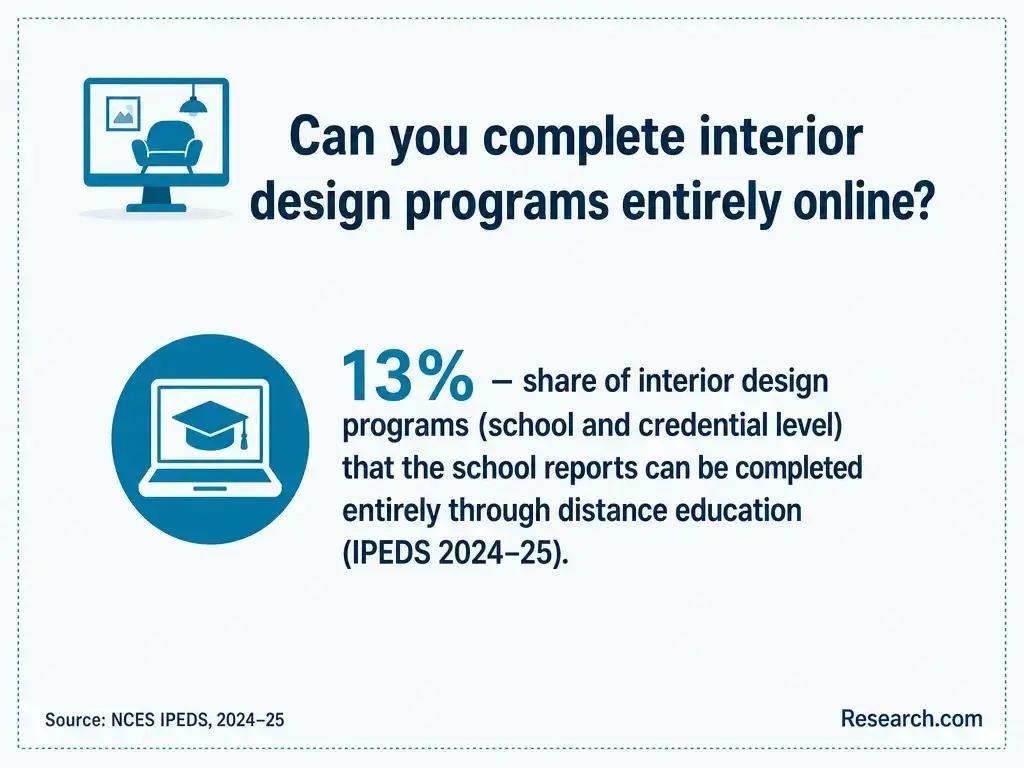
Online study can work well for design history, software demonstrations, and some drafting assignments. In-person studios make it easier to get feedback on physical materials, measured spaces, presentations, and collaborative projects. A hybrid program can combine both, but its schedule may still require travel for critiques or site work. Neither format should be judged by its label alone.
The format comparison below focuses on the training a student can demonstrate, not merely where lectures happen.
| Format | Potential advantage | What to verify |
| Online | Less routine travel; flexible access to course materials | Live feedback, software access, portfolio review, and any required site or studio work |
| On-campus | Direct studio instruction and access to shared resources | Studio hours, equipment availability, and commuting costs |
| Hybrid | Remote coursework with scheduled practical sessions | Exact in-person dates, locations, and attendance rules |
Ask to see how remote students receive critique and complete physical measurement or materials assignments. An online credential does not, by itself, establish eligibility for an optional professional credential or Illinois registration.
There is no defensible single average for Joliet interior-design training without a defined set of current programs and their full published charges. A tuition-only comparison would also miss expenses that can change the cheapest option. Request a current, itemized estimate from each provider, including resident tuition where relevant, mandatory fees, software or computer requirements, supplies, textbooks, and transportation.
The cost categories below show why two programs with similar tuition may require different amounts of cash to finish.
| Cost category | Decision implication |
| Tuition and mandatory fees | Check the total for the credential, not a single term's advertised rate. |
| Software, equipment, and materials | Confirm whether licenses, a capable computer, samples, and printing are included. |
| Travel and lost earnings | Account for studio visits, work placements, and time away from paid work. |
| Borrowing | Consider repayment obligations even if training is not completed. |
Compare grants, scholarships, eligible federal or Illinois aid, and employer assistance against those costs. Aid depends on the student and the eligible program; a school's accreditation alone does not make every course aid-eligible. If an associate degree fits your job target, cheapest associate's degree comparisons can help frame price questions, but verify interior-design coursework and hands-on requirements separately.
The award depends on the program: it could be a certificate, diploma, or associate degree. A short credential may suit someone adding showroom, styling, or software skills; a longer, technically focused program may better support applications for design-assistant work and future professional credential review. Ask for the exact award name and transcripted coursework. Similar-sounding credentials can represent substantially different studio and technical preparation.
Employment experience and employer-sponsored instruction are other routes into some support roles, but they do not necessarily award an academic credential. Likewise, a course-completion certificate is not the same as professional certification or Illinois registration. If you are comparing shorter options, lists of certificates that pay well are useful only after you confirm that the specific curriculum builds the portfolio and skills your intended employers request.
Requirements vary by credential and provider. Ask whether entry requires a high school diploma or equivalent, placement assessment, prerequisite coursework, a portfolio, or a particular computer and software setup. Also ask whether prior coursework can transfer and whether relevant work experience can receive credit; neither should be assumed without a written evaluation from the receiving program.
For Joliet Junior College or any other option you investigate, confirm admission to the specific program, not just admission to the institution, and obtain its current course schedule before planning around work. Federal aid requires separate eligibility checks for both the student and program. A comparison of most affordable online schools that accept fafsa cannot establish that a particular interior-design credential qualifies for aid; verify that through the school's financial-aid office and Federal Student Aid.
A technically oriented program should give students practice translating a client brief into layouts, drawings, material selections, and a presentation that explains design choices. Coursework may address color, lighting, furniture, accessibility, building systems, and industry software. The U.S. Bureau of Labor Statistics notes that interior designers consider building codes and accessibility standards; a program limited to aesthetics may therefore be a poor match for someone seeking technical design work.
Judge hands-on depth by finished work. Ask how many projects receive instructor critique, whether students measure real spaces, what software they use, and whether they prepare a portfolio for employers. If a provider advertises an internship, verify whether it is required, who secures the placement, whether it is paid, and how it affects the schedule. Those answers reveal more than the credential name alone.
Illinois distinguishes working in interior design from using the state-regulated registered interior designer title. Registration is not a blanket requirement for every decorating, showroom, or design-support job. The Illinois Department of Financial and Professional Regulation administers registration under the Illinois Interior Design Title Act; candidates interested in the title should check its current education, experience, and examination requirements before choosing a program.
Professional certification, such as the NCIDQ credential, is separate from school accreditation and state registration. The Council for Interior Design Qualification sets its own eligibility and examination rules. Institutional accreditation concerns the school; any specialized program recognition concerns the curriculum; neither automatically grants certification, registration, or a job. Ask the relevant organization to confirm whether your proposed coursework and supervised experience would count toward your long-term goal.
Start with the job you want, then work backward to the skills, portfolio, credential, and budget it requires. An affordability ranking can narrow the search, but its cost-and-debt score does not evaluate studio quality or career fit. A low-cost decorating course may be excellent for a showroom goal and unsuitable for a technical-design goal.
Use these questions when contacting programs; written answers make offers easier to compare.
Red flags include a promised salary, vague claims that a certificate makes students "licensed," or an unwillingness to show required projects and total charges. To evaluate the investment, weigh completion probability, aid and debt, earnings you would give up while studying, plausible post-training pay, and how long you expect to use the skills. Do not treat the national occupational median as a personal return-on-investment forecast.
A beginning student might pursue showroom consulting, design-assistant work, or drafting support, depending on their portfolio and software ability. With experience, a worker may take on more client responsibility, specialize in a product or space type, or consider independent work. Advancement depends on demonstrated work and employer expectations; an optional certification or Illinois registered title is a separate decision, not an automatic promotion after graduation.
Someone seeking the fastest paid entry may prefer a relevant showroom role with employer training, then add targeted coursework. Someone aiming to produce technical plans should prioritize sustained drafting and studio practice. Interior design also has a different earnings and training profile from many occupations featured in guides to what is the highest paying trade school job; choose it for the work you want to perform, not an unrelated trade's advertised pay.
The U.S. Bureau of Labor Statistics projects 2.7% national employment growth for interior designers from 2025 to 2035. That is a national occupational projection, not a forecast of openings in Joliet. For an applicant, it suggests building a portfolio and employer-relevant software skills matters more than assuming rapid growth will make entry easy.
Local opportunities may appear under several titles across design firms, remodeling businesses, and showrooms in the wider commuting area. Review recent postings for the specific work you want, noting whether they ask for technical drawings, sales experience, or client presentations. If most accessible jobs differ from your intended role, reconsider the credential before paying for training - not after completing it.
Investing in training is a consequential decision. Research.com designed this ranking to help readers compare affordable options against other programs in the same occupation and location, rather than against unrelated schools. Only programs with completions reported to the Integrated Postsecondary Education Data System (IPEDS) are eligible; that limit means the ranking does not cover every apprenticeship, employer-sponsored course, or training provider.
The most affordable ranking scores costs and debt only: tuition, cost of attendance, median student debt, and federal loan default rate. An entropy-based method assigns more weight to indicators that vary more across eligible programs. Accreditation, recognition, support services, completion, and earnings are not part of this affordability score, so a high placement is a starting point for investigation - not a finding that a program fits every career goal.
For context, Research.com's separate best programs rankings assess student outcomes, earnings and return on investment, costs and debt, and quality and recognition. Their weights assign 20% to relevant programmatic accreditation or industry recognition, 10% to institutional accreditation, 10% to student support, and 60% to outcomes, earnings, and costs using the entropy-based method. The team uses the following sources to check coverage and data quality across its trade-program rankings; not every source is applicable to interior design.
Readers can use the ranking to narrow their cost comparison, then verify current program details directly. See Research.com's methodology for more information about how its rankings are created.
# 1 position
# 2 position
That depends on current total charges, aid eligibility, and the credential you need. Use the accompanying affordability ranking to identify options, then request itemized program costs and confirm that each curriculum fits your target job.
A certificate may help with entry-level styling, showroom, or support work if it develops the skills employers request. It does not automatically meet the requirements for professional certification or Illinois registration.
It may be enough for a particular employer-facing skill, such as introductory software use. Check how the program handles measured spaces, material work, critique, and portfolio development before treating online and studio-based options as equivalent.
No. Illinois regulates use of the registered interior designer title, not every design-related job. Check current requirements with the Illinois Department of Financial and Professional Regulation if that title is your goal.
Some showroom or design-support employers train new hires while they work. Such jobs may reduce upfront education costs, but ask whether they provide the technical instruction and portfolio experience needed for your longer-term goal.