# 1 position


Audited and Verified:
Our Editorial and Data Verification Process
Research.com uses government datasets, official education statistics and primary institutional information to support its career and degree guides. Our review process checks factual accuracy, occupational definitions, source dates and the requirements associated with the credentials discussed.
How This Article Was Fact-Checked
Our editorial team verifies salary estimates, employment projections, education requirements and program information against original data providers and official organizations. Salary figures are checked against the relevant occupational definitions and reporting periods. Information about licensure, accreditation and required in-person training is reviewed separately.
Fact-checked and verified on:

Co-Founder and Chief Data Scientist

Reviewed by Karolina Broda
Fact-Checker and Data Verification
Choosing an affordable interior design program near Marietta means looking beyond tuition: a short certificate and a longer associate degree may prepare you for different jobs. The U.S. Bureau of Labor Statistics reports a $67,190 national median annual wage for interior designers in May 2025, but that is not an entry-level or local pay estimate. This guide explains credentials, costs, practical training, and Georgia registration. It also accompanies the Most Affordable Interior Design Trade Schools in Marietta for 2027 ranking, created by the Research.com team of data scientists to help students identify programs worth considering.
Expect a mix of design projects and technical work: measuring spaces, developing layouts, selecting materials, preparing presentations, and communicating plans to clients and contractors. Interior design differs from decorating because some roles also involve construction documents, accessibility, and building-code considerations. The depth of that technical training varies substantially by credential (U.S. Bureau of Labor Statistics).
Chattahoochee Technical College is a public technical-college option to investigate, but confirm its current interior design-related offerings, credential titles, campus location, and course schedule in the applicable catalog. A program associated with a Marietta-area institution is not necessarily taught at its Marietta campus. For a career pivot, ask to see student project examples and verify which software, supervised studio work, and employer-facing projects are included. Broad affordable college online comparisons cannot answer those occupation-specific questions.
Unlike a licensed construction trade, interior design does not have a standard paid apprenticeship that every entrant must complete. Work in a showroom, design office, or furnishings business can nevertheless provide valuable experience alongside training. Ask whether a placement is arranged, optional, paid, and accessible from your intended campus.
Potential workplaces include residential design practices, kitchen and bath firms, furniture showrooms, home-improvement businesses, and commercial design teams across Cobb County and the wider Atlanta labor market. The commute matters: a program or internship outside Marietta may expand your opportunities while increasing travel costs and time.
A short credential paired with strong product knowledge may suit showroom sales or a design-assistant position. Firms preparing commercial drawings may instead expect more advanced drafting, documentation, and code knowledge. Before enrolling, compare local job postings with the program's required courses and portfolio projects; a shared "interior design" label does not mean the training fits every role.
The U.S. Bureau of Labor Statistics reports a $67,190 national median annual wage for interior designers for May 2025. That occupation-wide midpoint includes experienced workers and should not be used as a Marietta starting-salary estimate. Pay for an assistant, showroom salesperson, or drafter may also be reported under a different occupation, so the interior-designer median may be the wrong comparison for a short certificate.
For a local return-on-investment check, collect pay ranges from current Marietta and Atlanta-area postings for the specific role you want. Compare those ranges with your present earnings, likely study time, borrowing, and the experience employers request. A higher potential wage is less useful if the credential does not qualify you for the advertised work.
There is no single statewide clock-hour requirement for every interior design training program. A focused certificate can take less time than an associate degree, while part-time scheduling, course sequencing, and internship availability can extend either route. Request the catalog's required credit or contact hours and a term-by-term plan rather than relying on an advertised completion time.
Accelerated study can reduce time away from work but may leave less room to develop a portfolio or gain office experience. A longer pathway may make sense if its additional studios, technical courses, and credential match the jobs you want. Comparisons with one-year graduate programs do not establish how quickly an occupational design credential can make you job-ready.
Online delivery can work well for design history, specifications, software demonstrations, and some digital critiques. On-campus or scheduled in-person work may be more useful for measuring spaces, handling materials, building models, receiving live studio feedback, and meeting local employers. A hybrid program can combine both, but "online" does not tell you whether any fieldwork or campus visits are required.
For a working adult, the relevant comparison is the complete schedule - not just the lecture format. Ask where studio critiques, assessments, and any work placement happen, and whether you can access the required software remotely. Guides to the best affordable online schools for working adults may help frame a scheduling search, but confirm the practical requirements of each interior design program directly.
A reliable Marietta-wide average cannot be stated without a defined set of programs, current prices, and a consistent cost measure. For a 2027 decision, request an itemized estimate for the credential and campus you would actually attend. Published tuition alone may omit costs that are especially relevant to design training.
The following comparison shows which expenses to obtain from each provider before deciding that one option is cheaper.
| Cost component | What to confirm | Why it changes the comparison |
| Tuition and mandatory fees | Price for all required courses; Georgia residency rules where applicable | A per-term quote may understate the full credential cost. |
| Design equipment and materials | Computer specifications, software access, printing, samples, and project supplies | These can differ even between similarly named programs. |
| Attendance and career entry | Travel, parking, any placement expenses, and optional examination or registration fees | Campus location and intended career path affect the total. |
| Funding and earnings | Eligible aid, scholarships, employer support, and time away from paid work | Net cost and foregone earnings matter more than sticker tuition alone. |
Georgia residents should check whether their specific technical-college credential qualifies for the HOPE Grant or HOPE Scholarship and whether they meet residency and other eligibility rules (Georgia Student Finance Commission). Federal aid also depends on the student, institution, and eligible program - not simply on the school's name (Federal Student Aid). Compare net cost after confirmed aid, not an assumed award.
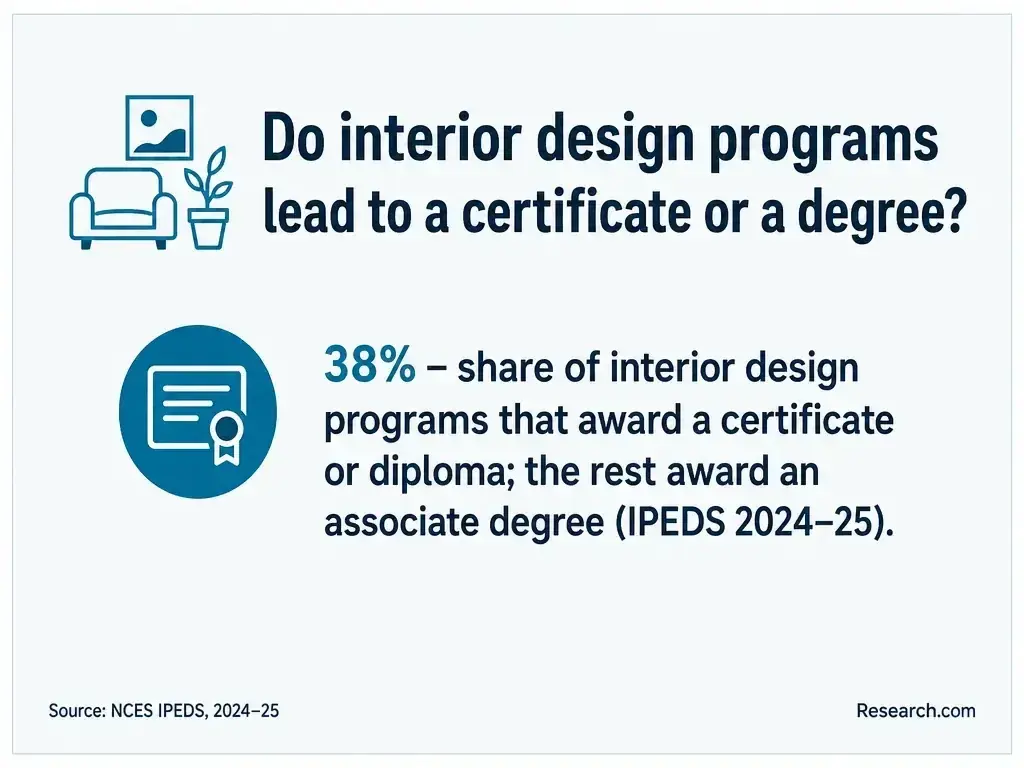
The award may be a certificate, diploma, or associate degree; these are not interchangeable. Verify the exact name on the transcript and whether the required courses build a portfolio suited to your target position. A software-focused certificate, for example, does not by itself establish preparation for every interior designer role.
Credential labels can also obscure transfer options. Ask whether certificate courses apply toward a longer credential, whether previous coursework or documented experience can count, and whether credits are accepted by the receiving program. General credential comparisons are no substitute for a written answer about this specific transfer or advanced-standing arrangement.
Institutional accreditation concerns the school. Programmatic accreditation concerns a particular curriculum; the Council for Interior Design Accreditation evaluates eligible interior design programs. Georgia authorization, professional certification, and state registration are separate matters. None should be inferred from the credential's title alone (Council for Interior Design Accreditation; Georgia Secretary of State).
Requirements vary by credential. A provider may ask for an application, prior school records, placement information, or prerequisite coursework; a portfolio is not automatically required for every entry-level program. Ask admissions for the current requirements for the specific credential and start term, including any software or computer specifications you must meet before classes begin.
Admission is different from eligibility for federal aid or Georgia aid, and both are different from eligibility for later professional registration. If you intend to pursue a registered interior designer designation, ask the program to explain in writing how its curriculum relates to the current education and experience rules; do not treat an admission offer as proof of future eligibility (Georgia Secretary of State; Federal Student Aid).
A substantial interior design curriculum can cover space planning, drawing and digital drafting, color and materials, lighting, furnishings, client presentations, and project documentation. For work connected to renovation or commercial interiors, look closely at instruction in accessibility, building systems, and applicable codes. The U.S. Bureau of Labor Statistics identifies drawings, material selection, coordination, and code awareness among interior designers' work activities.
Judge practical depth by the work you will produce. Ask how many projects require measured plans, technical drawings, material specifications, and revisions after critique - and whether the portfolio is suitable to show employers. Software instruction is useful, but a program consisting mainly of tutorials may not provide the same preparation as a supervised design studio. Broad education-format comparisons cannot establish that hands-on depth.
Do not assume that every design-assistant, decorating, or furnishings role requires an occupational license. Georgia does, however, regulate the registered interior designer designation through its state rules. If that designation is your goal, check the Georgia Secretary of State's current registration requirements - including qualifying education, examination, and experience - before choosing a program. Graduation alone does not establish eligibility (Georgia Secretary of State).
The NCIDQ examination is a professional credentialing route administered by the Council for Interior Design Qualification, with its own eligibility requirements. A school's institutional accreditation, a curriculum's programmatic accreditation, examination eligibility, and Georgia registration each answer a different question. Ask for documentation about the particular route you plan to pursue rather than accepting a general claim that a program is "accredited" or "certification-ready" (Council for Interior Design Qualification; Council for Interior Design Accreditation).
Start with the job you want, then work backward to its required skills and credential. The affordability ranking can narrow your search, but it does not score accreditation, portfolio quality, or fit with Georgia registration. A low-cost program is a poor investment if it cannot prepare you for your intended work.
Use these checks when speaking with an admissions representative or program lead:
Two avoidable mistakes are comparing tuition without equipment and lost earnings, and treating an occupation-wide median wage as a new graduate's expected pay. For a useful return-on-investment estimate, consider aid, debt, completion probability, your current earnings, plausible pay after training, and how long you expect to work in the field.
A focused certificate may help someone pursue design-assistant, showroom, product-selection, or drafting-support work when the curriculum matches an employer's needs. A more extensive program with technical documentation and studio projects may better support a move toward interior designer roles. Experience, a stronger portfolio, and any applicable professional credentials can matter for advancement; no initial award guarantees a particular title.
Another reasonable route is to enter a furnishings or design business first and seek employer-supported software or product training. That can preserve income while you test your interest in the field, though it may not provide the breadth of technical coursework needed for other roles. In the Atlanta-area market, compare the jobs within a workable commute before paying for a credential aimed at a different specialty.
U.S. interior designer employment is projected to grow 2.7% from 2025 to 2035 (U.S. Bureau of Labor Statistics, Employment Projections). This is a national occupational projection, not a forecast of Marietta vacancies. It suggests students should evaluate a program on demonstrable skills and portfolio strength rather than assume rapid growth will make entry easy.
Marietta residents can search across the wider Atlanta labor market, but the practical opportunity depends on specialization and commute. Review recent postings for residential, commercial, kitchen and bath, or showroom work separately; compare their requirements with the program's projects and any experience you can gain while studying.
Investing in training is a consequential decision, so Research.com evaluates programs against other programs in the same occupation and geographic area rather than against unrelated schools. Only programs with completions reported to IPEDS enter the ranking. That coverage limit matters: an employer training program or other legitimate provider may be absent without being unapproved or low quality.
The Most Affordable ranking scores costs and debt only: tuition, cost of attendance, median student debt, and federal loan default rate. Indicator weights are assigned through an entropy-based method, which gives more weight to measures that vary more across programs. Accreditation and other quality measures do not enter this affordability score. Separately, Research.com's best-program rankings consider outcomes, earnings and return on investment, costs and debt, and quality and recognition; readers should not mistake those broader criteria for this ranking's formula.
The Research.com team uses the following sources across its ranking work. Some cover occupations other than interior design; their inclusion as methodology sources does not imply that they accredit interior design programs.
The ranking offers a starting point for comparing reported affordability, not a finding that every listed program meets a particular career goal. Confirm current prices, curriculum, and credential eligibility directly before enrolling. More detail on Research.com's approach appears on its methodology page.
# 1 position
# 2 position
It may help with assistant, showroom, or software-focused roles if its projects match employer requirements. It is not interchangeable with more extensive technical preparation or proof of eligibility for Georgia's registered interior designer designation.
There is no universal trade-style apprenticeship required for every entry-level design job. Professional experience may matter for a particular credential or Georgia registration pathway, so check that pathway's current rules (Georgia Secretary of State; Council for Interior Design Qualification).
Some coursework can be remote, but verify how the program handles studio feedback, materials, fieldwork, and portfolio projects. An online format alone does not establish professional-credential eligibility.
Confirm its currently available interior design-related credentials, teaching campus, full program cost, schedule, hands-on projects, and how its courses align with your intended job. Use the current catalog and a written cost estimate rather than an older listing.
Not necessarily. The affordability score addresses reported costs and debt, not whether the training builds the portfolio, technical skills, and eligibility your career goal requires.