# 1 position
Montgomery College - Interior Design.
associate

Audited and Verified:
Our Editorial and Data Verification Process
Research.com uses government datasets, official education statistics and primary institutional information to support its career and degree guides. Our review process checks factual accuracy, occupational definitions, source dates and the requirements associated with the credentials discussed.
How This Article Was Fact-Checked
Our editorial team verifies salary estimates, employment projections, education requirements and program information against original data providers and official organizations. Salary figures are checked against the relevant occupational definitions and reporting periods. Information about licensure, accreditation and required in-person training is reviewed separately.
Fact-checked and verified on:

Co-Founder and Chief Data Scientist

Reviewed by Karolina Broda
Fact-Checker and Data Verification
Choosing an affordable interior design program in Rockville means looking beyond tuition: the credential, studio practice, and route into work must fit your goal. The U.S. Bureau of Labor Statistics reports a $67,190 national median annual wage for interior designers in May 2025, but that is not a starting-pay estimate. For the Most Affordable Interior Design Trade Schools in Rockville for 2027 ranking, the Research.com team of data scientists compared costs to help students identify programs worth considering. This guide explains the training, expenses, and career requirements behind that choice.
Expect a mix of design studio work and technical production - not just choosing colors and furniture. Interior design training commonly covers measured plans, materials, lighting, computer-aided drawing, accessibility, building-code awareness, client presentations, and a portfolio. The strongest option for you depends on whether you want to enter a showroom quickly, support a design firm as a drafter, or pursue more extensive professional design work (U.S. Bureau of Labor Statistics).
Montgomery College is the named local college option to investigate. Ask which of its current interior design offerings award a certificate or associate degree, which courses include supervised studio work, and whether work-based projects or internships are available. A short program can be a sensible test of the field, but it should not be treated as equivalent to a longer studio-based program simply because both use "interior design" in their titles. Readers comparing other short programs that pay well should weigh this field's portfolio and experience requirements against speed alone.
Potential settings include residential design businesses, architecture and commercial interiors firms, kitchen-and-bath showrooms, furniture retailers, and contractors serving Montgomery County and the wider Washington-area market. The location matters because a Rockville student can search beyond city limits for studio experience, while commuting to client sites, showrooms, or an internship may add real cost.
A certificate focused on finishes, sales, and presentation may fit showroom or design-assistant work. A portfolio with accurate plans and proficiency in the software requested by employers is more relevant to drafting-support roles. Independent client work also requires pricing, contracts, and coordination skills; a training credential alone does not establish a client base or confer a regulated title.
The U.S. Bureau of Labor Statistics reports a $67,190 national median annual wage for interior designers for May 2025. That midpoint covers experienced workers as well as newer ones; it is not a Rockville starting salary or a predicted return on a particular program. Do not apply it unchanged to showroom sales, decorating, or drafting-support jobs, which may fall under different occupational classifications.
For a local decision, compare job postings for the exact role you want in Rockville and commutable Washington-area locations. Check whether compensation is hourly, salaried, commission-based, or tied to client projects. Then compare plausible earnings with your current pay and the program's full cost rather than using the national median to justify borrowing.
A focused certificate generally takes less time than an associate degree, but the actual calendar depends on required courses, prerequisites, studio sequencing, and whether you attend part time. A conventional full-time associate degree is planned around two academic years; ask Montgomery College for the current interior design course map rather than assuming every required studio runs every term.
Interior design is not usually organized around a universal trade-school clock-hour minimum. Compare required credits and supervised studio hours instead: how much time will you spend producing drawings, revising plans, specifying materials, and presenting work? If a program advertises fast completion, establish what practical work fits within that schedule. A reader drawn to best paying 6 month certifications should not assume six months is sufficient preparation for every interior design role.
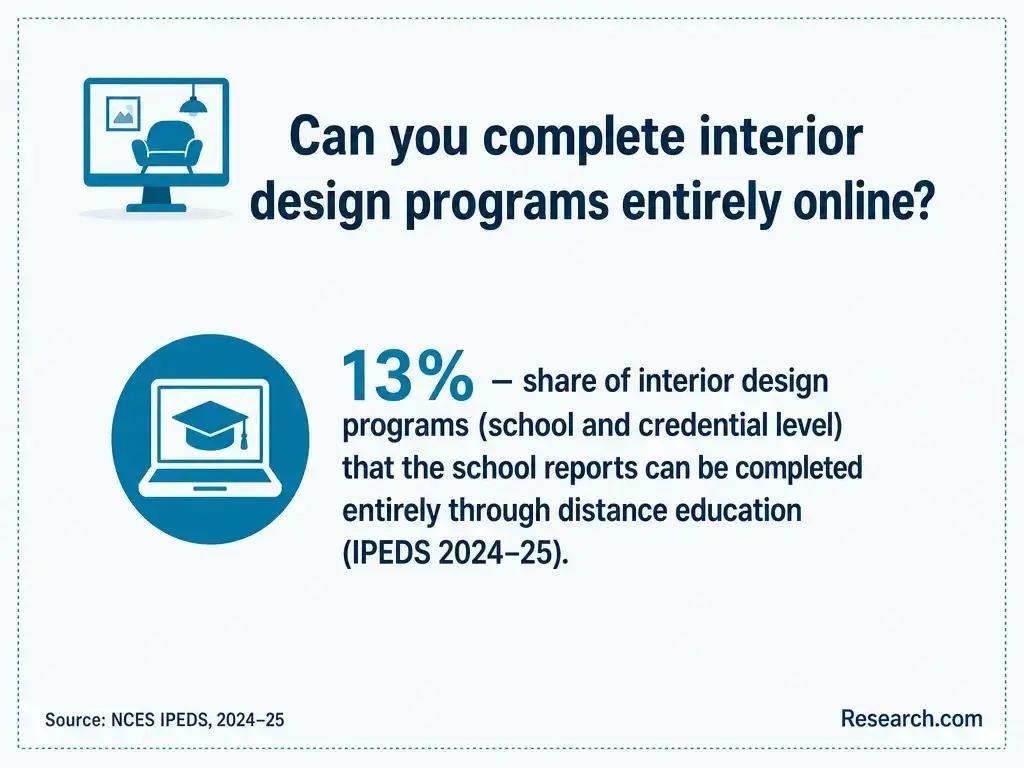
Online study can make lectures, design history, digital drafting, and some critiques easier to schedule around work. Campus or hybrid study can offer direct feedback on drawings, access to material samples and equipment, and practice presenting to clients or peers. Neither format automatically produces a stronger portfolio; the important comparison is what work you will complete and who will review it.
Ask an online provider whether software is included, whether you must buy a computer capable of running it, and where any required studio meetings, site measurements, or work placements occur. Rockville students may find a hybrid schedule more manageable than repeated trips to campus, but travel for practical activities still belongs in the budget. For broader scheduling and cost comparisons, see affordable online colleges for working students; verify the interior design program's own hands-on requirements before enrolling.
There is no reliable single Rockville average that covers certificates, associate degrees, and noncollege training on the same basis. Published tuition can omit mandatory fees, supplies, software, and travel, while a short course and a multi-term program buy different amounts of instruction. Request a current, itemized estimate for your actual attendance pattern before calling one option cheaper.
This comparison separates expenses that are easy to miss. Add each applicable item to reach an estimated total cost to become job-ready, rather than comparing tuition figures alone.
| Cost or offset | What to verify |
| Tuition and required fees | Total for all required courses, including any residency-based rate and repeat-course charges. |
| Design supplies and technology | Drawing materials, printing, samples, textbooks, software subscriptions, and computer requirements. |
| Practical experience | Travel to studios, worksites, client sites, or internships; whether a placement is paid. |
| Time and financing | Reduced earnings while studying, likely borrowing, and interest if costs are financed. |
| Potential offsets | Confirmed grants, scholarships, eligible student aid, or employer-paid training. |
Ask Montgomery College which specific program is eligible for federal student aid and what Maryland or institutional assistance may apply; eligibility can differ by credential and student. Federal Student Aid advises students to check the school's aid offer and borrowing terms. A paid showroom or employer-training role may lower your out-of-pocket cost, but may offer less structured instruction. For return on investment, also consider your completion likelihood, current earnings, expected post-training role, debt, and how long you expect to work in the field.
The credential depends on the specific offering: a college program may award a certificate or an associate degree, while an employer may provide training without an academic award. Verify the exact credential on the current program page and ask whether completed courses can apply toward a longer program. A certificate can be useful for targeted skills; an associate program may provide more time for technical coursework and a developed portfolio.
Institutional accreditation concerns the school. Programmatic accreditation, where available and relevant, concerns a particular program. Maryland's professional certification and a school's permission to operate are separate matters; none is established merely by the name of the credential. If flexibility is important, compare transfer and studio requirements alongside best affordable associate programs online, rather than assuming online credits or projects will transfer into a Rockville-area interior design program.
Requirements vary by offering. A college certificate or associate program may require an application, proof of prior schooling, and placement or prerequisite coursework; a course with studio software may also specify computer access. An employer-trained assistant role instead depends on the employer's hiring criteria. Ask whether a portfolio is needed to enter the program or is something you will build during it.
Working adults should also check evening-course availability and whether prior college coursework, documented experience, or prior-learning assessment can reduce required study. Older career changers exploring degrees for seniors should apply the same test to an interior design credential: will the schedule and practical workload fit their goal? Credit and admission decisions belong to the receiving program, so obtain confirmation before paying for courses elsewhere.
Look for instruction that moves from a client brief to a buildable, clearly communicated proposal. Relevant skills include measuring spaces, drafting scaled plans, using design software, selecting finishes and furnishings, planning lighting, preparing specifications, and explaining decisions to clients and contractors. Accessibility and code awareness matter because interior design work can affect how people safely use a space (U.S. Bureau of Labor Statistics).
Curriculum labels are not enough. Ask to see examples of student projects and determine how many receive instructor critique and revision. Emerging digital tools can speed up visualization, but a portfolio should still show that you can check dimensions, justify material choices, and communicate constraints - not simply produce attractive images.
Do not confuse employment with use of a regulated professional title. Maryland's Board of Certified Interior Designers administers a voluntary state certification and regulates use of the certified interior designer designation; certification is not a blanket requirement for every interior decorating, showroom, or design-assistant job (Maryland Board of Certified Interior Designers). Requirements for certification involve more than enrolling in a program, so check the board's current education, experience, and examination rules before choosing training for that goal.
NCIDQ is a professional examination and credential pathway, not a substitute for Maryland's state certification decision. Likewise, school accreditation does not by itself establish examination eligibility or permission to use a protected title. If your intended work crosses into activities reserved to another regulated profession, clarify the scope of that work with the appropriate Maryland authority rather than relying on a school's marketing description.
Start with the job you want, then test each program against it. A lower-cost certificate may be the right investment for showroom work; a program with substantial technical studios may make more sense for someone seeking design-firm responsibilities. The affordability ranking is a shortlist, not evidence that the lowest-cost option teaches the skills your target employer expects.
Before committing, put these questions to admissions staff and, where relevant, a program instructor:
Be cautious of guaranteed-salary claims, vague placement figures, or assurances that an online certificate automatically qualifies you for certification. Compare written answers, the work produced by students, and your likely debt before enrolling. Someone who needs immediate income may be better served initially by a paid assistant or showroom role paired with targeted coursework.
Training can support several entry points, but the credential alone does not determine a job title. This table connects common goals with the evidence of skill an applicant may need; employer requirements vary.
| Career direction | Useful preparation | Important distinction |
| Showroom or kitchen-and-bath assistant | Product knowledge, measurements, client communication, and presentation work. | May offer an earlier paid entry point, sometimes with employer training. |
| Design or drafting assistant | Accurate plans, design software, specifications, and a reviewed portfolio. | Technical output matters more than the credential name alone. |
| Residential or commercial design work | Broader studio projects, code awareness, coordination, and experience. | Responsibility typically develops with demonstrated work and employer trust. |
| Independent decorating or design services | Portfolio, client management, estimating, and business practices. | Self-employment brings business costs and does not waive title or scope rules. |
Over time, a worker might specialize in a project type, supervise others, or seek optional professional credentials. If Maryland certification is part of that plan, check its separate eligibility requirements early rather than assuming experience or a certificate will automatically count.
The U.S. Bureau of Labor Statistics projects 2.7% national employment growth for interior designers from 2025 to 2035. That is a modest outlook, not a Rockville hiring forecast or a count of local openings. It argues for evaluating a program's portfolio instruction, employer connections, and cost carefully rather than assuming that demand alone will repay training.
The Washington-area labor market can widen a Rockville applicant's search to design firms, showrooms, and project teams outside the city, but it can also make commuting and competition relevant. Before enrolling, sample current postings across the distance you would actually travel. Note the software, portfolio, experience, and title requirements that recur, then choose training that addresses those requirements.
Investing in training is a consequential decision, so Research.com designed its rankings to help readers compare programs against other options in the same occupation and location. The team reviews multiple education and outcomes sources and uses reported data rather than treating a low advertised tuition price as proof of value. Only programs with completions reported to IPEDS are eligible; absence from the ranking does not mean another training provider is unapproved or unsuitable.
The most affordable ranking scores costs and debt: tuition, cost of attendance, median student debt, and federal loan default rate. It distributes weights using an entropy-based method, which gives more weight to indicators that vary more across programs. Accreditation and other quality indicators do not enter that affordability score. Readers should therefore check instructional quality, practical training, and career fit separately.
For context, Research.com's best programs rankings use a different model: programmatic accreditation or occupation-relevant industry recognition accounts for 20%, institutional accreditation for 10%, and student support services for 10%. Student outcomes, earnings, and costs account for the remaining 60%, distributed through the entropy-based method. Outcomes include completion and full- and part-time retention; earnings measures include median earnings one year after completion and earnings relative to annual attendance cost. Cost measures include resident and nonresident tuition, attendance cost, debt - including debt held by students who withdrew - and federal loan default rate.
The following data sources inform the ranking process. Some cover occupations other than interior design; listing a source does not mean its occupation-specific approval applies to an interior design program.
Use the ranking to narrow a shortlist, then obtain current program-level prices and verify that the training supports your intended role. More detail about the approach appears on Research.com's methodology page.
# 1 position
# 2 position
Not necessarily. Compare the full cost, portfolio and studio work, credential, completion prospects, and fit with your intended role. A lower tuition price helps only if the training meets your goal.
Possibly, particularly in an assistant, showroom, or related support role. Ask employers what skills they require; do not assume a short certificate prepares you for every interior designer position or Maryland certification.
Some coursework can be remote, but check how you will complete and receive feedback on measured plans, materials work, studio projects, and any required placement. Online delivery alone does not establish professional certification eligibility.
Interior design is not generally entered through the registered trade-apprenticeship structure used by some construction occupations. Employer training and supervised work experience can still matter, particularly for skill development and professional credential goals.
Do not assume so. Aid depends on the eligible program and your circumstances. Ask the college which credential and courses qualify, then request an aid estimate alongside the full program budget.