# 1 position


Audited and Verified:
Our Editorial and Data Verification Process
Research.com uses government datasets, official education statistics and primary institutional information to support its career and degree guides. Our review process checks factual accuracy, occupational definitions, source dates and the requirements associated with the credentials discussed.
How This Article Was Fact-Checked
Our editorial team verifies salary estimates, employment projections, education requirements and program information against original data providers and official organizations. Salary figures are checked against the relevant occupational definitions and reporting periods. Information about licensure, accreditation and required in-person training is reviewed separately.
Fact-checked and verified on:

Co-Founder and Chief Data Scientist

Reviewed by Karolina Broda
Fact-Checker and Data Verification
Can an affordable program near Palatine teach the drafting, materials, and client-facing skills needed to enter interior design - without leaving you with more debt than the credential warrants? The U.S. Bureau of Labor Statistics projects 2.7% national growth for interior designers from 2025 to 2035, making program fit as important as price. The Research.com team of data scientists created the Most Affordable Interior Design Trade Schools in Palatine for 2027 ranking to help students identify programs worth considering. This guide explains how to compare costs, practical training, credentials, and career prospects before enrolling.
Expect a mix of design studio work and technical production, not simply decorating. Interior design involves planning functional indoor spaces, selecting materials, producing drawings, and coordinating with clients and construction professionals; duties vary by position (U.S. Bureau of Labor Statistics). For a Palatine student, the practical question is whether a program produces a portfolio suitable for the jobs they want in the Chicago-area market.
Ask William Rainey Harper College which interior design credentials it currently offers, which courses meet on campus, and whether students complete measured drawings, specifications, presentations, and software-based projects. A short skills-focused credential may suit someone seeking showroom or drafting support work. An associate degree, where offered, generally provides more sustained studio practice, but the credential's name alone does not establish portfolio quality or eligibility for professional registration.
Possible workplaces include residential design businesses, kitchen-and-bath showrooms, furniture retailers, architecture and design firms, and commercial interiors teams. In the Palatine area, access to the wider Chicago metropolitan market can broaden the search beyond nearby storefronts - but it can also add commuting costs for interviews, internships, and work.
Entry roles may emphasize product specifications, drawings, purchasing, or client support rather than independent project leadership. Ask a program for recent examples of employer projects or placements, and check whether the work produced in class matches the type of employer you intend to approach. Employer training or a supervised assistant role can be a sensible alternative to additional classroom study when you already have a credible portfolio.
The U.S. Bureau of Labor Statistics reports a May 2025 national median annual wage of $67,190 for interior designers. This is the midpoint for employed workers nationally, not a Palatine wage estimate or a likely first salary. A graduate entering showroom sales or design-assistant work may also be employed in a different occupational category, so the interior-designer median may not describe that job.
When evaluating an offer, compare its base pay and any commission terms with the actual duties, benefits, commuting expense, and advancement opportunities. Request occupation- and area-specific wage information from the Illinois Department of Employment Security before using an earnings estimate in a loan repayment plan.
Duration depends on the credential, course sequence, and how often required studio courses run. A focused certificate may take less time than an associate degree; part-time study can extend either route. Do not assume that "accelerated" means equivalent practical preparation: ask for the current course map, required credit or contact hours, studio hours, and the earliest realistic completion term for your schedule.
Unlike trades built around a standard registered apprenticeship, interior design does not have one universal apprenticeship-hour requirement for entry-level work. Supervised experience may nevertheless matter for particular jobs and for later professional-examination eligibility (Council for Interior Design Qualification). A search result for one year graduate programs is therefore not a useful shortcut for comparing occupational interior design training; compare the actual studio and portfolio requirements instead.
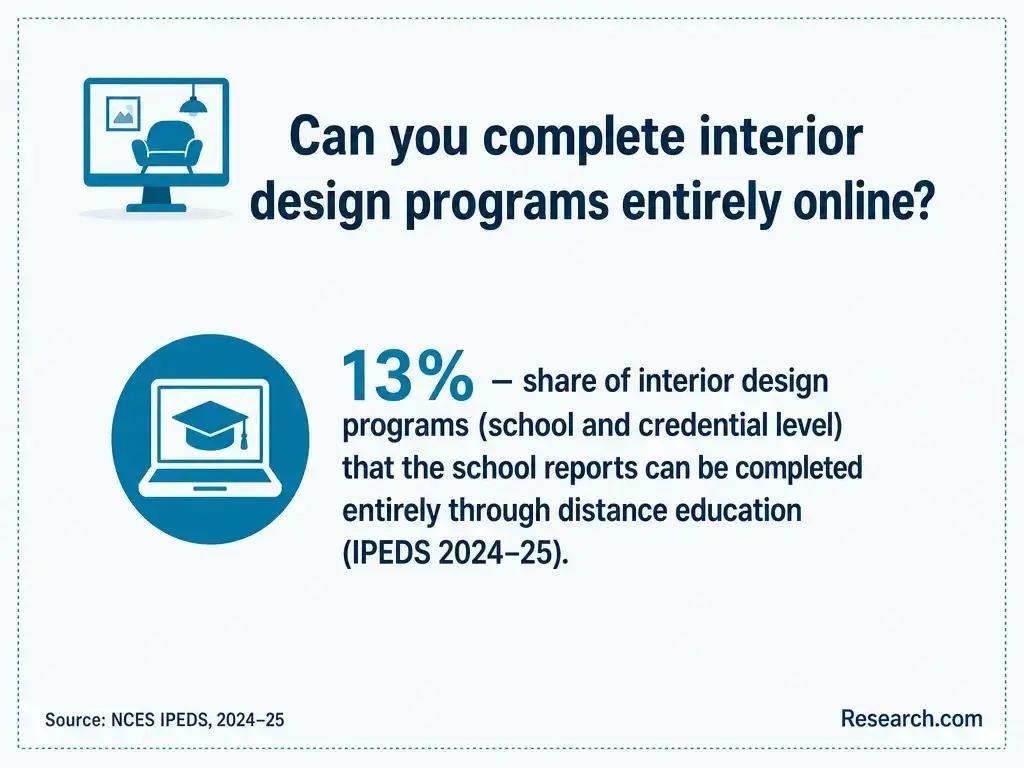
Software demonstrations, design history, and some client-presentation work can be taught remotely. Physical material evaluation, site measurements, critiques, and collaborative studio exercises may be harder to replicate online. A hybrid schedule can reduce travel from Palatine while retaining in-person feedback, but only if required campus sessions fit your work hours.
Before choosing an online option, request examples of completed student portfolios and ask how instructors assess drawings, materials, and revisions. Also confirm software and computer requirements, access to studio facilities, and whether any supervised experience must be arranged locally. Price comparisons with online cheap colleges are only useful after checking that the specific interior design training provides the practical work and credential you need. An online delivery format alone does not establish professional-examination eligibility.
There is no defensible single "Palatine average" from which to budget: program length, residency classification, fees, and materials can differ, and a ranking of IPEDS-reporting programs does not include every training route. For William Rainey Harper College, check the published tuition and fees for your intended entry term and ask whether your address qualifies for in-district rates. Do not treat a prior year's price as the confirmed 2027 price.
Build a job-ready budget rather than comparing tuition alone. Include required software and computer capacity, drawing or model-making supplies, books, transportation, and any portfolio-printing costs. Subtract grants or employer assistance you can actually obtain; then consider earnings you would forgo by reducing work hours. Federal Student Aid eligibility depends on both the student and the specific program (U.S. Department of Education). Comparisons with best affordable online colleges for job holders may help working adults think about scheduling costs, but they do not replace a program-specific interior design quote.
The credential depends on the program you enroll in: possibilities include a college certificate or an associate degree where the provider offers one. A certificate documents completion of its specified training; an associate degree is an academic credential with a broader required course sequence. Neither is the same as professional certification or Illinois registration.
Verify the exact credential name, course requirements, and whether completed certificate courses apply toward a longer credential at the same institution. If transfer or advanced standing matters, obtain a written course-by-course answer before paying. Employer recognition also depends on the portfolio and skills behind the credential, not its label alone.
Admission to a college and entry into a particular studio sequence are separate questions. Ask William Rainey Harper College about its current application process, placement or prerequisite courses, portfolio expectations if any, and when required interior design classes are offered. Confirm residency documentation early if you expect in-district tuition.
Open admission colleges online can be useful for understanding broad college-entry policies, but open admission does not promise a seat in every course or eliminate program prerequisites. Working adults should check evening-course availability and the sequence of required classes before assuming they can finish on a particular timetable.
Useful training connects design decisions to buildable, communicable plans. Look for measured drawing, space planning, materials and finishes, lighting concepts, accessibility considerations, digital drafting or modeling, specifications, budgeting, and client presentations. Interior designers must also understand how their proposals interact with building and safety requirements, even when other licensed professionals handle work outside a designer's authority (U.S. Bureau of Labor Statistics).
The strongest evidence of learning is a portfolio showing a process: the client brief, alternatives considered, technical drawings, material rationale, revisions, and final presentation. Ask how many projects receive instructor critique and whether assignments reflect the residential, retail, or commercial work you hope to pursue.
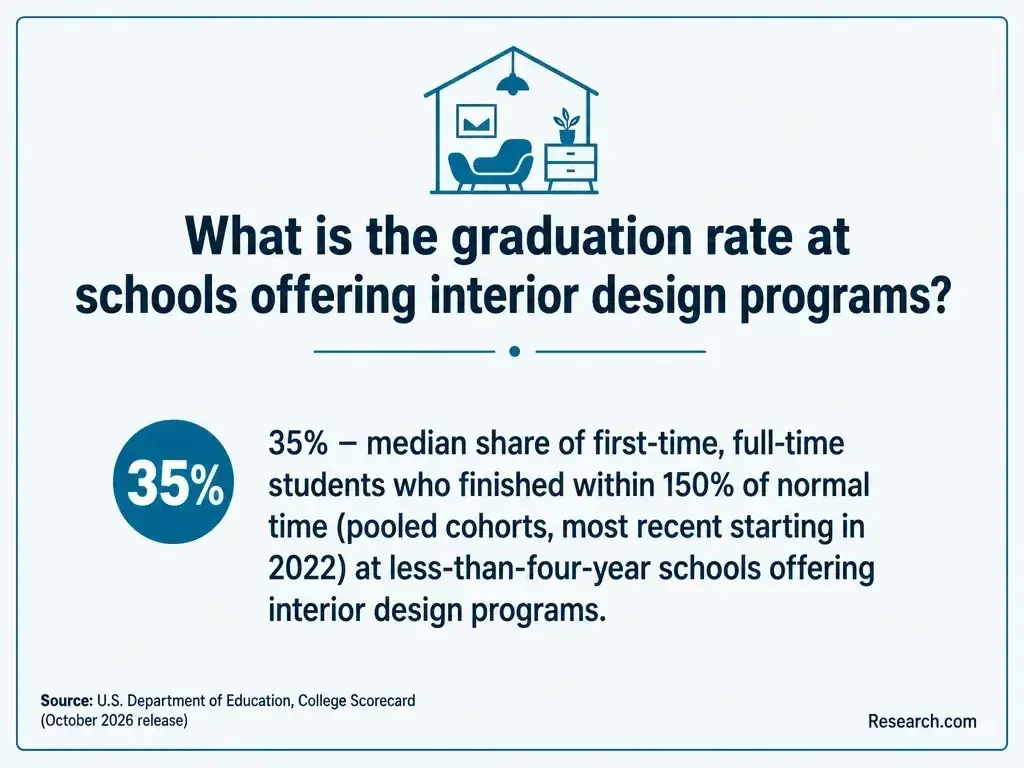
Do not assume every interior design job requires an occupational license. Illinois regulates the use of the registered interior designer designation; registration is distinct from taking an entry-level design or showroom position (Illinois Department of Financial and Professional Regulation). If your goal is that designation, check the department's current education, experience, examination, and application rules before selecting a program. Completing a certificate or associate degree does not automatically confer registration.
The NCIDQ examination is a professional credentialing pathway with its own eligibility requirements involving education and work experience (Council for Interior Design Qualification). Institutional accreditation, any programmatic accreditation, state authority to operate, NCIDQ eligibility, and Illinois registration are different checks; none should be assumed from a school's general claim that it is "accredited."
Start with the job you want, then test each program against that goal. The following checks are more useful than a price ranking alone because they expose gaps that can delay employment or add costs.
A red flag is a promise that a low tuition figure, an online format, or graduation itself guarantees a design job or registration. Unrelated search results - including online doctorate without dissertation listings - should not enter an occupational-training comparison. Estimate value using total cost, likely completion time, lost earnings, aid, debt, and realistic job options rather than institution type alone.
A practical first step may be design assistant, showroom specialist, drafting support, or materials coordinator. With a stronger portfolio and relevant experience, someone may take on more responsibility for client projects or specialize in residential, kitchen-and-bath, or commercial interiors. Independent work brings additional demands, including client acquisition, contracts, and coordination with other professionals; training alone does not establish readiness to run a business.
For someone already working in retail or construction-related sales, a targeted credential and portfolio may be more useful than repeating skills they already practice. For a newcomer seeking technical design work, sustained drawing and studio instruction may justify a longer program. Ask prospective employers which drawings, software, and project examples they expect for the particular entry role.
The U.S. Bureau of Labor Statistics projects 2.7% national employment growth for interior designers from 2025 to 2035. That is a national occupation forecast, not a count of openings in Palatine or a prediction that a particular graduate will find work. It suggests applicants should plan to compete on portfolio quality and relevant experience rather than rely on rapid occupation-wide growth.
Palatine students can search across the Chicago metropolitan area, but should weigh a larger search radius against travel time and costs. Review current postings for the roles you would accept, separate true interior design positions from sales roles, and note recurring software and experience requirements. That evidence can help you decide whether a program's projects prepare you for the vacancies you can realistically pursue.
Investing in training is a consequential decision, so Research.com compares programs with others in the same occupation and location rather than with unrelated schools. The Most Affordable ranking includes only programs with completions reported to IPEDS and scores tuition, cost of attendance, median student debt, and federal loan default rates. Weights are assigned using an entropy-based method, which gives more weight to measures that vary more across programs. Accreditation and other quality indicators are not part of this affordability score; readers should check them separately. The Research.com team uses the following sources across its trade-school rankings to check coverage, costs, outcomes, and occupation-specific recognition. Some sources cover other trades and should not be interpreted as interior-design accreditors.
The ranking offers a cost-focused shortlist, not a guarantee of admission, employment, or professional eligibility. IPEDS does not capture every employer-training or noncollege option. Readers can review Research.com's full methodology for more detail about how the rankings are created.
# 1 position
# 2 position
No. Compare the full cost with studio instruction, portfolio feedback, scheduling, and preparation for your intended role. The affordability ranking does not score those quality factors.
Some coursework can be remote, but ask how the program handles measurements, material evaluation, critiques, and portfolio assessment. Check professional-credential requirements separately if registration is your goal.
Not automatically. Confirm the current education, experience, and examination requirements with the Illinois Department of Financial and Professional Regulation and the Council for Interior Design Qualification before enrolling.
Choose based on the work you want to do and the projects you need in your portfolio. A focused certificate may suit a specific support role; a longer associate-degree program may provide more extensive studio preparation where offered.
Ask which interior design credentials are currently offered, your tuition classification, the complete cost of required courses and materials, when studio courses run, and whether student work can be reviewed.