# 1 position


Audited and Verified:
Our Editorial and Data Verification Process
Research.com uses government datasets, official education statistics and primary institutional information to support its career and degree guides. Our review process checks factual accuracy, occupational definitions, source dates and the requirements associated with the credentials discussed.
How This Article Was Fact-Checked
Our editorial team verifies salary estimates, employment projections, education requirements and program information against original data providers and official organizations. Salary figures are checked against the relevant occupational definitions and reporting periods. Information about licensure, accreditation and required in-person training is reviewed separately.
Fact-checked and verified on:

Co-Founder and Chief Data Scientist

Reviewed by Karolina Broda
Fact-Checker and Data Verification
Choosing an affordable interior design program near Sylmar means looking beyond tuition: the training must also build a portfolio and match the work you want to do. The U.S. Bureau of Labor Statistics projects 2.7% national growth for interior designers from 2025 to 2035, so cost and job readiness both matter. This guide explains local training options, expenses, credentials, and career prospects. It also accompanies the Most Affordable Interior Design Trade Schools in Sylmar for 2027 ranking, created by the Research.com team of data scientists to help students make an informed choice about programs worth considering.
Expect a mix of design studios, technical drawing, digital modeling, materials selection, and presentation work. The most useful output is a portfolio that shows how you moved from a client brief to plans, specifications, and a defensible design solution. Ask to see student work completed under the same curriculum you would enter - not only polished promotional images.
For a Sylmar commuter, Los Angeles Mission College is a practical public-college starting point for checking currently listed courses, schedules, and costs. Verify its current catalog before assuming a particular interior design credential is offered. Also compare available career-school training and entry-level showroom or design-assistant work: employer training can be more direct for sales-oriented roles, but may not provide the technical breadth of a studio-based program.
Interior design training is distinct from an accelerated undergraduate degree: a faster timetable is useful only if it leaves enough supervised practice to produce credible drawings and a portfolio.
The greater Los Angeles market offers more potential workplaces than Sylmar alone: residential design firms, furniture and kitchen showrooms, remodeling businesses, commercial design teams, and vendors supplying finishes or furnishings. Commuting distance matters because an internship or entry-level role may require repeated site visits, client meetings, or time in a showroom.
A portfolio-heavy program is most relevant to design-assistant or drafting applications. A shorter, product-focused credential may suit someone pursuing showroom sales or materials specification. Independent client work usually demands additional experience in budgeting, contracts, sourcing, and coordinating with appropriately licensed building professionals; a training certificate by itself does not establish those capabilities.
The U.S. Bureau of Labor Statistics reports a $67,190 national median annual wage for interior designers in May 2025. That figure covers employed designers at different career stages nationwide, not specifically Sylmar or newly trained workers. No Sylmar-specific wage estimate is established here, so request recent, occupation-specific placement information from each provider and compare actual local job postings by duties and experience requirements.
Titles also matter: showroom sales, design assistance, and independent interior design are different jobs and should not be assumed to pay the same wage. For an investment decision, compare plausible entry-level earnings with your current earnings, expected debt payments, and the time you would spend in training - not with the occupation-wide median alone.
There is no single required clock-hour total for entry into interior design work in California. Completion time depends on the provider's published course sequence, whether studio classes are offered every term, and whether you attend full time. A focused certificate can take fewer terms than an associate-degree program, while part-time study or limited course availability can extend either route.
Before enrolling, obtain the current catalog and ask how many units or contact hours are required, which studios must be taken in sequence, and how many hours involve instructor-reviewed drawing or design work. If you have prior coursework or relevant work experience, ask whether it earns credit and whether accepting that credit would leave gaps in your portfolio. A shortcut is worthwhile only when it preserves the skills employers expect.
Remote study can work well for design history, research, software demonstrations, and some drawing assignments. In-person studios make it easier to critique material samples, check measurements, collaborate, and present work. A hybrid program can combine both, but its campus meeting times and equipment access may determine whether it is actually convenient from Sylmar.
The comparison below shows what to verify rather than treating every program with the same delivery label as equivalent.
| Format | Potential advantage | Point to verify |
| On campus | Regular studio critique and access to physical materials | Commute, studio hours, and required supplies |
| Hybrid | Less frequent travel for suitable coursework | Which critiques, labs, and presentations require attendance |
| Online | Flexible access to lectures and digital assignments | Quality of feedback, software access, and portfolio support |
Use a list of top online colleges only as a starting point for checking delivery and support; it does not establish that a specific interior design credential includes adequate studio practice or meets any professional certification criteria.
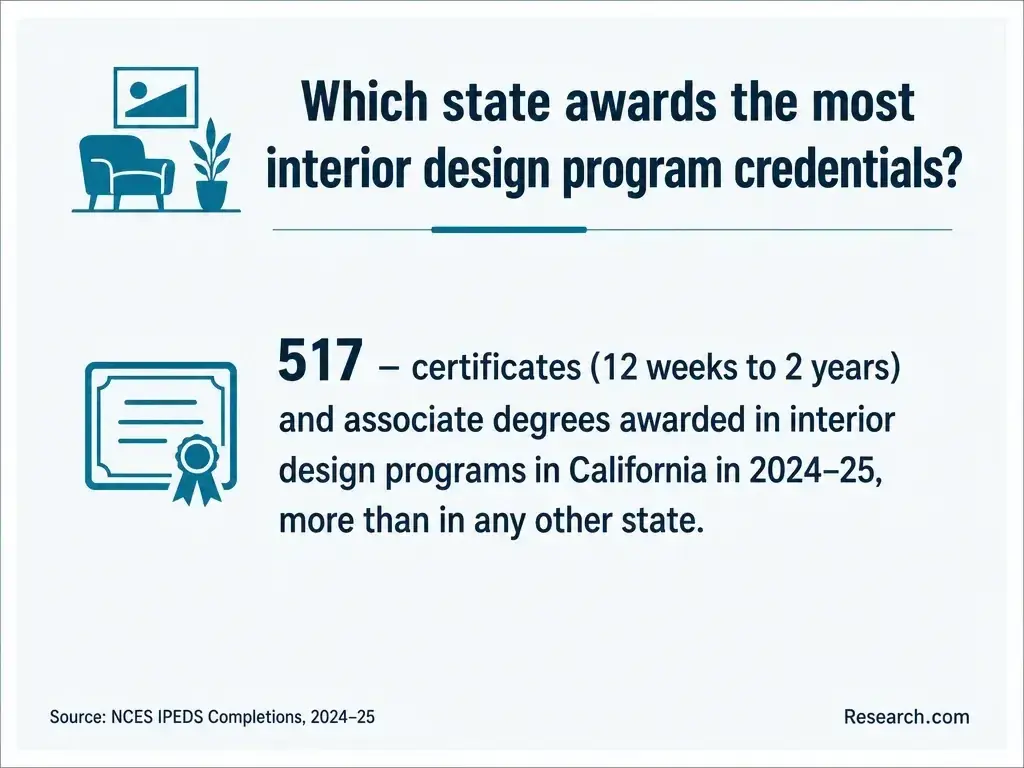
There is no defensible single Sylmar-wide average without a defined set of current programs and comparable published totals. As a public-college baseline, California's published resident community-college enrollment fee is $46 per unit; check the applicable fee and your residency classification for the term you would start (California Community Colleges Chancellor's Office). Private-provider charges and nonresident tuition can follow different schedules.
For each option, request an itemized, completion-to-job-search estimate. The following costs can change which program is genuinely affordable.
Ask about eligible federal aid, California aid, scholarships, and workforce assistance before borrowing; eligibility varies by student and program (Federal Student Aid; California Student Aid Commission). A search for the cheapest fastest masters degree addresses a different investment decision and should not be used as a price benchmark for job-entry interior design training.
Check the exact award on the program's current catalog page. Common pathways include a course or occupational certificate, a longer certificate or diploma, and an associate degree; employer training may instead document skills without awarding a college credential. Similar-sounding awards can contain very different amounts of studio work.
A certificate focused on drafting software or kitchen and bath products may fit a targeted support role. A broader associate-degree curriculum may give someone changing careers more time to build a varied portfolio. Neither institutional accreditation nor a credential name proves eligibility for an optional professional certification. If later study is possible, request a written explanation of which courses transfer; transferability is determined by the receiving institution, not the program advertisement.
Requirements vary by provider and credential. Ask about the application, placement or course prerequisites, software and computer specifications, and whether a portfolio is required at entry or developed during training. A beginner-friendly program should explain how students acquire drawing fundamentals before advanced studio assignments.
For a public-college option, confirm residency documentation and financial-aid deadlines early because they can affect the amount you pay. Career changers should also ask whether prior coursework or demonstrated skills can satisfy prerequisites without removing essential studio practice. Questions framed around what is the easiest degree are less useful here than asking whether you can meet the program's technical workload and produce work suitable for your intended job.
Relevant training can cover measured plans, space planning, color and materials, lighting concepts, furniture specifications, digital drafting and modeling, client presentations, and project documentation. Technical instruction should also teach students to recognize when accessibility, building codes, permitting, or structural changes require review by qualified professionals. The precise scope depends on the curriculum and the work being proposed (U.S. Bureau of Labor Statistics).
Look for repeated assignments with critique and revision, not merely software tutorials. Ask how many completed projects you can expect to present, whether they include realistic budgets and constraints, and whether internships or employer-reviewed projects are available. Generative tools may help explore concepts, but employers still need designers who can verify dimensions, materials, and buildability.
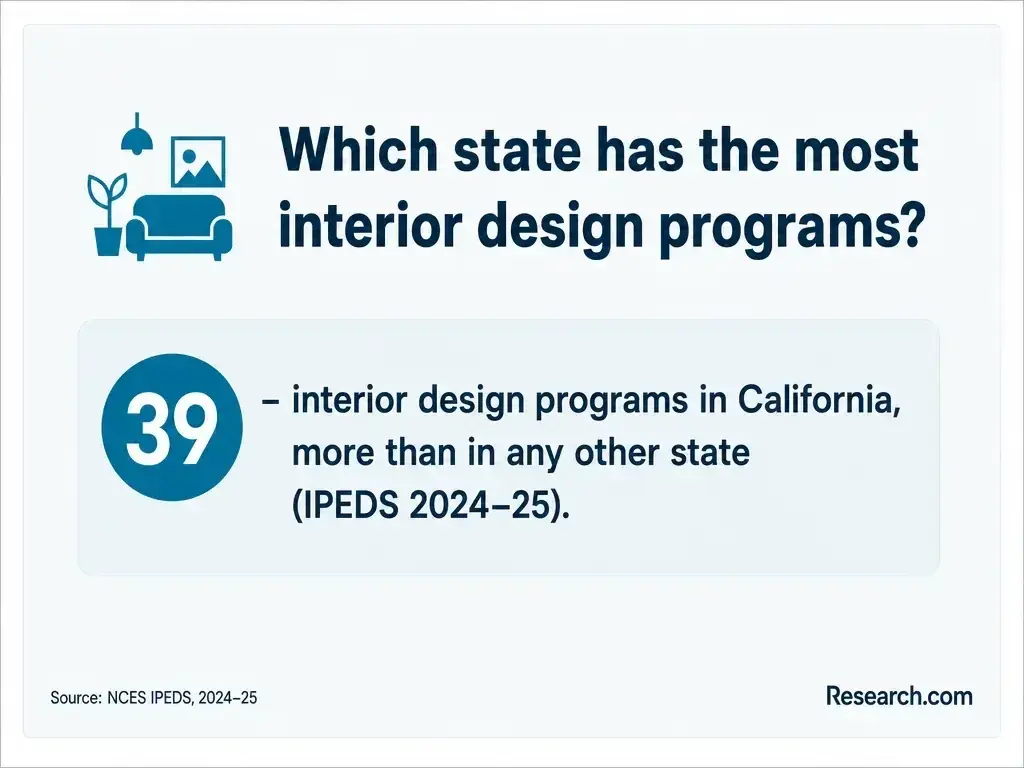
California does not require a general occupational license simply to work as an interior designer. It does protect the Certified Interior Designer title through a separate, voluntary certification framework; earning a school certificate does not grant that title (California Business and Professions Code; California Council for Interior Design Certification). Specific construction or design activities may be restricted by other laws, so a program should teach students when to refer work to an appropriately licensed professional.
Institutional accreditation addresses the school; state authorization addresses its permission to operate; professional certification addresses an individual's qualifications. They are not interchangeable. If certification is your goal, obtain the current eligibility rules from the certifying organization and ask the provider to show exactly how its coursework and any required experience align. Do not assume that online delivery, graduation, or an "industry-recognized" label establishes eligibility.
Start with the role you want, then compare programs on the evidence that matters for that role. The most affordable ranked option is worth considering, but a low price has limited value if its schedule prevents completion or its coursework leaves you without a usable portfolio.
Use these checks before paying a deposit or committing to a course sequence.
That final comparison is personal: a short, inexpensive course may be enough for showroom work, while a career changer targeting technical design assistance may benefit from more studio time. Neither a ranking nor an unrelated accelerated undergraduate degree comparison can make that choice for you.
Training may support entry into showroom sales, design assistance, drafting support, or materials and furnishings coordination. With stronger technical work, client experience, and a portfolio, some workers pursue more independent design assignments or specialize in residential or commercial projects. Job titles are not standardized, so judge postings by actual duties and required experience.
Interior design can involve substantial independent production, but it also requires client interviews, critique, vendor coordination, and presentations. Readers exploring best introvert careers should weigh that mix against their preferences rather than assume design is solitary. An entry-level employer route may suit someone testing the field before purchasing a longer credential.
The U.S. Bureau of Labor Statistics projects 2.7% national employment growth for interior designers from 2025 to 2035. This is a national occupation projection, not a forecast of openings in Sylmar or a guarantee that training will lead to a job. It suggests applicants should compete on demonstrated skills and relevant experience rather than rely on rapid overall job growth.
Search across the greater Los Angeles commute area and include related entry-level titles, then check whether postings repeatedly request the software, documentation, and client skills taught by a prospective program. This gives a more useful local demand test than treating a national projection as a neighborhood hiring count.
Education is a significant investment. Research.com created this ranking to help readers compare interior design training programs against relevant options in the same occupation and location, using reported data rather than tuition advertisements alone. The team checks multiple sources for quality, credibility, and accuracy; readers should still confirm current prices and program details directly with a provider.
Only programs with completions reported to the Integrated Postsecondary Education Data System (IPEDS) are eligible. The most affordable ranking scores tuition, cost of attendance, median student debt, and federal loan default rate. Its weights use an entropy-based method, which gives more weight to measures that vary more across included programs. Accreditation and other quality indicators are not part of this affordability score. A lower-cost ranking position therefore does not establish that a program offers the best portfolio training or career fit.
Research.com also maintains separate best-program rankings. Those consider student outcomes, earnings and return on investment, costs and debt, and quality and recognition. In that separate framework, occupation-relevant programmatic accreditation or industry recognition receives 20%, institutional accreditation 10%, student support 10%, and outcome, earnings, and cost measures collectively 60%, distributed through an entropy-based method. Those weights do not apply to this affordability ranking.
The ranking process draws on the following data sources. Some cover institutions or occupations outside interior design; their inclusion as sources does not mean an allied-health or construction credential is relevant to this field.
IPEDS and College Scorecard do not capture every career school, employer training route, or apprenticeship. A provider's absence from the ranking does not prove it is unavailable or poor quality. Use the ranking to narrow the search, then compare portfolios, instruction, total costs, and current authorization. Research.com explains its broader approach on its methodology page.
# 1 position
# 2 position
No. Compare total cost, scheduling, studio practice, portfolio quality, and the credential's fit with your target job. A low tuition bill can be poor value if required courses are difficult to complete.
Some showroom and support roles offer on-the-job training. A structured program may be more useful if you need technical drawing instruction, regular critique, and a portfolio for design-focused applications.
Some coursework can be remote, but check how the provider delivers material review, measured projects, critiques, and portfolio feedback. Online completion does not itself establish eligibility for professional certification.
No. A school-issued certificate and California's protected Certified Interior Designer title are different. Check the certifying organization's current education, experience, and examination rules before enrolling for that purpose.
Ask for the program's full estimated cost, whether that specific credential is aid-eligible, what grants or scholarships may apply, and the amount you would need to borrow. Confirm your eligibility with the provider's financial-aid office.