# 1 position
Chaffey College - Interior Design.
associate

Audited and Verified:
Our Editorial and Data Verification Process
Research.com uses government datasets, official education statistics and primary institutional information to support its career and degree guides. Our review process checks factual accuracy, occupational definitions, source dates and the requirements associated with the credentials discussed.
How This Article Was Fact-Checked
Our editorial team verifies salary estimates, employment projections, education requirements and program information against original data providers and official organizations. Salary figures are checked against the relevant occupational definitions and reporting periods. Information about licensure, accreditation and required in-person training is reviewed separately.
Fact-checked and verified on:

Co-Founder and Chief Data Scientist

Reviewed by Karolina Broda
Fact-Checker and Data Verification
Choosing an affordable interior design program means comparing more than tuition: you need a credential, a portfolio, and practical skills that fit the work you want. The U.S. Bureau of Labor Statistics projects 2.7% national growth for interior designers from 2025 to 2035, making career preparation worth examining carefully. This guide explains local training options, total costs, and California's certification rules. It also accompanies the Most Affordable Interior Design Trade Schools in Rancho Cucamonga for 2027 ranking, created by the Research.com team of data scientists to help students make an informed choice about programs worth considering.
Expect studio-based training that turns a client brief into a workable interior plan - not just lessons in decorating. Students may develop floor plans, select finishes and furnishings, prepare presentations, and revise designs around budget, accessibility, and building constraints. Computer-aided drafting and a portfolio matter because employers need evidence that you can communicate and document a design, according to the U.S. Bureau of Labor Statistics and O*NET.
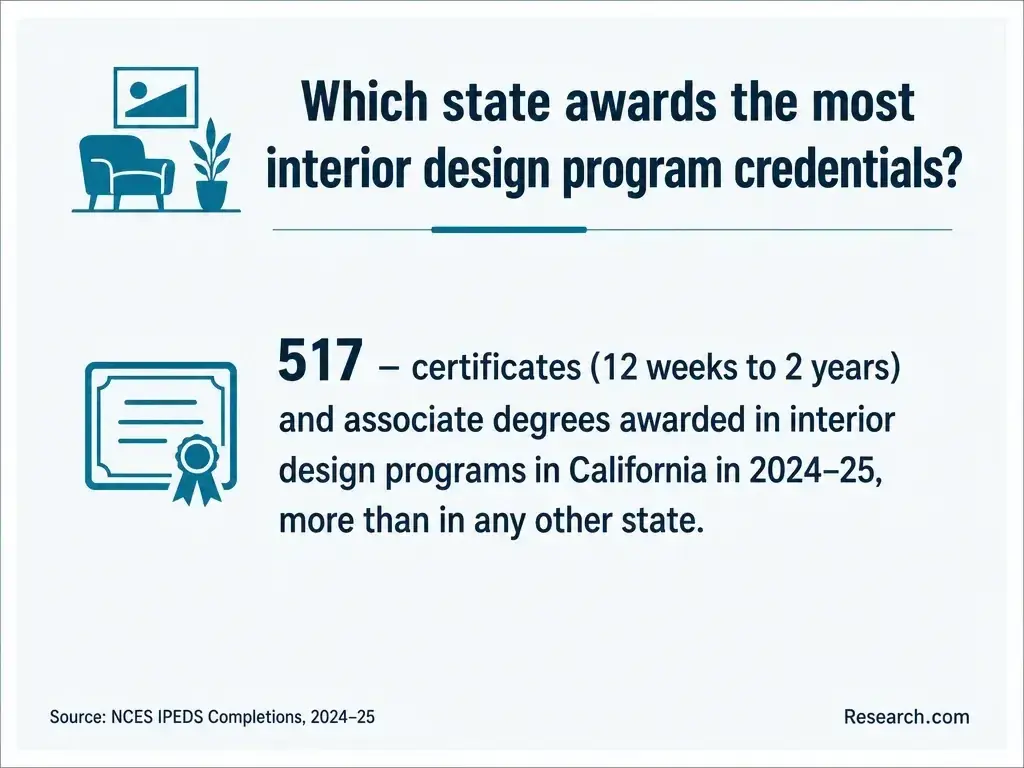
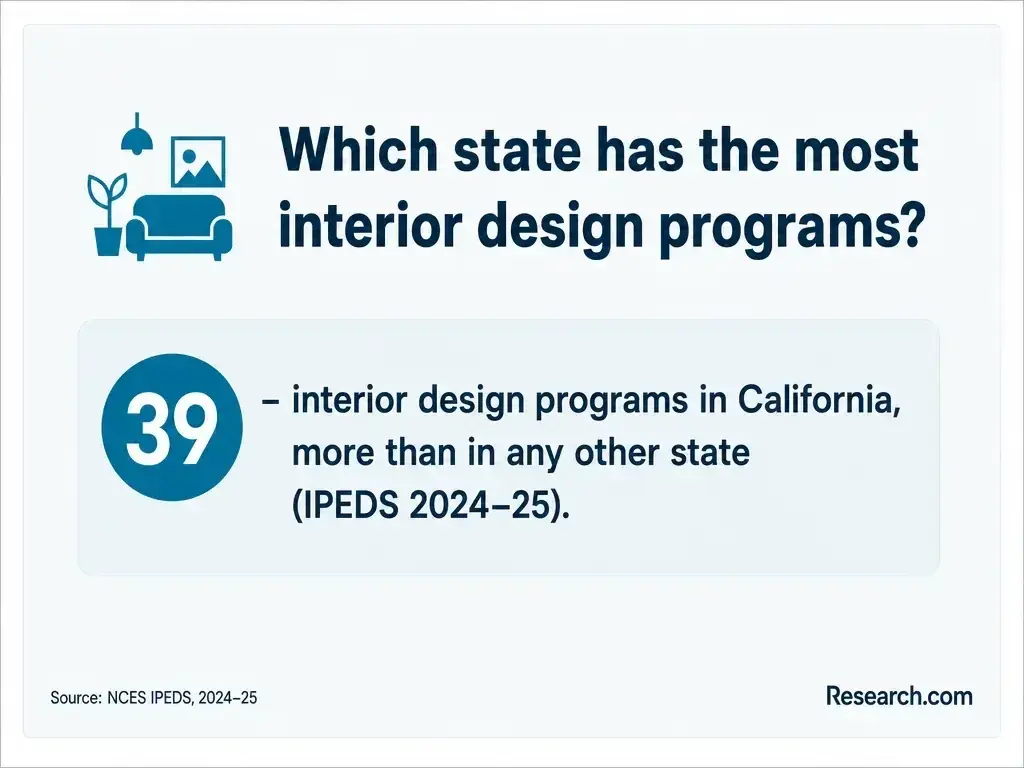
For a Rancho Cucamonga student, Chaffey College is a local public-college starting point to investigate. Check its current catalog for the exact interior design credential, required courses, studio access, and whether a capstone or work experience is available. A certificate can suit someone seeking focused skills or an assistant role; an associate-degree program, where offered, generally allows more time for technical coursework and portfolio development. Neither credential substitutes for experience.
Potential settings include residential design firms, kitchen and bath businesses, furnishings showrooms, and firms working on commercial interiors. Some roles focus on sales and product selection; others require drawing sets, specifications, and coordination with contractors. The U.S. Bureau of Labor Statistics identifies specialized design services, architectural and engineering services, and furniture retail among employers of interior designers.
Rancho Cucamonga students should search across the Riverside-San Bernardino-Ontario metro area rather than limit applications to one city. That wider commute can expand access to internships and entry-level work, but it can also increase transportation costs. Compare job descriptions before choosing courses: a showroom role and a documentation-heavy design-assistant role may call for different portfolios.
The national median annual wage for interior designers was $67,190 in May 2025, according to the U.S. Bureau of Labor Statistics. It describes employed workers across experience levels and locations, not the pay a new certificate holder should expect. It also does not cover every related showroom, drafting, or sales job.
For a local pay estimate, compare current Riverside-San Bernardino-Ontario postings for the specific role you want, noting required software, experience, and whether compensation includes commissions. Use the offered pay - not the national occupational median - when deciding how much training debt you could manage.
Duration depends on the credential and course sequence. A focused certificate may take several terms; an associate degree commonly takes about two years of full-time study, with part-time study taking longer. These are planning ranges, not confirmed completion times for a specific Chaffey College program. Ask whether required studio courses run every term, since an infrequently offered prerequisite can extend the calendar even when the total unit count looks manageable.
There is no single California clock-hour requirement for entry into ordinary interior design work. If voluntary certification is a later goal, check the California Council for Interior Design Certification's current education and experience routes before selecting a shorter program. An best accelerated online bachelor's degree for working adults is a different educational path; its speed says nothing about whether it supplies the studio work or experience needed for your interior design goal.
Online instruction can work well for design history, software demonstrations, and some drawing assignments. Campus studios make it easier to handle material samples, critique work in person, use shared equipment, and build relationships with classmates and instructors. A hybrid program may balance those benefits with a working adult's schedule.
The comparison below shows what to verify before treating two similarly named credentials as equivalent.
| Format | Potential advantage | Practical limitation to check |
| On-campus | Direct studio feedback and access to physical materials | Commute, scheduled studio hours, and campus fees |
| Hybrid | Less frequent travel while retaining some studio work | Required campus sessions may conflict with work |
| Online | Flexible access to lectures and digital assignments | Physical-material practice, critiques, and local work experience may require separate arrangements |
Before choosing a remote option, request examples of student portfolios and ask how instructors assess measured drawings, material specifications, and client presentations. Compare the full price with low cost online colleges for working adults, but do not assume that a low online price includes the practical training you need.
A reliable Rancho Cucamonga-wide average is not available from a complete inventory of interior design training providers. Published tuition alone would also understate the cost of becoming job-ready. For a 2027 comparison, obtain each provider's written estimate for your intended credential and enrollment status.
The following costs belong in that estimate because they can change which program is genuinely more affordable:
For Chaffey College, confirm current charges and whether you qualify for the California College Promise Grant, which can waive eligible community-college enrollment fees; it does not automatically cover every other expense, according to the California Community Colleges Chancellor's Office. Check federal-aid eligibility for the specific program through Federal Student Aid. To judge value, weigh net cost and possible debt against completion likelihood, your current earnings, realistic post-training pay, and how long you expect to use the skills.
The credential depends on the program: possibilities include a college certificate or an associate degree. The award name alone does not tell an employer how much drafting, studio work, or portfolio review you completed. Check the current Chaffey College catalog and the credential shown on the official program page rather than assuming every interior design course leads to an award.
If you are deciding whether a shorter college pathway fits your goals, the question is not which associate degree is easiest. It is whether the curriculum develops the drawings, specifications, software skills, and portfolio your target jobs request. California's voluntary certified interior designer designation is separate from a school credential; completing a certificate or associate degree does not automatically award it, according to the California Council for Interior Design Certification.
Community-college admission and admission to a particular course or credential are different steps. Check Chaffey College's current admissions and catalog information for enrollment eligibility, placement or prerequisites, course sequencing, and any portfolio requirements. Do not assume that enrolling in the college guarantees a seat in every studio class.
Before committing, ask whether prior coursework can satisfy requirements and whether part-time enrollment changes access to required courses. Prior-learning or transfer credit is useful only if the program formally accepts it toward the credential; keep copies of course descriptions and ask for a written evaluation.
A useful entry-level curriculum connects visual decisions to technical documentation. Look for measured drawing, space planning, computer-aided drafting, materials and finishes, lighting, accessibility, budgeting, and presentation. The U.S. Bureau of Labor Statistics notes that designers must account for how spaces function and comply with relevant building and accessibility requirements; decorative taste alone is not enough.
Ask to see a recent student project from brief to final drawings. It should reveal whether students practice revisions, explain selections to a client, and prepare work another professional could understand. Familiarity with AI-assisted visualization may help generate concepts, but verify that students still learn to check dimensions, specifications, and code-related assumptions rather than relying on generated images as buildable plans.
California does not issue a general occupational license that every interior designer must hold to enter the field. The certified interior designer title is a separate, voluntary designation administered by the California Council for Interior Design Certification; applicants must meet its applicable education, experience, and examination rules. Certification is not the same as institutional accreditation or permission to practice architecture, according to the council and California law.
If your goal is commercial interiors or work involving permits, ask prospective employers which tasks you may perform independently and which require another licensed professional. Before enrolling, compare the council's current eligibility routes with the program's actual coursework and your plan for gaining experience. Do not assume an online format, school accreditation, or a credential name establishes certification eligibility.
Start with the job you want, then work backward to the skills and portfolio it requires. An affordability ranking can identify options to investigate, but it cannot establish that the cheapest program is your best investment. A quickest masters program is not a substitute for comparing entry-level interior design training and practical work.
Use these checks when speaking with a program representative; they address common reasons an apparently inexpensive choice disappoints:
A warning sign is a promise of a designer job or particular salary without program-specific evidence. Another is a tuition quote that omits required software or studio expenses. If a lower-cost course does not teach the technical work your target role requires, a longer program - or supervised entry-level work - may offer better value.
A focused program may help you seek a design-assistant, showroom, furnishings, or kitchen-and-bath support role. A stronger technical portfolio may support applications involving space plans, drafting, and specifications. Advancement usually depends on demonstrated work, client communication, and experience - not simply the initial credential, according to the U.S. Bureau of Labor Statistics.
For someone already working in a showroom or related business, targeted courses plus supervised projects may be more economical than starting a full credential from scratch. For someone without relevant experience, a structured studio sequence may make it easier to build a credible portfolio. An 1 year online doctorate serves a different purpose and is not a normal entry route into interior design practice.
U.S. Bureau of Labor Statistics projections show 2.7% national employment growth for interior designers from 2025 to 2035. This is a modest-growth occupation, not evidence that jobs will grow at the same rate in Rancho Cucamonga or that every graduate will find work. Local opportunities also depend on construction activity, renovation demand, business spending, and the mix of firms hiring across the wider metro area.
Treat a portfolio and relevant experience as part of your employment plan from the first term. Search current Riverside-San Bernardino-Ontario openings for recurring software and documentation requirements, then choose projects that demonstrate those skills. If nearby openings are mostly sales-oriented while your goal is technical commercial design, account for a wider job search or commute before investing.
Investing in training is an important decision, especially when the lowest advertised tuition may not be the lowest total cost. Research.com evaluates programs against others in the same occupation and location so readers can compare realistic options. Only programs with completions reported to the Integrated Postsecondary Education Data System (IPEDS) are eligible; a provider's absence does not mean its training is unavailable or poor quality.
For the most affordable ranking, Research.com scores tuition, cost of attendance, median student debt, and federal loan default rate. Weights are assigned through an entropy-based method, which gives more weight to measures that vary more across eligible programs. Accreditation, student support, earnings, and completion are not included in this affordability score. Readers should check those factors separately before enrolling.
The Research.com team uses the following sources in its trade-program ranking work. Some cover other occupations and do not establish that an interior design program has a particular approval or certification outcome:
The ranking can narrow a cost-conscious search, but it cannot determine whether a particular curriculum meets your career goals. For more on the approach, see Research.com's methodology.
# 1 position
# 2 position
No. It is a local public-college option to investigate, but you can also compare other training formats and relevant supervised work. Check each option's current credential, practical instruction, total cost, and fit with your target job.
It may help you qualify for some support roles, especially with a strong portfolio. Job requirements vary; a certificate alone does not establish experience or eligibility for California's voluntary certified interior designer designation.
Some coursework can be completed remotely. Ask how an online program provides feedback on drawings, physical materials, and real project constraints, and whether you will need separate in-person experience.
No general registered apprenticeship is required to enter interior design. Supervised work, internships, and employer training can nevertheless help you develop a portfolio and gain experience.
Confirm the exact credential, complete cost, course availability, hands-on work, refund terms, and whether the training aligns with your intended job and any voluntary certification goal.