Most Affordable Cybersecurity Associate Degree Programs in New Hampshire for 2027
Audited and Verified:
Our Editorial and Data Verification Process
Research.com uses government datasets, official education statistics and primary institutional
information to support its career and degree guides. Our review process checks factual accuracy,
occupational definitions, source dates and the requirements associated with the credentials
discussed.
How This Article Was Fact-Checked
Our editorial team verifies salary estimates, employment projections, education requirements and
program information against original data providers and official organizations. Salary figures are
checked against the relevant occupational definitions and reporting periods. Information about
licensure, accreditation and required in-person training is reviewed separately.
Choosing an affordable cybersecurity associate degree means comparing more than tuition: the coursework, hands-on practice, and total cost must fit your career goal. The U.S. Bureau of Labor Statistics projects 21% national growth for information security analysts from 2025 to 2035, but that occupation is not typically an immediate first job for associate degree graduates. This guide explains the costs, pathways, and realistic entry roles. It also accompanies the Most Affordable Cybersecurity Associate Degree Programs in New Hampshire for 2027 ranking, created by the Research.com team of data scientists to help students make an informed choice about programs worth considering.
Key findings about associate cybersecurity degrees in New Hampshire
The most-affordable ranking compares reported tuition, attendance cost, debt, and loan default rates - not cybersecurity lab quality or job placement. Check those separately before enrolling.
A career-focused associate degree should offer substantial networking, systems, and security practice; a transfer-oriented associate degree may be a better fit if preserving future credit options matters most.
The national median for information security analysts was $129,180 in May 2025, according to the U.S. Bureau of Labor Statistics. It is an experienced-occupation benchmark, not a likely starting salary for a new associate degree graduate.
What can I expect from an associate cybersecurity degree in New Hampshire?
Expect a mix of general education, computing fundamentals, and applied security work. A useful program teaches students to configure and troubleshoot networks, administer operating systems, document incidents, and explain risk - not just recognize security terminology. Ask to see the current course sequence and whether labs require students to build, defend, and investigate working systems.
The degree title matters. An Associate of Applied Science (AAS) generally emphasizes career-focused technical coursework, while an Associate of Science (AS) or Associate of Arts (AA) may leave more room for broadly transferable courses. Titles alone do not prove transferability or job readiness: compare the actual requirements and obtain a written credit evaluation if you plan to continue studying.
In New Hampshire, investigate current cybersecurity or closely related computing associate offerings at NHTI-Concord's Community College, Nashua Community College, Great Bay Community College, River Valley Community College, and Southern New Hampshire University. Confirm the exact degree awarded and current delivery format in each school's catalog; a related IT degree is not necessarily a cybersecurity degree.
Where can I work with an associate cybersecurity degree in New Hampshire?
Likely starting points include IT support teams, network operations, managed service providers, and internal technology departments that handle account access, endpoint protection, or system administration. Healthcare organizations, financial firms, manufacturers, and public agencies all have systems to protect, although their hiring requirements differ. For a New Hampshire student, an employer's actual location and on-site expectations matter as much as its industry: a remote posting may still restrict where employees can work.
Look for positions that combine support or networking duties with security tasks. They can provide a more realistic route toward dedicated security work than applying only to analyst openings that require prior systems experience. Review local postings for required tools, schedules, and clearance or background-check conditions before selecting electives.
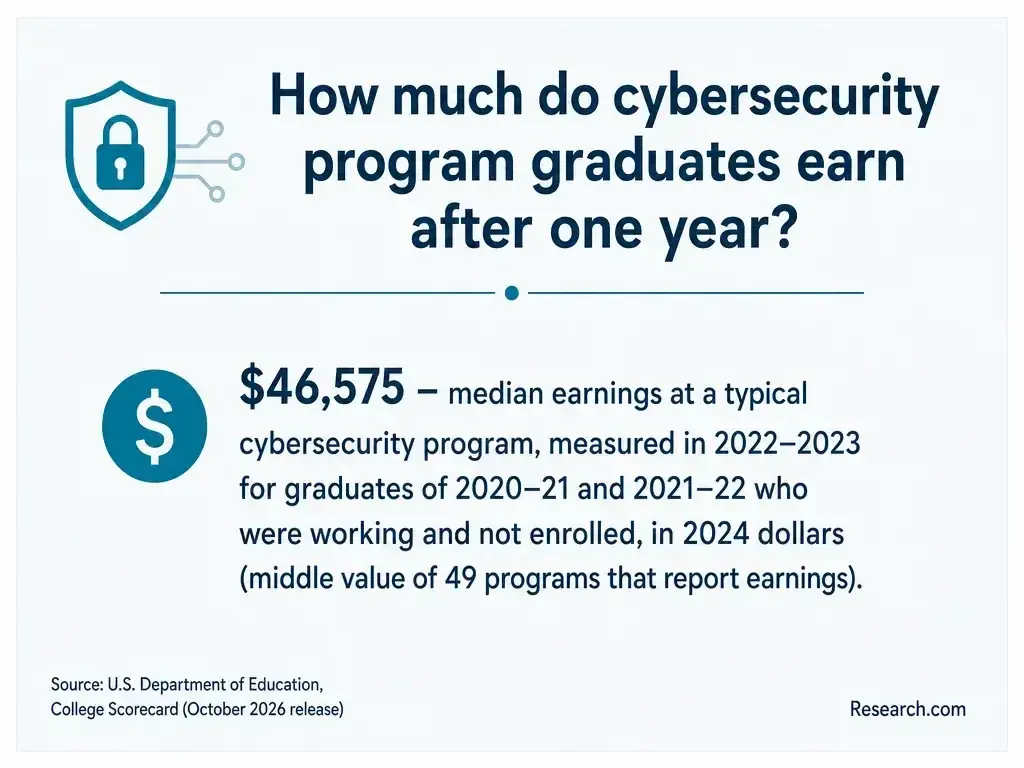
There is no single reliable salary for everyone with a cybersecurity associate degree. Pay depends on the job performed, experience, employer, and work location. The U.S. Bureau of Labor Statistics reports a $129,180 national median annual wage for information security analysts in May 2025. That figure covers the occupation as a whole; it is neither a New Hampshire wage nor an associate graduate's starting-pay estimate.
For a useful personal estimate, compare current New Hampshire postings for the entry-level titles you could qualify for now - not just analyst titles you hope to hold later. Note which postings disclose pay, require prior experience, or bundle security duties with IT support. Use a conservative starting-pay assumption when deciding how much debt you can afford.
Plan around the school's published credit requirements and course rotation, not a promised finish date. Associate degrees are commonly structured for roughly two years of full-time study, but part-time attendance, prerequisites, transfer-credit evaluations, and courses offered only in certain terms can extend completion. Ask an adviser to map every required course to a term before you commit to a work schedule.
An accelerated calendar does not necessarily reduce the number of credits or the workload. If you are comparing accelerated online associate options, check whether the advertised timeline depends on credits you already hold. Finishing sooner may save living expenses, but an unmanageable course load can increase the risk of paying for repeated classes.
Online study can make lectures, readings, and many virtual-machine exercises accessible from home. Campus study offers scheduled access to equipment and face-to-face troubleshooting. Neither format is automatically more practical: ask what you will configure yourself, what hardware or software you must provide, and whether exams, labs, or an internship require attendance at a particular site.
For students far from a campus, commuting can materially change the cheapest-looking option. Conversely, a low online tuition quote may omit a suitable computer, dependable internet, software, or travel for required activities. When comparing affordable online colleges, confirm that the specific associate degree has the cybersecurity labs and support you need; institution-wide affordability does not answer that question.
A single statewide average would be a weak budget: resident eligibility, institution, enrollment pace, and living arrangements can change the bill substantially. Request each school's current per-credit tuition, mandatory fees, required credits, and estimated indirect expenses. Do not treat a published annual cost of attendance as the exact price you will pay; it is a budgeting estimate that may include living costs.
The following comparison separates expenses you pay to the school from costs that can still determine whether an otherwise affordable degree is manageable.
Cost factor
What to verify for a cybersecurity associate degree
Tuition and mandatory fees
Resident-rate eligibility, required credits, technology fees, and any online or course fees.
Learning expenses
Textbooks, software, a computer capable of running labs, and reliable internet.
Attendance and career preparation
Travel to labs or worksites, living expenses, and optional certification exam fees.
Time and financing
Work hours forgone, likely borrowing, interest, and the effect of a delayed completion date.
Compare net expected cost to finish after grants and other assistance, not tuition alone. Recalculate if you must study part time or pay nonresident tuition; either change can reverse an apparent price advantage.
Start with the Free Application for Federal Student Aid (FAFSA) and the school's aid office. Depending on eligibility and the institution, assistance may include federal grants, loans, work-study, institutional scholarships, employer tuition assistance, or workforce funding. Federal Student Aid determines federal-aid rules; an admission offer does not itself establish aid eligibility.
Ask each school for an aid estimate covering the entire expected enrollment period, including any semesters in which you attend part time. Distinguish grants from loans, and ask whether a scholarship renews automatically. If an employer offers tuition assistance, confirm which cybersecurity courses qualify and whether reimbursement arrives only after you pass them. Broader searches about later-stage education costs should not replace a current, associate-degree-specific aid offer.
Check each college's current admissions and placement policies. Requirements can include a high school diploma or equivalent, an application, prior transcripts, and placement into college-level math or English. Technical courses may have their own sequencing requirements; being admitted to the college does not always mean you can immediately take the security course you want.
You do not need to arrive knowing how to investigate a breach, but comfort with basic computing and careful troubleshooting will help. Ask whether prior college coursework, documented learning, or relevant experience can earn credit - and whether applying that credit actually shortens the required course sequence.
A strong sequence usually builds from networking and operating systems to scripting, security fundamentals, access control, and incident response. General education commonly develops writing, quantitative reasoning, and communication skills that matter when documenting an incident or explaining a technical risk to a supervisor.
Compare lab assignments, not just course names. A networking course that requires configuring and diagnosing a network provides different evidence of skill from one assessed mainly through quizzes. Ask whether students use isolated practice environments, produce a portfolio of work, or complete a supervised project. If an internship is advertised, verify whether it is required, who finds the placement, and whether its hours fit your schedule.
At the associate level, specialization may mean a small set of electives rather than a separate degree track. Networking and system administration suit students seeking infrastructure roles; digital forensics or incident-response coursework may suit those interested in investigating events; secure scripting can help students who enjoy automating repetitive tasks. Availability depends on the current catalog and course schedule.
Choose a focus only after checking the foundational courses. A narrow elective cannot compensate for missing networking or operating-system practice. Students considering longer-range academic questions can explore them separately; a resource on broader study choices does not establish which cybersecurity associate courses will transfer or build entry-level skills.
Start with your intended first job and the amount you can spend to reach it. Then compare the degree awarded, complete course map, actual lab work, total net cost, and evidence of student support. An affordability ranking is a useful shortlist, but its cost-and-debt score does not measure whether a particular program teaches the systems you want to work on.
Use these checks with each finalist so that similarly named degrees are compared on the same terms.
Request the current catalog and identify the degree awarded, required credits, course rotation, and any in-person obligations.
Ask for examples of networking, systems, and security labs and whether an internship or supervised project is available.
Confirm institutional accreditation through the institution and its recognized accreditor; separately verify any claimed industry recognition or certification alignment.
Obtain a personalized cost and aid estimate, including fees, technology, travel, and likely time to completion.
If future study matters, request written confirmation of how your intended next institution evaluates these specific courses; accreditation alone does not guarantee credit transfer.
A common mistake is selecting the lowest tuition figure while ignoring a costly commute, limited course availability, or weak lab access. Another is assuming a certification-preparation claim means an exam is included or that employment is assured. Ask for those details in writing before paying a deposit.
An associate degree can support applications for help desk, technical support, junior network, and systems-support roles. Security-related responsibilities may grow from monitoring alerts, managing accounts, updating devices, and documenting problems. A dedicated information security analyst position often requires experience beyond graduation; the U.S. Bureau of Labor Statistics describes related work experience as typical for that occupation.
Professional certifications can help demonstrate particular skills, but exam rules and employer preferences vary. They are not New Hampshire occupational licenses: cybersecurity work does not generally require a state-issued occupational license. If your priority is the fastest possible entry into a specific technical job, compare the associate degree's broader coursework and expense with other job-focused routes, including the roles available through trade-focused pathways. Choose the degree when its combination of technical breadth, general education, and potential credit mobility serves your goal.
The U.S. Bureau of Labor Statistics projects 21% national employment growth for information security analysts from 2025 to 2035. That signals demand in the broader occupation, not a forecast of New Hampshire openings for new associate degree holders. Competition for dedicated security roles and requirements for prior IT experience make entry-level support or network positions important to investigate too.
To assess your local market, compare recent postings within a commute you would accept and separate genuinely entry-level jobs from roles labeled "junior" that still demand substantial experience. Record recurring tools and tasks, then check whether your prospective degree provides practice with them. This is more actionable than using a national growth figure as a promise of a local job.
Most Affordable Cybersecurity Associate Degree Programs in New Hampshire for 2027
Investing in an associate degree is a consequential financial decision. Research.com created this ranking to help readers compare affordable options against other programs in the same occupation and location, rather than against schools they would not realistically consider. The team draws on education, cost, debt, and institutional data and checks the resulting comparisons for credibility and accuracy.
The most-affordable ranking scores costs and debt only: tuition, cost of attendance, median student debt, and federal loan default rate. An entropy-based method gives more weight to indicators that vary more across included programs. Accreditation and other quality indicators do not enter this affordability score, so a high placement is not a substitute for checking curriculum or outcomes. Only programs with completions reported to IPEDS are included; exclusion does not establish that another program is unavailable or poor quality.
For transparency, these are the data sources used in the ranking process. Some occupation-specific sources in this broader source set do not establish cybersecurity program quality.
IPEDS database - program completions and institutional reporting.
Use the ranking to narrow your cost comparison, then verify each finalist's current price, cybersecurity coursework, and practical experience directly with the school. Research.com explains its ranking approach in more detail on its methodology page.
# 1 position
NHTI-Concord's Community College
associate
Computer and Information Systems Security/Auditing/Information Assurance
Delivery mode: On Campus (May Include Online Courses)
Institutional accreditation from New England Commission on Higher Education.
NHTI-Concord's Community College earned a Research.com Affordability Score of 82.51/100, with 8% federal loan default rate among the verified supporting factors.
Frequently asked questions about cybersecurity programs in New Hampshire
What is the cheapest cybersecurity associate degree in New Hampshire?
There is no universal cheapest choice: resident tuition eligibility, aid, required fees, commuting, and time to completion affect your total. Compare personalized estimates from the ranked schools rather than tuition rates alone.
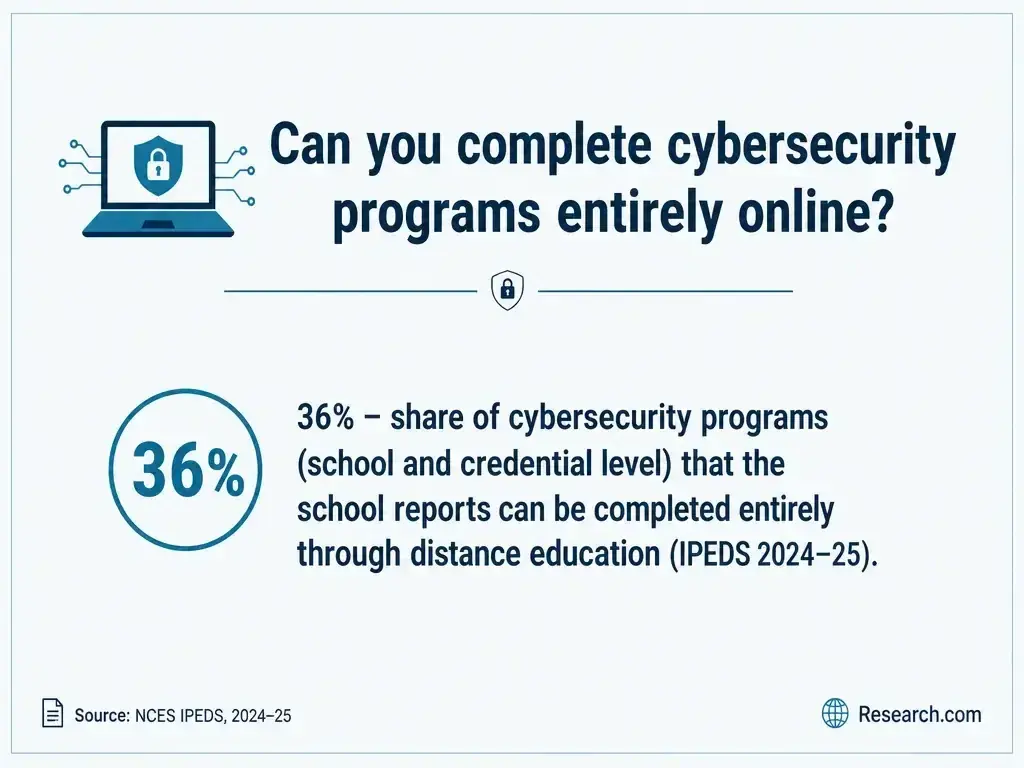
Can I earn a cybersecurity associate degree entirely online?
Some programs may offer remote coursework and virtual labs. Confirm the specific degree's current requirements, including any campus visits, proctored exams, or internship activities, before assuming you can complete it from home.
Is an AS or an AAS better for cybersecurity?
An AAS often emphasizes immediate technical preparation; an AS may provide more broadly transferable coursework. Compare the actual courses and obtain a written transfer evaluation if credit mobility is important to you.
Will an associate degree qualify me for an information security analyst job?
It may help, but it does not guarantee eligibility or employment. Many analyst openings expect prior IT experience, so support and network roles can be realistic first steps.
Do I need a New Hampshire cybersecurity license?
Cybersecurity work generally does not require a New Hampshire occupational license. Employers may instead specify experience, skills, background conditions, or professional certifications; check requirements for the jobs you want.