Best Cybersecurity Associate Degree Programs & Schools in Montana for 2027
Audited and Verified:
Our Editorial and Data Verification Process
Research.com uses government datasets, official education statistics and primary institutional information to support its career and degree guides. Our review process checks factual accuracy, occupational definitions, source dates and the requirements associated with the credentials discussed.
How This Article Was Fact-Checked
Our editorial team verifies salary estimates, employment projections, education requirements and program information against original data providers and official organizations. Salary figures are checked against the relevant occupational definitions and reporting periods. Information about licensure, accreditation and required in-person training is reviewed separately.
Fact-checked and verified on:

Co-Founder and Chief Data Scientist

Reviewed by Karolina Broda
Fact-Checker and Data Verification
Choosing a cybersecurity associate degree in Montana means weighing practical skills against cost, location, and the jobs available after graduation. The U.S. Bureau of Labor Statistics projects 21% national growth for information security analysts from 2025 to 2035, but that occupation is not typically an immediate destination for every new graduate. This guide explains which degree pathways fit different goals, what to verify before enrolling, and how to judge value. The Research.com team of data scientists created its Best Cybersecurity Associate Degree Programs in Montana for 2027 ranking to help students make an informed choice about programs worth considering.
Key findings about associate cybersecurity degrees in Montana
- Choose an applied associate degree for hands-on IT and security work; choose a transfer-oriented associate degree only after confirming that its courses meet your intended next program's requirements.
- The U.S. Bureau of Labor Statistics reports a $129,180 national median annual wage for information security analysts in May 2025. That is an occupational median, not a starting salary or a predicted outcome for Montana associate degree graduates.
- In Montana, compare the full cost of attending and reaching labs or worksites - not tuition alone - and ask schools to document security coursework, practical experience, and graduate outcomes.
Table of Contents
- Best Cybersecurity Associate Degree Programs & Schools in Montana for 2027
- What can I expect from an associate cybersecurity degree in Montana?
- Where can I work with an associate cybersecurity degree in Montana?
What can I expect from an associate cybersecurity degree in Montana?
A cybersecurity associate degree combines college-level general education with computing, networking, and security coursework. The crucial distinction is whether the degree is designed chiefly for immediate technical employment or for transferring credits. Degree titles alone do not establish either outcome; verify the published curriculum and agreements for the specific program (sources: institution catalogs; Montana University System).
This comparison shows what each degree type is generally built to do. Schools may use the same degree title differently, so the catalog - not the label - is decisive.
| Degree pathway | Best fit | Point to verify |
| Associate of Applied Science (AAS) | Students seeking technical employment after graduation | Depth of networking and security labs; which credits transfer |
| Associate of Science (AS) | Students prioritizing transferable computing and mathematics coursework | Whether required courses match the intended receiving program |
| Associate of Arts (AA) | Students seeking a broader general-education route | Whether enough technical courses fit within the degree |
Expect to practice configuring systems, protecting accounts, documenting incidents, and explaining risks to nontechnical colleagues. Ask whether labs use current tools, whether projects require individual troubleshooting, and whether an internship is available or required. An associate degree can be valuable when it provides both demonstrable skills and affordable credits; it is a weaker investment if its technical work is thin or its credits do not support your intended next step.
Where can I work with an associate cybersecurity degree in Montana?
Graduates may look for IT support, network support, junior systems administration, or security-support work with organizations that operate substantial computer networks. In Montana, that can mean healthcare systems, government agencies, financial institutions, education providers, utilities, and other employers managing sensitive information. The location matters: a rural student may have fewer nearby internship and entry-level options than someone able to commute to a larger employment center. Ask the program where students have completed projects or work-based learning and whether those opportunities are reachable from your home.
"Cybersecurity" in a job title does not necessarily mean entry-level work. Employers may seek prior IT experience for incident response or analyst roles; the U.S. Bureau of Labor Statistics describes related work experience as typical for information security analysts. Judge a program partly by how well it prepares you for an attainable first IT role, not solely by its most ambitious advertised destination (source: U.S. Bureau of Labor Statistics, Occupational Outlook Handbook).
The national median annual wage for information security analysts was $129,180 in May 2025 (source: U.S. Bureau of Labor Statistics, Occupational Outlook Handbook). This figure covers workers across experience and education levels nationwide. It is not a Montana wage estimate or a reasonable assumption about a new associate degree graduate's first paycheck.
For a useful earnings comparison, check current Montana wage estimates for the specific jobs you could enter first - such as computer support - and compare them with actual local job postings' experience requirements. Then weigh any likely pay change against debt, time away from work, and your current earnings. A higher-paying occupation may be a long-term goal without being an immediate return on the degree.
Full-time students often plan on roughly two academic years, but the actual timeline depends on the school's required credits, course sequence, accepted transfer credits, and whether required classes run every term. Request a degree map showing when networking, security labs, general education, and any work-based component are offered. A part-time schedule can protect current income but may delay completion if a prerequisite is available infrequently.
An accelerated schedule is worthwhile only if it leaves time to develop and demonstrate technical skills. When comparing other quick college degrees that pay well, use the same test: the advertised duration should include every course and practical requirement needed to finish, not merely the time spent in the first term.
Online study can reduce travel across Montana's long distances, but cybersecurity competence still requires practice. Lectures, reading, discussion, and some virtual-machine labs can be completed remotely; an institution may require campus labs, proctored assessments, or an internship at a physical worksite. Confirm those requirements before assuming that "online" means no travel (source: institution program catalogs).
This format comparison highlights the trade-off that matters most for students balancing work and distance from campus.
| Format | Potential advantage | Question to resolve |
| Online | Less routine commuting | What equipment, live sessions, exams, or worksite visits are required? |
| Hybrid | Remote coursework with scheduled in-person practice | How often must you travel, and when? |
| On campus | Regular access to equipment and classmates | Do class times and travel costs fit your schedule? |
Do not assume that similar degree names indicate similar hands-on preparation. Ask to see sample lab assignments and confirm that you can access the software and computing equipment needed to complete them.
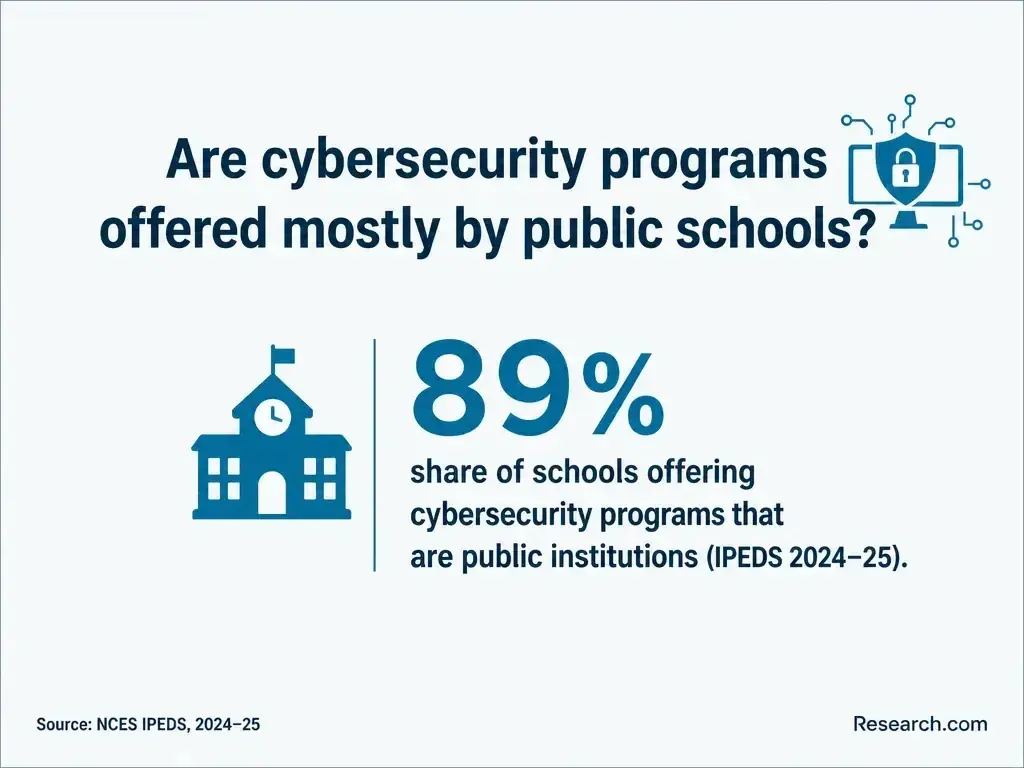
There is no single reliable statewide price for a cybersecurity associate degree: schools set different tuition and fees, and a student's residency, enrollment pace, and living arrangements change the final bill. Request a program-level estimate covering all required terms. Add mandatory fees, books, a suitable computer, software or lab access, optional certification exams, transportation, housing, and earnings you may give up while studying (sources: institution tuition schedules and program catalogs).
Compare net total cost to completion, not the lowest advertised tuition. For example, a less expensive campus program may cost more overall if travel makes attendance difficult, while a flexible program may allow you to keep working. Resources on the cheapest online associate's degree options can help frame a price comparison, but confirm Montana-specific eligibility, fees, and practical requirements before treating any listing as the cheaper choice.
Start with the Free Application for Federal Student Aid (FAFSA) to determine eligibility for federal grants, loans, and work-study at a participating institution. Then ask the school's aid office about institutional scholarships, Montana-specific assistance for which you may qualify, and whether an employer will reimburse relevant coursework. Eligibility and award amounts depend on the student and program; a published tuition figure is not a net-price offer (source: U.S. Department of Education, Federal Student Aid).
Before accepting loans, ask for an aid estimate covering the entire degree, including terms when you may study part-time. Check whether a scholarship requires a minimum course load or continued academic progress. Grants and employer assistance may improve value, but neither should be assumed until eligibility is confirmed in writing.
Admissions requirements vary by institution. Expect to review the school's application, high school completion or equivalent requirements, placement process, and any prerequisites for computing or mathematics courses. Open admission to a college does not necessarily mean immediate access to every course or to a particular degree program; confirm both policies with admissions and the department (source: institution admissions and program catalogs).
If your academic record is a concern, information about colleges offering open admissions can help you identify questions to ask. In Montana, also ask whether prior college coursework or documented technical learning can count toward the degree. Obtain a written credit evaluation before planning your completion date.
Common coursework includes operating systems, computer hardware, networking, system administration, scripting, security fundamentals, and incident documentation, alongside general education. The exact mix matters more than a program's name: students aiming for technical support need strong troubleshooting foundations, while those hoping to progress toward security operations should look for sustained practice with networks, logs, access controls, and clear written reports (sources: institution program catalogs; U.S. Bureau of Labor Statistics, Occupational Outlook Handbook).
Ask how often students perform hands-on tasks rather than only read about them. A useful capstone or lab should require you to identify a problem, test a response, document what happened, and explain the result. If an internship is advertised, determine whether it is guaranteed, competitive, optional, or simply eligible for credit.
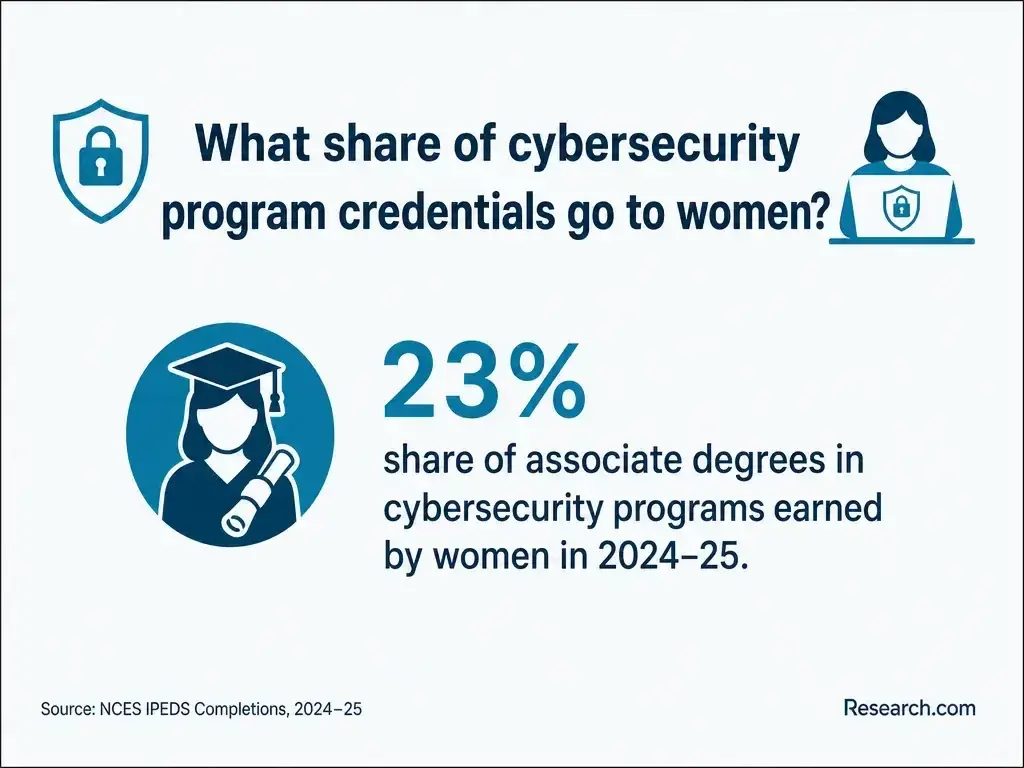
At the associate degree level, "specialization" often means a cluster of courses or projects rather than a separately awarded degree. Networking and systems administration suit students who want a broad technical first job. Security operations coursework suits those interested in monitoring and incident response; cloud or scripting electives may help students interested in securing modern infrastructure. Check the catalog to see whether these subjects are required, elective, or unavailable in the term you need (source: institution program catalogs).
Do not select a narrow emphasis at the expense of networking and operating-system basics. Employers can assess practical skills through projects and experience, while an elective title alone says little about what you can do.
Start with the job you want immediately after graduation, then work backward to the required skills and realistic local opportunities. Research.com's ranking can narrow the field, but it cannot establish whether a particular program fits your schedule, transfer plans, or budget. If considering Miles Community College, Highlands College of Montana Tech, or The University of Montana, verify the current associate degree award and cybersecurity coursework directly rather than assuming that every institution offers the same pathway.
Use these checks to turn a shortlist into an enrollment decision:
- Confirm the exact degree awarded, required courses, credit total, course rotation, and expected completion time.
- Verify institutional accreditation with the school and recognized accreditor; ask separately about relevant industry recognition and certification preparation.
- Request written transfer evaluations or articulation details if you intend to continue studying; accreditation alone does not guarantee that credits transfer.
- Review lab access, internship conditions, technical support, and outcomes for the jobs you would actually seek.
- Compare full net cost, likely debt, completion probability, lost earnings, and a realistic time horizon for any expected earnings improvement.
A common mistake is treating the analyst wage as a promised starting salary or assuming that the lowest tuition means the best return. If your goal is immediate employment, prioritize demonstrable skills and reachable opportunities; if your goal is further study, prioritize confirmed credit applicability. Someone already established in IT may need a different educational next step: cheap one year master's programs online address a different audience and should not be confused with an entry-level associate degree comparison.
A realistic progression often begins in user support, network support, or systems support, followed by greater responsibility for access management, monitoring, or security operations as experience grows. A relevant professional certification may help demonstrate skills, but it is separate from an associate degree and is not a substitute for hands-on competence. Cybersecurity roles discussed here do not have a general Montana occupational license; employers set their own hiring requirements (sources: U.S. Bureau of Labor Statistics, Occupational Outlook Handbook; institution program catalogs).
If your main goal is rapid entry to well-paid practical work rather than computing specifically, compare the degree's cost and timeline with other career options, including best paying trade jobs. That comparison is most useful when it includes local openings, the work you would actually enjoy, and the time required to become employable - not headline wages alone.
The U.S. Bureau of Labor Statistics projects 21% national employment growth for information security analysts from 2025 to 2035. This is a strong long-term signal for that occupation, but it is a national projection, not a forecast of entry-level openings in Montana or proof that an associate degree alone meets employers' requirements (source: U.S. Bureau of Labor Statistics, Employment Projections).
Montana applicants should search the jobs they could perform upon graduation as well as the jobs they hope to reach later. Compare postings across locations you could commute to, noting required experience, networking skills, security tools, and work arrangements. Ask a prospective school whether its graduates have secured local placements and how it verifies those outcomes. Remote roles may expand a search, but they also bring competition beyond the local market.
Best Cybersecurity Associate Degree Programs & Schools in Montana for 2027
Investing in an associate degree is a consequential decision. Research.com created the accompanying ranking to help readers compare eligible programs against relevant alternatives, rather than rely on a school's marketing claims alone. The team checks outcomes, costs, recognition, and student support using multiple sources and a consistent scoring approach.
For best-program rankings, student outcomes include completion and full-time and part-time retention. Earnings and return-on-investment measures include median earnings one year after completion relative to annual cost of attendance. Cost measures include resident and nonresident tuition, attendance cost, median debt - including debt held by students who withdrew - and federal loan default rate. Quality measures include institutional accreditation, relevant programmatic accreditation or industry recognition, and student support. Relevant programmatic recognition receives 20% of the score, institutional accreditation 10%, and student support 10%; an entropy-based method distributes the remaining 60% across outcomes, earnings, and costs. Most-affordable rankings instead score only costs and debt, with entropy-based weights.
The ranking draws on the following sources. Some are used across Research.com's occupation-specific rankings but are not cybersecurity accrediting bodies; their inclusion should not be read as a cybersecurity program endorsement.
- IPEDS database - reported program completions and institutional data.
- National Center for Education Statistics - federal education data and definitions.
- College Scorecard database - institutional costs, debt, and outcomes where available.
- Peterson's database - supplementary college information.
- Commission on Accreditation of Allied Health Education Programs - occupation-specific recognition checks where applicable.
- Accrediting Bureau of Health Education Schools - occupation-specific recognition checks where applicable.
- Commission on Dental Accreditation - occupation-specific recognition checks where applicable.
- Dental Assisting National Board - occupation-specific recognition checks where applicable.
- National Center for Construction Education and Research - industry-recognition checks where applicable.
- Apprenticeship.gov Partner Finder - occupation-specific pathway information where applicable.
Programs are compared within the same occupation and geography, and only those with completions reported to IPEDS are included. That limit does not mean an unlisted provider lacks quality or approval. Use the ranking as a shortlist, then confirm current curriculum, delivery, costs, and outcomes directly with each school. Research.com explains the scoring in more detail on its methodology page.


# 3 position
The University of Montana
associateComputer and Information Systems Security/Auditing/Information Assurance
Delivery mode: On Campus (May Include Online Courses)
27.13
/ 100
Final score
- School graduation rate
- 48%
- Students receiving Pell Grants
- 33%
- In-state tuition & fees (per year)
- $9,188
- Out-of-state tuition & fees (per year)
- $34,312
- School website
- umt.edu
Accreditation
Institutional accreditation from Northwest Commission on Colleges and Universities.
The University of Montana received a Research.com Trade Program Score of 27.13/100.
Frequently asked questions about cybersecurity programs in Montana
Is a cybersecurity associate degree worth it in Montana?
It can be if the program builds practical IT skills, fits your budget, and leads to reachable work or transferable credits. Compare its full cost with your likely first job - not an experienced analyst's national median wage.
Which associate degree type should I choose?
An AAS generally fits a career-first goal; an AS or AA may better support a transfer-first goal. Confirm the actual courses and written credit-transfer rules before choosing.
Can I complete the degree entirely online?
Possibly, but do not infer that from an "online" label. Ask about required labs, assessments, equipment, and any in-person internship or worksite activity.
Will the degree qualify me for an information security analyst job?
Not automatically. Employers often seek prior IT experience, so support or systems roles may be more realistic first steps (source: U.S. Bureau of Labor Statistics, Occupational Outlook Handbook).
Do I need a Montana cybersecurity license?
There is no general occupational license for the cybersecurity roles discussed here. Check each employer's education, experience, and certification requirements separately.
What should I ask a school before applying?
Request the exact degree map, total cost estimate, lab and internship requirements, transfer evaluation, and evidence of graduate outcomes for the jobs you intend to pursue.
- U.S. Bureau of Labor Statistics - Information Security Analysts
Used to verify salary, employment outlook, and typical education requirements.
https://www.bls.gov/ooh/computer-and-information-technology/information-security-analysts.htm - NCES College Navigator (IPEDS)
Used to verify programs offered and institutional accreditation.
https://nces.ed.gov/collegenavigator/ - CompTIA Security+
Professional certification reference for graduates of this occupation.
https://www.comptia.org/certifications/security - Miles Community College - official website
Official school website (programs, tuition, admissions).
https://www.milescc.edu/ - Highlands College of Montana Tech - official website
Official school website (programs, tuition, admissions).
https://www.mtech.edu/ - The University of Montana - official website
Official school website (programs, tuition, admissions).
https://www.umt.edu/