# 1 position


Audited and Verified:
Our Editorial and Data Verification Process
Research.com uses government datasets, official education statistics and primary institutional information to support its career and degree guides. Our review process checks factual accuracy, occupational definitions, source dates and the requirements associated with the credentials discussed.
How This Article Was Fact-Checked
Our editorial team verifies salary estimates, employment projections, education requirements and program information against original data providers and official organizations. Salary figures are checked against the relevant occupational definitions and reporting periods. Information about licensure, accreditation and required in-person training is reviewed separately.
Fact-checked and verified on:

Co-Founder and Chief Data Scientist

Reviewed by Karolina Broda
Fact-Checker and Data Verification
A low tuition price does not necessarily make a cybersecurity associate degree affordable: fees, commuting, and time away from work can change the calculation. The U.S. Bureau of Labor Statistics projects 21.0% national growth for information security analysts from 2025 to 2035, but that experienced occupation is not a guaranteed first job. This guide helps Dallas students compare costs, coursework, and career fit. It also features a Most Affordable Cybersecurity Associate Degree Programs in Dallas for 2027 ranking, created by the Research.com team of data scientists to help students make an informed choice about programs worth considering.
Expect a combination of general education, computing fundamentals, and security practice. A useful program should teach students to configure and troubleshoot networks, work with operating systems, manage access, document incidents, and explain risk to people who are not security specialists. Hands-on work matters: a course title such as "network security" tells you less than whether you will actually configure a firewall, inspect logs, or investigate a simulated incident.
Degree labels signal different priorities, but the school's catalog controls what you will study and where credits may count later.
| Associate degree | Usual emphasis | Best fit | Point to verify |
| Associate of Applied Science (AAS) | Career-focused technical coursework and labs | Students seeking an IT role soon after completion | Whether technical credits can be used toward a later degree |
| Associate of Science (AS) | More transferable general education and computing foundations | Students prioritizing continued academic study | Whether it offers enough security labs for the jobs they want now |
| Associate of Arts (AA) | Broad general education; security content varies substantially | Students whose intended pathway specifically accepts its courses | Whether cybersecurity is an actual concentration rather than an elective or marketing label |
For a Dallas applicant comparing Dallas College and Peloton College, the first question is whether each currently offers the specific associate degree sought, in a workable format and location. Do not infer that similarly named programs have equivalent labs, credit requirements, or employment outcomes.
Dallas-area employers in healthcare, financial services, retail, telecommunications, and other technology-dependent operations need people who can keep systems running and protect access to data. An associate degree may support applications for help-desk, desktop support, network support, or security-operations support positions, depending on the applicant's skills and the posting. Security-focused jobs are often more competitive than general IT support roles, so a first IT position can be a deliberate stepping-stone rather than a poor outcome.
Look beyond employers with "cybersecurity" in their names. Compare local postings for required operating systems, networking tasks, shift schedules, and experience; a program is more valuable if its labs let you demonstrate those skills. Ask whether the school has Dallas-area work-based learning contacts, and confirm whether any internship is required, optional, or arranged by the student.
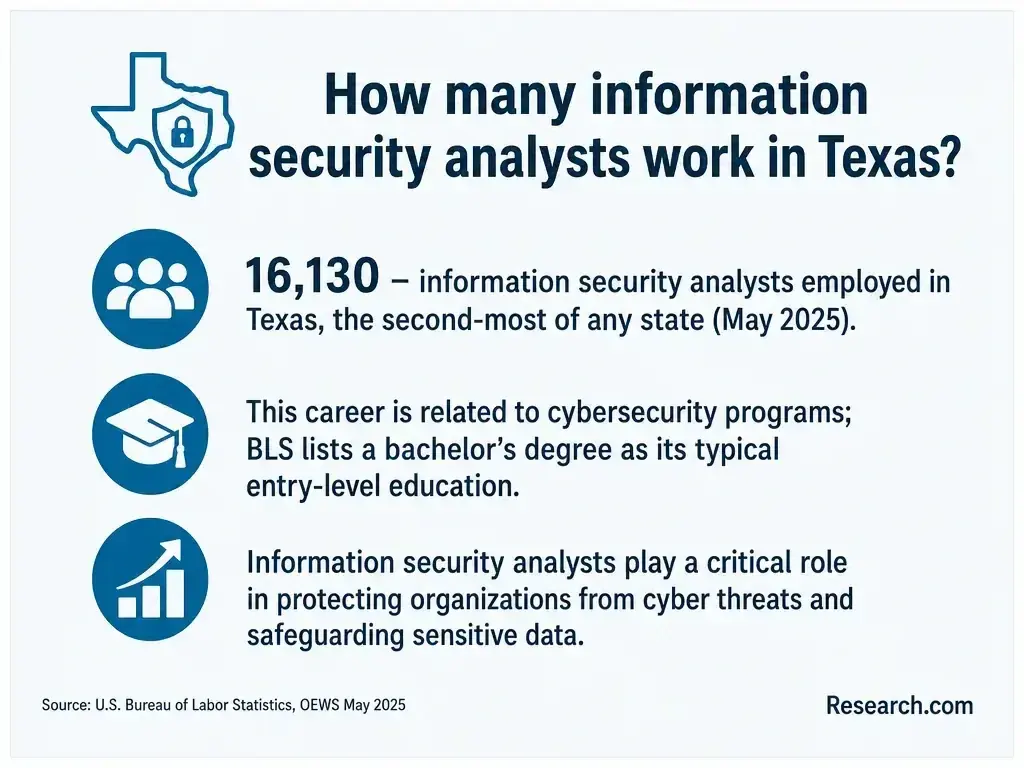
There is no single Dallas wage for "cybersecurity associate degree graduates." Job title, prior IT experience, and employer matter more than the degree label. Nationally, the median annual wage for information security analysts was $129,180 in May 2025, according to the U.S. Bureau of Labor Statistics. That figure describes workers across experience levels, not new graduates or Dallas specifically; the BLS notes that analysts typically need related work experience.
For a personal estimate, collect current Dallas-area postings for positions you could qualify for immediately, separate them from analyst postings requiring experience, and compare their stated pay with your present earnings. If you are already in IT, the degree's potential value may be access to more specialized responsibilities; if you are new to IT, budget for the possibility of starting in support.
A cybersecurity associate degree commonly requires about 60 semester credits and takes approximately two academic years of full-time study; the exact catalog requirements, course sequence, and schedule determine an individual student's timeline. Part-time attendance can preserve income but lengthen the period over which tuition, commuting, and living costs accrue. A compressed schedule may reduce time away from full-time work, but only if prerequisite courses and required labs are offered when you need them.
Be skeptical of comparisons with best associate degrees in 6 months online that overlook transferred credits or unusually heavy course loads. Ask for a term-by-term plan showing the required cybersecurity courses, general education, prerequisites, and anticipated graduation date for your own transcript.
Online study can make lectures, reading, discussion, and some virtual labs easier to fit around work. Campus study may provide more direct access to equipment, classmates, instructors, and local employer events. Neither format is automatically stronger: the test is whether you can complete realistic, supervised exercises and get feedback on your work.
Before choosing an online or hybrid program, ask which labs use remote simulations, whether any exams or lab sessions require attendance, and how internships work for students living in Dallas. A program described as online may still require travel. If application costs affect your shortlist, a list of accredited online colleges with no application fee can help identify questions to ask, but verify that the institution actually offers the associate degree and format you want. Institutional accreditation alone does not establish credit transfer or employer acceptance.
No single published "Dallas average" reliably represents what an individual will pay for a cybersecurity associate degree. Dallas College's applicable tuition category can depend on residency and district rules; living in the city does not, by itself, establish eligibility for the lowest rate. Private-college pricing may use a different fee structure. Obtain a current, written estimate from each school for your residency category and intended schedule rather than treating an advertised per-credit price as the degree's cost.
These cost components belong in the same comparison because an apparently cheaper program can cost more to finish.
| Cost component | What to include in a Dallas comparison |
| School charges | Tuition for all required credits, mandatory fees, and any repeat-course costs |
| Learning expenses | Textbooks, required software, computer and internet access, and any certification exam fees you choose to pay |
| Attendance expenses | Travel or parking for classes and labs, plus living expenses during enrollment |
| Time and financing | Income forgone if you reduce work, less grants and employer assistance; consider borrowing costs separately |
Value also depends on completion probability and the time needed to benefit from the degree. An honest return-on-investment comparison weighs baseline and plausible post-degree earnings over a stated time horizon, financial aid, debt, and the opportunity cost of studying; it does not assume an analyst's median wage will follow graduation.
Eligible students may have access to federal grants, loans, or work-study after submitting the Free Application for Federal Student Aid (FAFSA), subject to Federal Student Aid rules and the institution's participation. Institutional scholarships, Texas aid for eligible residents, and employer tuition assistance may further reduce out-of-pocket costs. Eligibility, deadlines, and whether a particular degree qualifies must be checked with the school's financial aid office; an award is not assured.
Ask each school for a net-cost estimate for the full degree, distinguishing grants from loans. Confirm whether aid covers required summer terms or part-time enrollment and whether employer reimbursement arrives only after a course is completed. Borrowing less may matter more than a small difference in advertised tuition.
Admissions requirements vary by institution and program. Expect to provide prior education records and complete any required assessment or placement process; a student may also need introductory computing or math coursework before advanced networking and security classes. Check the current Dallas College or Peloton College catalog for the exact degree, prerequisites, and policies that apply to your entry term.
You do not need to assume cybersecurity is the easiest associate degree simply because a school admits beginners. Try a basic networking exercise before enrolling: if you enjoy tracing why devices cannot connect and documenting a fix, the technical coursework may suit you. Prior IT experience can help, but ask the school to evaluate any prior credits rather than assuming experience replaces required classes.
Typical coursework combines English, mathematics, and other general education with networking, operating systems, system administration, scripting, security fundamentals, and incident-response concepts. The most useful sequence builds from understanding how a network works to identifying a vulnerability, applying a control, testing it, and explaining the result.
Compare assignments, not just course names. Ask to see whether students configure systems, analyze logs, use isolated practice environments, write incident reports, and complete a substantial final project. Also check when labs are offered: a required course available only at an inconvenient time can delay completion even when the program's published length looks manageable.
Associate programs may emphasize network defense, systems administration, cloud security, or digital forensics through particular courses or electives. These are curriculum emphases, not necessarily formally named specializations. Network defense suits students who like traffic analysis and access controls; systems administration can be a practical entry point for students seeking broader IT roles before moving into security. Forensics-focused coursework may appeal to investigators, but a single elective should not be mistaken for preparation for every forensic job.
Optional professional certifications can complement an associate degree when a target employer names a specific exam. A guide to online certifications that pay well can help frame that comparison, but confirm exam objectives, experience expectations, and fees with the certifying organization. Certification preparation is not the same as earning a certification, and Texas does not impose a general occupational license on information security analysts.
Start with your intended first job and available study time, then test each program against both. An AAS with strong labs may be the better investment for immediate technical work; an AS may be preferable when its course-transfer options serve your academic plans. A lower-cost program is not a bargain if its schedule prevents completion or its coursework misses the skills in your target job postings.
Use these checks before paying an enrollment deposit; they uncover risks an affordability ranking cannot score.
A common mistake is treating an affordable-rank position as a quality verdict. Another is assuming a security-themed degree leads directly to an analyst job. Resolve both by checking practical coursework, transferable credits where needed, total cost, and plausible first roles before choosing.
A realistic progression might begin in help desk or desktop support, move toward network or systems administration, and then develop into security operations or incident-response work as technical experience grows. Someone who already has IT experience may be ready to compete for security-focused roles sooner. Titles differ among employers, so read duties and qualifications rather than relying on "cyber" in a job title.
Cybersecurity may appear among lucrative majors, but the relevant decision is whether this associate degree improves your opportunities relative to its full cost. Build a portfolio of authorized lab work, concise troubleshooting notes, and a project you can explain in an interview. These provide evidence of skills without implying that a degree alone qualifies you for an advanced role.
The national outlook is strong for the occupation many students eventually target: the U.S. Bureau of Labor Statistics projects 21.0% growth for information security analysts from 2025 to 2035. It is a national occupational projection, however, not a forecast of Dallas openings for new associate degree graduates. Hiring requirements can differ sharply between entry-level IT support and an analyst role responsible for protecting an organization's systems.
Dallas offers a range of technology-dependent employers, which makes it useful to search across industries rather than one type of company. Before enrolling, review current postings within your commuting range and count which ones accept your experience level. If most desired roles require experience you lack, choose a program that makes general IT entry practical while letting you build security skills.
Education is a consequential investment, so Research.com designed this ranking to make local cost comparisons more credible and useful. The most-affordable ranking compares programs in the same occupation and location, includes only programs with completions reported to IPEDS, and scores tuition, cost of attendance, median student debt, and federal loan default rates. Indicator weights are assigned using an entropy-based method. Unlike a best-programs ranking, accreditation, student outcomes, and support services do not contribute to the affordability score. Readers should check those factors separately before enrolling.
The Research.com team draws on the following data sources in its ranking work. Some cover occupations other than cybersecurity; their inclusion here does not mean a cybersecurity program needs approval from a healthcare or construction organization.
The ranking can narrow a Dallas student's cost-conscious shortlist, not determine which curriculum fits a particular job. Check each school's current price, accreditation, degree requirements, and practical learning opportunities. More detail on the ranking approach appears on the Research.com methodology page.
# 1 position
# 2 position

It can be if its labs and schedule prepare you for jobs you can realistically pursue and the full cost fits your budget. Compare your likely first role and current earnings with the degree's net cost; do not base the decision on experienced analysts' wages.
An AAS generally emphasizes technical career preparation, while an AS often gives more attention to transferable coursework. Compare the actual security labs and employer-relevant skills in each catalog before deciding.
Possibly, but format varies by program. Confirm whether labs, exams, or work-based activities require attendance and whether remote labs offer enough practical experience for your target job.
Texas does not require a general occupational license for information security analysts. Individual employers may require background screening, experience, or a particular professional certification; check the jobs you intend to pursue.
No. Accreditation concerns an institution's recognized status; the receiving institution determines whether particular courses apply to its degree. Request a written course-by-course evaluation when transfer matters.
Get full-degree estimates from each school using your actual residency category and schedule. Include fees, technology, transportation, and lost work time, then compare costs after confirmed grants and other assistance.