Most Affordable Cybersecurity Associate Degree Programs in Pennsylvania for 2027
Audited and Verified:
Our Editorial and Data Verification Process
Research.com uses government datasets, official education statistics and primary institutional information to support its career and degree guides. Our review process checks factual accuracy, occupational definitions, source dates and the requirements associated with the credentials discussed.
How This Article Was Fact-Checked
Our editorial team verifies salary estimates, employment projections, education requirements and program information against original data providers and official organizations. Salary figures are checked against the relevant occupational definitions and reporting periods. Information about licensure, accreditation and required in-person training is reviewed separately.
Fact-checked and verified on:

Co-Founder and Chief Data Scientist

Reviewed by Karolina Broda
Fact-Checker and Data Verification
The cheapest cybersecurity associate degree is not necessarily the least expensive path to a job: fees, commuting, transfer credits, and time away from work can change the calculation. The U.S. Bureau of Labor Statistics projects 21% growth for information security analysts nationwide from 2025 to 2035, but that is not a forecast of entry-level openings for associate degree graduates. This guide explains how to compare costs, coursework, and career prospects. It also features the Research.com team of data scientists' Most Affordable Cybersecurity Associate Degree Programs in Pennsylvania for 2027 ranking to help students make an informed choice about programs worth considering.
Key findings about associate cybersecurity degrees in Pennsylvania
- An affordable choice is the program with the lowest realistic cost to completion for your residency status and schedule - not necessarily the lowest advertised tuition.
- Career-focused AAS degrees usually emphasize technical preparation; transfer-oriented AA or AS pathways warrant a close check of which cybersecurity and general education credits will transfer.
- The national median for information security analysts was $129,180 in May 2025, according to the U.S. Bureau of Labor Statistics. It reflects workers across experience and education levels, not a starting salary for associate degree graduates.
Table of Contents
- Most Affordable Cybersecurity Associate Degree Programs in Pennsylvania for 2027
- What can I expect from an associate cybersecurity degree in Pennsylvania?
- Where can I work with an associate cybersecurity degree in Pennsylvania?
What can I expect from an associate cybersecurity degree in Pennsylvania?
Expect a combination of networking, operating systems, security fundamentals, and general education. An associate degree can prepare you to seek technical support or network-support work while building security skills; it is not, by itself, a direct route to every job titled "cybersecurity analyst." Employers may also look for practical experience, demonstrated skills, or professional certification (U.S. Bureau of Labor Statistics, Occupational Outlook Handbook).
The degree letters matter because they often signal different priorities. Compare actual course requirements rather than assuming that similarly named programs deliver the same preparation.
| Associate degree pathway | Typical emphasis | Best fit when your priority is |
| Associate of Applied Science (AAS) | Career-focused technical coursework and labs | Developing job-ready support, networking, and security skills |
| Associate of Science (AS) | Technical coursework alongside a transfer-oriented foundation | Keeping future study options open while learning cybersecurity |
| Associate of Arts (AA) | Broader general education, with technical depth varying by program | A documented transfer plan that accepts the intended courses |
For an AAS, ask to see the lab sequence and any internship option. For an AA or AS, obtain a written credit-by-credit transfer evaluation before enrolling. If speed is your main concern, compare the degree's full cost and credit value with short certificate programs that pay well; a shorter option may offer less general education and a different transfer outcome.
Where can I work with an associate cybersecurity degree in Pennsylvania?
Potential workplaces include hospital IT departments, financial services firms, manufacturers, managed IT service providers, and public-sector organizations. Security work in these settings often begins with maintaining accounts and devices, troubleshooting networks, documenting incidents, or following access-control procedures rather than leading investigations. The relevant question is whether a program's labs resemble the systems used by your target employers (U.S. Bureau of Labor Statistics, Occupational Outlook Handbook).
Location can affect your search. Students able to commute to the Philadelphia or Pittsburgh areas may have access to a broader mix of IT employers, while those elsewhere may need to consider local healthcare, government, or manufacturing IT teams and the availability of remote work. Before choosing a campus, review nearby job postings for required tools and experience, and ask whether the program connects students with local employers.
There is no defensible single salary for Pennsylvania cybersecurity associate degree graduates: pay depends on the occupation, location, experience, and employer. For context, the national median annual wage for information security analysts was $129,180 in May 2025 (U.S. Bureau of Labor Statistics, Occupational Outlook Handbook). That occupation commonly calls for more than an associate degree, so its median is a long-term career benchmark - not an expected first paycheck.
For a more useful personal estimate, compare Pennsylvania job postings for help desk, network support, and junior security roles you could credibly pursue at graduation. Check stated pay against requirements, then estimate how experience and any employer-paid development might change your options. Do not treat an occupational median or a school's advertised outcome as guaranteed earnings.
Full-time students commonly plan around two academic years for an associate degree; part-time attendance, developmental coursework, course sequencing, and internship availability can extend that timeline. Required credits vary by institution and degree, so use the current catalog rather than a generic completion promise (Pennsylvania community college program catalogs).
Ask an advisor to map every required course by semester, including prerequisites for networking and advanced security labs. An accelerated schedule is only cheaper if the courses are actually offered when you need them and the pace does not make completion less likely. Working students should compare the value of finishing sooner with the wages they would give up to study full time.
Online delivery can reduce commuting and make lecture-based courses easier to schedule. On-campus access can simplify equipment-heavy labs, instructor help, and local employer connections. A hybrid program may offer both, but "online" does not tell you whether exams, labs, or an optional internship require travel; confirm each requirement in the program schedule.
Ask whether remote students use cloud-based virtual labs, physical equipment, or both, and how instructors assess troubleshooting skills. Compare required technology and internet costs with travel costs. If you are considering an online college affordable enough to fit your budget, verify its degree requirements and support services as carefully as you would those of a nearby campus.
A single statewide "average cybersecurity associate degree cost" would obscure the price students actually pay. Pennsylvania community-college charges can differ by residency or sponsoring-district status, and published tuition may exclude fees and living costs. Request an estimate for your address, enrollment pace, and program rather than applying an institutional average to every student (institutional tuition schedules; NCES IPEDS).
Build a completion budget that includes tuition, mandatory fees, books, software, a computer if needed, possible certification exams, travel to labs or worksites, and living expenses. Subtract grants and employer assistance, but account separately for loans and earnings forgone while studying. For example, compare the current estimates from Butler County Community College, Bucks County Community College, Westmoreland County Community College, Community College of Allegheny County, and Lehigh Carbon Community College only after checking which residency rate applies to you.
Students at eligible institutions may be able to use federal grants, loans, or work-study after submitting the FAFSA. Pennsylvania residents should also check the Pennsylvania State Grant Program's current eligibility rules, deadlines, and school participation; awards are not automatic (Federal Student Aid; Pennsylvania Higher Education Assistance Agency). Colleges may offer scholarships, and employed students can ask whether tuition assistance covers their chosen degree.
Compare net cost and debt, not just the aid offer's headline total: a loan lowers the amount due now but must generally be repaid. Ask each financial aid office how changing to part-time enrollment, transferring credits, or taking summer courses affects aid. If a remote option appears cheaper, confirm that it is an eligible institution before counting on federal assistance; lists of nationally accredited online colleges do not replace checking the particular institution's accreditation, aid eligibility, and transfer policies.
Requirements depend on the college. Applicants should expect to document prior education and complete the school's admissions and course-placement process; particular math or computing courses may have prerequisites. A student new to IT need not assume prior cybersecurity employment is required, but should check whether the first-term course sequence starts at an accessible level (institutional admissions and program catalogs).
Before accepting an offer, request a degree audit for prior college credit and ask how any military, industry, or work-based learning is assessed. Credit that satisfies an elective may not replace a required networking lab. Confirm both admission requirements and eligibility to enter the courses that determine your graduation timeline.
Common subjects include computer networking, Windows and Linux administration, scripting, security principles, risk management, and incident response, alongside writing, mathematics, and other general education. Course titles alone are weak evidence of technical depth: a useful program lets students configure systems, examine logs, secure accounts, and document findings in a controlled lab (Pennsylvania community college program catalogs).
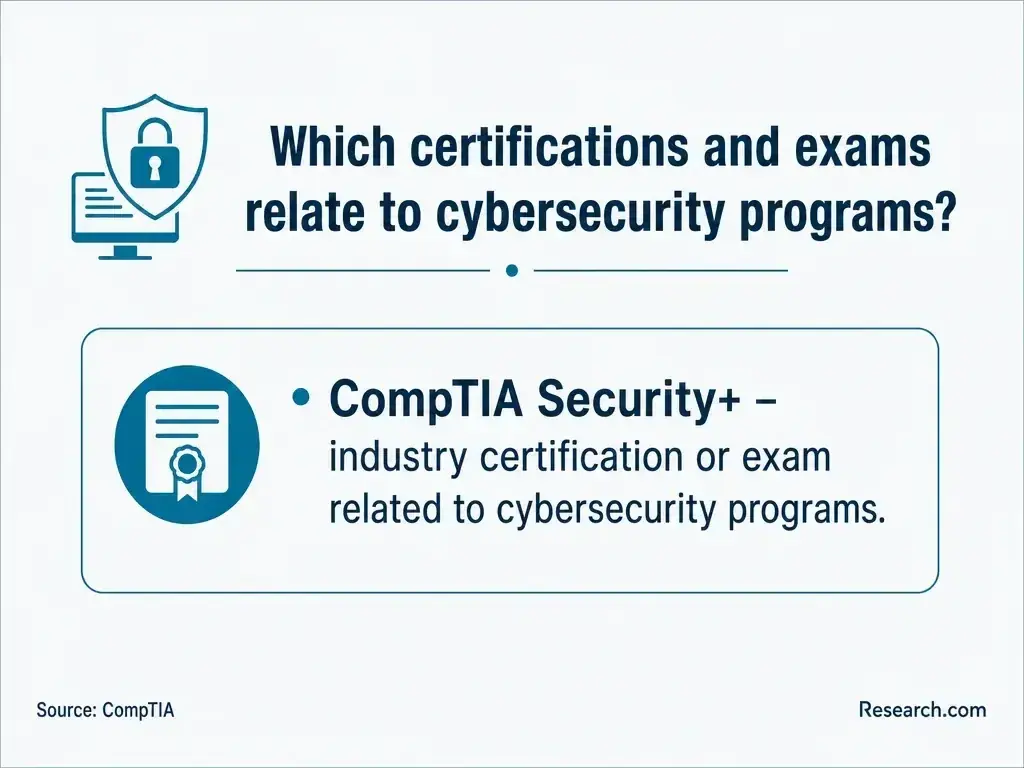
Ask to see a syllabus or sample lab project for the advanced courses. Look for instruction in both prevention and troubleshooting, plus ethical and legal boundaries for security testing. If a program advertises preparation for a professional certification, check its current course-to-exam mapping with the certifying organization; a degree does not automatically award certification.
At the associate level, specialization may mean a few electives rather than a separately awarded degree. A networking emphasis can suit students seeking support or infrastructure roles; system administration and cloud-focused coursework can help with identity and configuration work; digital forensics or security-operations coursework may appeal to students interested in investigations or alert triage. Availability varies by college (institutional program catalogs).
Choose a focus by examining the required labs and local entry-level postings, not the concentration's label. A narrow elective track is less valuable if it displaces foundational networking or operating-system skills that employers expect. Ask whether the relevant courses run regularly enough for you to finish on schedule.
Start with your intended first job and the amount you can afford to spend. Then compare the programs that meet both conditions, rather than assuming the lowest-ranked price or most familiar name settles the decision.
- Confirm the exact degree awarded and whether its required courses support your employment goal or documented transfer plan.
- Verify institutional accreditation with a U.S. Department of Education-recognized accreditor and ask separately about state authorization, credit transfer, and any claimed industry recognition.
- Review lab access, instructor feedback, internship arrangements, and the frequency of advanced-course offerings.
- Request a personalized estimate covering residency-based tuition, fees, equipment, travel, aid, and the time you expect to spend enrolled.
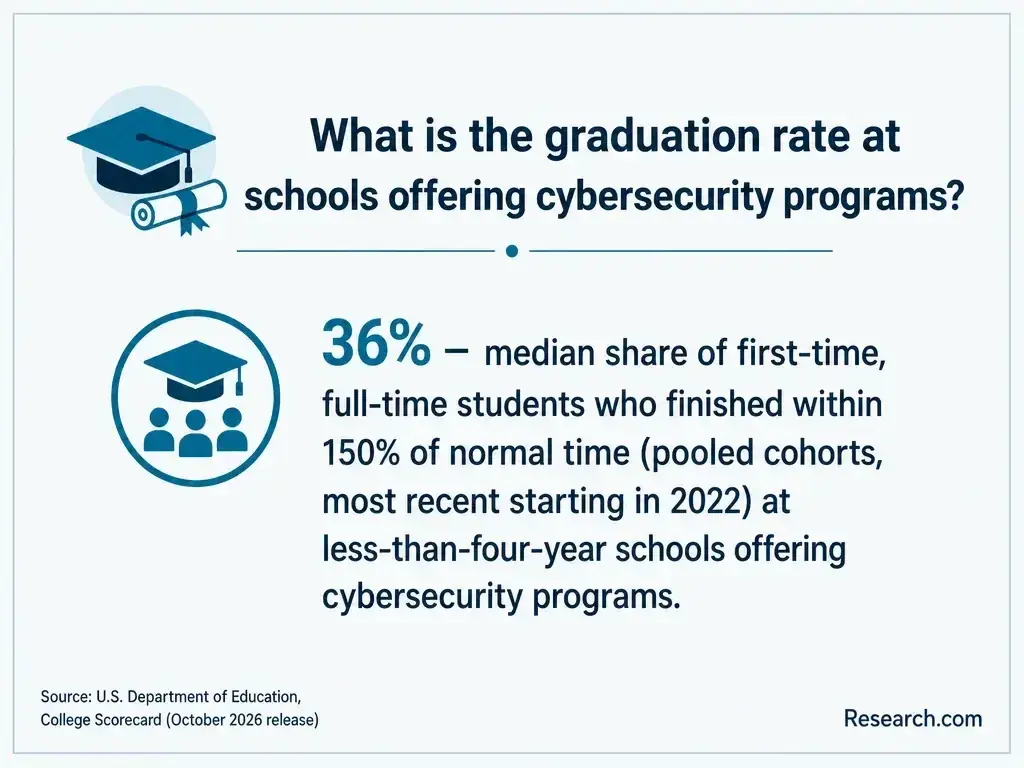
- Ask for program-level completion and career-support information where available; note when a school can provide only institution-wide figures.
A common mistake is to treat accreditation as proof that credits will transfer or that an employer will hire you. Those are separate decisions. Likewise, an affordability ranking is a screening tool, not a substitute for verifying hands-on preparation and your likely cost to finish.
Possible first steps include IT support, network support, systems administration support, and security operations support, depending on the student's skills and the employer's requirements. With experience, some workers move toward dedicated security analysis, incident response, or infrastructure security. Professional certifications can help demonstrate particular skills, but their value and prerequisites vary by role and employer (U.S. Bureau of Labor Statistics, Occupational Outlook Handbook; official certifying organizations).
An associate degree can also preserve a route to further study if its credits transfer as intended. Students whose long-term goal requires more advanced education should confirm that pathway early; resources on a fast bachelors degree online may help frame later options, but do not establish that a particular associate degree's credits will be accepted. Similarly, information about a highest earning master's degree should not be used to estimate the return from this associate degree. The immediate decision is whether this program offers a viable first step at an acceptable cost.
National demand is strong for the established analyst occupation: the U.S. Bureau of Labor Statistics projects 21% employment growth for information security analysts from 2025 to 2035. This does not mean that Pennsylvania has the same growth rate, or that all projected roles are open to applicants with an associate degree and no experience.
For a local reality check, search recent vacancies within your commuting range and separate genuinely entry-level support roles from analyst jobs requiring prior security work. Compare the tools, schedules, and education requirements in those postings with each program's labs and employer connections. Pennsylvania students who need to remain in a smaller labor market should pay particular attention to whether the degree builds broadly usable networking and systems skills, not just a specialized job title.
Most Affordable Cybersecurity Associate Degree Programs in Pennsylvania for 2027
Investing in an education is an important decision, so Research.com's team uses reported education data and a consistent scoring method to help readers compare programs with relevant local options. Only programs with completions reported to IPEDS are eligible; a program's absence from the ranking does not establish that it is unavailable or poor quality.
Most affordable rankings score costs and debt only: tuition, cost of attendance, median student debt, and federal loan default rate. An entropy-based method gives more weight to indicators that vary more across programs. Unlike Research.com's separate best-program rankings, this affordability score does not include accreditation or other quality measures. Students should therefore check academic fit and outcomes independently. Readers can find further details on the Research.com methodology page.
The ranking draws on the following data sources. Some are relevant to Research.com rankings across occupations rather than cybersecurity specifically; their inclusion should not be read as a cybersecurity-program endorsement.
- IPEDS database - institutional reporting, including completions and cost measures.
- National Center for Education Statistics - federal education data and definitions.
- College Scorecard database - institutional costs, debt, and outcomes where available.
- Peterson's database - supplementary college information.
- Commission on Accreditation of Allied Health Education Programs - occupation-specific accreditation information where applicable.
- Accrediting Bureau of Health Education Schools - occupation-specific accreditation information where applicable.
- Commission on Dental Accreditation - occupation-specific accreditation information where applicable.
- Dental Assisting National Board - occupation-specific recognition information where applicable.
- National Center for Construction Education and Research - occupation-specific industry recognition where applicable.
- Apprenticeship.gov Partner Finder - apprenticeship-provider information where applicable.
Use the ranking to narrow the field, then request a current, program-specific cost estimate and degree plan. College-wide averages may not capture a cybersecurity program's software, exam, or scheduling costs.









# 11 position



Frequently asked questions about cybersecurity programs in Pennsylvania
Is an affordable cybersecurity associate degree worth it?
It can be if the program teaches usable technical skills, fits your job or transfer goal, and leaves you with manageable total costs. Compare expected time to completion, aid, debt, and realistic first-job options - not tuition alone.
Will an associate degree get me a cybersecurity analyst job?
Possibly, but do not plan on that outcome automatically. Many analyst positions seek additional experience or education. Support and networking roles may offer a more realistic first step (U.S. Bureau of Labor Statistics, Occupational Outlook Handbook).
Do I need a Pennsylvania cybersecurity license?
Pennsylvania does not have a general occupational license for cybersecurity analysts. Employer requirements and voluntary professional certifications are separate from institutional accreditation and the award of a degree.
Is an online associate degree cheaper than an on-campus one?
Not necessarily. Compare your residency-based tuition and fees with technology, travel, and any required in-person activities. Online delivery may save commuting time without reducing the college's charges.
Which is better for me: an AAS or an AS?
Choose based on the courses and your next step. An AAS often prioritizes applied technical work; an AS may be a better starting point for a planned transfer. Obtain a written transfer evaluation rather than relying on the degree label.
- U.S. Bureau of Labor Statistics - Information Security Analysts
Used to verify salary, employment outlook, and typical education requirements.
https://www.bls.gov/ooh/computer-and-information-technology/information-security-analysts.htm - NCES College Navigator (IPEDS)
Used to verify programs offered and institutional accreditation.
https://nces.ed.gov/collegenavigator/ - CompTIA Security+
Professional certification reference for graduates of this occupation.
https://www.comptia.org/certifications/security - Butler County Community College - official website
Official school website (programs, tuition, admissions).
https://www.bc3.edu/ - Bucks County Community College - official website
Official school website (programs, tuition, admissions).
https://www.bucks.edu/ - Westmoreland County Community College - official website
Official school website (programs, tuition, admissions).
https://westmoreland.edu/ - Community College of Allegheny County - official website
Official school website (programs, tuition, admissions).
https://www.ccac.edu/ - Lehigh Carbon Community College - official website
Official school website (programs, tuition, admissions).
https://www.lccc.edu/