Most Affordable Cybersecurity Associate Degree Programs in Massachusetts for 2027
Audited and Verified:
Our Editorial and Data Verification Process
Research.com uses government datasets, official education statistics and primary institutional information to support its career and degree guides. Our review process checks factual accuracy, occupational definitions, source dates and the requirements associated with the credentials discussed.
How This Article Was Fact-Checked
Our editorial team verifies salary estimates, employment projections, education requirements and program information against original data providers and official organizations. Salary figures are checked against the relevant occupational definitions and reporting periods. Information about licensure, accreditation and required in-person training is reviewed separately.
Fact-checked and verified on:

Co-Founder and Chief Data Scientist

Reviewed by Karolina Broda
Fact-Checker and Data Verification
A low-priced cybersecurity associate degree can become expensive if its fees, schedule, or coursework do not fit your goal. The decision matters: the U.S. Bureau of Labor Statistics projects 21% national growth for information security analysts from 2025 to 2035, although that role typically requires more than an associate degree. This guide helps Massachusetts students compare costs, practical experience, transfer options, and realistic first jobs. It also accompanies the Most Affordable Cybersecurity Associate Degree Programs in Massachusetts for 2027 ranking, created by the Research.com team of data scientists to help students make an informed choice about programs worth considering.
Key findings about associate cybersecurity degrees in Massachusetts
- Massachusetts community college aid can substantially change the price a resident pays; compare each college's full cost after confirmed aid, not its listed tuition alone (Massachusetts Department of Higher Education).
- Cybersecurity associate degrees commonly combine networking, systems, security, and general education. Confirm the awarded degree and credit-transfer terms before treating two similarly named programs as interchangeable.
- The national median for information security analysts was $129,180 in May 2025, but that occupation generally requires more experience or education than a new associate degree graduate has (U.S. Bureau of Labor Statistics). Compare programs against attainable first IT roles, not that median.
Table of Contents
- Most Affordable Cybersecurity Associate Degree Programs in Massachusetts for 2027
- What can I expect from an associate cybersecurity degree in Massachusetts?
- Where can I work with an associate cybersecurity degree in Massachusetts?
What can I expect from an associate cybersecurity degree in Massachusetts?
Expect an associate degree that builds the IT foundation beneath security work: operating systems, networks, scripting, and the protection of accounts and data. Security is rarely an entry-level job in isolation. A program is a stronger fit when its labs let you configure systems, troubleshoot failures, document findings, and explain risk - not merely recognize security terminology.
The degree label matters most when you have a specific next step. These are useful distinctions, but the college's catalog and transfer agreement determine what actually applies:
| Degree pathway | Typical emphasis | Best fit | Check before enrolling |
| Associate of Science (AS) or Associate of Arts (AA) | General education alongside technical study; may emphasize transfer | Students who want to preserve further-study options | Whether the intended courses transfer and satisfy the receiving program's requirements |
| Associate of Applied Science (AAS) or other career-focused associate degree | More occupational coursework and labs | Students prioritizing near-term IT employment | Whether credits transfer as major requirements, electives, or not at all |
Program names alone cannot establish this distinction: compare course maps. For broader context on selecting a best college degree for your goals, weigh the cybersecurity curriculum against the work you actually want to do.
Where can I work with an associate cybersecurity degree in Massachusetts?
Massachusetts students can look for IT and security-related work with healthcare organizations, colleges, financial firms, technology employers, and government contractors. The employer matters because its systems and hiring rules shape the job: a hospital may emphasize access controls and protected information, while a contractor may require a background investigation or clearance eligibility. Neither an associate degree nor residence in the state confers a clearance.
For a first position, search beyond "cybersecurity analyst." Help desk, desktop support, network support, and junior systems roles can provide the troubleshooting and access-management experience employers seek for later security work. Ask a college whether its employer contacts and work-based opportunities are reachable from your campus or home; a Boston-area placement may be impractical for a student relying on a western Massachusetts commute.
There is no single salary attached to the degree. The U.S. Bureau of Labor Statistics reports a $129,180 national median annual wage in May 2025 for information security analysts. That is an occupation-wide median, not Massachusetts starting pay or an expected outcome for associate degree graduates; BLS says these analysts typically need substantial preparation, often including related work experience.
For budgeting, compare pay in the specific first job you could obtain with each program's skills, then consider what additional experience a security role may require. Request program-specific graduate outcomes when available, including job titles, reporting period, response rate, and whether wages represent full-time workers. Do not treat a schoolwide earnings figure as a cybersecurity graduate salary.
Many associate degree plans are designed around two academic years of full-time study and approximately 60 credits, but the catalog - not the degree title - sets the actual requirement. Developmental coursework, course sequencing, and limited lab sections can extend the calendar. Part-time study may make employment easier to maintain while delaying completion and the point at which you can use the full degree.
Ask for a term-by-term plan that includes prerequisites and when required security courses run. A faster schedule is valuable only if you can complete the labs and afford the earnings you give up by reducing work hours.
Online delivery can reduce commuting for lectures, reading, and some virtual-machine labs. On-campus study may offer easier access to networking equipment, supervised troubleshooting, classmates, and employer events. A hybrid program can combine the two, but "online" does not tell you whether exams, equipment labs, or an internship require attendance at a particular site.
Before committing, request the schedule for every required course and ask whether remote students receive the same lab software, technical support, and placement assistance. Check the institution's recognized accreditation and the degree's current availability separately; a list of non profit regionally accredited online colleges is a starting point for examining institutions, not proof that a particular cybersecurity associate degree is offered or transferable. Cybersecurity work does not have a general Massachusetts occupational license that an online format must satisfy.
No single statewide "average program price" will reliably describe what a particular student pays. Published tuition can exclude mandatory fees, and residency, enrollment intensity, aid eligibility, and living arrangements change the total. Get a written, current-year estimate from each college rather than multiplying a posted per-credit rate by the degree's credits.
For a useful comparison, place these costs beside the aid you can actually receive:
- Tuition and required college, course, and technology fees for every term
- Books, software, a suitable computer, and any lab or certification-exam charges
- Transportation, internet, living expenses, and earnings forgone while studying
- Grants, scholarships, and confirmed employer assistance, shown separately from loans
Massachusetts residency can materially affect public-college charges and state aid. Compare the total cost to finish, including an extra term if required courses are not offered when you need them; the cheapest advertised tuition may not produce the lowest final bill.
Start with the Free Application for Federal Student Aid (FAFSA). Depending on eligibility and enrollment, federal grants, work-study, and loans may be available; grants generally do not need repayment, while loans do (Federal Student Aid). Massachusetts also offers community college assistance through initiatives including MassEducate and MassReconnect. Eligibility and covered costs depend on current state rules, residency, and the student's circumstances (Massachusetts Department of Higher Education).
Request an aid estimate from each college and ask whether it covers mandatory fees, books, and later terms - not just the first semester. If you work, ask your employer about tuition assistance and reimbursement timing. Compare net cost and likely borrowing before deciding that a more expensive-looking program is unaffordable. Longer-term planning resources, including those on easiest masters degrees, should not distract from the immediate question: whether this associate degree's aid package makes completion feasible.
Admissions and course placement are separate questions. A college may admit you to study while requiring placement steps or prerequisite math, English, or computing coursework before certain classes. Check its current catalog for high school completion or equivalent documentation, application deadlines, placement procedures, and any prior-course requirements.
Cybersecurity beginners do not necessarily need programming experience, but comfort working through technical problems helps. If you have prior college credit or documented work experience, ask for an official evaluation before choosing a schedule. Confirm whether accepted credit fulfills required courses or merely adds electives; the difference affects time and cost.
Course titles vary, but a credible plan should connect general education and technical foundations to practical security tasks. Common subjects include writing and quantitative reasoning, networking, operating systems, scripting, system administration, information assurance, and security policy. The National Institute of Standards and Technology's NICE Framework describes cybersecurity work in terms of knowledge and skills; it can help you assess whether coursework matches a target role without implying that any one course qualifies you for it.
Look beyond the course list for evidence of assessed practice: configuring a network, managing permissions, analyzing logs, documenting an incident, or explaining a finding to a nontechnical audience. Ask how many required courses include labs, whether the equipment is current, and whether an internship or employer project is available. Do not assume every program requires an internship.
At the associate level, a "specialization" may be a course cluster rather than a distinct degree. Network defense suits students who enjoy infrastructure and troubleshooting; digital forensics emphasizes careful evidence handling; and systems or cloud security emphasizes configuration, identity, and monitoring. Compare the actual required courses and labs before paying more for an appealing label.
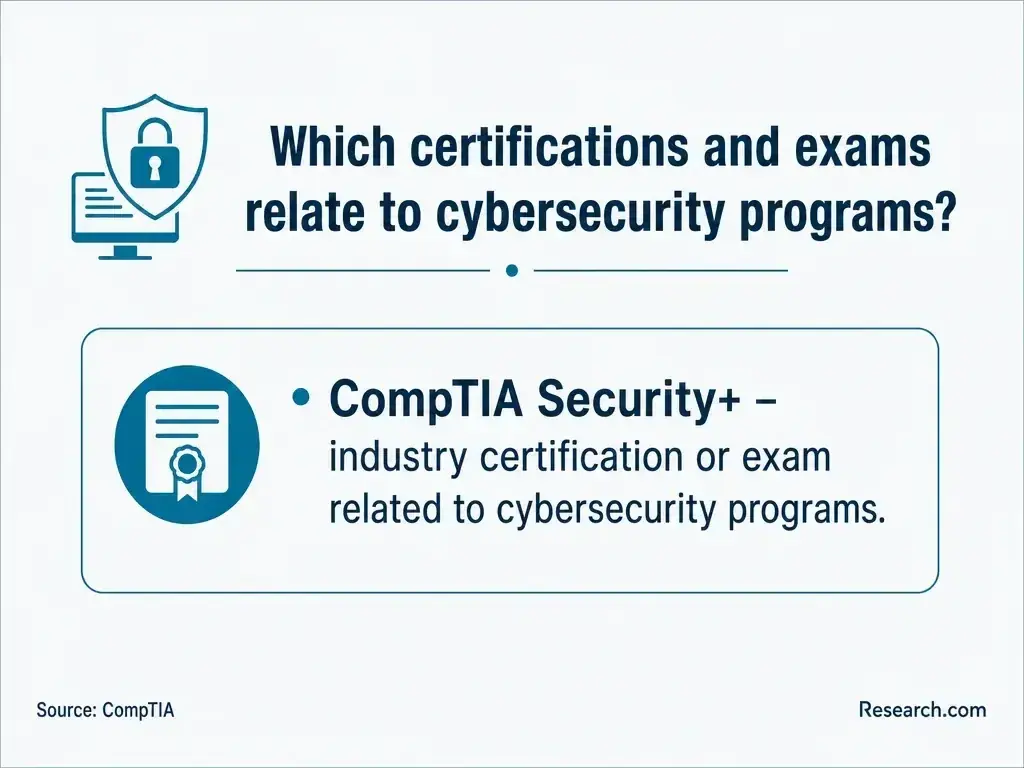
Some courses may help students prepare for optional industry certification exams, but preparation is not a promise of passing and an exam fee may be separate. When evaluating licenses and certifications that pay well, check the certifying organization's current exam objectives and any experience expectations. There is no general Massachusetts cybersecurity occupational license required simply to enter the field.
Begin with your intended first job or further-study destination, then compare colleges against that goal. Massachusetts Bay Community College, North Shore Community College, Springfield Technical Community College, Northern Essex Community College, and Holyoke Community College are schools to investigate; confirm each school's current cybersecurity-related associate degree, location, format, and catalog rather than assuming identical offerings.
Use the same questions for every school so that a low ranking price does not conceal a poor fit:
- What exact degree is awarded, which courses are required, and when do the needed labs run?
- What is my estimated full-program cost after confirmed aid, including fees, equipment, travel, and possible extra terms?
- Is the institution accredited by a U.S. Department of Education-recognized accreditor, and what written transfer agreements apply to this degree?
- Which practical projects, internships, or employer connections are accessible to students in my format and location?
- What verified graduate job titles and completion outcomes can the college share, and for what reporting period?
Institutional accreditation, transfer agreements, and certification preparation answer different questions; none substitutes for the others. For return on investment, consider program duration, completion likelihood, aid, debt, wages you already earn, plausible post-degree earnings, and when those earnings might arrive - not institutional type or an analyst salary alone.
An associate degree may support entry into IT support, network support, or junior systems work, with security responsibilities expanding as experience grows. An internship, demonstrable lab projects, and clear written documentation can help show employers what you can do. Direct entry into a dedicated information security analyst role is possible in some circumstances but should not be the assumed first outcome; BLS describes related experience as a common expectation for analysts.
Choose a program with transferable credits if further study is part of your plan, and verify how its courses will be accepted before enrolling. If your main goal is immediate employment, prioritize accessible labs and local employer connections. Resources on highest roi masters degrees concern a much later decision and should not be used to justify the cost of an associate degree today.
National demand for experienced security workers is strong: BLS projects information security analyst employment to grow 21% from 2025 to 2035. That projection describes an occupation across the United States, not openings reserved for new Massachusetts associate degree graduates. It is a reason to build a durable IT foundation, not evidence that every cybersecurity degree leads directly to an analyst job.
Local opportunities differ by commute area and employer requirements. Search current postings for attainable first roles, record their requested operating systems, networking skills, schedules, and experience, and compare those requirements with each college's labs. Be cautious about postings that bundle extensive experience or clearance requirements into an "entry-level" label. Career planning may eventually extend beyond an associate degree - resources such as easiest masters degrees can address other stages - but your immediate comparison should be between programs that prepare you for jobs you can realistically pursue.
Most Affordable Cybersecurity Associate Degree Programs in Massachusetts for 2027
Investing in education is a consequential decision. Research.com created this ranking to help readers compare affordable programs against other relevant options, using reported data rather than advertised tuition alone. The team reviews source coverage and program information for credibility and accuracy; readers should still confirm current prices and requirements with each college.
For most affordable rankings, the score uses tuition, cost of attendance, median student debt, and federal loan default rate. Indicator weights are assigned through an entropy-based method, which gives more weight to measures that vary more across programs. Accreditation, student support, and other quality measures are not part of this affordability score. Only programs with completions reported to IPEDS are included; absence from the ranking does not establish that another program is unavailable or poor quality.
The ranking draws on the following data sources. Several cover other occupations in Research.com's broader ranking work and should not be mistaken for cybersecurity-specific approval bodies:
- IPEDS database
- National Center for Education Statistics
- College Scorecard database
- Peterson's database
- Commission on Accreditation of Allied Health Education Programs (CAAHEP)
- Accrediting Bureau of Health Education Schools (ABHES)
- Commission on Dental Accreditation (CODA)
- Dental Assisting National Board (DANB)
- National Center for Construction Education and Research (NCCER)
- Apprenticeship.gov Partner Finder
Use the ranking to narrow a shortlist, then compare the degree requirements, actual aid offer, lab access, and employment or transfer fit yourself. More detail about the ranking approach is available on the Research.com methodology page.






Frequently asked questions about cybersecurity programs in Massachusetts
What is the cheapest cybersecurity associate degree in Massachusetts?
The cheapest option depends on your residency, fees, aid, and time to completion. Compare written full-program estimates from schools where you meet the eligibility rules; a ranking price is a shortlist tool, not your personal net price.
Can I become a cybersecurity analyst with only an associate degree?
Some employers may consider applicants with relevant skills and experience, but an associate degree alone should not be treated as sufficient for every analyst opening. Related IT work is a realistic route into security responsibilities (U.S. Bureau of Labor Statistics).
Are Massachusetts community college cybersecurity associate degrees free?
Eligible students may receive state assistance toward community college costs, but coverage depends on current program rules and individual eligibility. Confirm fees, books, living costs, and your award with the college (Massachusetts Department of Higher Education).
Does an online associate degree require campus visits?
It depends on the program. Ask specifically about required labs, exams, and internships before enrolling; an online course listing does not establish that every degree requirement is remote.
Is an AS or an AAS better for cybersecurity?
Neither is automatically better. Compare the AS's transfer terms with the AAS's occupational coursework and labs, then choose the degree whose required courses support your next step.
- U.S. Bureau of Labor Statistics - Information Security Analysts
Used to verify salary, employment outlook, and typical education requirements.
https://www.bls.gov/ooh/computer-and-information-technology/information-security-analysts.htm - NCES College Navigator (IPEDS)
Used to verify programs offered and institutional accreditation.
https://nces.ed.gov/collegenavigator/ - CompTIA Security+
Professional certification reference for graduates of this occupation.
https://www.comptia.org/certifications/security - Massachusetts Bay Community College - official website
Official school website (programs, tuition, admissions).
https://www.massbay.edu/ - North Shore Community College - official website
Official school website (programs, tuition, admissions).
https://www.northshore.edu/ - Springfield Technical Community College - official website
Official school website (programs, tuition, admissions).
https://www.stcc.edu/ - Northern Essex Community College - official website
Official school website (programs, tuition, admissions).
https://www.necc.mass.edu/ - Holyoke Community College - official website
Official school website (programs, tuition, admissions).
https://www.hcc.edu/