Most Affordable Cybersecurity Associate Degree Programs in Maryland for 2027
Audited and Verified:
Our Editorial and Data Verification Process
Research.com uses government datasets, official education statistics and primary institutional information to support its career and degree guides. Our review process checks factual accuracy, occupational definitions, source dates and the requirements associated with the credentials discussed.
How This Article Was Fact-Checked
Our editorial team verifies salary estimates, employment projections, education requirements and program information against original data providers and official organizations. Salary figures are checked against the relevant occupational definitions and reporting periods. Information about licensure, accreditation and required in-person training is reviewed separately.
Fact-checked and verified on:

Co-Founder and Chief Data Scientist

Reviewed by Karolina Broda
Fact-Checker and Data Verification
Choosing an affordable cybersecurity associate degree means comparing more than tuition: the degree must also build usable skills and fit your career goal. The U.S. Bureau of Labor Statistics projects 21% national growth for information security analysts from 2025 to 2035, but those jobs are not automatic entry-level outcomes. The Research.com team of data scientists created its Most Affordable Cybersecurity Associate Degree Programs in Maryland for 2027 ranking to help students make an informed choice about programs worth considering. This guide explains costs, coursework, career prospects, and the checks to make before enrolling.
Key findings about associate cybersecurity degrees in Maryland
- Affordability depends on your residency rate, mandatory fees, aid, and completion time - not the published tuition alone. Maryland community colleges may distinguish in-county, out-of-county, and out-of-state students.
- A career-focused Associate of Applied Science generally emphasizes job-ready technical coursework; an Associate of Science or Associate of Arts may better fit a student prioritizing transferable general education. Confirm the actual curriculum and credit agreements.
- Information security analysts had a $129,180 U.S. median annual wage in May 2025, with 21% projected national employment growth for 2025-2035 (U.S. Bureau of Labor Statistics). Neither figure represents a likely starting wage or guarantees an analyst job to an associate-degree graduate.
Table of Contents
- Most Affordable Cybersecurity Associate Degree Programs in Maryland for 2027
- What can I expect from an associate cybersecurity degree in Maryland?
- Where can I work with an associate cybersecurity degree in Maryland?
What can I expect from an associate cybersecurity degree in Maryland?
Expect a combination of general education, computer networking, operating systems, and security-focused coursework. A credible program should let you practice configuring systems, reviewing logs, identifying vulnerabilities, documenting findings, and responding to simulated incidents - not just memorize security terms. Ask whether labs use isolated virtual environments, campus equipment, or supervised work experience, and which are required for graduation.
The degree title matters less than its requirements. The comparison below shows how common associate-degree types may serve different goals; individual Maryland colleges can organize their curricula differently.
| Degree pathway | Typical emphasis | Best fit and check to make |
| Associate of Applied Science (AAS) | Career-focused technical courses and applied labs | Fits students seeking an IT or security operations role soon after graduation; check how many credits remain usable if you later transfer. |
| Associate of Science (AS) | Technical foundation alongside transferable math and general education | Fits students who want both technical preparation and a defined transfer route; verify course-by-course applicability. |
| Associate of Arts (AA) | Broader general education with available computing electives | May fit a transfer-first plan, but check whether it includes enough networking and security labs for the jobs you want. |
Colleges such as College of Southern Maryland, Garrett College, Hagerstown Community College, Carroll Community College, and Harford Community College are useful Maryland starting points for comparing current associate-degree offerings. Do not assume each offers the same cybersecurity degree, format, or lab sequence in 2027; consult its current catalog.
Where can I work with an associate cybersecurity degree in Maryland?
Maryland's federal agencies, defense-related employers, healthcare organizations, local governments, and commercial IT teams all need secure systems. Proximity to the Fort Meade area may broaden the employers a student can investigate, but some federal and contractor positions have citizenship, clearance, or experience conditions beyond a degree. Students elsewhere in the state should weigh commute distance against the availability of local IT support and network roles.
An associate degree can be a practical entry point to a help desk, systems support, or network support team where security tasks are part of the job. Dedicated security analyst positions often demand demonstrated experience; an internship, documented lab projects, or prior IT work can make an application more credible. Ask a program which local employers host its students and whether those placements involve actual security work.
There is no single salary for this degree. The U.S. Bureau of Labor Statistics reports a $129,180 national median annual wage for information security analysts in May 2025. That is the midpoint for employed analysts across experience levels and education backgrounds - not a Maryland wage or an expected first salary for an associate-degree graduate.
For a realistic earnings comparison, search current Maryland postings for the specific support, network, or security roles you qualify for now. Note required experience, clearance conditions, shifts, and location before comparing posted pay with your current earnings. A higher-paying analyst role can be a longer-term goal, but it should not be the sole figure used to justify borrowing for an entry-level degree.
Full-time associate-degree study is commonly planned around two academic years; the actual time depends on required credits, course sequencing, placement, and whether you attend year-round. Cybersecurity courses may have networking or operating-system prerequisites, so missing one course can delay later labs even if general education classes are available.
Part-time study can preserve earnings but extend the period in which you pay fees and wait for the degree. An accelerated schedule can shorten that period only if required technical courses and labs are offered when you need them. If you are considering a fast track associate's degree online, ask for a term-by-term cybersecurity course map rather than relying on an advertised completion time.
Online delivery can remove a commute for lectures, writing assignments, and some virtual-machine labs. Campus study may provide easier access to physical networking equipment, supervised troubleshooting, and classmates working through the same problems. Hybrid programs combine these approaches, but "online" alone does not tell you whether exams, labs, or an internship require attendance.
Format changes the practical costs as well as the schedule. The comparison below helps identify what to verify before treating two programs as equivalent.
| Format | Potential advantage | Question that affects the decision |
| Online | Less routine travel; flexible access to course materials | Are labs fully remote, and what computer, software, and scheduled attendance are required? |
| On campus | Direct access to equipment and supervised practice | When are required labs held, and what will commuting cost? |
| Hybrid | Fewer campus trips while retaining in-person practice | How often must you attend, and can you reach any required worksite? |
Working adults comparing most affordable online universities for working students should apply the same test to a cybersecurity associate degree: confirm its exact lab schedule and total price, not just its delivery label. Online coursework does not by itself establish transferability or readiness for a professional certification exam.
A defensible statewide average cannot be inferred from a few advertised tuition rates. Your likely cost depends heavily on where you live and which rate the college assigns you. Maryland community colleges may publish different in-county, out-of-county, and out-of-state rates; confirm your classification and whether it can change before multiplying a per-credit price by the degree requirements.
Compare each college's written estimate using the same cost categories. This makes a lower-tuition program less likely to surprise you with expenses that affect completion.
| Cost category | What to include in an associate-degree estimate |
| College charges | Tuition at your residency rate and mandatory, technology, and course-specific fees |
| Learning materials | Books, software access, a suitable computer, and any lab supplies |
| Career preparation | Optional certification exam fees and travel to an internship or employer site |
| Time and living costs | Transportation, living expenses, and earnings you may give up to attend |
| Offsets and borrowing | Grants, scholarships, employer assistance, and the amount you would need to borrow |
The cheapest program on paper is not necessarily the least costly to complete. A delayed required course can add living costs or postpone a move into better-paid work, while an accessible schedule may reduce both risks.
Students at eligible colleges may qualify for federal grants, work-study, or loans after submitting the Free Application for Federal Student Aid (FAFSA); eligibility depends on federal rules and individual circumstances (Federal Student Aid). Maryland's Community College Promise Scholarship may help eligible community-college students with remaining tuition costs, subject to current state rules, funding, and application requirements (Maryland Higher Education Commission). College scholarships and employer tuition assistance can further change your net price.
Ask each financial aid office for an estimate covering the entire planned degree, including part-time terms if applicable. Separate grants from loans, check renewal conditions and deadlines, and ask which fees or materials remain unpaid. If you are comparing accredited online colleges free to apply for, remember that an application-fee saving says little about the full cost of attending.
Start with the college's current admission and placement policies. Admission to a college does not necessarily mean immediate access to every cybersecurity course: math, writing, computing, or networking placement and course prerequisites can affect your first-term schedule. Ask whether prior coursework, eligible examinations, or documented experience can satisfy requirements, and obtain a written evaluation before assuming credits will count.
No Maryland occupational license is generally required simply to work in cybersecurity. Institutional accreditation, state authorization, an employer's hiring conditions, and a professional certification are separate matters; none automatically substitutes for another. Where a job calls for clearance or a particular certification, check that employer's requirements rather than assuming degree admission or graduation meets them.
A useful cybersecurity associate-degree curriculum usually builds from networking and computer systems into security controls and investigation. Look for general education in communication and quantitative reasoning alongside technical work in operating systems, scripting, network administration, access control, security fundamentals, and incident response. The precise course names and sequence belong to each college's catalog.
Ask to see what students actually do in the labs: configure a network, harden a system, inspect traffic, interpret logs, and explain a finding in writing. Those tasks connect coursework to support and security operations more directly than a long list of topics alone. Students browsing online courses for jobs that pay well should still check whether the associate degree provides the supervised practice and general education they want; a short course is not the same degree outcome.
At the associate level, specialization is often a cluster of electives or labs rather than a separately awarded degree. Network defense suits students who enjoy configuring and monitoring infrastructure; digital forensics emphasizes preserving and examining evidence; cloud security focuses on protecting hosted systems and identities. Availability varies by college, so confirm which electives run regularly and whether they fit within the published graduation plan.
Choose breadth first if you have not yet worked in IT. Strong networking, operating-system, and scripting skills remain useful across security roles. A narrower elective path makes more sense when you already know the work you want and can verify that the college offers relevant hands-on projects.
Define the outcome first: an initial IT role, a move into security from existing IT work, or further study through a documented transfer route. Then compare each program against that goal rather than letting its ranking position decide for you. Unrelated results - including cheap phd listings - do not answer whether a cybersecurity associate degree meets your immediate needs.
Before accepting an offer, request answers to these checks from each college. They expose differences that an affordability score cannot measure.
- Confirm the exact degree awarded, required courses and credits, prerequisite sequence, and a schedule you can complete.
- Verify institutional accreditation through the U.S. Department of Education or the recognized accreditor, and ask the college to explain any claimed cybersecurity-specific recognition; recognition is not a job guarantee.
- Request written details on required labs, remote access, internships, and employer connections, including any travel obligations.
- If further study matters, obtain the applicable transfer agreement or course-by-course guidance; do not assume every AAS, AS, or AA credit will apply.
- Compare written total-cost and aid estimates, then test whether likely earnings, debt, completion risk, lost wages, and the time needed to benefit make the investment reasonable for you.
A red flag is a promise of an analyst salary or immediate security employment without evidence about graduate roles. Another is an "online" label with no clear explanation of labs. Ask for specifics in writing before committing.
Graduates can pursue IT support, network support, and junior systems roles, then compete for security-focused work as their practical experience grows. Someone already employed in IT may be better positioned to move directly into monitoring, access administration, or incident-response support than someone entering the field for the first time. Employers decide what experience and skills each position requires.
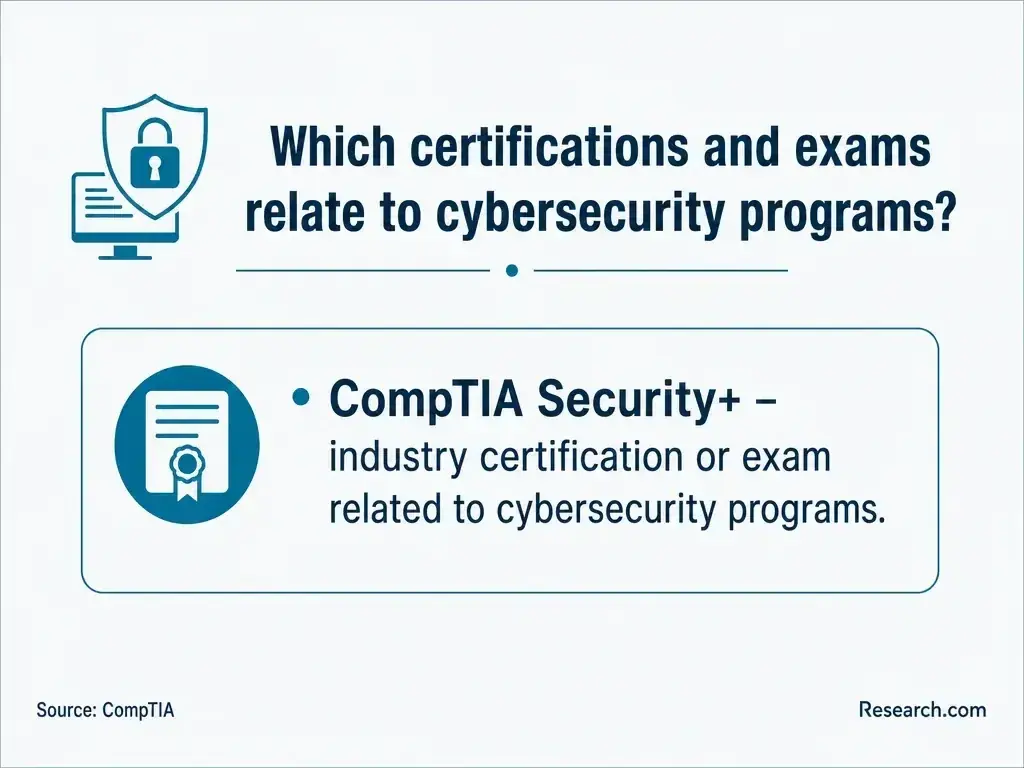
Optional professional certifications can help demonstrate particular skills, but an associate degree does not automatically award them or qualify a student for every exam. Ask whether exam costs are included and whether the coursework matches the current objectives of any certification you intend to pursue. For a transfer goal, use the college's documented agreements rather than assuming that a career-focused degree will transfer in full.
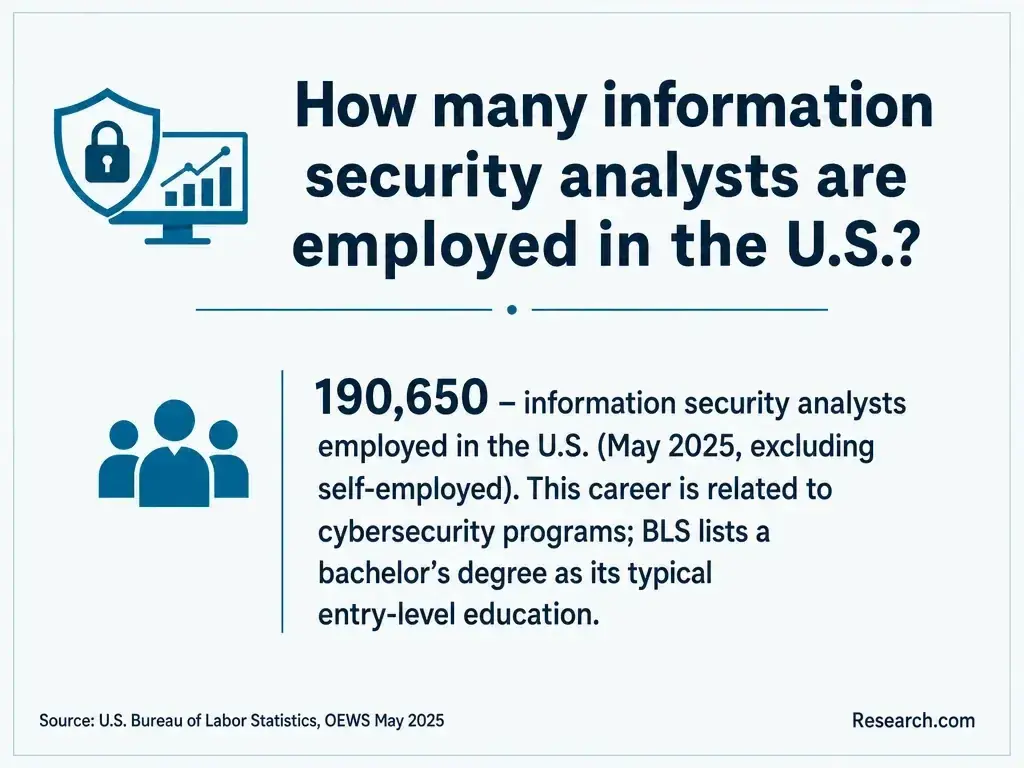
The U.S. Bureau of Labor Statistics projects 21% growth in information security analyst employment nationally from 2025 to 2035. That indicates a growing occupation, not the number of Maryland openings available to new associate-degree graduates. Analyst postings can require substantial experience, while support roles may offer a more accessible way to build it.
Maryland students should compare job listings in the places they can realistically work. The Fort Meade-area market may include positions with clearance-related conditions; local government, healthcare, and business IT jobs may have different requirements. Read several postings for each target role, note repeated skills and experience requirements, and use those findings to judge whether a program's labs and employer connections justify its net cost.
Most Affordable Cybersecurity Associate Degree Programs in Maryland for 2027
Investing in an associate degree is a consequential decision, especially when a low advertised tuition rate may not reflect fees, borrowing, or the time needed to finish. Research.com evaluates programs against other programs in the same occupation and location; only programs with completions reported to the Integrated Postsecondary Education Data System (IPEDS) are eligible for the ranking. The team reviews data for credibility and comparability so readers can use the results as a starting point, not a substitute for checking current program details.
This is an affordability ranking, not an overall quality ranking. Its score uses tuition, cost of attendance, median student debt, and federal loan default rate. Weights are assigned through an entropy-based method, which gives more weight to measures that vary more across eligible programs. Accreditation, student support, and other quality indicators do not enter the affordability score. Research.com's separate best-program rankings evaluate outcomes, earnings and return on investment, costs and debt, and quality and recognition.
The ranking draws on the following databases and reference organizations. Some serve broader Research.com program evaluations rather than supplying a cybersecurity-specific accreditation measure; their inclusion should not be read as an endorsement of any cybersecurity program.
- IPEDS database - program completions and institutional data.
- National Center for Education Statistics - federal education data and definitions.
- College Scorecard database - available college cost, debt, and outcome measures.
- Peterson's database - supplementary institution and program information.
- Commission on Accreditation of Allied Health Education Programs (CAAHEP) - accreditation reference for applicable health programs, not a cybersecurity accreditor.
- Accrediting Bureau of Health Education Schools (ABHES) - accreditation reference for applicable health programs, not a cybersecurity accreditor.
- Commission on Dental Accreditation (CODA) - accreditation reference for applicable dental programs, not a cybersecurity accreditor.
- Dental Assisting National Board (DANB) - certification reference for applicable dental programs, not a cybersecurity certifier.
- National Center for Construction Education and Research (NCCER) - industry-recognition reference for applicable construction programs.
- Apprenticeship.gov Partner Finder - reference for apprenticeship options where applicable.
Use the ranking to identify programs for closer comparison, then confirm the current degree requirements and your own net price with each college. More detail about Research.com's approach appears on its methodology page.

# 2 position





# 9 position

# 11 position


Frequently asked questions about cybersecurity programs in Maryland
Is an affordable cybersecurity associate degree worth it?
It can be if its labs, schedule, net cost, and likely first job fit your goals. Compare what you would borrow and give up in earnings with realistic entry-level roles, not an experienced analyst's median wage.
Which associate degree type should I choose?
Consider an AAS for a career-focused technical route and an AS or AA when a documented transfer plan is central. Check actual course requirements: degree labels alone do not establish job readiness or transferable credit.
Can I complete the degree entirely online?
Possibly, but delivery varies by program. Confirm whether labs, exams, internships, or other required activities involve scheduled attendance or travel before enrolling.
Will the degree qualify me for a security analyst job?
Not automatically. Employers may require prior IT experience, specific skills, certifications, or clearance eligibility. Ask colleges about graduates' first roles and the practical experience built into the degree.
What should I verify before paying a deposit?
Confirm the degree plan, institutional accreditation, residency-based tuition and fees, aid estimate, lab requirements, and any transfer agreement you intend to use. Get answers for your intended enrollment year in writing.
- U.S. Bureau of Labor Statistics - Information Security Analysts
Used to verify salary, employment outlook, and typical education requirements.
https://www.bls.gov/ooh/computer-and-information-technology/information-security-analysts.htm - NCES College Navigator (IPEDS)
Used to verify programs offered and institutional accreditation.
https://nces.ed.gov/collegenavigator/ - CompTIA Security+
Professional certification reference for graduates of this occupation.
https://www.comptia.org/certifications/security - College of Southern Maryland - official website
Official school website (programs, tuition, admissions).
https://www.csmd.edu/ - Garrett College - official website
Official school website (programs, tuition, admissions).
https://www.garrettcollege.edu/index.php - Hagerstown Community College - official website
Official school website (programs, tuition, admissions).
https://www.hagerstowncc.edu/ - Carroll Community College - official website
Official school website (programs, tuition, admissions).
https://www.carrollcc.edu/ - Harford Community College - official website
Official school website (programs, tuition, admissions).
https://www.harford.edu/