Most Affordable Cybersecurity Associate Degree Programs in Texas for 2027
Audited and Verified:
Our Editorial and Data Verification Process
Research.com uses government datasets, official education statistics and primary institutional
information to support its career and degree guides. Our review process checks factual accuracy,
occupational definitions, source dates and the requirements associated with the credentials
discussed.
How This Article Was Fact-Checked
Our editorial team verifies salary estimates, employment projections, education requirements and
program information against original data providers and official organizations. Salary figures are
checked against the relevant occupational definitions and reporting periods. Information about
licensure, accreditation and required in-person training is reviewed separately.
The cheapest advertised tuition is not always the cheapest path into cybersecurity. Fees, commuting, time away from work, and whether a degree teaches usable security skills can change the calculation. The U.S. Bureau of Labor Statistics projects 21.0% growth for information security analysts nationwide from 2025 to 2035, but that occupation is not typically an immediate destination for new graduates. For students and working adults, the Research.com team of data scientists created a Most Affordable Cybersecurity Associate Degree Programs in Texas for 2027 ranking to help identify programs worth considering. This guide explains how to compare their costs, coursework, and career fit.
Key findings about associate cybersecurity degrees in Texas
Compare the full cost to complete, not tuition alone: district residency, mandatory fees, software, transportation, and time away from work can change which Texas program is least expensive for you.
A career-focused AAS usually offers a more direct route to technical coursework; an AA or AS may suit students prioritizing transferable coursework. Confirm the actual course sequence and credit-transfer terms before choosing.
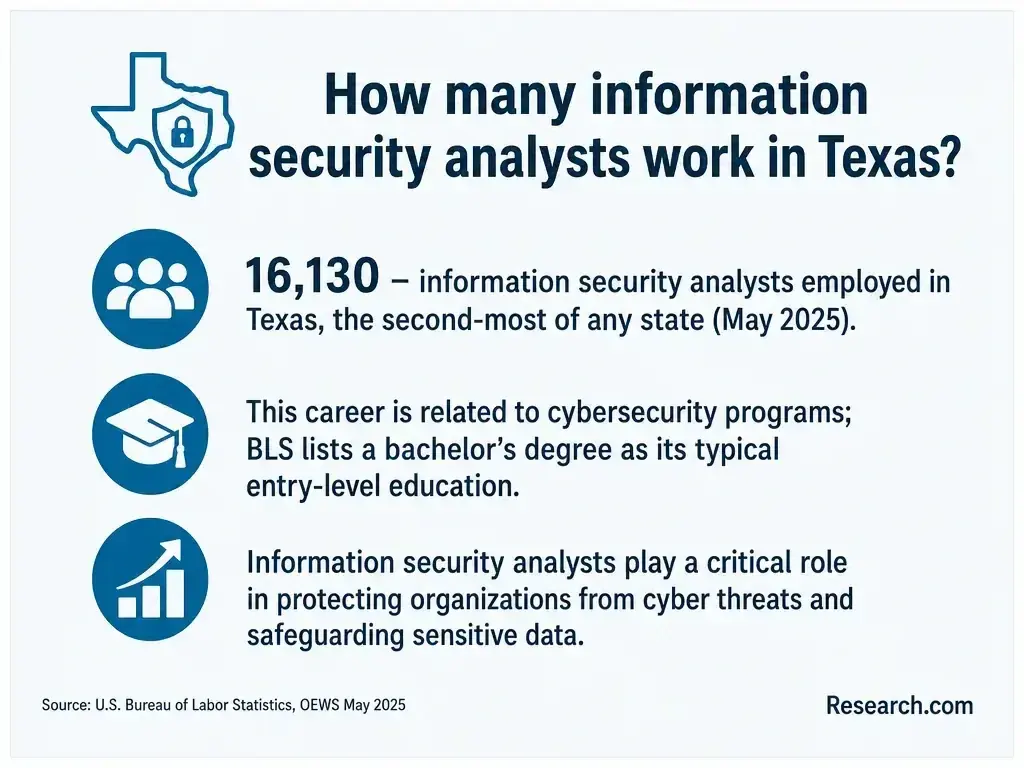
Cybersecurity is a promising field, but the national information security analyst median of $129,180 in May 2025 describes an occupation, not expected pay for a new associate-degree graduate (U.S. Bureau of Labor Statistics).
What can I expect from an associate cybersecurity degree in Texas?
Expect a combination of computing fundamentals and security practice: networking, operating systems, system administration, defensive monitoring, and troubleshooting. A strong program gives students access to supervised virtual or physical labs where they can configure systems, examine logs, and document findings - not just watch demonstrations. Ask how many courses include assessed lab work and whether an internship or employer project is available.
The letters on the degree matter. This comparison helps distinguish a direct technical route from a route built around transferable coursework; the exact curriculum depends on the college.
Associate degree
Usual emphasis
Best fit to investigate
Associate of Applied Science (AAS)
Occupational courses and practical IT skills
Students seeking technical work soon after completion
Associate of Science (AS)
Science, mathematics, and transferable coursework
Students prioritizing continued academic study while building computing fundamentals
Associate of Arts (AA)
Broad general education and transferable coursework
Students whose intended next institution confirms that the chosen computing courses will transfer
An AAS is not automatically nontransferable, and an AS is not automatically a cybersecurity degree. Under Texas Higher Education Coordinating Board rules, the Texas Core Curriculum supports transfer of completed core courses between public institutions; that does not mean every cybersecurity elective will satisfy another institution's major requirements. Obtain a written course-by-course evaluation if further study is central to your plan.
Where can I work with an associate cybersecurity degree in Texas?
Potential workplaces include managed IT providers, healthcare organizations, local governments, manufacturers, financial institutions, and energy-related businesses. In many of these settings, an associate-degree holder's first job may combine security tasks with user support, network operations, or systems administration. That can be useful experience, but it is different from being hired directly as an information security analyst (U.S. Bureau of Labor Statistics, Occupational Outlook Handbook).
Location affects the search. A student near the Gulf Coast might investigate IT operations supporting industrial or healthcare employers, while someone able to commute to a larger metro area may see a wider range of specialized teams. Before choosing a campus, search actual entry-level postings within a realistic commute and note the tools, experience, and work schedules employers request. Ask the college whether its lab projects and employer connections match those postings.
There is no reliable single salary for "cybersecurity associate-degree graduates." The U.S. Bureau of Labor Statistics reports a $129,180 national median annual wage for information security analysts in May 2025. That figure covers workers across experience and education levels; it is not a Texas starting salary or a forecast of what this degree will pay.
Use the occupation only as a possible longer-term benchmark. For an immediate earnings estimate, compare local postings for help desk, network support, junior systems, and security operations roles that accept your experience level. A program's value depends on what you would otherwise earn, whether you can study while working, your aid and debt, the likelihood of completing, and how earnings might change over time - not on the analyst median alone.
Full-time students often plan for about two academic years. Texas associate degrees commonly require around 60 semester credit hours, although the approved plan and any exceptions should be checked with the college (Texas Higher Education Coordinating Board). Part-time attendance, course prerequisites, and courses offered only in certain terms can extend the calendar time.
If speed matters, compare the next available course sequence, not just an advertised completion time. Taking more classes at once may shorten the schedule but leave less time for labs, paid work, or an internship. The same trade-off applies when considering fast track degrees online: verify that the pace still permits the hands-on practice your intended role requires.
Online delivery can reduce commuting, especially for students outside major college service areas. Lectures, discussions, and some virtual networking or security labs may be completed remotely. On-campus study may make it easier to use dedicated equipment, get immediate troubleshooting help, and meet local employers. Hybrid programs can offer both, but an internship, supervised assessment, or particular lab may still require attendance at a set place and time.
When comparing a campus program with a most affordable online associate's degree option, request the cybersecurity course schedule and lab-access rules. Check whether required software runs on your computer, whether exams need a testing site, and whether remote students can access the same career services. Online delivery alone says nothing about institutional accreditation, course transfer, or readiness for a particular job.
A single statewide "average" would be a poor budget for an individual student: public colleges may charge different in-district, out-of-district, and nonresident rates, while course fees and living arrangements also vary. Ask each college for a current estimate covering every term needed to finish, not only its published annual tuition. Do not treat a 2027 price as final until the college publishes the rates for your enrollment period.
Build the estimate from tuition and mandatory fees; books, software, a computer capable of running labs, and any required materials; possible certification exam costs; transportation; and living expenses. Add lost earnings if your schedule limits work. Then subtract grants, scholarships, and employer assistance for which you are actually eligible. Comparing that net completion cost alongside time to finish and likely borrowing is more informative than comparing sticker tuition.
Eligible students may use federal aid, including Pell Grants and federal loans, at participating institutions after submitting the Free Application for Federal Student Aid (FAFSA). Texas aid may include the Texas Educational Opportunity Grant for eligible students at public community or technical colleges; eligibility and funding depend on current state rules and availability (Federal Student Aid; Texas Higher Education Coordinating Board). College scholarships, employer tuition assistance, and eligible workforce funding may further reduce what a student pays.
Before assuming that schools with low tuition programs that accept financial aid will be cheapest for you, compare your actual aid offers. Ask the financial aid office whether your specific degree, enrollment intensity, and repeated courses qualify, and check satisfactory academic progress rules. Borrow only after estimating the remaining cost to complete, not merely the first term.
Colleges set their own admission and course-placement requirements. Applicants should expect to provide prior school records and complete the institution's application; placement, prerequisite math or computing courses, and any assessment requirements depend on the college and the student's record. Prior IT experience can help with the material but should not be assumed to waive a required course.
Ask an adviser to map your first term before paying a deposit: which networking or programming courses have prerequisites, when are they offered, and will prior coursework count toward this exact associate degree? Returning students considering programs for seniors online should ask the same questions, along with whether technical support and lab access are available outside regular business hours.
A cybersecurity course sequence generally builds from computer hardware and operating systems to networking, system administration, and security concepts. Depending on the degree plan, later courses may address scripting, access control, network defense, incident response, and digital forensics. General education coursework is also part of an associate degree, though its share differs between an AAS and a transfer-oriented AA or AS.
Look past course titles. A "network security" class that has students configure access rules, investigate traffic, and write an incident report develops different evidence of skill from one assessed mainly through quizzes. Request syllabi or lab descriptions, and ask whether students leave with projects they can discuss in an interview without exposing sensitive systems or data.
At the associate level, a specialization may be a small cluster of electives rather than a separate degree. Common emphases to look for in a published plan include network defense, systems administration, digital forensics, and cloud or infrastructure security. Choose by comparing the courses with local entry-level job descriptions: a network-focused plan may be more useful for an operations role than a forensics elective that rarely appears in nearby postings.
Some coursework may help students prepare for optional industry exams, but an associate degree does not automatically award a professional certification, and exam fees may be separate. If you are comparing certifications that pay the most, check the certifying organization's current exam objectives and experience recommendations rather than treating a potential salary as a degree outcome. Cybersecurity employment generally does not require a Texas occupational license; an employer may still impose its own requirements.
Start with the job and schedule you want, then test each program against them. Texas Southmost College, College of the Mainland, Alvin Community College, Brazosport College, and Laredo College are among the institutions a Texas student might investigate; confirm each school's current cybersecurity associate-degree availability, delivery format, and residency-based price directly rather than assuming similarly named offerings are equivalent.
Use the following checks to turn an affordability ranking into an enrollment decision:
Verify the institution's accreditation with the recognized accreditor or U.S. Department of Education, and confirm the exact degree awarded and current course plan with the college.
Request a full-program cost estimate for your residency category, including mandatory fees, technology, commuting, and any required lab or exam costs.
Ask which courses use assessed hands-on labs, whether employer projects or internships are available, and whether working students can access them.
If you plan further study, obtain a written evaluation of how both general education and cybersecurity courses will transfer; do not assume the degree title settles the question.
Compare the likely time to finish, available aid, borrowing, and employment options with your current earnings and responsibilities.
A common mistake is selecting the lowest tuition without checking course availability: an extra term or a long lab commute can erase the apparent saving. Another is treating accreditation as proof of job placement or certification eligibility. It establishes a different kind of assurance; investigate outcomes and employer requirements separately.
An associate degree can support applications for IT support, network support, junior systems administration, or security operations roles, depending on the student's projects and prior experience. None is guaranteed by the degree title. In particular, information security analyst work often calls for experience securing and administering systems, so an initial IT role can be a deliberate step toward it (U.S. Bureau of Labor Statistics, Occupational Outlook Handbook).
Choose coursework for the first plausible role, not only the eventual title. Someone with an IT background might use security labs to move toward monitoring or incident-response work; a newcomer may benefit more from a plan with substantial networking and troubleshooting. Keep records of completed projects and ask employers how they evaluate hands-on experience. Further academic study is another possible outcome, provided the receiving institution accepts the relevant credits.
The U.S. Bureau of Labor Statistics projects 21.0% national employment growth for information security analysts from 2025 to 2035. That signals demand for the occupation, not a Texas-specific forecast or an estimate of openings reserved for associate-degree holders. Entry-level competition and experience requirements can make a direct move into an analyst position difficult even in a growing field.
For a local test of opportunity, compare current postings in the areas where you could actually work. Separate roles that accept foundational networking and support skills from those requiring substantial security experience. Then ask each college for recent, clearly defined placement information and employer connections. A program with accessible labs and relevant local contacts may be the better investment even if another has a lower advertised tuition rate.
Most Affordable Cybersecurity Associate Degree Programs in Texas for 2027
Investing in an associate degree is a consequential decision. Research.com's most-affordable ranking is designed to help readers compare programs against other options in the same occupation and location, rather than against unrelated schools. Only programs with completions reported to IPEDS are included. That coverage rule does not establish that an unlisted program is unavailable or unsuitable.
For this ranking, the Research.com team evaluates tuition, cost of attendance, median student debt, and federal loan default rates. Weights are assigned using an entropy-based method, under which indicators that vary more across programs receive more weight. Unlike a best-programs ranking, the affordability score does not include accreditation, student support, or other quality indicators. Readers should verify those separately before enrolling.
The following databases and organizations are among the data sources used to create the ranking. Some occupation-specific organizations in this broader source set do not evaluate cybersecurity programs; their inclusion should not be read as cybersecurity approval.
IPEDS database - institutional reporting, including program completions.
The ranking can narrow an affordability search, but it cannot determine whether a particular student will complete a program or get a job. Readers can learn more about the approach on the Research.com methodology page.
# 1 position
Texas Southmost College
associate
Computer and Information Systems Security/Auditing/Information Assurance
Delivery mode: On Campus (May Include Online Courses)
Institutional accreditation from Southern Association of Colleges and Schools Commission on Colleges.
Texas Southmost College earned a Research.com Affordability Score of 97.31/100, supported by $3,298 annual in-state tuition and $5,500 median student debt.
Frequently asked questions about cybersecurity programs in Texas
What is the cheapest cybersecurity associate degree in Texas?
There is no universally cheapest choice. Your district residency, fees, aid, commuting costs, and time to completion determine your actual cost. Compare written full-program estimates using the same assumptions.
Is an AAS or AS better for cybersecurity?
An AAS is generally the more career-focused option; an AS generally emphasizes transferable coursework. Compare the actual security labs and obtain a written transfer evaluation if continued study matters to you.
Can I complete a cybersecurity associate degree entirely online?
That depends on the college's course, lab, exam, and work-based learning requirements. Ask which activities require attendance and whether remote students have equivalent access to equipment and support.
Will this degree qualify me for a cybersecurity job?
It can help you compete for suitable entry-level IT and security-related roles, but it does not guarantee employment. Match the program's practical work to local postings and account for experience requirements.
Do I need a Texas license to work in cybersecurity?
Cybersecurity jobs generally do not require a Texas occupational license. Employers may require particular skills, background screening, or professional certifications; check the roles you intend to pursue.