# 1 position


Audited and Verified:
Our Editorial and Data Verification Process
Research.com uses government datasets, official education statistics and primary institutional information to support its career and degree guides. Our review process checks factual accuracy, occupational definitions, source dates and the requirements associated with the credentials discussed.
How This Article Was Fact-Checked
Our editorial team verifies salary estimates, employment projections, education requirements and program information against original data providers and official organizations. Salary figures are checked against the relevant occupational definitions and reporting periods. Information about licensure, accreditation and required in-person training is reviewed separately.
Fact-checked and verified on:

Co-Founder and Chief Data Scientist

Reviewed by Karolina Broda
Fact-Checker and Data Verification
Choosing a cybersecurity associate degree in Dallas means deciding whether a program will build employable technical skills without costing more time or money than your goal requires. The U.S. Bureau of Labor Statistics projects 21.0% national growth for information security analysts from 2025 to 2035, but that advanced role is not a typical first job. The Research.com team of data scientists created its Best Cybersecurity Associate Degree Programs in Dallas for 2027 ranking to help students identify programs worth considering. This guide explains how to compare those options, costs, practical experience, and career paths.
Expect a combination of general education and applied computing: networking, operating systems, scripting, security principles, and troubleshooting. A career-focused AAS generally emphasizes technical practice; an AS or AA may devote more space to broadly transferable coursework. Names alone do not establish what a student can do on graduation. Compare the required course sequence, not just the program description.
Effective hands-on instruction lets students configure systems, analyze logs, identify vulnerabilities in authorized lab environments, and document an incident response. Ask whether labs use current virtual environments, whether projects produce work you can show an employer, and whether an internship is available or required. Dallas College is one local institution to investigate; confirm the current award, campus availability, and course requirements in its catalog. If considering Peloton College, first verify that the specific cybersecurity associate degree you want is offered and eligible for your intended use.
Dallas-area employers across finance, healthcare, retail, telecommunications, and business services operate networks and handle sensitive information. That creates relevant workplaces, but it does not mean every security vacancy accepts an associate degree. Look for openings in IT support, network operations, access administration, and security operations that explicitly accept your education and experience.
For an applicant without prior IT work, a support or network role can be a practical first step toward security duties. For a working technician, an associate degree with strong security labs may help demonstrate a broader skill set. Compare actual Dallas-area job descriptions with program coursework: if employers repeatedly request skills the degree does not teach, ask how students acquire them before accepting a place.
There is no single wage for "cybersecurity associate degree graduate." Pay depends on the job, prior IT experience, employer, and responsibilities. The U.S. Bureau of Labor Statistics reports a $129,180 national median annual wage for information security analysts in May 2025. It covers workers across experience and education levels; using it as a Dallas graduate's starting-pay estimate would overstate what the data establishes.
For a useful local estimate, search Dallas-Fort Worth postings for the entry-level roles you could realistically qualify for, record their stated pay ranges, and distinguish those from analyst postings requiring prior experience. If a school presents graduate earnings, ask for the occupation, graduation cohort, measurement date, number of graduates represented, and whether the figure covers this degree specifically.
An associate degree commonly takes about two years of full-time study, but the applicable catalog - not a general estimate - sets the required credits and course sequence. Part-time attendance, prerequisites, course availability, and transfer credit can change the calendar substantially. Security courses may build on networking and operating systems, so missing an early course can delay later labs.
Ask for a term-by-term plan that fits your work schedule and shows when each required class runs. An accelerated schedule may reduce time away from full-time earnings, but it can also compress the lab practice needed for technical interviews. Working adults comparing the quickest online degrees for working adults should check whether the advertised pace applies to the entire cybersecurity associate degree, including any scheduled assessments or practical work.
Online delivery can make lectures, readings, discussions, and some virtual labs easier to fit around Dallas-area work and commuting. Campus study may offer scheduled access to equipment, instructors, and peers. Neither format is automatically more rigorous; the decisive question is whether you can complete and receive feedback on the same technical competencies.
This comparison separates convenience from requirements. Obtain the program's actual schedule before assuming that "online" means no campus visits.
| Consideration | Online or hybrid associate degree | On-campus associate degree |
| Technical practice | May use remote virtual labs; confirm access hours, software needs, and any in-person assessments. | May provide scheduled physical or virtual labs; confirm equipment access outside class. |
| Time and travel | Can reduce routine commuting, but scheduled labs or internships may still require travel. | Requires regular travel, which can affect work hours and total cost. |
| Best fit | Students who can work independently and have reliable technology. | Students who benefit from structured lab time and face-to-face troubleshooting. |
Admission flexibility and course delivery are separate questions. A school appearing among the best online colleges with open admissions policy still may have course prerequisites or limited seats in its associate degree. Check both before planning a start date.
A defensible Dallas average requires comparable, current prices for the specific associate degrees under consideration; a single tuition figure cannot provide one. Dallas College's applicable in-district, out-of-district, or other published rate may materially change your estimate, so verify your classification rather than assuming that a Dallas mailing address qualifies you for the lowest rate. Request a degree-wide estimate from each school, including terms in which fees or course loads differ.
The total should include tuition and mandatory fees; textbooks, software, a suitable computer, and internet access; any optional certification exam you plan to take; transportation for labs or an internship; living expenses; and earnings you might forgo by reducing work hours. Subtract grants, scholarships, and employer tuition assistance only when eligibility and award amounts are confirmed. Searches for cheap online masters degrees answer a different cost question; for this decision, compare associate-degree net costs and the jobs each program could realistically help you pursue.
Eligible students may be able to use federal grants, federal student loans, state aid, institutional scholarships, or employer tuition assistance. Availability depends on the student, institution, and degree; admission alone does not establish aid eligibility. Federal Student Aid advises students to complete the Free Application for Federal Student Aid (FAFSA) to be considered for federal aid. Ask each financial aid office which associate-degree courses count toward your eligible enrollment.
Compare net cost and likely borrowing, not just the largest advertised scholarship. If you are reviewing low tuition universities online that accept financial aid, confirm that the relevant cybersecurity associate degree is offered, that its institution participates in the applicable aid programs, and that aid covers the terms you intend to attend. An employer benefit may lower debt but require continued employment or a minimum grade.
Schools set their own admission and placement rules. Expect to provide prior education records and complete any required application, placement, or advising steps. An introductory course may welcome computing beginners, while later networking, scripting, or security courses can have prerequisites. Ask whether placement results add coursework before you can enter the published degree sequence.
Applicants with prior college credit should request a written evaluation showing which credits satisfy this degree, not merely which credits the institution accepts. Working IT professionals should also ask whether documented prior learning can fulfill a requirement and whether that credit remains useful if they later transfer. Neither admission nor prior IT experience guarantees a shorter completion time.
Most cybersecurity associate-degree comparisons should start with the technical foundation: computer systems, networking, operating systems, basic scripting, and security concepts. More applied study may address access controls, system hardening, threat analysis, incident documentation, and legal or ethical boundaries. General education requirements also matter because they affect total credits and, potentially, transfer.
Look beyond course titles. A "network security" class with repeated configuration and troubleshooting labs provides different preparation from one assessed mainly through reading. Ask to see recent syllabi, the software students use, and a description of the final project. If a program advertises preparation for a professional certification, compare its assessed topics with the certifying organization's current exam objectives; the degree itself does not award certification.
At the associate level, specialization often means a set of electives or applied projects rather than a separately awarded degree. Options to look for include network defense, security operations, cloud-system security, and digital forensics. Confirm that the interest area appears in required or reliably available courses; a catalog elective that rarely runs may not fit your graduation plan.
Network defense suits students interested in configuring and protecting infrastructure. Security operations emphasizes monitoring, triage, and clear incident notes. Forensics may appeal to students who like preserving and examining evidence, but a single elective does not establish eligibility for a specialized investigation job. Choose a strong systems-and-networking foundation first, then use electives to test a direction.
The best choice is the degree you can finish at a manageable net cost that teaches the skills required for your next step. A ranking can narrow the search, but a high position cannot tell you whether a particular lab schedule works with your job or whether your credits will meet a receiving institution's requirements.
Use the following checks with each school so that similar-sounding associate degrees become comparable decisions:
Red flags include vague claims that every graduate becomes an analyst, an "online" label without an explanation of practical assessments, or a price that omits required fees. Cybersecurity work in Texas does not depend on a general occupational cybersecurity license; professional certifications are separate, typically optional employer preferences. Confirm any claim that a degree prepares you for a particular certification with the certifying organization's current requirements.
The most realistic first role depends heavily on prior experience. A newcomer may start in help desk support, desktop support, or network operations and move toward access management or security monitoring. Someone already working in IT may be positioned to seek security-focused responsibilities sooner. An information security analyst role can be a later target, but the associate degree alone should not be treated as an analyst-job guarantee.
Students comparing hands-on occupations through best trade school careers should note a distinctive feature of cybersecurity: employers can assess troubleshooting, documentation, and systems experience alongside the degree. Save authorized lab projects, practice explaining what you changed and why, and pursue optional certification only when it matches the vacancies you want. Continued study may be another goal; check transfer agreements before choosing a career-focused degree on that basis.
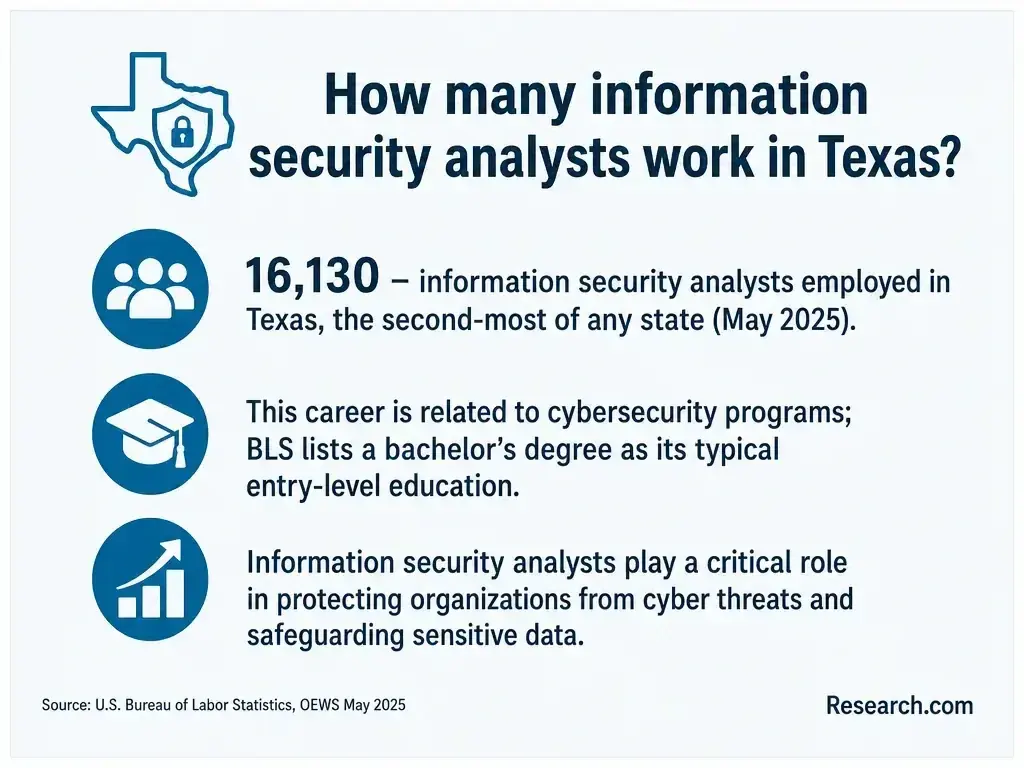
The national outlook is strong for the occupation most closely associated with the field: the U.S. Bureau of Labor Statistics projects 21.0% growth for information security analysts from 2025 to 2035. That projection is national, covers an occupation rather than associate-degree graduates, and does not establish the number of entry-level openings in Dallas. It supports planning for a long-term security career, not assuming immediate access to an analyst position.
Dallas-area applicants should assess demand at the job-title level. Compare current support, network, and security-operations postings for required experience, shift schedules, tools, and on-site expectations. Automation and AI-enabled security tools may change individual tasks, making the ability to investigate alerts, check results, and communicate findings especially useful. Favor a degree whose labs teach durable systems fundamentals rather than only how to operate one vendor's interface.
Investing in an associate degree is a consequential decision, so the Research.com team designed the ranking to compare programs against other reported options in the same occupation and location. Only programs with completions reported to the Integrated Postsecondary Education Data System (IPEDS) are included. This makes the ranking a useful shortlist, not a complete inventory of every possible pathway or a substitute for checking a current college catalog.
For best-program rankings, the team evaluates student outcomes; earnings and return on investment; costs and debt; and quality and recognition. Relevant programmatic accreditation or industry recognition receives 20% of the score, institutional accreditation 10%, and student support services 10%. Completion, full- and part-time retention, earnings one year after completion, earnings relative to annual attendance cost, tuition, attendance cost, median debt - including debt held by students who withdrew - and federal loan default rates share the remaining 60%. An entropy-based method gives more weight to indicators that vary more across programs. Most-affordable rankings instead score only tuition, attendance cost, median debt, and default rates using entropy-based weights; they do not include accreditation or other quality measures.
The ranking draws on the following data sources. Some support Research.com's broader program-ranking framework rather than cybersecurity-specific accreditation; their inclusion does not imply that a health or dental accreditor evaluates a cybersecurity degree.
Research.com checks these measures to make comparisons more credible, but reported earnings or debt may describe an institution rather than a particular cybersecurity associate degree. Readers should use the ranking to identify questions for each school, then verify current degree requirements, pricing, and outcomes directly. More detail is available on Research.com's methodology page.
# 1 position
# 2 position

It can be if its net cost and schedule are manageable, its labs build skills relevant to jobs you can pursue, and you understand that a first role may be in IT support or networking. Compare likely first-job opportunities with your current earnings and borrowing needs.
An AAS usually fits a near-term technical employment goal; an AS or AA may fit a transfer-focused plan. Verify the actual courses and written transfer arrangements, because degree titles alone do not establish either outcome.
That depends on the specific program. Ask which labs, assessments, and any internship must be completed at a scheduled site, and what computer and internet access remote labs require.
There is no general Texas occupational cybersecurity license for typical IT security roles. A particular employer may request a professional certification, background screening, or other job-specific qualifications; graduation does not automatically provide them.
Not necessarily. Analyst postings often seek relevant technical experience. Review local requirements and consider whether the degree offers a credible route through support, networking, or security-operations work.
Confirm the exact associate degree, current accreditation and authorization, required credits, lab format, complete price, aid eligibility, course availability, and any promised transfer arrangement in writing.