Choosing a counseling degree in Kansas means choosing a career path before choosing a school: clinical practice, school counseling, and addiction counseling lead to different credentials. The 2027 Best Counseling Degree Programs Ranking in Kansas, created by the Research.com team of data scientists, helps students identify programs worth considering. This guide explains how to compare those options, including licensure fit, training format, costs, and career prospects, so prospective students and working professionals can judge which degree is a sound investment for their goals.
Key findings about Counseling degrees in Kansas
Match the degree to the credential first: Kansas clinical counseling licensure and school counselor certification follow different state processes (Kansas Behavioral Sciences Regulatory Board; Kansas State Department of Education).
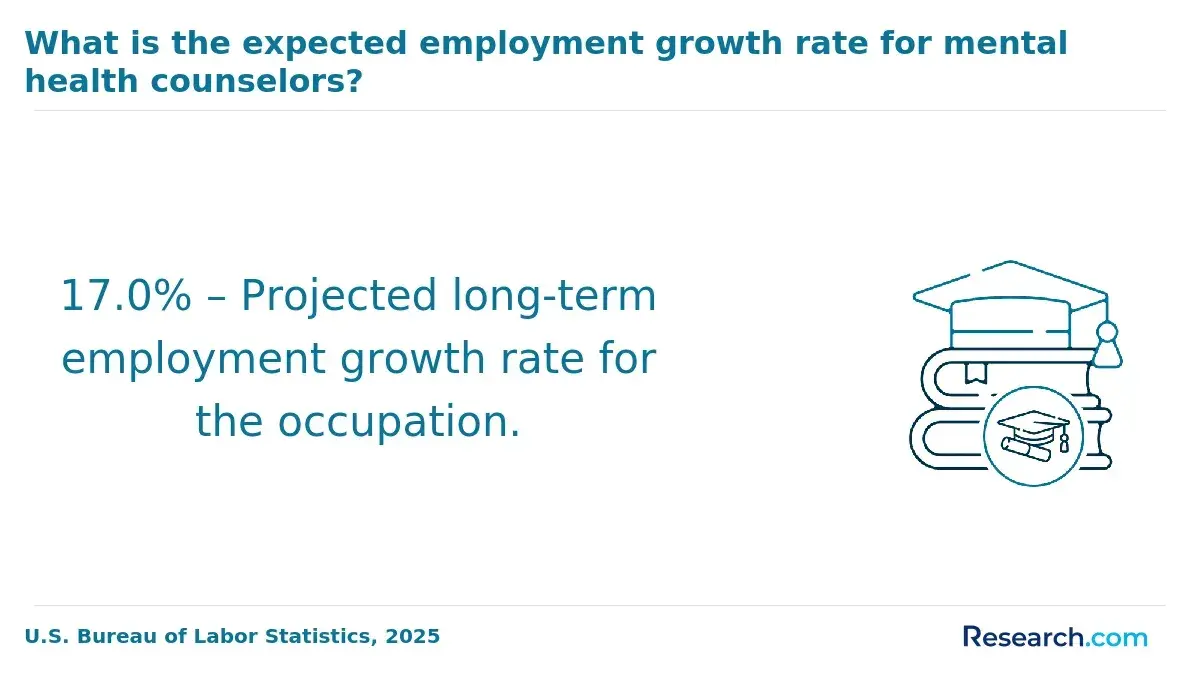
The national median annual wage for substance abuse, behavioral disorder, and mental health counselors was $59,350 in May 2025; that occupation's projected employment growth is 18% for 2025-2035, not a guarantee of local earnings or openings (U.S. Bureau of Labor Statistics).
A counseling master's commonly takes about 2-3 years of full-time study. Compare total tuition, required fieldwork, and the income you may forgo - not the advertised per-credit price alone.
What can I expect from a Counseling degree in Kansas?
A counseling degree trains students to assess client needs, build a therapeutic relationship, apply ethical and culturally responsive practices, and work under supervision. The appropriate degree depends on the work you want to do. A bachelor's degree can support entry into human services or preparation for graduate study, but it is not interchangeable with the graduate education required for independent clinical counseling licensure in Kansas (Kansas Behavioral Sciences Regulatory Board).
At the master's level, clinical mental health counseling generally emphasizes assessment, treatment planning, and clinical practice. School counseling focuses on students' academic, career, and social-emotional needs within schools. Addiction and marriage, couple, and family pathways add more targeted preparation. A doctorate is principally relevant to advanced research, teaching, or supervision goals; it is not automatically necessary for someone whose goal is master's-level practice.
Students should expect skills courses as well as supervised practicum and internship work. That makes placement logistics unusually important: a convenient class schedule will not help much if the required site, supervisor, or work hours are incompatible with your job. Before enrolling, request a written explanation of which Kansas credential the curriculum is designed to support and which requirements remain after graduation.
Where can I work with a Counseling degree in Kansas?
Work settings depend on specialization and credential. Clinical and addiction counselors may work in behavioral health agencies, hospitals, community programs, or private practice when appropriately licensed. School counselors work within educational systems; marriage and family therapists may work in clinics or practices serving couples and families. Employers set additional hiring requirements, and independent practice requires the applicable state license (Kansas Behavioral Sciences Regulatory Board; Kansas State Department of Education).
Location matters during training as well as after it. Students considering work outside a major population center should ask programs how they approve placements near home and whether appropriate supervisors are available there. Students targeting a particular school district or healthcare employer can instead ask which local sites regularly accept interns. Neither a placement nor a job should be assumed before the school confirms its current arrangements.
National occupational medians provide a comparison point, not a prediction of a Kansas graduate's pay. The table uses May 2025 U.S. median annual wages from the U.S. Bureau of Labor Statistics; each figure describes an occupation, not the earnings of everyone holding a similarly named degree.
Potential career direction
U.S. median annual wage, May 2025
How to interpret it
Substance abuse, behavioral disorder, and mental health counseling
$59,350
Covers a broad occupational group; setting and licensure affect individual opportunities.
School and career counseling and advising
$64,330
Includes roles beyond K-12 school counseling.
Marriage and family therapy
$66,940
Describes an occupation with its own credential requirements.
Rehabilitation counseling
$46,850
Reflects a different mix of employers and duties from clinical practice.
For a Kansas investment decision, ask about actual local job requirements and pay ranges for the credential you plan to pursue. A national median cannot account for your starting experience, employer, hours worked, or the time needed to become independently licensed (U.S. Bureau of Labor Statistics; Kansas Behavioral Sciences Regulatory Board).
The most useful distinctions among these Kansas options are their intended credentials and how specifically they let students pursue a practice interest. The following program-page comparisons identify a concrete reason to investigate each pathway; verify current degree requirements and licensure alignment directly before applying.
MidAmerica Nazarene University, clinical mental health counseling: This is the university's clinical mental health pathway rather than its school or couples-and-family option. It is the more relevant starting point for applicants targeting clinical counseling practice; ask the program to map its coursework and supervised training to Kansas counselor licensure (MidAmerica Nazarene University, clinical mental health counseling program page).
MidAmerica Nazarene University, school counseling plus: The program presents a distinct school-counseling-plus pathway. Applicants interested in school-based work should ask precisely what the "plus" component adds, which school placements are required, and how the degree aligns with Kansas educator credentialing before treating it as equivalent to a clinical track (MidAmerica Nazarene University, school counseling plus program page; Kansas State Department of Education).
Emporia State University, clinical counseling with addictions counseling: An explicitly identified addictions pathway gives applicants a more focused comparison than a general clinical counseling degree alone. It is worth examining if substance-use treatment is the intended practice area; confirm whether its curriculum supports the particular Kansas counseling or addiction credential you seek (Emporia State University, addictions counseling program page; Kansas Behavioral Sciences Regulatory Board).
Emporia State University, clinical counseling concentrations: The department also presents concentration choices within clinical counseling. That structure suits students who want to compare specialty coursework before committing to one practice focus; request the current plan of study for each concentration rather than assuming the options have identical electives or placements (Emporia State University, clinical counseling concentrations page).
Wichita State University, M. Ed. counseling clinical mental health track: Clinical mental health is identified as a track within an M. Ed. counseling degree. Applicants should compare its required clinical curriculum with a standalone clinical counseling master's, especially if the degree title will need explaining to an employer or licensing authority (Wichita State University, clinical mental health track page).
MidAmerica Nazarene University, marriage, couple, and family counseling: Its stated focus on marriage, couple, and family counseling differs from a general clinical mental health pathway. It merits closer review for students drawn to relationship-centered practice, provided they confirm which Kansas license its coursework and supervised experience are intended to support (MidAmerica Nazarene University, marriage, couple, and family counseling program page; Kansas Behavioral Sciences Regulatory Board).
Wichita State University, school counseling: The program makes a school counseling handbook available, giving prospective students a document to inspect for current academic and fieldwork expectations. That is particularly useful when comparing school-based training with Wichita State's separate clinical mental health track; confirm the handbook edition and Kansas certification pathway with the program (Wichita State University, school counseling handbook page; Kansas State Department of Education).
These features are not substitutes for comparable outcome data. Ask each program for its current completion information, applicable exam results, placement support, and a written explanation of credential eligibility before deciding that one feature outweighs another.
A full-time bachelor's degree typically takes about four years; a counseling master's commonly takes about two to three years after the bachelor's. Part-time enrollment can extend that timeline, while transfer credit may shorten undergraduate study. Doctoral timelines vary more substantially with research and dissertation requirements.
For a working adult, the decisive question is not just how quickly courses can be completed. Ask when internships start, whether they require weekday hours, and how the school handles a delayed placement. An accelerated schedule may save time on paper but be a poor fit if it forces you to reduce paid work or cannot accommodate supervised training near home.
Online study can reduce commuting and broaden the programs available to someone living far from a campus. On-campus study may make scheduled skills practice and local networking easier. Neither delivery format eliminates the need to complete required supervised experience; the relevant Kansas credentialing authority evaluates educational and training requirements, not a program's marketing label (Kansas Behavioral Sciences Regulatory Board; Kansas State Department of Education).
An online option makes sense when the program can approve an accessible field site, arrange qualified supervision, and schedule any required live sessions around your obligations. A campus option may be preferable if you want in-person skills practice or need stronger help securing a nearby placement. Ask both types of programs who finds sites, what happens if a site falls through, and whether the curriculum meets the rules for the state where you intend to work.
There is no single Kansas-wide price that reliably represents every counseling degree: a public university's resident graduate tuition, a private nonprofit program's charges, and a part-time student's total bill are different measures. IPEDS reports institutional tuition and fees, but those figures should not be mistaken for the full price of a particular counseling program (National Center for Education Statistics, IPEDS). Use each school's current program-specific estimate instead of an unsupported statewide average.
Compare required credits, the rate charged for each credit, mandatory fees, and whether summer enrollment changes the bill. Then add books, travel to placements, background checks where required, and living expenses. Residents considering public universities should confirm tuition classification early; students comparing private nonprofit and public programs should compare their net costs after aid, not presume institution type determines value. The most affordable counseling programs offer a useful shortlist for that closer price check.
Start with the Free Application for Federal Student Aid (FAFSA), then request each school's graduate or undergraduate aid offer as appropriate. Federal aid eligibility depends on the student and program; grants commonly associated with undergraduate study should not be assumed available for a counseling master's. Graduate students should review current federal loan terms and eligibility directly with Federal Student Aid, because borrowing rules and annual limits can change (Federal Student Aid, U.S. Department of Education).
Ask each Kansas institution about assistantships, departmental scholarships, employer tuition benefits, and aid tied to service commitments. Check the Kansas Board of Regents for state-administered opportunities and their current eligibility rules rather than assuming an award applies to graduate counseling study. To assess affordability, calculate the amount you would need to borrow after confirmed aid and compare repayment with plausible early-career pay - not with a national occupational median alone.
View the chart data as a table
Best score distribution across ranked programs (Source: Research.com)
Category
Value
91–91
1
92–92
4
93–93
1
94–94
0
95–95
1
Master's applicants generally need a completed bachelor's degree, transcripts, and the application materials specified by the program. Schools may also request recommendations, a statement of purpose, an interview, or prerequisite coursework; a psychology major should not be assumed universally required. Confirm current requirements on each institution's admissions page before paying an application fee.
Admission and future credential eligibility are separate checks. For clinical practice, ask the program to document how its degree, courses, and supervised training correspond to Kansas Behavioral Sciences Regulatory Board requirements. For school counseling, ask about the Kansas State Department of Education pathway and any educator-licensure conditions. A transfer student should obtain a written evaluation of accepted credits and remaining requirements: transferred coursework that advances graduation does not necessarily satisfy a required counseling competency or field experience.
Graduate curricula typically combine counseling theories, helping skills, ethics, human development, assessment, research, and supervised practice. Clinical mental health students should look for preparation in diagnosis and treatment planning; school counseling students should look for school-based services and collaboration; addiction-focused students should inspect the substance-use curriculum. Course titles alone do not establish eligibility for a Kansas credential (Kansas Behavioral Sciences Regulatory Board; Kansas State Department of Education).
Request the current course sequence alongside the fieldwork handbook. It should show when prerequisites must be completed, how practicum differs from internship, and which classes require live participation. This is especially important if you plan to study part time: a course offered infrequently can affect graduation more than an appealing advertised completion time.
Relevant choices include clinical mental health, school counseling, addictions, marriage and family counseling, and rehabilitation counseling. They are not merely different elective bundles: they can point toward different work settings and credentialing authorities. The Kansas Behavioral Sciences Regulatory Board regulates relevant behavioral-health licenses, while the Kansas State Department of Education handles school counselor educator credentials (Kansas Behavioral Sciences Regulatory Board; Kansas State Department of Education).
Choose a specialization by starting with the role you want, then tracing backward to its required credential and approved training. If you are uncertain between school and clinical practice, ask whether changing tracks would add courses or placements. Do not assume a short certificate, a concentration name, or an otherwise accredited degree by itself confers eligibility for another counseling license.
The best fit is the program that supports your intended credential at a manageable total cost and schedule - not necessarily the highest-ranked or shortest option. Accreditation needs two separate checks: institutional accreditation and any programmatic accreditation relevant to your goal. Verify current status with the institution and accreditor, including CACREP where applicable, rather than relying on an undated promotional statement (U.S. Department of Education; Council for Accreditation of Counseling and Related Educational Programs).
Use the following sequence to turn a shortlist into a decision. It also exposes common mistakes before they become expensive.
Name the job and jurisdiction. Identify the Kansas license or school credential the job requires; check another state's rules if you may move.
Get credential alignment in writing. Ask each program which requirements its curriculum meets and which exams or supervised experience remain after graduation.
Test the placement plan. Confirm who secures sites, whether supervisors are available near you, and what schedule fieldwork requires.
Compare complete costs. Include fees, travel, aid, likely debt, program length, and income you may give up while training.
Check outcomes and fit. Request comparable completion and applicable licensure-exam information, then evaluate the schedule and support you would actually use.
For return on investment, consider your current earnings, plausible post-degree earnings, borrowing, completion probability, and the time it may take to qualify for your desired role. If your target job does not require a counseling master's - or the available program cannot document credential alignment - the investment may not fit your goal. The most valuable counseling programs can inform a shortlist, but they cannot replace that personal calculation.
View the chart data as a table
Programs by specialization (Source: Research.com)
Category
Value
Clinical Mental Health Counseling
2
School Counseling
2
Addiction Counseling
1
Clinical Rehabilitation Counseling
1
Marriage, Couple, and Family Counseling
1
A bachelor's graduate might pursue qualifying support roles in human services while preparing for further study; it should not be treated as a shortcut to independent counseling practice. A relevant master's degree can form part of the pathway toward clinical counseling, school counseling, addiction counseling, or marriage and family therapy, depending on its content and the applicable credential. Licensure, certification, supervised experience, and employer requirements still apply (Kansas Behavioral Sciences Regulatory Board; Kansas State Department of Education).
Students aiming to teach future counselors or conduct research can investigate doctoral study and its additional time and cost. Those who mainly want direct client work should first establish whether the master's-level pathway meets their intended role. This distinction prevents paying for an advanced credential that a target job neither requires nor rewards.
View the chart data as a table
Projected job growth 2025-2035 by counseling career path (U.S., BLS) (Source: BLS)
Category
Value
Mental Health Counselors
18
Marriage & Family Therapists
14
Postsecondary Teachers
7
Psychologists
6
School & Career Counselors
3
Rehabilitation Counselors
2
All occupations
3
The U.S. Bureau of Labor Statistics projects 18% employment growth for substance abuse, behavioral disorder, and mental health counselors from 2025 to 2035. That national projection indicates a growing occupational field, but it is not a Kansas hiring forecast and does not show how many positions will be available to a newly qualified graduate in a particular community.
Evaluate the market at the level where you intend to work: review Kansas postings for the required license, preferred experience, work setting, and location. Compare those requirements with each program's placement opportunities and your willingness to commute or relocate. Program popularity may reveal what other students are choosing, but it does not establish employer demand; use the most popular counseling programs alongside, not instead of, credential and local-job checks.
2027 Best Counseling Degree Programs Ranking in Kansas
Investing in a counseling degree is a significant decision, especially when program choice can affect licensure eligibility and borrowing. Research.com designed its rankings to help readers compare programs using documented outcomes, accreditation, and cost rather than reputation alone. Its team reviews and standardizes information from these sources to support credible, consistent comparisons:
IPEDS database - institutional data, including enrollment, completion, and costs.
The Best ranking first combines program completion (40%), employment or doctoral admission (20%), applicable licensure-exam pass rates (20%), applicable CACREP programmatic accreditation (16%), and institutional Title IV eligibility (4%). When a criterion does not apply, its share is redistributed among the applicable criteria. Program cost then contributes a smaller component - about 7% of the final score. The same approach applies to online and campus programs; other Research.com rankings order programs by the dimension named in each ranking. Readers can find further details on the Research.com methodology page.
A ranking is a starting point, not a finding that every listed degree qualifies for every Kansas credential. Use it to narrow the field, then confirm the current curriculum, accreditation status, field placements, and total cost with each program and the relevant state authority.
# 1 position
MidAmerica Nazarene University
Master
M.A. in Counseling – Clinical Mental Health Counseling
Delivery mode: hybrid
95.18
/ 100
Final score
Program length
Complete in 33 months
Specialization
Clinical Mental Health Counseling
Required credits
60 semester credits
GPA range
3.00 - 4.00
Program completion rate
95.8% (2024-25)
Employment or doctoral admission
100% (2024-25)
Licensure exam pass rate
100% (2024-25)
Application deadline
Applications and interviews occur every February and April
Application process
direct
Prerequisites
Bachelor's degree from a regionally accredited college or university; minimum cumulative GPA of 3.0 (or 3.2 in last 30 hours), with lower GPAs eligible under probation
Additional requirements
Official transcripts, three professional and/or academic references, a writing assessment, and one half-day of comprehensive interviews with graduate faculty
Accreditation
Accredited by the Council for Accreditation of Counseling and Related Educational Programs (CACREP), with institutional accreditation from the Higher Learning Commission (HLC).
MidAmerica Nazarene University earned a Research.com Counseling Program Score of 95.18/100, supported by 100% licensure exam pass rate and 95.8% program completion rate. The program is CACREP-accredited, valid through 2033-10-31.
# 2 position
MidAmerica Nazarene University
Master
Master of Arts in Counseling
Delivery mode: hybrid
93.77
/ 100
Final score
Program length
Complete in 33 months
Specialization
School Counseling
Required credits
62 semester credits
GPA range
3.00 - 4.00
Program completion rate
91.6% (2024-25)
Employment or doctoral admission
100%
Licensure exam pass rate
100% (2024-25)
Application deadline
Applications and interviews occur every February and April
Application process
direct
Prerequisites
Bachelor's degree from a regionally accredited institution; undergraduate GPA of 3.0, or 3.2 in last 30 hours (lower GPAs may enter on probation). Teaching experience not required; unlicensed candidates add two field-experience credits.
Additional requirements
Application, official transcripts, three professional/academic references, writing assessment, and a half-day of faculty interviews. Non-native English speakers need a TOEFL score of 600+ from the past five years.
Accreditation
Accredited by the Council for Accreditation of Counseling and Related Educational Programs (CACREP), with institutional accreditation from the Higher Learning Commission (HLC).
MidAmerica Nazarene University earned a Research.com Counseling Program Score of 93.77/100, supported by 100% licensure exam pass rate and 91.6% program completion rate. The program is CACREP-accredited, valid through 2033-10-31.
# 3 position
Emporia State University
Master
M.S. in Clinical Counseling
Delivery mode: hybrid
92.82
/ 100
Final score
Specialization
Addiction Counseling
Required credits
60 semester credits
GPA range
3.00 - 4.00
Program completion rate
92% (2022-23)
Employment or doctoral admission
94% (2022-23)
Licensure exam pass rate
94% (2022-23)
Application deadline
Summer: March 1; Fall: July 1; Spring: October 1
Application process
direct
GRE
no
Prerequisites
Earned BS, BA, BFA, or BSE degree. Undergraduate GPA of at least 3.0 on a 4.0 scale, or 3.25 over the last 60 semester hours, and/or graduate GPA of at least 3.0. No specific prerequisite coursework is stated for this concentration.
Additional requirements
Graduate School application with departmental application; transcripts; government-issued ID; three references, including a supervisor when relevant; education and employment history; faculty interview.
Accreditation
Accredited by the Council for Accreditation of Counseling and Related Educational Programs (CACREP), with institutional accreditation from the Higher Learning Commission (HLC).
Emporia State University earned a Research.com Counseling Program Score of 92.82/100, supported by 94% licensure exam pass rate and 92% program completion rate. The program is CACREP-accredited, valid through 2030-10-31.
# 4 position
Emporia State University
Master
MS, Clinical Counseling
Delivery mode: hybrid
92.73
/ 100
Final score
Specialization
Clinical Rehabilitation Counseling
Required credits
60 semester credits
GPA range
3.00 - 4.00
Application deadline
Summer: March 1; Fall: July 1; Spring: October 1
Application process
direct
GRE
no
Prerequisites
Official transcripts showing an earned BS, BA, BFA, or BSE degree; undergraduate GPA of 3.0+ (or 3.25 on last 60 semester hours) and/or graduate GPA of 3.0+.
Additional requirements
Graduate School application, official transcripts, government ID copy, departmental application, three reference forms, writing sample/statement, education and employment history, and a faculty interview.
Accreditation
Accredited by the Council for Accreditation of Counseling and Related Educational Programs (CACREP), with institutional accreditation from the Higher Learning Commission (HLC).
Emporia State University earned a Research.com Counseling Program Score of 92.73/100. The program is CACREP-accredited, valid through 2030-10-31.
# 5 position
Wichita State University
Master
M.Ed. in Counseling
Delivery mode: hybrid
92.37
/ 100
Final score
Specialization
Clinical Mental Health Counseling
Required credits
60 semester credits
GPA range
3.00 - 4.00
Application deadline
Fall: July 15; Spring: Dec 1
Application process
direct
GRE
no
Prerequisites
Bachelor's degree with a minimum 3.00 GPA for the last 60 credit hours; statement of professional goals, résumé, and three professional references; criminal background check required before the first semester.
Additional requirements
Completed graduate school application; official transcripts showing 3.00 GPA for the last 60 hours; a statement of professional goals; a resume; names, addresses and phone numbers of three professional references.
Accreditation
Accredited by the Council for Accreditation of Counseling and Related Educational Programs (CACREP), with institutional accreditation from the Higher Learning Commission (HLC).
Wichita State University earned a Research.com Counseling Program Score of 92.37/100. The program is CACREP-accredited, valid through 2029-10-31.
# 6 position
MidAmerica Nazarene University
Master
Master of Arts in Counseling
Delivery mode: hybrid
92.11
/ 100
Final score
Program length
Complete in 33 months
Specialization
Marriage, Couple, and Family Counseling
Required credits
60 semester credits
GPA range
3.00 - 4.00
Program completion rate
80% (2024-25)
Employment or doctoral admission
100% (2024-25)
Licensure exam pass rate
100% (2025)
Application deadline
Applications and interviews occur every February and April
Application process
direct
GRE
no
Prerequisites
Bachelor's degree from a regionally accredited college or university.
Additional requirements
All official transcripts; Three professional and/or academic references; A writing assessment; One half-day of comprehensive interviews with graduate faculty after all other admission requirements have been met.
Accreditation
Accredited by the Council for Accreditation of Counseling and Related Educational Programs (CACREP), with institutional accreditation from the Higher Learning Commission (HLC).
MidAmerica Nazarene University earned a Research.com Counseling Program Score of 92.11/100, supported by 100% licensure exam pass rate and 80% program completion rate. The program is CACREP-accredited, valid through 2033-10-31.
# 7 position
Wichita State University
Master
M.Ed. in Counseling
Delivery mode: hybrid
91.67
/ 100
Final score
Specialization
School Counseling
GPA range
3.00 - 4.00
Application deadline
Fall: July 15; Spring: Dec 1
Application process
direct
GRE
no
Prerequisites
Bachelor's degree with a minimum 3.00 GPA for the last 60 credit hours; statement of professional goals, résumé, and three professional references; criminal background check required before the first semester.
Additional requirements
Completed graduate school application; official transcripts showing 3.00 GPA for the last 60 hours; a statement of professional goals; a resume; names, addresses and phone numbers of three professional references.
Accreditation
Accredited by the Council for Accreditation of Counseling and Related Educational Programs (CACREP), with institutional accreditation from the Higher Learning Commission (HLC).
Wichita State University earned a Research.com Counseling Program Score of 91.67/100. The program is CACREP-accredited, valid through 2029-10-31.
Frequently asked questions about Counseling degree in Kansas
Do I need a master's degree to become a licensed counselor in Kansas?
A relevant graduate degree is part of the Kansas professional counseling licensure pathway. Graduation alone is not a license: check the current education, examination, and supervised-experience requirements with the Kansas Behavioral Sciences Regulatory Board before selecting a program.
Is school counseling the same credential as clinical counseling?
No. School counselor educator credentials and clinical counseling licenses follow different Kansas processes. Ask a program which pathway its degree supports rather than assuming either credential follows from a counseling degree title (Kansas State Department of Education; Kansas Behavioral Sciences Regulatory Board).
Can an online counseling master's lead to a Kansas credential?
Potentially, if the education and supervised training meet the applicable Kansas requirements. Confirm credential alignment, live-course expectations, and approved local field placements before enrolling; "online" alone does not establish eligibility.
How long should I plan for a counseling master's?
Plan on roughly two to three years of full-time study as a starting estimate. Ask about the actual course sequence and internship schedule, especially if you will enroll part time or continue working.
Is a counseling degree worth the cost?
It can be if the degree is needed for your target credential and the total cost fits realistic career prospects. Compare confirmed aid, likely debt, lost work time, completion requirements, and local job qualifications before committing; an occupational salary median is not a personal earnings forecast.
See What Experts Have To Say About Studying Counseling