2027 Online Digital Photography Degrees That Help Build Lighting Skills

Co-Founder and Chief Data Scientist
Choosing an online digital photography degree is really a question about outcomes: will the program help you create professional, well-lit images that clients, studios, and employers will pay for? The U. S. Bureau of Labor Statistics reported a May 2024 median annual wage of $42,520 for photographers, showing that skill differentiation matters in a competitive field. This guide is for aspiring photographers, career changers, and working creatives who want structured training in studio and location lighting. You'll learn how programs work, what they cost, which schools to compare, and how to judge whether the degree fits your goals.
Key Things You Should Know
- Online digital photography degrees can build lighting skills through critique-based assignments, virtual demonstrations, home studio projects, and portfolio reviews, but students usually need their own camera, lighting modifiers, and editing software.
- Cost varies widely: College Board's 2024-25 published tuition and fee averages were $11,610 for in-state public four-year colleges and $43,350 for private nonprofit four-year colleges, before grants, transfer credits, and online fees.
- The BLS projects 4% employment growth for photographers from 2024 to 2034, so lighting specialization can help applicants compete, but it does not remove the need for portfolio quality, marketing, client management, and business skills.
What is an online digital photography degree, and how does it build lighting skills?
An online digital photography degree is a college program that teaches image-making, visual storytelling, digital workflow, editing, portfolio development, and the business side of photography through a distance-learning format. Depending on the school, the credential may be an associate degree, bachelor's degree, Bachelor of Fine Arts, or sometimes a photography concentration within a broader art, media, or visual communication program.
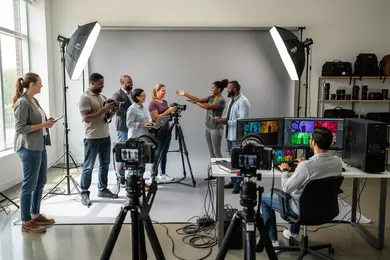
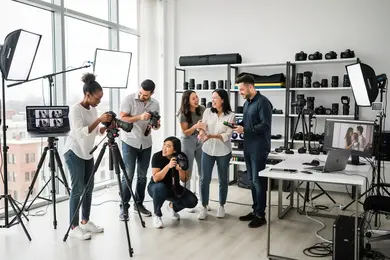
Lighting skills are central because they affect mood, clarity, texture, depth, color, and commercial polish. In photography education, lighting usually means more than "making an image bright." Students learn how to control natural light, continuous light, strobes, reflectors, diffusers, grids, softboxes, umbrellas, gels, and mixed-light environments. They also learn how exposure, white balance, dynamic range, and post-production choices interact with the original lighting setup.
Online programs build these skills by combining demonstration, repetition, critique, and revision. A student might watch a recorded studio-lighting demo, reproduce a setup at home using a speedlight or window light, upload files with lighting diagrams, receive instructor feedback, then reshoot the scene. That cycle is especially useful because lighting improves through visible cause and effect: when a shadow is too harsh, the student can adjust distance, modifier size, angle, or fill ratio and immediately compare results.
The degree is usually a good fit for students who want structured creative training, faculty critique, a portfolio-building sequence, and a credential that may support employment in media, marketing, e-commerce, education, or studio production. It may be a weaker fit for someone who only wants a quick hobby course, already has a strong portfolio and client base, or needs hands-on access to expensive studio facilities every week.
A useful way to understand the credential is to compare degree levels by purpose. The table below summarizes how each option typically serves students who want lighting-focused photography training.
| Degree option | Typical focus | Best fit | Lighting-skill value |
| Associate degree | Foundations in camera operation, editing, composition, and introductory studio work | Students seeking entry-level skills or a lower-cost transfer pathway | Good for learning basic portrait, product, and available-light techniques |
| Bachelor's degree | Broader general education plus advanced photography, portfolio, and business courses | Students who want stronger career flexibility and a complete portfolio sequence | Stronger opportunity for repeated lighting assignments across genres |
| BFA in photography | Intensive studio practice, critique, visual concept development, and exhibition-ready work | Students aiming for commercial, fine art, editorial, or graduate study pathways | Often the strongest degree format for advanced studio and location lighting practice |
| Certificate or nondegree training | Targeted technical instruction in a shorter format | Working photographers filling a specific skill gap | Useful for a lighting upgrade, but usually less comprehensive than a degree |
Students comparing creative majors sometimes look at adjacent programs in visual communication, especially if they want to combine photography with branding, layout, or digital media. A graphic design bachelor degree can be a better fit when the goal is broader design employment rather than photography-centered production.
How do online digital photography programs compare with campus-based options for learning lighting?
Online and campus-based photography programs can both teach lighting well, but they do so differently. The key decision is whether you learn best through self-directed practice in your own shooting environment or through frequent access to school studios, lighting kits, classmates, and supervised lab time.
The comparison below highlights the practical trade-offs that matter most when lighting is a priority. Use it to decide whether convenience, equipment access, critique format, or networking should carry the most weight in your search.
| Factor | Online digital photography degree | Campus-based photography degree | Decision takeaway |
| Lighting equipment | Students often buy or rent basic kits for home projects | Students may access institutional studios, strobes, stands, modifiers, and grip gear | Campus can be stronger if you need frequent access to advanced lighting tools |
| Practice environment | Assignments are completed at home, outdoors, in rented studios, or at client-style locations | Assignments often use school studios and controlled classroom settings | Online can build strong real-world adaptability if assignments are well designed |
| Critique | Feedback may be asynchronous through discussion boards, annotated files, and video reviews | Feedback often happens live during critiques and lab sessions | Online students should look for detailed faculty critique, not just peer comments |
| Scheduling | Often more flexible for working adults and parents | Requires set studio, lecture, and critique times | Online is usually easier to fit around employment |
| Networking | Depends on virtual critique groups, internships, local assisting, and portfolio events | Often includes stronger local peer and faculty studio networks | Online students need to be more intentional about building professional contacts |
Online study makes sense if you are disciplined, can create a small shooting area, and want to practice lighting in environments similar to real client work. For example, product photographers often shoot in compact home setups, and portrait photographers may learn a great deal by controlling window light, reflectors, and portable flash in ordinary rooms.
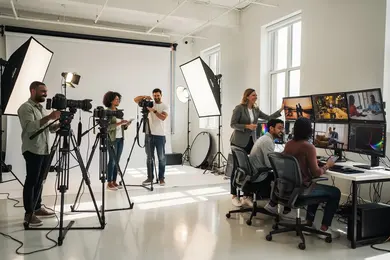
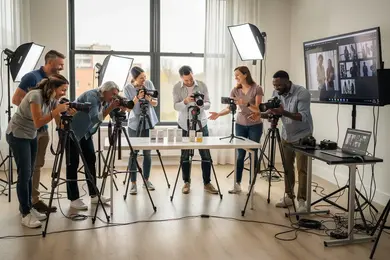
Campus study may be better if you need repeated access to large studios, cycloramas, tethered capture stations, models, high-output strobes, or collaborative production crews. It can also help students who learn faster through immediate in-person correction, especially when setting up multiple lights safely and efficiently.
Before choosing either format, compare the actual learning experience rather than the delivery label. A strong online program with required lighting diagrams, resubmissions, video critique, and portfolio assessment may teach more than a weak campus course with limited feedback. A strong campus program, however, can offer resources that are expensive to replicate at home.
Which accredited schools offer online digital photography degrees focused on studio and lighting work?
Several U.S. institutions offer online photography degrees or online art degrees with digital photography coursework. Availability, course names, and modality can change, so students should verify the current catalog, accreditation status, state authorization, transfer policy, and equipment expectations before applying.
The schools below are examples worth comparing because they offer online pathways where photography, digital imaging, studio practice, or portfolio development is central. The table is not a ranking; it is a starting point for checking fit.
| School | Online photography-related credential | Institutional accreditation to verify | Why lighting-focused students may compare it |
| Southern New Hampshire University | Online BA in Digital Photography | New England Commission of Higher Education | Designed for online delivery with digital workflow, portfolio, and practical image-making assignments |
| Academy of Art University | Online photography degrees at multiple levels | WASC Senior College and University Commission | Offers a studio-art orientation with commercial, fine art, and technical photography coursework |
| Rocky Mountain College of Art + Design | Online BFA in Photography | Higher Learning Commission | BFA structure can support critique-heavy portfolio development and genre-specific lighting practice |
| Savannah College of Art and Design | Online photography-related study through SCADnow offerings | Southern Association of Colleges and Schools Commission on Colleges | Known for creative-industry programs and portfolio-driven visual arts training |
| Arizona State University Online | Online art and digital photography-related coursework, depending on current catalog options | Higher Learning Commission | May appeal to students who want a large public university environment and broader art curriculum |
When reviewing any school, look beyond the program title. A degree called "digital photography" may emphasize editing and storytelling, while a BFA may emphasize critique and studio practice. Read course descriptions for terms such as studio lighting, portrait lighting, product photography, location lighting, digital capture, color management, portfolio, and professional practices.
Also confirm whether the program is institutionally accredited by an accreditor recognized by the U.S. Department of Education or the Council for Higher Education Accreditation. Accreditation affects federal financial aid eligibility, transfer credit, graduate school recognition, and employer confidence. Programmatic accreditation is less common for photography than for fields such as nursing or engineering, so institutional accreditation is usually the main baseline.
What core courses and hands-on projects teach lighting techniques in online photography programs?
Lighting skills develop through a sequence: first students learn exposure and composition, then they study light quality and direction, then they apply lighting to specific subjects such as portraits, products, interiors, food, fashion, events, or documentary work. A strong online program should make students submit original shoots, not just quizzes about terminology.
The table below shows common courses and the lighting outcomes they should support. Course titles vary by institution, but the learning goals are similar across serious photography curricula.
| Course area | What students learn | Lighting skill developed |
| Digital photography fundamentals | Manual exposure, ISO, shutter speed, aperture, lenses, focus, and file formats | Controlling exposure before adding artificial light |
| Studio lighting | Key light, fill light, backlight, modifiers, ratios, metering, and tethered capture | Building repeatable lighting setups for portraits and products |
| Location lighting | Balancing flash with daylight, using reflectors, managing mixed light, and adapting to spaces | Creating polished images outside a controlled studio |
| Portrait photography | Posing, facial analysis, catchlights, background separation, and mood | Shaping flattering light for individuals and groups |
| Product or commercial photography | Reflective surfaces, texture, shadow control, scale, color accuracy, and client briefs | Using precise light placement for e-commerce and advertising-style images |
| Digital editing and color workflow | RAW processing, retouching, color correction, masking, and output standards | Preserving lighting intent through post-production |
| Portfolio and professional practices | Sequencing work, writing project statements, pricing, client communication, and revisions | Presenting lighting competence in a market-ready body of work |
Hands-on projects are where the quality of the program becomes visible. Before enrolling, ask whether students complete assignments that require lighting diagrams, technical notes, before-and-after revisions, and instructor critique. Those details show whether the school is evaluating process, not just the final image.
Students who want serious lighting practice should expect projects like the following. These assignments matter because they force learners to solve the same problems photographers face in paid work.
- One-light portrait series showing hard light, soft light, Rembrandt lighting, butterfly lighting, and split lighting with written explanations of the setup.
- Product shoot using controlled reflections, flags, diffusion, and background separation to create a clean e-commerce or advertising-style image.
- Mixed-light location assignment balancing window light, ambient indoor light, and portable flash while maintaining realistic color.
- Low-key and high-key image series demonstrating contrast control, shadow detail, highlight management, and mood.
- Portfolio reshoot assignment where students revise a failed lighting setup after instructor critique and explain what changed.
Equipment requirements should be realistic. Many online students can start with a mirrorless or DSLR camera, a sturdy tripod, a speedlight or small strobe, a trigger, a reflector, a light stand, and one modifier. More advanced kits can come later, especially if the program allows renting, borrowing, or substituting natural-light assignments early in the curriculum.
What are the typical admission requirements for online digital photography degrees in the U.S.?
Admission requirements depend on degree level and selectivity. Many online bachelor's programs in digital photography are accessible to first-year students and transfer applicants, while BFA programs may place more weight on a portfolio, creative statement, or prior art coursework.
Most U.S. online undergraduate photography programs ask for a combination of academic records, identity documentation, and creative materials. The exact list varies, so always check the current admissions page for your state and applicant type.
- High school diploma, GED, or equivalent for first-year undergraduate applicants.
- Official high school and college transcripts, including transfer-credit documentation when applicable.
- Online application and possible application fee, though some schools waive fees during admissions events.
- Portfolio or sample images for more selective BFA or art-school pathways.
- Personal statement, creative statement, or short essay explaining goals and artistic interests.
- Proof of English proficiency for applicants whose prior education was not in English, depending on school policy.
- Technology readiness, including reliable internet, image-editing software access, and hardware capable of handling RAW files.
Test scores are less central than they once were at many colleges, especially for adult and transfer students, but policies vary. A strong portfolio can help applicants show readiness even if their academic background is uneven, while strong transfer credits can reduce both time and cost.
Flexible start dates can be helpful for adults who do not want to wait for a fall semester. If scheduling is a major factor, compare schools that support rolling admissions or frequent terms, including lists of the best online colleges with weekly start dates, while still checking whether the photography courses themselves run on the same flexible calendar.
Common admission mistakes include applying before confirming equipment requirements, assuming all credits will transfer, and choosing a program without reviewing student portfolio examples. A better approach is to ask admissions and faculty whether incoming students need previous lighting experience, what camera systems are acceptable, and whether portfolio feedback is available before enrollment.
How long do online digital photography degrees take, and what do they cost?
An online associate degree in digital photography commonly takes about two years of full-time study, while a bachelor's degree usually takes about four years for first-time students. Transfer credits, accelerated terms, prior learning assessment, and part-time enrollment can change the timeline substantially.
Cost depends on tuition, fees, credits required, transfer credits accepted, software, camera gear, lighting equipment, printing, portfolio hosting, and optional studio rental. College Board's 2024-25 tuition and fee averages show the broader U.S. pricing environment: $11,610 at public four-year in-state institutions and $43,350 at private nonprofit four-year institutions. Online photography students should treat those as context, not as a quote, because individual online tuition can be lower or higher.
When comparing costs, look at total program cost rather than the per-credit number alone. The following cost categories are the ones most likely to affect the real price of a lighting-focused online photography degree.
- Tuition and required institutional fees for all credits needed after transfer evaluation.
- Digital imaging software subscriptions, color-calibrated monitor needs, external storage, and backup tools.
- Camera body, lenses, tripod, memory cards, card readers, and maintenance or insurance.
- Lighting equipment such as speedlights, strobes, stands, modifiers, reflectors, triggers, backgrounds, and clamps.
- Printing, portfolio books, website hosting, domain registration, and exhibition or submission fees.
- Optional studio rental, model fees, product props, travel, and local permits for location shoots.
Students can often lower costs by transferring general education credits, starting at a community college, buying used equipment, renting specialized lighting only when needed, applying for federal aid, and asking whether the school has software discounts. The maximum federal Pell Grant for the 2024-25 award year was $7,395, which can meaningfully reduce net cost for eligible undergraduates but may not cover the full cost of attendance.
Timeline comparisons can be confusing because creative degrees use different studio sequences. For example, discussions of architect course duration often involve accreditation and professional pathway constraints, while photography degrees usually depend more on credit load, portfolio sequencing, and how often required studio courses are offered.
The smartest financial question is not "What is the cheapest photography degree?" It is "What is the lowest net-cost program that gives me credible critique, enough lighting practice, transferable credits, and a portfolio I can use?" A very cheap program with weak feedback can be a poor investment, while an expensive program without clear career support can also be risky.
What careers can graduates pursue with strong lighting skills from an online photography degree?
Graduates with strong lighting skills can pursue employment, freelance work, or hybrid careers that combine photography with editing, content production, marketing, and visual design. The degree alone is rarely enough; employers and clients usually evaluate the portfolio, consistency, professionalism, and ability to solve visual problems under deadlines.
The table below summarizes common career directions for graduates who can demonstrate strong studio and location lighting. It is designed to help readers connect coursework to real work settings.
| Career path | Typical work | Why lighting matters | Portfolio evidence to show |
| Portrait photographer | Headshots, family portraits, senior portraits, personal branding, and studio sessions | Flattering light and consistent skin tones are central to client satisfaction | Clean portraits with varied light patterns, backgrounds, and moods |
| Commercial product photographer | E-commerce, catalog, packaging, advertising, and social media product imagery | Precise light control shows shape, texture, color, and reflective surfaces accurately | Product sets with controlled shadows, reflections, and brand consistency |
| Wedding and event photographer | Ceremonies, receptions, corporate events, conferences, and private celebrations | Photographers must balance flash, ambient light, motion, and changing venues quickly | Low-light reception images, flash-balanced portraits, and consistent event coverage |
| Editorial or documentary photographer | Magazine, nonprofit, news-adjacent, and story-based assignments | Lighting supports mood and clarity while preserving authenticity | Environmental portraits, narrative photo essays, and location-lighting examples |
| Studio assistant or digital tech | Lighting setup, tethered capture, file management, equipment handling, and set support | Assistants must understand gear, safety, light placement, and capture workflow | Behind-the-scenes documentation, lighting diagrams, and technical competence |
| Content creator or visual media specialist | Photography, short-form video, social media assets, brand campaigns, and editing | Lighting quality affects both still images and video content | Cross-platform campaigns with consistent visual style |
Lighting skills are especially valuable in product, portrait, food, fashion, beauty, interiors, and brand photography because clients expect repeatable results. Natural-light creativity is useful, but paid assignments often require photographers to produce a specific look even when the available light is poor.
Career changers should also consider whether photography will be a primary income source or part of a broader creative services package. Some graduates combine photography with graphic design, web content, social media strategy, retouching, or video production to stabilize income. Others specialize deeply in one niche and build a referral network around that visual style.
What salary ranges and freelance income potential exist for photographers with advanced lighting skills?
Photography income varies more than many degree fields because workers may be salaried, self-employed, part-time, seasonal, project-based, or supported by related services such as editing and content production. According to BLS May 2024 data, the median annual wage for photographers was $42,520. That figure is useful as a national benchmark, but it does not predict what an individual graduate will earn.
Advanced lighting skills can support higher-value work because they help photographers handle commercial briefs, difficult environments, and repeatable brand standards. Still, income depends on market, niche, client base, business skill, portfolio strength, turnaround time, and whether the photographer owns or rents equipment.
The income models below show how lighting ability can connect to earning potential. The table does not promise pay levels; it explains how different work structures tend to function.
| Income model | How it works | Lighting-related advantage | Main limitation |
| Salaried employment | Work for a studio, retailer, media company, university, hospital, agency, or corporate marketing team | Consistent lighting quality can support product, portrait, and campaign workflows | Openings may be competitive and portfolios are heavily scrutinized |
| Freelance client work | Charge by session, day rate, project, licensing package, or retainer | Controlled lighting helps justify professional pricing and repeat bookings | Income fluctuates and requires marketing, contracts, and client management |
| Studio ownership | Operate a portrait, product, wedding, or commercial studio | Lighting consistency becomes part of the brand and client experience | Overhead, insurance, rent, gear, and staffing can reduce profit |
| Hybrid creative services | Combine photography with video, editing, design, social media, or marketing support | Lighting skills improve both still and motion assets | Requires broader skill development beyond photography alone |
Freelancers should think in terms of net income, not just gross bookings. A photographer who charges strong session fees may still have expenses for gear, editing time, insurance, taxes, marketing, assistants, studio rental, subscriptions, and file storage. Students should look for programs that teach pricing, licensing, contracts, usage rights, and client communication, not only image capture.
A practical way to evaluate return on investment is to compare the program's net cost with the kind of portfolio it helps you build. If the degree leads to a stronger, more specialized portfolio and better business readiness, it may support more opportunities. If it leaves you with debt but no marketable lighting work, the credential may be less useful than targeted training plus assisted studio experience.
How is the job outlook for photographers who specialize in studio and location lighting?
The BLS projects photographer employment to grow 4% from 2024 to 2034, which is about as fast as the average for all occupations. For students, the important interpretation is that the field is not disappearing, but it remains competitive and portfolio-driven.
Demand is shaped by e-commerce, social media, digital advertising, real estate, events, and brand content. Businesses still need original visuals, and many prefer photographers who can produce consistent results across lighting conditions. At the same time, smartphones, AI image tools, stock libraries, and inexpensive content platforms have reduced demand for some basic image-making tasks.
Lighting specialization can help because it is harder to automate or replace in real-world assignments. A client may use AI for concept mockups, but photographing reflective products, people, interiors, food, events, or brand campaigns still requires judgment about light direction, texture, color, timing, and human expression. Photographers who understand both capture and post-production are better positioned than those who rely on presets or available light alone.
Students should watch three current trends when planning a career. These trends affect what employers and clients expect from photography graduates.
- Hybrid still-and-video production: Many clients want one creator or team to produce photos, reels, short videos, and campaign assets from the same shoot.
- AI-assisted editing and ideation: Photographers increasingly use AI tools for culling, masking, retouching support, background planning, and concept development, but they still need ethical judgment and original capture skills.
- Commercial content speed: Brands often need fast turnaround for product launches, social campaigns, and e-commerce updates, making organized workflow and repeatable lighting setups more valuable.
The outlook is strongest for students who build a clear niche, maintain a professional website, understand rights and licensing, and can show before-and-after examples of lighting problem-solving. It is weaker for graduates who leave school with only general images and no evidence that they can meet client specifications.
How can students evaluate and choose a reputable online digital photography program for lighting?
Choosing a reputable online digital photography program requires more than scanning tuition and course titles. Students should evaluate accreditation, curriculum depth, faculty expertise, critique quality, equipment expectations, portfolio outcomes, career support, and total cost before committing.
Use the following process to compare programs in a practical order. It is designed to prevent the most common enrollment mistakes.
- Verify institutional accreditation through the school's accreditor and confirm that the institution is eligible for federal financial aid if you plan to use it.
- Read the current curriculum and identify every course that directly involves studio lighting, location lighting, portraiture, product photography, color workflow, or portfolio development.
- Ask admissions or faculty for sample assignments so you can see whether students submit lighting diagrams, technical notes, revisions, and final images.
- Review faculty portfolios to confirm that instructors have professional or exhibition experience relevant to the type of lighting you want to learn.
- Request a complete cost estimate that includes tuition, fees, software, camera gear, lighting equipment, printing, and portfolio expenses.
- Ask how critique works online, including whether feedback comes from instructors, peers, recorded video reviews, live sessions, or annotated files.
- Check transfer-credit rules before enrolling, especially for general education, prior art courses, and community college credits.
- Look for career support such as portfolio reviews, internship guidance, business-practices courses, alumni work examples, and employer or client-facing preparation.
Red flags include vague course descriptions, no clear faculty involvement, no portfolio requirement or capstone, unrealistic salary claims, pressure-heavy admissions conversations, unclear equipment requirements, and lack of transparency about total cost. A reputable program should be willing to explain how online students practice lighting, receive critique, and graduate with work that can be shown to clients or employers.
Be careful not to choose a school just because it appears in a ranking or advertises a fast path. Speed can be useful, but photography learning requires practice and revision. If a program is very short, ask what trade-offs it makes in critique, lighting assignments, and portfolio development.
Also make sure your program matches your actual career goal. If you are exploring a completely different field, such as how to become an autopsy technician, a photography degree will not satisfy that education path; choose a program aligned with the occupation you want.
The best choice is usually the program that gives you the strongest combination of accredited status, affordable net price, substantial lighting practice, meaningful critique, and a portfolio path tied to your intended niche. If two programs are similar, choose the one with clearer faculty feedback and better examples of student work.
Other Things You Should Know About Digital Photography
Online photography degrees in 2027 offer virtual labs, software simulations, and interactive tutorials to teach lighting techniques. These programs often provide guidance on affordable equipment and creative uses of natural light, ensuring students can develop strong lighting skills without the need for a professional studio.
You can learn basic light direction, shadow, composition, and color with a smartphone, but most degree programs require a camera that supports manual controls and high-quality file capture. Smartphones are useful for practice, planning, and behind-the-scenes documentation.
Most programs require a digital camera, tripod, speedlight or strobe, light stand, and basic modifiers such as a softbox or reflector. Some courses also ask for a laptop with Adobe Lightroom or Photoshop, and a home workspace that can support controlled indoor lighting exercises.
Most students benefit from trying several genres first, including portrait, product, event, and documentary work. Specializing later is easier when you understand which subjects, clients, and lighting challenges match your strengths.
References
- Planit : Job Profiles https://www.planitplus.net/JobProfiles/View/45/22
- How Much Do Photographers Make? | Backstage https://www.backstage.com/magazine/article/how-much-do-photographers-make-79070/
- Light Tricks Photography Course Online | iPhotography Club https://www.iphotography.com/light-tricks-course/
- Digital Photography Course Online | Learn Camera Skills https://www.australianphotographyschool.com.au/blog/digital-photography-course-master-modern-camera-skills-from-home/
- Photographers | WorkBC https://www.workbc.ca/career-profiles/photographers
- What can you do with a Photography degree? https://www.falmouth.ac.uk/study/undergraduate/what-can-you-do-photography-degree
- How an Online Photography Course Works https://www.nyip.edu/photo-articles/photography-tutorials/how-an-online-photography-course-works
- Online Photography Classes, Photography Courses https://www.sessions.edu/online-classes/photography-courses/
- What Can You Do With a Photography Degree? https://pnca.willamette.edu/academics/bfa/photography/career-options
- Photography Careers https://theartcareerproject.com/photography-careers/