2027 Humanities Degrees Explained: Are They Classified as Professional Degrees?
Audited and Verified:
Our Editorial and Data Verification Process
Research.com uses government datasets, official education statistics and primary institutional information to support its career and degree guides. Our review process checks factual accuracy, occupational definitions, source dates and the requirements associated with the credentials discussed.
How This Article Was Fact-Checked
Our editorial team verifies salary estimates, employment projections, education requirements and program information against original data providers and official organizations. Salary figures are checked against the relevant occupational definitions and reporting periods. Information about licensure, accreditation and required in-person training is reviewed separately.
Fact-checked and verified on:

Co-Founder and Chief Data Scientist
Could choosing a humanities degree instead of a professional degree limit your career opportunities after graduation? If you’re drawn to studying history, philosophy, or literature, you may be worried about whether you can get a job and what kind of qualifications you can get. A study by the American Academy of Arts and Sciences found that 55% of people who ended up with a humanities degree first studied something else, showing how students’ priorities in school can shift and change during college.
This guide will show you how humanities degrees are categorized, how they’re different from professional degrees, and what you can expect when you get out into the job market. We’ll discuss accreditation, specialized training, earning potential, and possibilities for further education. This will help you decide whether a humanities degree is the right fit for you, based on your interests, financial situation, and career goals.
Key Things You Should Know About Humanities Degrees
- Humanities degrees are not generally regarded as professional degrees because they are considered more of an academic degree than one that focuses on training for a specific profession.
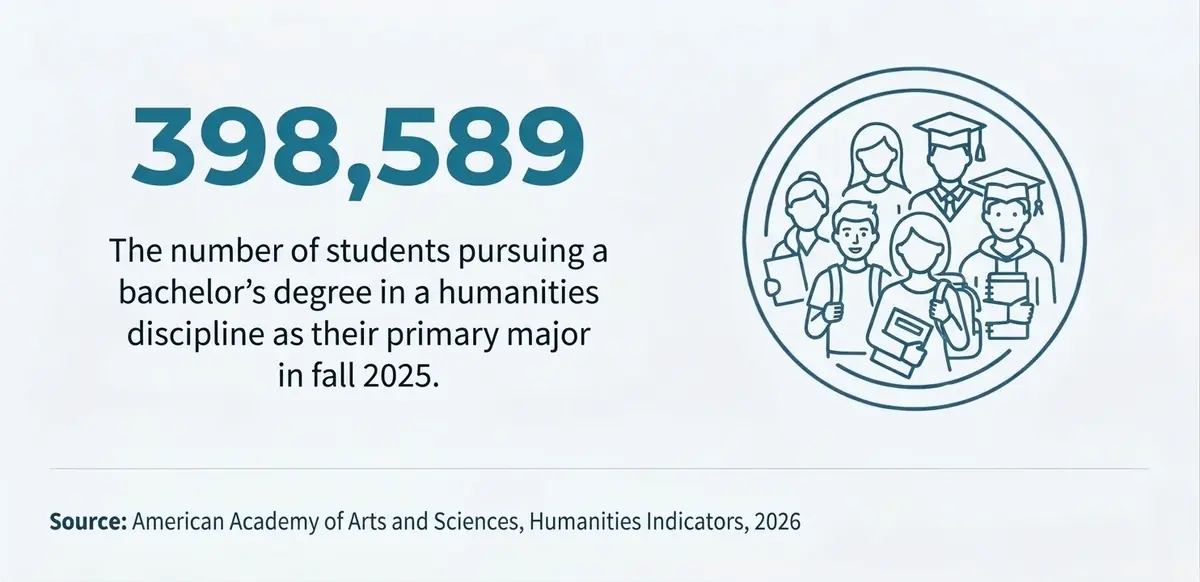
- In fall 2025, there were approximately 398,589 students who were pursuing a humanities discipline as their primary major for their bachelor's degree, and while the number of humanities degree completions may be decreasing, there continues to be an interest in these types of academic degrees.
- A humanities degree can prepare graduates to work in a variety of fields, including education, publishing, marketing and communications, government or public administration, non-profit organizations, and cultural institutions, depending on the student’s qualifications and experience.
Are humanities degrees officially classified as professional degrees?
Degrees in humanities are generally considered academic degrees since the purpose of these degrees is to develop knowledge, skills, and competencies in the particular academic discipline. Students who obtain degrees in history, philosophy, literature, or religious studies normally receive a bachelor of arts (BA), master of arts (MA), or PhD degree. These degrees allow students to obtain a general educational background without the need to pursue a specific occupation.
The National Center for Education Statistics (NCES) differentiates between research doctorates and professional practice doctorates such as the juris doctor (JD) and doctor of medicine (MD). Professional practice degrees provide the knowledge and training required for professional recognition, credentialing, or licensure.
While humanities degrees are generally not considered professional practice degrees, students who obtain a degree in the humanities may seek professional careers in education, law, business, and public administration upon meeting the additional academic or occupational requirements, where necessary.
What subjects and disciplines fall under humanities degrees?
Humanities courses explore various aspects of culture, belief, language, society, and history. Although coursework varies by discipline, students generally learn to analyze information, evaluate different perspectives, and examine ideas within their cultural and historical contexts.
Popular humanities areas of study include:
- History: Analyzes previous events, documents, and political and social change.
- Philosophy: Looks at moral issues, reasoning, understanding, and core questions relating to human life.
- Literature: Enables students to analyse literature and literary periods and recognize these in cultural settings.
- Languages: Includes language skills and linguistic and translation analysis as well as analyzing cultural customs.
- Religious Studies: Explores people’s religion, religious behavior, and organizations and how these affect society.
- Cultural Studies: Analyzes an individual’s identity, popular culture, and societal behaviors along with cultural portrayal.
- Classical Studies: Concentrates on ancient civilizations, especially looking at their language, literature, history, and philosophy.
How do humanities degrees differ from professional degrees?
Humanities degrees and professional degrees are different in a variety of ways. While a humanities degree will give you an academic education, a professional degree will prepare you for work in a specific field. For instance, someone earning a humanities degree in literature might study various literary movements and learn about different methods of research. Meanwhile, a student earning a professional degree in medicine would spend their degree working on clinical rotations and learning about different ways to treat patients.
There are many differences between the two types of degrees, from the admission requirements to the curriculum, amount of practical experience required, and qualifications needed to begin working in the field.
| Comparison Factor | Humanities Degrees | Professional Degrees |
| Education goals | Academic inquiry and intellectual development | Preparation for a specific profession |
| Common degrees | BA, MA, or PhD in a humanities discipline | JD, MD, DDS, or PharmD |
| Degree level | Undergraduate and graduate | Typically graduate or doctoral |
| Admission requirements | Must meet certain academic requirements and program-specific prerequisites | Requires a prior college education and specific admission requirements |
| Curriculum focus | Research, theory, interpretation, and critical analysis | Application of knowledge in the field and training for the specific profession |
| Practical training | May require internships, research projects, or fieldwork (depending on the program) | May require clinical rotations, supervised practice, or other professional placements |
| Accreditation | Primarily institutionally accredited | Institutionally and often programmatically accredited |
| Licensure | Not typically required to complete a degree | Typically required to practice independently |
| Career path | Allows you to work in a variety of industries and fields | Allows you to work primarily in a specific profession |
| Employment | You can apply your education in a variety of industries | You are more specialized in a specific profession |
It’s also important to note that earning an advanced degree in humanities doesn’t necessarily make it a professional degree. For example, a PhD in history is likely to focus more on scholarship than preparing students for professional licensure. When considering earning an advanced degree, you should research not only the level of the degree, but the intended purpose and any occupational requirements.
Accreditation and licensing impact how your humanities degree will be viewed by employers, graduate schools, and professional organizations. Graduating from an accredited institution can help strengthen your degree’s credibility and make sure that it meets standards for education. This may help you become eligible for graduate programs, scholarships, and employment opportunities that require a bachelor's degree from a recognized institution. If you are comparing online programs for a degree in humanities, such as an accredited online business degree, be sure to check that the institution is accredited.
In terms of licensing, the requirements for a degree in the humanities are usually less restrictive because many careers in writing, communication, history, literature, and related fields do not require professional licensure. For students who want to work in careers such as teaching, which does require additional qualifications, a recognized degree in the humanities can help you qualify for these careers. Of course, for some of these positions, you will need to take additional examinations and get approval in a specific state.
A degree in the humanities can provide graduates with a variety of skills that can be applied to the workforce. Humanities degrees often prepare their graduates to go into careers that require research, communication, and good decision-making skills. The skills you develop studying the humanities are beneficial in many fields, including business, education, government, and other industries.
- Critical Thinking: Studying the humanities allows you to think critically and evaluate evidence. It also helps you identify inconsistencies and evaluate arguments to come to an informed conclusion.
- Communication: To succeed in your studies, you will have many opportunities to communicate your ideas through writing and discussion, a useful skill for engaging different audiences.
- Research: Studying the humanities allows you to collect and evaluate information from various sources. This is an important skill when you are trying to make a decision that is in the best interests of an organization.
- Ethical Reasoning: Studying the humanities allows you to consider various ethical and social issues in society. You can use this knowledge when it comes to making decisions in your workplace.
- Cultural Awareness: You will have the opportunity to study different cultures and traditions in a variety of contexts. These skills can be very useful when working with a diverse group of people.
- Problem Solving: The humanities allow you to view a problem from various angles to come up with an evidence-based solution.
Humanities graduates have many different career options. Your career prospects will depend on your particular discipline, your work experience, and any additional qualifications you may have. Certain careers are open to applicants from a variety of academic backgrounds, while others require you to have a specific education.
Here are some common career paths for humanities graduates:
- Publishing: Some humanities graduates find employment in publishing, working as editors, copywriters, or editorial assistants. They review content, develop new materials, and work with authors and writers in preparing materials for publication.
- Education: Many humanities majors go on to become teachers, curriculum developers, or administrators in various educational settings. Those who work as teachers in public schools will generally need to become licensed by their state.
- Communications: Communications jobs are another popular option for humanities majors. These roles include public relations specialists, communications officers, and others who help to manage an organization's communication and messaging.
- Marketing: Humanities majors often become content strategists or copywriters. These professionals might conduct research on consumers or work with the brand's marketing staff to communicate their message. Those seeking leadership positions can explore the cheapest online MBA programs to develop their business management and strategic marketing skills.
- Public Administration: Humanities majors who work in public administration often take on the roles of policy assistants, government program coordinators, and similar positions. They might conduct research, prepare reports, and help to manage the government's public services.
- Nonprofit Organizations and Cultural Institutions: Many humanities majors work in nonprofit organizations, helping to raise funds, write grants, reach out to the local community, and coordinate various program initiatives. Humanities majors also work in museums, archives, and historical organizations.
A humanities degree can prepare you for professional school by helping you develop research, analytical, and communication skills. However, it should be noted that your admission to a professional school is dependent on you meeting their requirements. If you are interested in pursuing a career in law, medicine, psychology, or education, here are some steps you can take:
- Decide on a professional path. This includes figuring out the graduate qualifications and professional credentials you’ll need to enter the profession you’re interested in.
- Take required prerequisite courses. For example, if you are interested in going to medical school, you will need to have taken science classes. If you’re considering cheap psychology masters programs, you may need to have taken some courses in psychology, statistics, and/or research methods.
- Prepare for entrance exams. Look into whether or not the professional school that you want to attend requires you to take the LSAT, MCAT, GRE, or any other entrance exam.
- Get experience in the profession. Try to seek out internships, volunteer opportunities, or shadowing opportunities with professionals in the field of interest.
- Prepare your application materials. You will need your transcripts from school, recommendation letters, and a personal statement describing how your undergraduate work relates to your professional interests.
- Apply to professional schools. Look into deadlines for the programs, whether or not they require an interview, and their application process. Make sure you meet all prerequisites to be able to apply to the program.
A degree in the humanities can provide a lucrative career path. However, a humanities graduate’s income and employment options largely depend on the specific humanities field, industry, and professional experience. According to the U.S. Bureau of Labor Statistics, history degree holders had a median annual wage of $72,000, while English degree holders had a median annual wage of $65,000. Furthermore, 62% of English degree holders who were employed worked in jobs that required at least a bachelor’s degree, versus 61% of all people with degrees in different fields.
The value of a humanities degree can also be determined by how much one pays for their education and how they progress in their career. On the one hand, a humanities student can minimize their tuition costs and reduce their student loan debt by pursuing cheap online degrees.
On the other hand, an individual can enhance their job prospects by acquiring practical experience through an internship or improving their skills in various fields, such as digital marketing, business administration, or project management. Furthermore, humanities graduates can pursue professional certifications or higher education to qualify for more specialized job positions. However, before pursuing higher education, a student should consider how much their salary could increase with an additional degree in relation to the additional tuition fees and the requirements of a desired job.
How can students determine whether a humanities or professional degree is right for them?
The right choice of degree depends on your personal preferences, your academic interests, your career aspirations, and your budget. It also depends on the kind of environment you want to work in after graduating. You also need to know if you want to get a more general education or if you are looking to get specialized in a particular field to prepare for a particular job.
Here are some steps that should help you make an informed choice:
- Think about your career goals. Explore some of the careers that interest you and figure out if they require a particular professional degree or if you can pursue them with a degree in any field. Think about your long-term career goals and advancement possibilities.
- Assess academic interests. Think about what you like and dislike. Think about your strengths, interests, and your preferred study methods. Read course descriptions to find out whether or not the course material is to your liking.
- Find out about the requirements for your career of choice. Does it require some kind of training or special certification or license? Does it require additional education or work experience?
- Compare educational costs and duration. How much is the tuition fee? Do you get any financial aid? How long does it take to earn the degree? How much debt are you willing to take? There are also plenty of quick online degrees. Take a look if you're interested in pursuing a shorter degree programme that meets your career requirements.
- Find out about the prospects of employment and the salaries, and how much scope for advancement you will have in the field.
- Speak to an advisor. They will be able to explain to you the requirements of a particular programme, what it takes to get there, and what you can do with that degree. You can also speak to some graduates or people working in that field for a better idea of a career in that field.
Other Things You Should Know About Humanities Degrees
As of 2027, humanities degrees are not generally considered to be professional degrees. Professional degrees tend to be degrees that prepare students to work in a specific profession, such as law or medicine. Humanities degrees are valuable in their own right, but they are broader in scope than professional degrees and do not focus on preparing students to work in a specific profession.
In 2027, there are often online and part-time options for pursuing a humanities degree. These allow students to fit their studies into a schedule that works for them, which can be particularly useful if they have other responsibilities to balance alongside their studies. With online learning, students are also able to access learning resources and virtual classroom environments at any time, which means that they can study their humanities degree without it interfering with their other responsibilities.
A humanities degree program should be accredited by a recognized accreditor for institutions, such as a regional accreditor like the Higher Learning Commission or the Middle States Commission on Higher Education in the United States. If the program offers specific professional tracks, it may also be accredited by the relevant licensing or certifying body.
Yes, professional humanities degrees can provide internships or other practical experiences for students as part of the program. Many humanities programs will work with organizations and companies in order to provide students with the opportunity to gain practical experience during their degree program. This is helpful to students who are trying to gain experience in their field and make themselves more employable upon graduation.
- American Academy of Arts and Sciences. (n.d.-a). Bachelor’s degrees in the humanities. https://www.amacad.org/humanities-indicators/higher-education/bachelors-degrees-humanities
- American Academy of Arts and Sciences. (n.d.-c). Workforce. https://www.amacad.org/humanities-indicators/workforce
- American Academy of Arts and Sciences. (2025, March). From matriculation to completion: How college students move between majors. https://www.amacad.org/publication/matriculation-completion-how-college-students-move-between-majors
- American Bar Association. (n.d.). Pre-law. https://www.americanbar.org/groups/legal_education/resources/law-students/pre-law/
- American Library Association. (n.d.). Accredited programs. https://www.ala.org/educationcareers/accreditedprograms
- Angeles, D. (2025, September). Field of degree: Humanities employment and wages. U.S. Bureau of Labor Statistics. https://www.bls.gov/careeroutlook/2025/data-on-display/field-of-degree-humanities-employment-and-wages.htm
- Council for Higher Education Accreditation. (n.d.). American Library Association, Committee on Accreditation. https://www.chea.org/american-library-association-committee-accreditation
- National Association of Colleges and Employers. (2025). Competencies for a career-ready workforce. https://www.naceweb.org/docs/default-source/default-document-library/2025/career-readiness/competencies/nace-career-readiness-competencies-december-2025.pdf
- U.S. Bureau of Labor Statistics. (2025, August 28). Field of degree. Occupational Outlook Handbook. https://www.bls.gov/ooh/field-of-degree/home.htm
- U.S. Department of Education. (2026). Accreditation in the U.S. https://www.ed.gov/laws-and-policy/higher-education-laws-and-policy/college-accreditation/accreditation-in-the-us