2027 Social Science Careers: Guide to Career Paths, Options & Salary

Co-Founder and Chief Data Scientist
A career in social science starts with a practical question: how do you want to understand people, systems, institutions, culture, policy, behavior, markets, and communities—and how do you want that understanding to shape real decisions? Social scientists help schools, agencies, nonprofits, companies, health systems, courts, and public leaders make better choices by replacing guesswork with evidence.
This matters now because many high-stakes decisions depend on behavioral data, public opinion research, economic modeling, longitudinal evidence, and careful ethical interpretation. For instance, the U.K. government’s 2024 planning for future respiratory health threats reflects stronger attention to long-term data after earlier debates about non-pharmaceutical interventions and the contested idea of “behavioral fatigue,” a concept the UK Health Security Agency continues to examine because empirical support remains limited in crisis-response settings.
That example shows why social science is valuable. A phrase like “social fatigue” may sound persuasive, but social scientists ask whether it can be defined, measured, tested, and responsibly used in public policy. The same evidence-first approach applies in public health, education, economics, marketing, law, community planning, conflict resolution, security, and organizational leadership.
This guide explains what social science careers look like, how different degree levels connect to job options, which skills employers notice, how pay can vary across fields, when online education makes sense, and how to choose a pathway that fits your goals instead of relying on a broad major alone.
Quick answer: Social science careers suit people who want to investigate human behavior, analyze social systems, interpret evidence, write clearly, and influence decisions in areas such as government, education, healthcare, business, law, nonprofit work, research, and public service. Some entry-level roles may be possible with a certificate, associate degree, or bachelor’s degree, while many research, clinical, academic, policy, and advanced specialist positions require graduate study.
Common social science disciplines include anthropology, economics, education, history, law, political science, psychology, and sociology. Using focused research questions, social scientists study how people behave, how institutions operate, and how communities adapt to social, economic, political, and technological change.
A student may begin with a two-year associate degree, move into a four-year bachelor’s program, or continue into graduate school for more specialized work. When researching people and groups, social science programs typically combine qualitative and quantitative methods. Students often develop critical thinking, statistical reasoning, writing, research design, project management, numeracy, and communication skills.
Graduate certificates may also be available in focused areas such as international relations and political economy, organizational design and development, terrorism studies, policymaking, negotiation, and conflict resolution. These options can be useful for professionals who already hold a degree and want targeted expertise without completing another full degree program.
Social Science Careers for 2027 Table of Contents
- Reasons to choose a social science career
- Career outlook for social science fields
- Skills social science employers value
- How to judge quality and affordability in social science programs
- How social science pay compares with related careers
- Whether online education can support a social science career
- Steps for entering the social science workforce
- Advanced clinical social work study options
- Specialized online programs for social science professionalsClinical social work advancementEntry-level career starting points
- Ways to move up in social science careers
- Trends shaping social science research and education
- How social scientists contribute to environmental policyProfessional advancement routes
Why pursue a career in social science?
The real question behind “What can you do with a social science degree?” is what kind of human problem you want to work on. Depending on the discipline and degree level, graduates may become political scientists, anthropologists, social workers, psychologists, economists, historians, survey researchers, policy analysts, research assistants, community program staff, or public service professionals. A political science major, for example, can build skills in research, policy interpretation, evidence evaluation, writing, debate, and analysis that transfer into government, advocacy, consulting, journalism, law-related work, and public affairs.
Social science is the structured study of people and organized social life. Political scientists examine power, policy, institutions, and political behavior. Anthropologists study culture, human variation, and social meaning. Social workers assist individuals, families, and communities facing complex challenges. Psychologists investigate thinking, emotion, behavior, and development. Economists analyze markets, incentives, resources, policy effects, and financial decision-making.
What connects these fields is the use of evidence. Social science professionals gather information, identify patterns, test explanations, and translate findings for people who must make decisions.
The Bureau of Labor Statistics reported in 2024 that jobs are growing fastest in occupations that require strong interpersonal, cognitive, and analytical abilities. Social science training closely matches those strengths because students learn to define problems, interpret statistical findings, understand human needs and values, write persuasively, present ideas, and collaborate across teams.
Social science careers appear in government, nonprofits, education, research, public health, business, law, and community services. Social science research has helped explain pandemic-related behavior, assess information quality, support collective behavior change, analyze racism and stereotyping, and improve evidence-based leadership.
| Choose social science if you want to... | Consider a different route if you... |
| Investigate behavior, culture, institutions, public policy, markets, or communities. | Want work that involves very little reading, writing, research, or interpretation of evidence. |
| Use data and human insight to improve services, policies, programs, or communication. | Prefer a major that points to one narrow job title with little need for career planning. |
| Work in settings such as government, education, business, health, nonprofits, law, or research. | Need a guaranteed income level immediately after earning an undergraduate degree. |
| Combine qualitative understanding with quantitative analysis. | Are uncomfortable with ambiguity, competing explanations, and complex human factors. |
Social Science Career Outlook
The COVID-19 pandemic raised major social science questions about public trust, risk perception, inequality, social networks, misinformation, institutional response, and compliance with public guidance. Researchers continue to study current social science research topics, including how crises reveal social structures, inequalities, and tensions that already exist.
Social science expertise is needed well beyond colleges and universities. Public agencies hire people who can evaluate economic, population, and policy trends. Businesses need professionals who understand customers, workplaces, consumer behavior, and communication. Nonprofits depend on needs assessment, grant evaluation, and program measurement. Government and public organizations need policy analysts, survey researchers, and data-literate communicators who can explain human behavior without reducing it to numbers alone.
Artificial intelligence and machine learning are also changing the value of social science work. Technical tools can process large amounts of data, but they do not automatically explain social context, institutional incentives, cultural meaning, bias, ethics, or the lived consequences of decisions. Those are areas where social science training remains highly relevant.
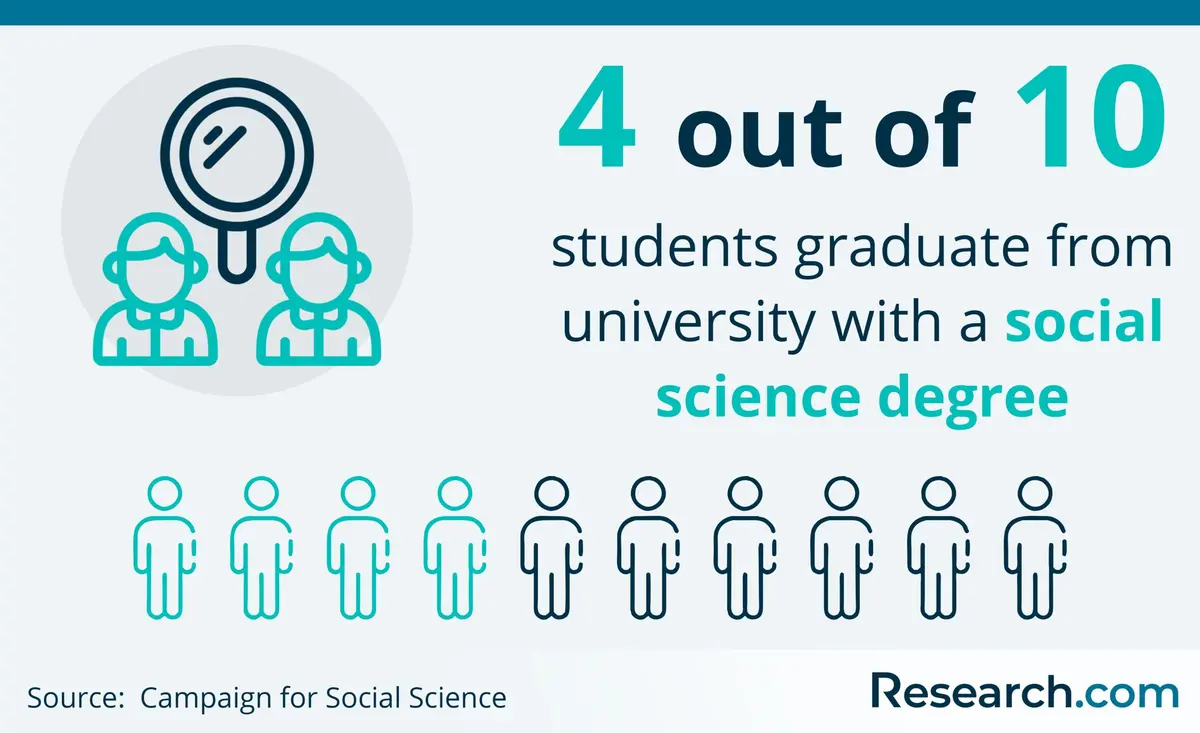
According to a report by the Academy of Social Sciences, more than 1 in 3 students in the U.K. graduate with a social science degree. The report also found that graduates who develop numerical and data skills have wider employment options (Hanson, 2024).
Chen and Sullivan’s 2025 study, “Beyond the Algorithm: Integrating Social Theory into Modern AI,” makes a similar point about the limits of purely technical approaches. The authors concluded that “at this limit, we must instead turn to social theory. Social theory can be used to answer basic methodological and interpretive questions that technical solutions cannot when building machine learning models, and when assessing, comparing, and using those models. In both cases, we draw on related existing critiques, provide examples of how social theory has already been used constructively in existing work, and discuss where other existing work may have benefited from the use of specific social theories.”
| Role | Salary | Demand |
| Legal Assistant | $52,920 | 10% |
| Museum Archivist | $56,790 | 11% |
| Credit Analyst | 84,930 | 8% |
| Sociologist | $86,110 | 4% |
| Psychologist | $82,180 | 3% |
| Political Scientist | $125,350 | 6% |
| Historians | $63,100 | 3% |
| Economist | $108,350 | 14% |
| Anthropologist | $66,130 | 5% |
Treat salary and demand numbers as planning benchmarks rather than promises. Earnings and hiring conditions can change based on education level, region, employer, specialization, licensure, experience, industry, and whether a position is clinical, research-focused, administrative, technical, or managerial.
Required Skills for Social Science Professionals
Social science careers require more than curiosity about people. Professionals must know how to frame a useful question, select credible evidence, compare explanations, recognize limitations, and communicate findings to people who may act on them. Whether the issue involves public opinion, consumer behavior, criminal justice, education, health policy, organizational culture, or community development, the work usually blends disciplined research with practical judgment.
Essential Skills for Social Science Professionals
Research. Social science professionals apply qualitative and quantitative methods to gather, organize, evaluate, and interpret evidence. Strong research skills help them move beyond personal opinion and produce findings that can guide policy, programs, services, and organizational strategy.
Writing. Clear writing is essential because social science work often appears in reports, literature reviews, policy briefs, grant proposals, case notes, academic papers, evaluation summaries, and public explanations. Research has limited value if stakeholders cannot understand the findings or use them responsibly.
Active Listening and Observation. Listening and observation help professionals notice context, relationships, behavior, social cues, and group dynamics. These skills are especially important when surveys or interviews do not capture the full picture or when self-reported information may be incomplete.
General Skills
Reading Comprehension. Social scientists must interpret research studies, policy documents, legal records, historical sources, statistical reports, and theoretical arguments. Strong reading skills reduce the risk of drawing conclusions from weak evidence or misunderstanding a source.
Analytical Thinking. Professionals in this field compare patterns, weigh evidence, evaluate uncertainty, and connect findings to real-world decisions. Analytical judgment matters most when data are incomplete, research results conflict, or a decision affects different groups in different ways.
Communication. Social scientists often explain evidence to funders, executives, educators, public officials, community groups, agencies, or the general public. As in public relations careers, the ability to translate complex information into clear messages is valuable. Students with a communications degree may also find social science-related work appealing if they want to connect messaging, research, policy, and public engagement.
| Skill | Why it matters | How to build it |
| Research design | Helps you create questions that can actually be answered and choose methods that fit the problem. | Take methods courses, support faculty research, or complete a capstone project. |
| Data literacy | Supports interpretation of surveys, demographic patterns, economic data, and program outcomes. | Practice spreadsheets, statistics, data cleaning, and visualization tools. |
| Interviewing and observation | Builds insight into lived experience, institutional behavior, group dynamics, and social meaning. | Learn ethical interviewing, field notes, coding, and qualitative analysis. |
| Writing for stakeholders | Turns evidence into policy recommendations, funding proposals, reports, or community action plans. | Prepare writing samples for different audiences, not only academic instructors. |
| Ethical judgment | Protects research participants, communities, sensitive data, and professional credibility. | Study confidentiality, informed consent, bias reduction, and responsible data use. |
How do I assess the quality and affordability of my social science education?
Begin with accreditation, then review the curriculum, faculty qualifications, research opportunities, internship access, advising, career services, and graduate outcomes. Low tuition can help, but true affordability also depends on transfer credits, required fees, financial aid, time to completion, fieldwork costs, technology requirements, and whether the program supports the career outcome you want.
If you are considering counseling, social work, psychology, sociology, education, or policy-related programs, verify whether the degree satisfies any state-specific licensure or certification rules. An online or out-of-state program may be convenient, but it does not automatically meet local professional requirements.
When cost is a major factor, compare specific programs instead of relying only on a school’s general reputation. For example, reviewing an online master of school counseling can help you see how affordable online options differ in structure, specialization, field placement expectations, and professional preparation.
| Question to ask | Why the answer matters |
| Is the institution accredited? | Accreditation may influence financial aid eligibility, transfer credits, employer recognition, and graduate school admission. |
| Does the program require research methods and statistics? | Methods and data training are central to many social science jobs and graduate programs. |
| Are internships, practicums, field placements, or applied projects built in? | Hands-on experience can make a broad degree easier to translate into employment. |
| What is the full cost beyond tuition? | Books, fees, travel, technology, placement costs, and extra semesters can change the real price. |
| Does the degree align with licensure or target job requirements? | Some fields require specific coursework, supervised hours, exams, practicum experiences, or graduate credentials. |
How do social science salaries compare with other related fields?
Pay in social science varies significantly because the category includes research, legal support, finance-adjacent work, public policy, education, community services, clinical practice, and academic roles. Positions that require graduate education, quantitative expertise, licensure, management duties, or specialized industry knowledge often follow different pay patterns than entry-level community or administrative roles.
When evaluating compensation, compare more than the title. Region, experience, certification, employer type, benefits, union coverage, grant funding, advancement paths, and public versus private employment can all affect long-term earnings. Comparisons such as social work vs counseling salary can help students understand how related helping professions differ in education, credentials, scope of practice, and pay expectations.
Can online education boost your social science career?
Online education can support a social science career when the program is accredited, aligned with your target role, and designed around real interaction, research training, applied assignments, and career preparation. It can be especially useful for working adults who need flexibility while finishing a bachelor’s degree, earning a new credential, or preparing for graduate-level opportunities.
The delivery format alone does not determine quality. Before enrolling, examine faculty access, field placement support, software requirements, internship options, cohort structure, licensure alignment, and whether employers in your target field recognize the credential. For students pursuing social work with cost in mind, comparing the cheapest online MSW program options can be helpful, but price should be weighed against accreditation, practicum support, academic quality, and career fit.
How to Start Your Career in Social Science
The best starting point is to match your education level to the work you want to do. A certificate can introduce targeted skills or support limited entry-level roles. An associate degree can provide a broad foundation and a transfer pathway. A bachelor’s degree often opens wider access to research support, public service, communications, program coordination, business, and nonprofit roles. Graduate degrees are commonly needed for advanced research, clinical practice, policy leadership, teaching, and specialized analysis.
Many students begin with an Associate of Arts or Associate of Science in Social Science and later transfer to a bachelor’s program. These programs often introduce history, psychology, geography, public relations, communication, social institutions, and research fundamentals. Depending on your career goal, associate and bachelor’s programs can provide a useful base for research, service, administrative, and community-facing work.
Entry-level options may appear in administration, public policy, government services, behavioral services, education and training, nonprofit programming, and community agencies. Because social science is broad, graduates need to translate coursework into employer language: research support, writing, data interpretation, public communication, community engagement, policy analysis, and program coordination.
| Education level | Best use | Important caution |
| Certificate | Focused skill-building, career exploration, or support-level work. | Usually insufficient for research-intensive, licensed, or advanced professional roles. |
| Associate degree | Foundational study and transfer preparation for a bachelor’s degree. | Career options may be narrower without additional education or experience. |
| Bachelor’s degree | Entry-level professional work, research support, program roles, communications, public service, and administration. | Some specialized roles require graduate study, licensure, or fieldwork. |
| Master’s degree | Advanced practice, policy work, research, clinical preparation, management, or specialized analysis. | Confirm practicum, accreditation, and licensure requirements before applying. |
| Doctorate | Academic careers, senior research, clinical specialization, high-level policy work, or expert consulting. | Requires substantial time, cost, and long-term planning. |
What can I do with an Associate’s Degree in Social Science?
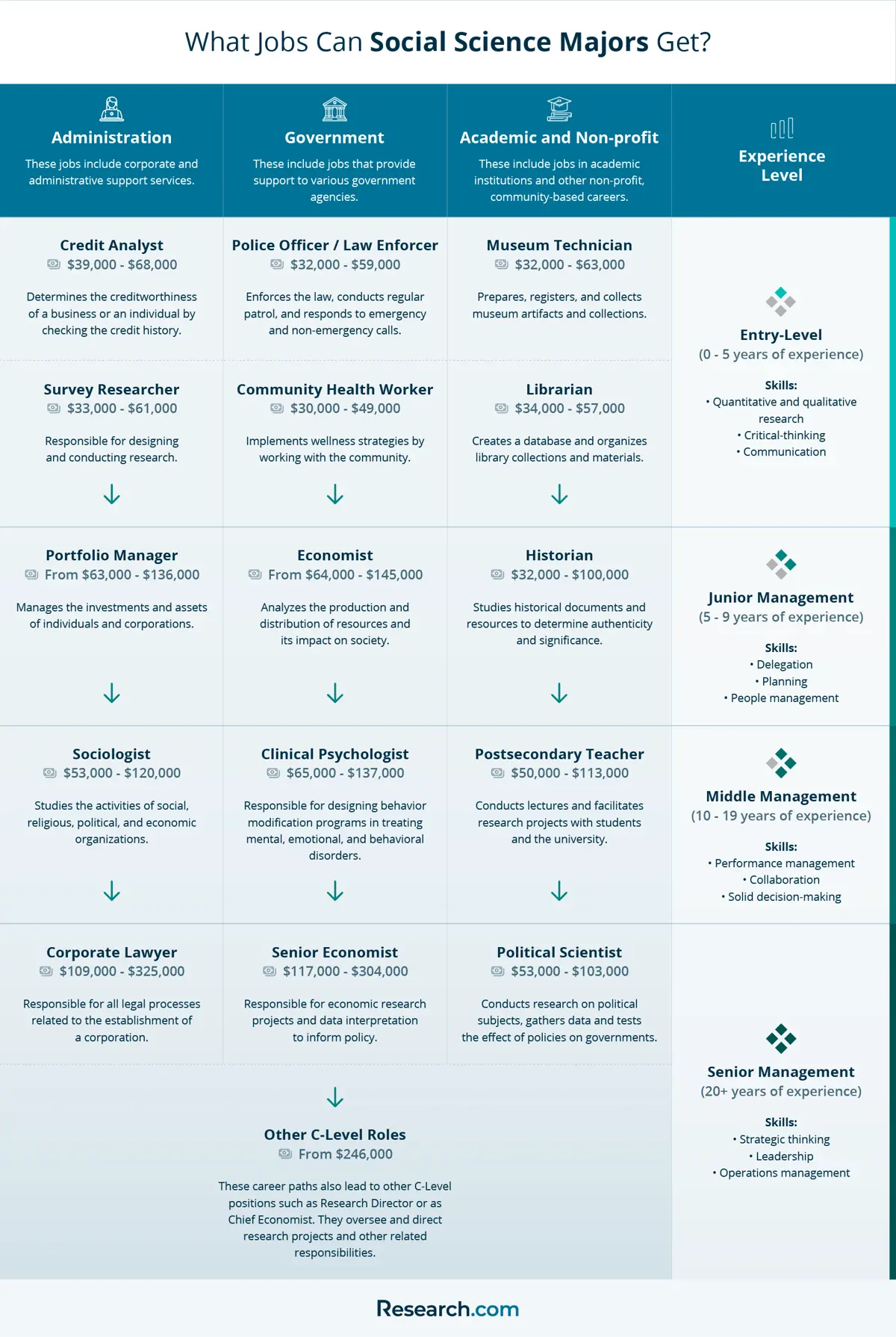
Community Health Worker
A community health worker helps support local wellness efforts by identifying health concerns, collecting information, and speaking with community members about health needs. This work is often done in partnership with health education specialists, clinics, agencies, and community organizations.
Median salary: $42,007
Police Officer
Police officers enforce laws, patrol assigned areas, respond to emergency and non-emergency calls, and contribute to public safety. Social science coursework can strengthen understanding of communities, institutions, conflict, behavior, and social conditions.
Median salary: $56,644
Museum Technician
Museum technicians may prepare objects for exhibition or storage, maintain collection records, help with loans or acquisitions, and support curators, researchers, or visiting scholars. The role can combine documentation, preservation, historical knowledge, and public education.
Median salary: $46,339
Credit Analyst
Credit analysts assess whether an individual or organization is likely to repay borrowed money. They review credit history and related financial information, and their analysis can influence lending decisions.
Median salary: $55,450
What can I do with a Bachelor’s Degree in Social Science?
Librarian
Librarian duties vary in public, school, academic, corporate, legal, medical, and administrative settings. Common responsibilities include organizing information, managing collections, building databases, and helping users locate and evaluate materials. Students interested in this path may also research a library science degree online.
Median salary: $52,344
Business Reporter
Business reporters cover companies, industries, markets, finance, and economic trends for digital media, television, radio, or print publications. A social science background can help reporters interpret institutions, market behavior, policy effects, and public impact.
Median salary: $43,000
Survey Researcher
Survey researchers design studies to measure public opinion, consumer preferences, candidate support, social attitudes, or behavior patterns. Their work may involve questionnaire design, sampling, data collection, analysis, and reporting.
Median salary: $59,371
Social Worker
Social workers assist people dealing with challenges involving family, school, health care, mental health, substance use, housing, crisis situations, and social services. Many social work positions are better matched to a dedicated social work major, especially when licensure or supervised practice is required.
Students who want stronger advancement prospects in this profession may need an online master degree in social work or another graduate credential, depending on state rules and career goals.
Median salary: $51,528
Can you get a social science job with just a certificate?
Yes. A certificate may help with certain entry-level or support roles, particularly in office administration, community outreach, research assistance, basic counseling support, or community services. Some colleges and universities offer one-year or two-year certificate programs in social science areas.
However, a certificate usually does not replace a degree when employers expect deeper theory, research methods, supervised practice, broad preparation, or field experience. If you pursue a certificate, choose one that adds a usable skill such as data analysis, program evaluation, grant writing, public policy, conflict resolution, community engagement, or applied research rather than repeating only general coursework.
Social science professionals must adapt to changing technology, new research tools, ethical questions about data, and the challenge of connecting theory to practice. Understanding related pathways, such as the distinction between a psychology vs social work degree, can help students choose the right graduate program, licensure route, and work setting.
Specialized credentials can strengthen a resume when they match a clear career target. Certificates, licenses, and graduate programs may demonstrate expertise in clinical practice, evaluation, public policy, organizational development, conflict resolution, or community services. Students considering social work advancement can review MSW jobs to see how graduate training connects to specific roles.
How can advanced clinical social work studies enhance your expertise?
Advanced clinical social work study can expand skills in assessment, intervention planning, ethical decision-making, research interpretation, and community-based care. It can also help professionals connect behavioral science, advocacy, public health, and direct services.
Programs such as online masters in clinical social work may be relevant for students who want to focus on clinical practice, leadership, or specialized service delivery. Before enrolling, verify accreditation, supervised field placement support, state licensure alignment, and whether the program’s clinical emphasis fits your intended population or practice environment.
Can specialized online programs enhance professional expertise in social science?
Specialized online programs can be worthwhile when they build competencies that employers, agencies, or licensing bodies actually recognize. Strong programs connect theory with applied work, offer faculty guidance, use current research methods, and provide opportunities to engage with cases, datasets, communities, organizations, or policy problems.
For professionals who need a faster option while managing work or family responsibilities, online accelerated MSW programs may be worth comparing. Speed should not be the only deciding factor; the program still needs adequate field education, academic support, accreditation, and preparation for your intended role.
How can I advance my career in Social Science?
Advancement in social science usually comes from combining graduate education, applied experience, stronger research ability, professional relationships, and specialization. Many people are formally described as social scientists after completing a master’s degree or doctor of philosophy (Ph.D.) in fields such as anthropology, sociology, psychology, economics, political science, or history.
Graduate-trained social scientists may analyze data, explain social behavior, advise administrators, guide policy decisions, manage research projects, or teach. They may also use tools for statistical analysis, qualitative coding, survey design, mapping, visualization, and social network analysis.
To plan your next step, first identify the responsibility level you want: practitioner, analyst, researcher, program manager, policy specialist, professor, clinician, consultant, or executive leader. Each route can require a different mix of education, credentials, experience, and technical skills.
What can I do with a Master’s in Social Science?
Sociologist
Sociologists use qualitative and quantitative methods to study social, religious, political, and economic organizations and how those systems influence individual and group behavior. Their findings may inform public policy, institutional change, or community programs.
Median salary: $60,000
Economist
Economists study how resources are produced, distributed, and consumed, along with how economic activity affects households, organizations, communities, and societies. They may analyze employment, inflation, business cycles, exchange rates, interest rates, taxes, and policy effects.
Median salary: $84,077
Portfolio Manager
Portfolio managers advise individuals or organizations on investments and asset strategies. The work may involve financial products, risk assessment, portfolio construction, and strategies designed to support profitability or investment goals.
Median salary: $93,333
Historian
Historians evaluate documents, archives, records, artifacts, and other historical materials to determine authenticity, meaning, and significance. They may also support preservation work that protects sources for future scholarship and public understanding.
Median salary: $56,628
What kind of job can I get with a Doctorate in Social Science?
Corporate Lawyer
Corporate lawyers manage legal issues related to forming and operating business entities, including limited liability companies, partnerships, and alliances. They prepare and file documents needed to comply with state, federal, and local rules.
Median salary: $118,168
Clinical Psychologist
Clinical psychologists evaluate and treat mental, emotional, and behavioral disorders. Their work may include therapy, assessment, behavior modification programs, and, in some states, prescribing medications to patients.
Median salary; $85,708
Political Scientist
Political scientists examine political systems, public policy, political behavior, governance, and international relations. They use theory and research methods to study political issues, collect evidence, and evaluate the effects of laws and policies.
Median salary: $56,390
Senior Economist
Senior economists often direct economic research in finance, policy, consulting, or organizational settings. They interpret economic data to support forecasts, policy recommendations, and financial strategy.
Median salary: $127,139
Which certification is best for social science?
The best certification depends on the work you plan to do. A community program manager, policy analyst, social worker, organizational consultant, and security researcher may need very different credentials. Graduate certificates can strengthen a bachelor’s or master’s degree by adding focused training in social theory, applied research, policy, administration, or management.
- Graduate Certificate in Organization Design and Development
- Expert in Policies in Management of Migration and Asylum
- Graduate Certificate in Youth Program Management and Evaluation
- Postgraduate Certificate in Policy Making
- Graduate Certificate in Retirement Residence Management
- Advanced Certificate in Terrorism Studies
Postgraduate certificates are most useful when they build deeper expertise, improve qualifications for a specific role, or support a move into consulting, campaigns, government, policy analysis, public opinion research, community leadership, or further graduate study.
What are the emerging trends in social science research and education?
Social science research is increasingly shaped by advanced analytics, machine learning, digital surveys, administrative data, online ethnography, and interdisciplinary collaboration. These tools can expand what researchers are able to observe, but they also raise important questions about consent, privacy, bias, interpretation, and ethical use.
Social science education is changing as well. More programs now combine online learning with applied projects, research methods, analytics, and professional preparation. Students looking for flexible and cost-conscious sociology options may compare the cheapest online sociology degree programs while still checking accreditation, transfer rules, faculty access, and career relevance.
| Trend | What it means for students and professionals |
| AI and machine learning | As technical systems expand, social scientists who can explain human context, bias, institutions, and social impact remain important. |
| Data-driven policy | Employers value professionals who can connect statistics, lived experience, and practical recommendations. |
| Online and hybrid education | Flexible formats can improve access, but students still need to verify support, quality, recognition, and career alignment. |
| Ethics and privacy | Research involving people, communities, and digital behavior requires careful consent, confidentiality, and responsible data practices. |
| Interdisciplinary hiring | Graduates who add technical, communication, or industry-specific skills may qualify for a broader range of roles. |
How can social scientists impact environmental policy-making?
Environmental policy is not only a scientific or technical challenge. It is also a social challenge because implementation depends on trust, behavior, economic incentives, communication, politics, and unequal effects across communities.
- Understanding public attitudes toward environmental issues. Social scientists study how communities think about climate change, conservation, waste, transportation, energy, land use, and environmental regulation. This evidence can help policymakers design proposals that are clearer, more practical, and more responsive to public concerns.
- Assessing the social impacts of environmental policies. Research can show how environmental rules affect neighborhoods, workers, businesses, public services, and marginalized groups. This helps decision-makers consider equity and social justice before policies are implemented.
- Facilitating behavioral change. Social science helps identify what motivates individuals, organizations, and communities to conserve energy, recycle, adopt new technologies, or support environmental protections.
By pairing behavioral insight with environmental evidence, social scientists can help create policies that are not only technically sound but also socially realistic and more likely to be carried out effectively.
Alternative Career Options for Social Science Professionals
Social science graduates are not limited to academic, public agency, or traditional research roles. Their skills can transfer to any setting that needs evidence review, audience research, investigation, communication strategy, behavioral analysis, stakeholder engagement, or program evaluation.
What else can a Social Science Professional Do?
Growth Hacker. Growth hackers combine marketing, experimentation, data analysis, and audience insight to help organizations attract and retain customers. Social science training can support message testing, user research, consumer behavior analysis, and interpretation of engagement data.
Private Investigator. Private investigators gather information through interviews, surveillance, records research, and evidence review. Social science majors may bring useful skills in observation, questioning, documentation, and analytical reasoning.
Brand Evangelist. Brand evangelists promote organizations, products, or services by shaping messages that connect with specific audiences. Knowledge of behavior, culture, identity, and communication can help them understand what motivates different groups.
| Common mistake | Better approach |
| Choosing a program only because the tuition looks low. | Compare accreditation, total cost, transfer policies, fieldwork, outcomes, faculty support, and career services. |
| Assuming any social science degree automatically leads to one defined job. | Match courses, internships, credentials, skills, and projects to specific target roles before enrolling. |
| Avoiding statistics or data courses. | Build quantitative ability even if your main interest is qualitative, policy-based, or community-focused work. |
| Using rankings as the only decision tool. | Treat rankings as one input and also evaluate curriculum fit, cost, location, support, and career preparation. |
| Assuming every online program meets licensure requirements. | Check state-specific rules before committing to an online or out-of-state degree. |
| Waiting until graduation to gain experience. | Build experience early through internships, research assistantships, volunteer work, field placements, or applied projects. |
Be More Than Social: Engage in the Scientific Study of Relationships
Social science can be a strong choice for students who want to understand people and systems well enough to improve them. The field is especially relevant as organizations rely on more data, governments face complex public decisions, and communities need professionals who can interpret behavior, inequality, culture, institutions, and evidence responsibly.
Technology will keep changing the tools social scientists use. Researchers increasingly work with digital datasets, survey platforms, visualization tools, and the latest technology in research. Even so, the core value of social science remains human: asking stronger questions, interpreting context, identifying bias, communicating clearly, and helping decision-makers act with evidence and care.
If you are considering this path, start by naming the problem you want to work on. Then identify the degree level, field experience, technical skills, writing samples, and credentials required for that type of work. A social science degree becomes more valuable when it is connected to a clear direction and supported by practical experience.
Key Insights
- Social science careers turn human questions into evidence-based decisions. The field helps governments, organizations, schools, businesses, and communities understand behavior, policy, markets, institutions, and social change.
- Your degree level shapes your options. Certificates and associate degrees may support entry-level work, bachelor’s degrees broaden professional opportunities, and graduate degrees are often required for research, clinical, academic, policy, or senior specialist roles.
- Data ability increases career flexibility. Graduates who combine theory, writing, statistics, research design, and communication can compete for a wider range of roles.
- AI strengthens the need for social interpretation. Machine learning can process data, but social scientists help explain context, ethics, bias, institutional incentives, and human meaning.
- Program selection should be practical, not just reputational. Check accreditation, total cost, transfer credit, fieldwork, licensure alignment, faculty support, and career services before committing.
- Career outcomes require preparation beyond coursework. Internships, research projects, community experience, data practice, and strong writing samples can make a broad social science background more employable.
References:
- Bureau of Labor Statistics (2025), Occupational Outlook Handbook, https://www.bls.gov/ooh/
- Gitnux. (2026). Public affairs industry statistics. https://gitnux.org/public-affairs-industry-statistics/
- Research and Markets. (2025). Social sciences and humanities services market report 2026. https://www.researchandmarkets.com/reports/5735273/social-sciences-humanities-services-market-report Related data research source
- The Social Science Research Council, https://www.ssrc.org/
- ZipRecruiter. (2026). Salary: Social scientist (March, 2026) United States. https://www.ziprecruiter.com/Salaries/Social-Scientist-Salary Social Science Research Council
Other Things You Should Know About Social Science Careers
Certifications like Certified Social Science Research Professional and Project Management Professional (PMP) can enhance a social science professional's career in 2027. These certifications demonstrate expertise and leadership skills, which are valued across various industries and can lead to better compensation and career advancement opportunities.
Social science graduates should learn SPSS, Stata, and R, because these tools are common in research, policy analysis, and program evaluation. Basic proficiency in Excel is also useful for data cleaning, charts, and reporting, while SQL helps with database queries and larger datasets.
Emerging technologies like artificial intelligence, data analytics, and machine learning are influencing social science careers in 2027 by enabling more robust data analysis and predictive modeling, which are crucial for research roles, policy development, and decision-making processes in various social sectors.