
2027 Hospice Nurse Salary by State

Co-Founder and Chief Data Scientist
Roughly 4% of U.S. registered nurses (RNs) and licensed vocational/practical nurses (LVN/LPNs) specialize primarily in hospice and palliative care (Smiley et al., 2025). This may seem like a small proportion of the workforce, but they are a cornerstone of the healthcare system.
A hospice nurse assists patients nearing the end of life, providing comfort and care to improve the quality of their lives. Their work also extends to their patients’ families by offering guidance and emotional support during one of the most challenging stages of care.
In this guide, we will identify the average annual salaries of hospice nurses for each state. We will also discuss other income details, job outlook, and career considerations to help aspiring and current nurses better understand the professional and financial aspects of this vital field.
Key Things You Should Know About Hospice Nurse Salaries
- A hospice nurse earns an annual salary of around $87,000, with variations based on location, employer type, credentials, and experience.
- Hospice nurse salaries differ widely across the U.S., with some states offering much higher wages due to demand, cost of living, or local healthcare funding.
- Holding a BSN, MSN, or specialty certifications can lead to higher salaries since employers often value these as a sign of expertise in end-of-life care.
- What is the hospice nurse salary by state? State Salaries
- What are the top-paying states for a hospice nurse? Top-Paying States
- What are the lowest-paying states for a hospice nurse? Lowest-Paying States
- Which cities pay a hospice nurse the most? Top-paying Cities
- How does the experience level of a hospice nurse affect wages? How does the experience level of a hospice nurse affect wages?
- Which type of employer offers the highest hospice nurse salaries? Which type of employer offers the highest hospice nurse salaries?
- What are the factors that influence the salary of a hospice nurse? What are the factors that influence the salary of a hospice nurse?
- What credentials boost earning potential for a hospice nurse? Certifications
- How does a hospice nurse salary compare to other nurses? Wage Comparisons
- What are the continuing education opportunities for hospice nurses? What are the continuing education opportunities for hospice nurses?
- What is the job outlook for a hospice nurse? Job Outlook
- How do advanced academic degrees impact hospice nursing careers? How do advanced academic degrees impact hospice nursing careers?
Hospice nurse salary in 2026: quick answer
Hospice nurses are registered nurses, licensed practical nurses, or advanced practice nurses who care for patients with serious, life-limiting illness, often in homes, hospice agencies, hospitals, nursing homes, or assisted living settings. Pay varies widely by state, employer, credentials, experience, and call requirements.
The U.S. Bureau of Labor Statistics (BLS) reports an average annual RN wage of $98,430, but it does not publish a separate wage category for hospice nurses. ZipRecruiter reports an average hospice nurse salary of $87,186, while the 2024 National Nursing Workforce Survey (Smiley et al., 2025) reports that RNs in hospice and palliative care earn around $89,000.
- Highest-paying states in the ZipRecruiter data: Washington, District of Columbia, New York, Massachusetts, and Alaska.
- Lowest-paying states in the ZipRecruiter data: Florida, West Virginia, Arkansas, Georgia, and Louisiana.
- Highest-paying cities listed: San Mateo County, CA; Nome, AK; Berkeley, CA; Sitka, AK; and Kilauea, HI.
- Main salary drivers: location, years of experience, employer type, RN versus LPN/LVN status, certifications, shift differentials, overtime, and reimbursement conditions.
This guide explains how hospice nurse salaries compare by state and city, what affects pay, which credentials may improve earning potential, and how to decide whether hospice nursing is the right career move financially and professionally.
Hospice nurse salary by state: how much can you earn?
Hospice nurse pay should be compared carefully because salary sources measure slightly different things. BLS data reflect registered nurses broadly, not hospice nurses specifically. ZipRecruiter salary figures are role-specific to hospice nursing, while the 2024 National Nursing Workforce Survey provides specialty-level context for RNs in hospice and palliative care.
For career planning, the most useful approach is to compare hospice nurse wages with overall RN wages in the same state. This shows whether hospice roles are tracking above or below the broader RN labor market in that location. It also helps nurses evaluate whether a higher offer is truly competitive or simply reflects a high-cost region.
State salary differences are shaped by cost of living, local demand, staffing shortages, employer budgets, reimbursement rates, union presence, and the mix of home-based versus facility-based hospice care. The table below compares ZipRecruiter hospice nurse wages with BLS annual RN wages by state.
| State | Annual hospice nurse wages (ZipRecruiter) | RN annual wages (BLS) |
| Alabama | $79,024 | $74,970 |
| Alaska | $93,894 | $112,040 |
| Arizona | $81,247 | $95,230 |
| Arkansas | $72,094 | $77,720 |
| California | $86,044 | $148,330 |
| Colorado | $91,677 | $95,470 |
| Connecticut | $82,939 | $103,670 |
| Delaware | $87,261 | $95,450 |
| District of Columbia | $98,522 | $109,240 |
| Florida | $65,153 | $88,200 |
| Georgia | $73,618 | $91,960 |
| Hawaii | $90,582 | $123,720 |
| Idaho | $82,033 | $89,770 |
| Illinois | $84,485 | $91,130 |
| Indiana | $82,963 | $85,850 |
| Iowa | $81,891 | $77,780 |
| Kansas | $77,757 | $79,430 |
| Kentucky | $75,723 | $83,900 |
| Louisiana | $74,555 | $84,110 |
| Maine | $84,413 | $87,440 |
| Maryland | $84,617 | $96,650 |
| Massachusetts | $95,218 | $112,610 |
| Michigan | $75,991 | $90,580 |
| Minnesota | $85,391 | $99,460 |
| Mississippi | $82,571 | $79,470 |
| Missouri | $81,781 | $81,950 |
| Montana | $80,023 | $88,480 |
| Nebraska | $83,127 | $82,890 |
| Nevada | $88,782 | $102,280 |
| New Hampshire | $84,789 | $94,620 |
| New Jersey | $88,514 | $106,990 |
| New Mexico | $84,489 | $94,360 |
| New York | $95,384 | $110,490 |
| North Carolina | $79,235 | $86,270 |
| North Dakota | $92,250 | $81,900 |
| Ohio | $82,887 | $86,110 |
| Oklahoma | $80,502 | $85,800 |
| Oregon | $92,180 | $120,470 |
| Pakistan | ||
| Pennsylvania | $87,395 | $90,830 |
| Rhode Island | $85,382 | $99,770 |
| South Carolina | $80,904 | $84,930 |
| South Dakota | $87,186 | $72,210 |
| Tennessee | $79,131 | $82,010 |
| Texas | $81,227 | $91,690 |
| Utah | $79,371 | $88,240 |
| Vermont | $92,701 | $92,710 |
| Virginia | $86,438 | $90,930 |
| Washington | $98,746 | $115,740 |
| West Virginia | $67,496 | $80,650 |
| Wisconsin | $88,001 | $90,450 |
| Wyoming | $83,805 | $88,020 |
Top-paying states for hospice nurses
The highest-paying states for hospice nurses tend to have some combination of expensive housing markets, larger healthcare systems, stronger competition for nurses, remote staffing challenges, or higher wage expectations across clinical roles. However, a high salary does not automatically mean better take-home value.
Before relocating for pay, nurses should compare income against rent or mortgage costs, commuting expenses, state taxes, health insurance premiums, childcare, and the amount of unpaid or lightly compensated on-call time expected by the employer.
According to ZipRecruiter, the five highest-paying states and districts for hospice nurses are:
- Washington: $98,746
- District of Columbia: $98,522
- New York: $95,384
- Massachusetts: $95,218
- Alaska: $93,894
Salary should be only one part of the decision. The American Health Care Association (AHCA) reports that since 2020, 90% of nursing homes nationwide have raised salaries for their workers, yet 94% still struggle with recruitment. This shows that compensation matters, but it does not solve every workforce problem.
Hospice employers are also trying to retain nurses through better benefits, flexible scheduling, mentoring, staff recognition, and technology that reduces documentation burdens. One retention priority is using tools that streamline administrative and regulatory tasks so nurses can spend more time on direct patient care (Vossel, 2025).
When comparing high-paying states, ask whether the employer offers manageable caseloads, mileage reimbursement, safety support for home visits, clear on-call policies, bereavement resources for staff, and realistic documentation expectations.
This chart shows the best states for hospice nurses according to annual average salary.
Lowest-paying states for hospice nurses
Lower-paying states are not always poor career choices. In many cases, wages are lower because the local cost of living is lower, healthcare budgets are smaller, or employers face different reimbursement and staffing conditions. A nurse who earns less on paper may still have a reasonable quality of life if housing and transportation costs are manageable.
According to ZipRecruiter, the lowest-paying states for hospice nurses are:
- Florida: $65,153
- West Virginia: $67,496
- Arkansas: $72,094
- Georgia: $73,618
- Louisiana: $74,555
- Kentucky: $75,723
- Michigan: $75,991
- Kansas: $77,757
- Alabama: $79,024
- Tennessee: $79,131
These markets may still appeal to nurses who prefer community-based work, shorter commutes, lower housing costs, or closer relationships with patients and families. For some hospice nurses, professional fit and emotional sustainability matter as much as maximizing salary.
Still, nurses should be cautious about accepting a lower base wage without understanding the full compensation package. Review on-call pay, weekend rates, mileage reimbursement, documentation time, patient load, continuing education support, paid time off, and health benefits. A lower salary with strong benefits may be better than a slightly higher offer with heavy unpaid expectations.
LPNs and LVNs comparing hospice work with other specialties can use this salary context alongside Research.com’s guide to the highest paying LPN specialties, especially if they are deciding whether hospice, rehabilitation, infusion support, or another care area offers the best long-term fit.
Cities where hospice nurses earn the highest salaries
City-level pay can differ sharply from state averages. Major metro areas may pay more because of competition among hospitals, academic medical centers, home health organizations, and hospice providers. Remote communities may also offer higher pay to attract nurses who are willing to work in isolated or hard-to-staff locations.
ZipRecruiter lists the following top-paying cities and areas for hospice nurses:
- San Mateo County, CA: $128,335
- Nome, AK: $108,154
- Berkeley, CA: $106,754
- Sitka, AK: $105,031
- Kilauea, HI: $104,499
- Holdrege, NE: $104,437
- San Francisco, CA: $102,720
- Santa Clara, CA: $102,394
- Novato, CA: $102,362
- Sunnyvale, CA: $102,326
BLS data for RNs overall also show that California metropolitan areas are among the highest-paying locations for registered nurses. San Jose-Sunnyvale-Santa Clara, San Francisco-Oakland-Fremont, Vallejo, and Santa Rosa-Petaluma report annual RN salaries ranging from $170,000 to $190,000.
These locations often combine high demand, high operating costs, strong competition for clinical labor, and expensive local living conditions. In remote communities such as Nome and Sitka, higher wages may be used as a recruitment tool because employers have a smaller local nurse labor pool.
The same pattern appears in home health nurse salary data: large metro markets and remote areas often offer stronger wages because employers must compete harder for nurses who can provide care outside traditional hospital units.
How experience affects hospice nurse pay
Experience is one of the clearest predictors of nursing wages. New hospice nurses may start with lower pay because they are still building confidence in symptom management, family communication, care coordination, documentation, and end-of-life decision support. Over time, nurses who can manage complex cases, mentor colleagues, and work independently usually become more valuable to employers.
BLS data show the following RN wage distribution in the United States:
- 10th percentile: $66,030
- 25th percentile: $78,610
- 50th percentile (median): $93,600
- Average (mean): $98,430
- 75th percentile: $107,960
- 90th percentile: $135,320
Early-career hospice nurses often fall closer to the 10th or 25th percentile, especially if they are new to RN practice or transitioning from another care setting. Nurses with several years of hospice, oncology, geriatrics, home health, or palliative care experience may move closer to the median or mean wage level.
More advanced hospice nurses can improve their earnings through specialty certification, preceptor roles, case management expertise, quality improvement work, leadership responsibilities, or advanced practice education. Some experienced nurses also transition into the nursing administrator career path, where responsibilities may include staffing, compliance, budgeting, and care quality oversight.
The 2024 National Nursing Workforce Survey shows a similar experience-based wage pattern. RNs with zero to five years of experience earn between $63,000 and $75,000. Nurses with six to ten years of practice have a median wage of around $87,000, while those with more than 11 years in the profession report incomes of $93,000 or higher.
Employer types that may pay hospice nurses more
Hospice nurses work for hospice agencies, hospitals, long-term care organizations, assisted living facilities, skilled nursing facilities, and home-based care providers. Some roles involve scheduled visits, while others require triage, crisis response, admissions, continuous care, or after-hours on-call coverage.
BLS does not isolate hospice nurse pay by employer category, but its RN wage data show which industries report the highest annual mean wages for registered nurses overall:
- Federal Executive Branch: $124,460
- Medical Equipment and Supplies Manufacturing: $116,040
- Navigational, Measuring, Electromedical, and Control Instruments Manufacturing: $115,210
- Computer Systems Design and Related Services: $111,790
- Facilities Support Services: $109,120
These are not the most common employers for hospice nurses, but the comparison is useful. It shows that pay is often higher in sectors with larger budgets, specialized technical needs, or stronger competition for experienced clinical professionals.
For hospice nurses who want broader salary options, advanced practice education can open doors to palliative care consultation, hospice medical group roles, clinical leadership, and advanced symptom management positions. Nurses researching graduate options may start with Research.com’s overview of the easiest nurse practitioner program to understand how program format, clinical placement support, and workload affect completion.
Factors that influence hospice nurse salary
Hospice nurse compensation is not determined by job title alone. Two nurses with the same license can earn different salaries depending on where they work, the type of patients they serve, the amount of call coverage required, and the employer’s financial model.
| Salary factor | How it affects hospice nurse pay | What to ask before accepting a role |
| Geographic location | High-cost states and competitive metro areas often post higher wages, while some rural or lower-cost regions pay less. | How does the salary compare with local RN wages and housing costs? |
| Experience level | Nurses with stronger hospice, palliative care, geriatrics, oncology, or home health backgrounds may qualify for higher pay. | Does the employer have a step-based pay scale or experience differential? |
| Education and credentials | A BSN, MSN, specialty certification, or graduate preparation may support advancement into leadership or advanced clinical roles. Nurses considering graduate study can compare options such as 12 month nurse practitioner programs. | Does the employer pay more for certification, BSN completion, or graduate education? |
| Employer type | Large hospital systems, federal agencies, and well-funded private organizations may offer stronger compensation than smaller agencies. | What are the base salary, benefits, bonuses, mileage reimbursement, and retirement contributions? |
| Reimbursement environment | Medicare, Medicaid, and private insurance payment structures can affect staffing levels and wage flexibility. Medicare directs 93.78% of payments to routine home care, which can shape how hospice providers allocate resources across care settings. | What patient mix and care setting does the organization primarily serve? |
| Shift differentials and overtime | Evening, night, weekend, holiday, overtime, and on-call work may increase total earnings. | Is call time paid separately, and how often are nurses called out after hours? |
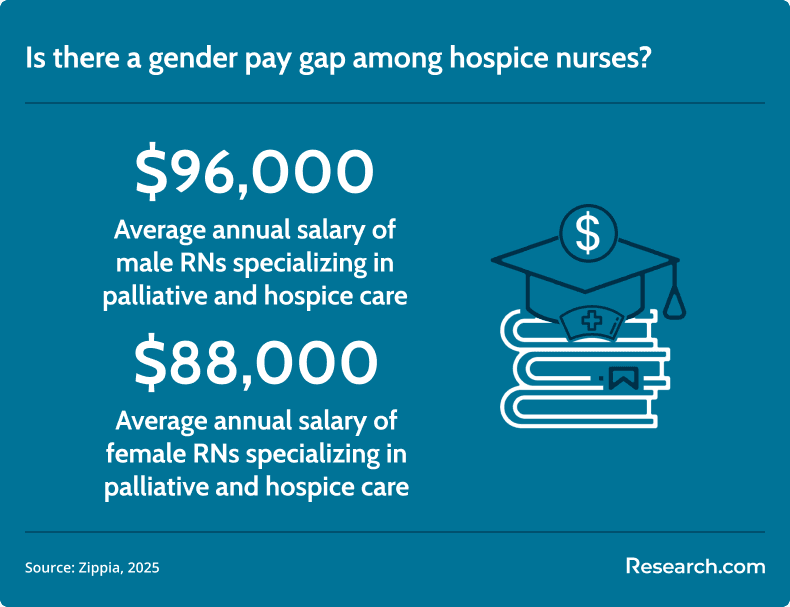
| Gender pay gaps | Male RNs working in hospice earn $8,000 more than female RNs in the same field, even when accounting for education and experience. | Is the pay scale transparent, and are raises based on objective criteria? |
The best salary decision is not always the highest hourly rate. A role with lower caseloads, strong team support, paid documentation time, and fair call pay may be more sustainable than a higher-paying job with constant after-hours demands.
Credentials that can increase hospice nurse earning potential
Professional certification can help hospice nurses document specialized knowledge in symptom control, communication, ethics, family support, and interdisciplinary care. Certification does not guarantee a raise, but it may strengthen a nurse’s case for higher pay, promotion, specialty assignments, preceptor roles, or leadership opportunities.
The Hospice and Palliative Credentialing Center (HPCC) offers several credentials relevant to hospice and palliative care:
- Certified Hospice and Palliative Nursing Assistant: This credential supports nursing assistants who help with bathing, feeding, mobility, comfort measures, and family support during end-of-life care.
- Certified Hospice and Palliative Licensed Nurse: The CHPLN credential is intended for LPNs and LVNs who provide hospice and palliative support under their scope of practice.
- Certified Hospice and Palliative Nurse: The CHPN is a common credential for RNs in hospice nursing. In 2024, 990 out of 1,386 takers passed the CHPN certification exam. It signals knowledge in pain management, communication, ethics, and end-of-life nursing care.
- Certified Hospice and Palliative Pediatric Nurse: The CHPPN credential focuses on pediatric hospice and palliative care, including support for children and families facing serious illness.
- Advanced Certified Hospice and Palliative Nurse: The ACHPN is designed for advanced practice nurses involved in complex clinical care, consultation, leadership, and interdisciplinary palliative care work. Nurses comparing hospice with adjacent home-based roles can also review Research.com’s guide on how to become a home health nurse.
Before paying for an exam or review course, ask your employer whether certification affects your wage scale, qualifies you for reimbursement, supports promotion, or counts toward clinical ladder advancement.
This chart displays the number of certified hospice nurses who passed the certification exam in 2024.
Hospice nurse salary compared with other nursing roles
Hospice nursing is usually a mid-range nursing specialty by salary. It may not pay as much as some advanced practice or high-acuity leadership roles, but it can offer meaningful patient relationships, autonomy, interdisciplinary teamwork, and a strong sense of purpose.
| Nursing role | Annual wage cited | How the role differs from hospice nursing |
| Hospice nurses | $87,186 | Provide end-of-life care, symptom management, family education, care coordination, and emotional support. |
| Charge nurses | $85,509 | Lead shift operations, coordinate staff, and provide direct care. Research.com’s charge nurse salary guide explains this leadership pathway in more detail. |
| ICU nurses | $90,000 | Care for critically ill or unstable patients who require intensive monitoring and rapid clinical decisions. |
| Oncology RNs | $90,000 | Support patients receiving cancer treatment and help manage chemotherapy, radiation, and treatment side effects. |
| Travel nurses | $92,366 | Work temporary contracts across locations, often filling urgent staffing gaps. |
| Adult-Gerontology Acute Care Nurse Practitioners | $96,063 | Provide advanced care for adults and older adults with acute, complex, or critical conditions. |
| Nurse managers | $99,901 | Supervise staff, manage budgets and schedules, and oversee unit or program performance. |
| Family Nurse Practitioners | $108,133 | Deliver primary care across the lifespan and often serve as a patient’s ongoing healthcare provider. |
Higher pay often comes with trade-offs. ICU roles may involve more acute stress. Travel nursing may require relocation and schedule instability. Management can reduce bedside time and increase administrative responsibility. Hospice nursing may pay less than some paths, but it can be a strong fit for nurses who value communication, autonomy, continuity, and whole-person care.
Nurses who want to build specialty credentials beyond hospice may also compare RNC certification requirements, including eligibility rules, exam preparation, and clinical experience expectations.
This chart displays the annual wages of hospice nurses and other types of nurses.
Continuing education options for hospice nurses
Continuing education is especially important in hospice because nurses must stay current on pain control, respiratory distress management, medication safety, ethical issues, family communication, cultural considerations, grief support, documentation, and regulatory requirements.
Common continuing education options include hospice and palliative care workshops, employer-sponsored training, certification review courses, online CE modules, conferences, preceptor training, quality improvement projects, and academic degree completion. Nurses who entered the profession through an associate degree may consider an easy RN to BSN online program if they want a flexible pathway to bachelor’s-level coursework while continuing to work.
When choosing continuing education, prioritize options that match your career goal. A bedside hospice nurse may benefit most from symptom management and communication training. A nurse aiming for leadership may need education in compliance, staffing, budgeting, and quality measures. A nurse pursuing advanced practice should compare graduate prerequisites, clinical hour requirements, and state scope-of-practice rules.
Job outlook for hospice nurses
The overall nursing employment outlook remains favorable, although demand varies by occupation and location. BLS projections through 2033 show that CNAs are expected to grow by 2.3% with about 204,100 annual job openings, while LVN/LPN roles are projected to grow by 2.6%, producing 54,400 annual openings.
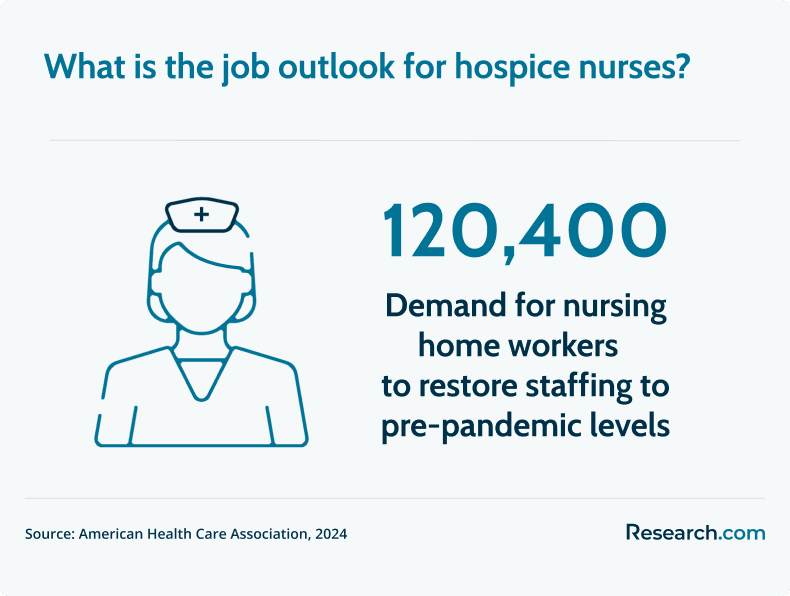
Registered nurses, including those in hospice care, are projected to grow by 4.9% with 189,100 annual openings. Nurse practitioners have a much higher projected growth rate of 40.1%, adding 29,500 positions each year. AHCA also reports that nursing homes need more than 120,400 workers to return to pre-pandemic staffing levels.
Hospice demand is supported by population aging, longer life expectancy, and increased attention to palliative and end-of-life care. Many patients and families prefer care that emphasizes comfort, dignity, symptom relief, and support at home or in familiar care settings.
At the same time, hospice nursing has retention challenges. Emotional fatigue, documentation requirements, staffing shortages, travel time, after-hours calls, and reimbursement limits can make the work difficult. Employers that invest in reasonable caseloads, strong interdisciplinary teams, bereavement support, mentoring, and practical technology are better positioned to retain experienced hospice nurses.
Students planning for hospice early can strengthen their preparation by choosing coursework or minors related to aging, counseling, psychology, communication, ethics, social work, or palliative care. Research.com’s guide to top minors for nursing can help students think through supportive academic options.
How advanced degrees can change a hospice nursing career
Advanced degrees can move hospice nurses into broader clinical, leadership, education, research, policy, or advanced practice roles. A master’s-prepared or doctoral-prepared nurse may work in palliative care consultation, hospice leadership, quality improvement, clinical education, program development, or advanced symptom management.
A Doctor of Nursing Practice (DNP), for example, can prepare nurses for evidence-based practice leadership, executive roles, policy work, and advanced clinical decision-making. Nurses comparing doctoral pathways should look beyond convenience and ask whether the curriculum, clinical requirements, faculty expertise, and project expectations align with hospice or palliative care goals. Research.com’s guide to what is the easiest DNP program can help readers understand how program structure affects workload and completion planning.
How to decide whether a hospice nurse job offer is worth it
A hospice nurse salary offer should be evaluated as a full employment package, not just a base number. This is especially important in home-based hospice, where mileage, documentation time, call coverage, and caseload size can change the real value of the job.
| Decision point | Why it matters | Better question to ask |
| Base salary | Shows guaranteed income before differentials, overtime, or bonuses. | How does this compare with local RN pay and hospice salaries in nearby markets? |
| Caseload | Heavy caseloads can increase stress, documentation, and after-hours calls. | What is the average active caseload per nurse? |
| On-call expectations | Call coverage can substantially affect work-life balance. | How often is call required, and is it paid separately? |
| Mileage and travel | Home hospice roles can involve frequent driving. | Is mileage reimbursed, and are travel zones reasonable? |
| Documentation time | Unpaid charting can reduce the real hourly value of the job. | Is documentation time built into the schedule? |
| Team support | Hospice care depends on nurses, physicians, aides, chaplains, social workers, and bereavement staff. | How quickly can nurses reach clinical backup during difficult cases? |
| Career growth | Promotion pathways affect long-term earning potential. | Are there clinical ladders, certification pay, tuition support, or leadership tracks? |
Common mistakes when comparing hospice nurse salaries
- Looking only at the annual salary: A higher wage may not be better if it comes with heavy call coverage, unpaid documentation, poor benefits, or high commuting costs.
- Ignoring cost of living: Top-paying states and cities may also have expensive housing, transportation, and childcare.
- Assuming all hospice jobs are the same: Admissions nursing, case management, inpatient hospice, crisis care, triage, and after-hours roles can have very different workloads.
- Not asking about reimbursement for travel: Mileage and vehicle wear can matter in home-based hospice positions.
- Overlooking emotional support: Hospice nursing can be deeply meaningful, but it also requires grief support, team debriefing, and sustainable staffing.
- Assuming certification automatically raises pay: Credentials can improve credibility, but nurses should confirm whether their employer offers certification pay or advancement credit.
- Relying only on rankings or salary lists: State and city salary data are useful starting points, but the best job depends on the specific employer, workload, benefits, and career fit.
References:
- American Health Care Association. (2024, May). Long Term Care Needs Help To Address A Historic Labor Crisis. https://www.ahcancal.org/Advocacy/IssueBriefs/Workforce%20Crisis.pdf
- Hospice and Palliative Credentialing Center. (2024). 2024 Exam Results. https://www.advancingexpertcare.org/hpcc/why-certification/exam-statistics
- PayScale. (2025, May 30). Average Travel Nurse (RN) Hourly Pay. Retrieved September 9, 2025, from https://www.payscale.com/research/US/Job=Travel_Nurse_(RN)/Hourly_Rate
- Smiley, R. A., Kaminski-Ozturk, N., Reid, M., Burwell, P., Oliveira, C. M., Shobo, Y., Allgeyer, R. L., Zhong, E., O’Hara, C., Volk, A., & Martin, B. (2025). The 2024 National Nursing Workforce Survey. Journal of Nursing Regulation, 16(1), S1–S88. https://doi.org/10.1016/s2155-8256(25)00047-x
- U.S. Bureau of Labor Statistics. (2024). Registered nurses [Interactive data]. Occupational Employment and Wage Statistics (OEWS) Profiles. Retrieved September 9, 2025, from https://data.bls.gov/oesprofile
- U.S. Bureau of Labor Statistics. (2025, April 18). Occupational projections, 2023–33, and worker characteristics, 2023 (Numbers in thousands). Employment Projections. https://www.bls.gov/emp/tables/occupational-projections-and-characteristics.htm
- ZipRecruiter. (n.d.). What Is the Average Hospice Nurse Salary by State. Retrieved September 9, 2025, from https://www.ziprecruiter.com/Salaries/What-Is-the-Average-Hospice-Nurse-Salary-by-State
- ZipRecruiter. (2025, August 31). Hospice Nurse Salary. Retrieved September 9, 2025, from https://www.ziprecruiter.com/Salaries/Hospice-Nurse-Salary
Key Insights
- Hospice nurse salary data should be read alongside broader RN wage data because BLS does not publish a separate hospice nurse wage category.
- ZipRecruiter reports an average hospice nurse salary of $87,186, while the 2024 National Nursing Workforce Survey reports around $89,000 for RNs in hospice and palliative care.
- Washington, the District of Columbia, New York, Massachusetts, and Alaska lead the state salary list, but nurses should compare those wages with local living costs.
- Florida, West Virginia, Arkansas, Georgia, and Louisiana have the lowest hospice nurse salary figures in the cited ZipRecruiter data, though lower living costs may offset part of the difference.
- Experience, certification, advanced education, employer type, overtime, and call pay can significantly affect total compensation.
- Hospice nursing can be financially stable and deeply meaningful, but job quality depends heavily on caseload, team support, documentation expectations, travel demands, and emotional sustainability.
- The best hospice nurse job offer is not always the highest salary. The strongest choice balances pay, benefits, workload, support systems, and long-term career goals.
Other Things You Should Know About Hospice Nurse Salaries
In 2027, hospice nurse salaries vary by state due to factors like cost of living, state healthcare funding, demand for hospice services, and local nurse shortages. States with higher living costs and demand often offer higher salaries to attract qualified professionals.
In 2027, California, New York, and Massachusetts are among the states offering the highest salaries for hospice nurses. Factors include cost of living, demand, and regional healthcare budgets, which significantly influence the earning potential in these states.
Hospice nurse jobs often include health insurance, retirement plans, paid time off, and mileage reimbursement for home visits. Some employers also offer shift differentials, tuition support, and sign-on bonuses. These benefits are set by the employer, not the state nursing board.
Licensing requirements for hospice nurses in 2027 typically include completion of a nursing program, passing the NCLEX-RN exam, and meeting state-specific continuing education criteria. States may have additional conditions, so it's crucial to check the specific state's nursing board for detailed requirements.


