2027 Thesis vs Non-Thesis SLP Master's Programs: Graduation Requirements and Career Fit

Co-Founder and Chief Data Scientist

Reviewed by Rhea Paul, PhD
SLP Education & Research Expert
Choosing between a thesis and a non-thesis speech-language pathology master's program affects how you spend your graduate-school time, not whether you can become a practicing SLP. Both paths can support clinical licensure when the program meets accreditation and state requirements. The better option depends on whether you want direct clinical practice, research experience, doctoral study, or academic work.
This guide explains graduation requirements, career trade-offs, completion risks, and the questions to ask before committing to a track.
Key Things You Should Know
- A thesis is usually not required for ASHA certification or state SLP licensure; accredited clinical coursework, supervised practicum, and the Clinical Fellowship are the central requirements.
- Non-thesis tracks usually replace an original research thesis with a comprehensive exam, clinical capstone, evidence-based practice project, portfolio, or other culminating assessment.
- The Bureau of Labor Statistics projects 17% employment growth for speech-language pathologists from 2025 to 2035, with about 12,500 openings annually; choose the track that best prepares you for the work you actually want to pursue.
How do thesis and non-thesis SLP master's tracks differ in structure and intent?
A thesis-option SLP master's track adds a faculty-supervised original research project to the professional curriculum. Students typically formulate a question, review research literature, obtain approvals when human participants or protected data are involved, analyze findings, write a formal manuscript, and defend it before a committee. Its central purpose is research training.
A non-thesis track is designed primarily around clinical preparation. It generally retains the same required professional coursework and clinical practica but uses a shorter culminating experience to demonstrate synthesis of knowledge. That may be a comprehensive examination, clinical case presentation, evidence-based practice review, professional portfolio, or applied capstone.
The comparison below separates the decision factors applicants most often confuse. Program catalogs control, so terminology and exact requirements vary substantially by university.
| Decision factor | Thesis track | Non-thesis track |
| Primary purpose | Develop research design, analysis, and scholarly writing skills | Complete professional clinical preparation efficiently |
| Typical culminating work | Original thesis and oral defense | Exam, capstone, portfolio, case project, or applied presentation |
| Faculty relationship | Usually requires a thesis chair and committee | Often involves course and clinic faculty rather than a standing committee |
| Best fit | Students considering PhD study, research, or academia | Students focused on clinical practice after graduation |
| Completion uncertainty | Can be affected by advising, data collection, analysis, and approval timelines | Usually follows a more standardized academic schedule |
Neither label reliably signals program quality. A strong non-thesis student can build research literacy through coursework, and a thesis student still must meet the same clinical competencies required by the program. Review the actual plan of study rather than assuming one option is academically easier or professionally superior.
What graduation requirements define thesis-option SLP master's programs at most universities?
Most thesis-option programs require students to complete all professional degree requirements plus a research sequence that culminates in an approved, defended thesis. The thesis does not replace foundational clinical coursework, practica, or competency evaluations needed for the professional degree.
Although each graduate catalog differs, applicants should expect the following components and confirm them in writing with the department:
- Completion of required graduate SLP coursework, including academic and clinical content specified by the program.
- Completion of required supervised clinical practicum experiences and demonstration of clinical competencies.
- Selection of a faculty thesis chair, often followed by formation of a committee with two or more members.
- Approval of a proposal that defines the research question, methods, timeline, and analytic approach.
- Institutional Review Board approval before recruiting human participants, accessing identifiable records, or beginning other human-subjects research activities when required.
- Enrollment in thesis research credits, submission of a written thesis, and successful oral defense or final examination.
- Compliance with formatting, deposit, deadline, and minimum-grade rules in the graduate school and departmental catalog.
Thesis research may use existing de-identified data, a survey, experimental methods, qualitative interviews, chart review, or another approved approach. However, "research available" is not the same as "research immediately ready." A project involving recruitment, clinic coordination, or external sites may take longer than a project using an established dataset.
A common mistake is assuming the thesis is simply an extended class paper. It is usually a formal graduation requirement with separate milestones. Ask whether a failed defense, delayed revision, unavailable chair, or incomplete data collection delays degree conferral, clinical fellowship timing, or eligibility to begin employment.
What graduation requirements define non-thesis SLP master's programs and capstone alternatives?
Non-thesis SLP programs generally award the same master's degree after students complete the prescribed curriculum, clinical education, and a department-selected culminating assessment. The alternative is meant to verify professional integration without requiring a multi-stage original research study.
Common alternatives are listed below, but schools may use different names for similar work:
- Comprehensive examination: A written, oral, or combined assessment covering major areas of speech-language pathology.
- Clinical capstone: An applied project that may involve case analysis, treatment planning, program development, or professional presentation.
- Evidence-based practice project: A structured review and clinical application of research evidence to a defined population or practice question.
- Portfolio: A curated collection of clinical artifacts, reflections, competency documentation, and faculty evaluations.
- Integrative seminar: A final course requiring synthesis of clinical, ethical, and professional decision-making skills.
These options are not automatically less rigorous than a thesis; they assess a different outcome. A capstone can demand substantial clinical reasoning, scholarly reading, and writing, but it usually has a clearer course schedule and fewer dependencies on participant recruitment or research approvals.
Students comparing accelerated speech pathology programs should examine the culminating requirement closely. A compressed academic calendar can make a predictable capstone more manageable than a thesis, particularly when students are also balancing full-time practica, travel, or caregiving responsibilities.
How does choosing thesis or non-thesis affect ASHA CCC-SLP eligibility and state licensure?
For most future clinicians, the direct answer is: choosing a thesis or non-thesis option does not by itself determine eligibility for the Certificate of Clinical Competence in Speech-Language Pathology (CCC-SLP) or state licensure. What matters is whether the degree and clinical education satisfy current professional certification and jurisdiction-specific licensing requirements.
Students generally need to graduate from an appropriately accredited SLP graduate program, complete the required supervised clinical practicum, meet knowledge-and-skills standards, pass the required national examination, and complete the Clinical Fellowship for CCC-SLP. State boards may impose additional requirements, such as applications, fees, background checks, jurisprudence training, school credentialing, or supervision documentation.
The practical distinction is indirect: a thesis can consume elective space, research credits, or time that might otherwise be used for another clinical experience, while a non-thesis option may make scheduling more predictable. Neither path excuses a student from the program's clinical training requirements.
Before enrolling, verify three separate items: the program's current accreditation status, its authorization to enroll students in your state if studying online, and the licensing board's requirements for the state where you plan to work. This is particularly important for applicants comparing online speech pathology masters programs, because clinical placements and state participation rules can change.
For students pursuing clinical practice only, when is a non-thesis SLP track the better fit?
A non-thesis track is usually the better fit for students whose near-term goal is to graduate, complete the clinical fellowship, and work in direct patient or student care rather than conduct research. This includes many future school-based SLPs, medical SLPs, early-intervention clinicians, and private-practice clinicians.
Clinical employers typically focus on licensure eligibility, supervised experience, communication skills, clinical judgment, population-specific competence, and fit with the setting. A thesis can be personally valuable, but it is rarely a routine hiring requirement for entry-level clinical positions.
A non-thesis option may be especially sensible when the following conditions apply:
- You want the most predictable route through required coursework and clinical placements.
- You do not expect to apply to PhD programs or research-intensive positions soon after graduation.
- You prefer applied casework, intervention planning, and clinical reflection to independent research management.
- You are managing substantial work, family, financial, or travel responsibilities during graduate school.
- You want to reduce the risk that research approvals, recruitment, or data analysis will postpone graduation.
This choice does not mean avoiding research literacy. Practicing SLPs need to interpret evidence, evaluate intervention claims, and adapt care as research evolves. Students interested in a specialty such as pediatric SLP work can strengthen their profile through relevant practica, continuing education, mentorship, and evidence-based coursework without completing a formal thesis.
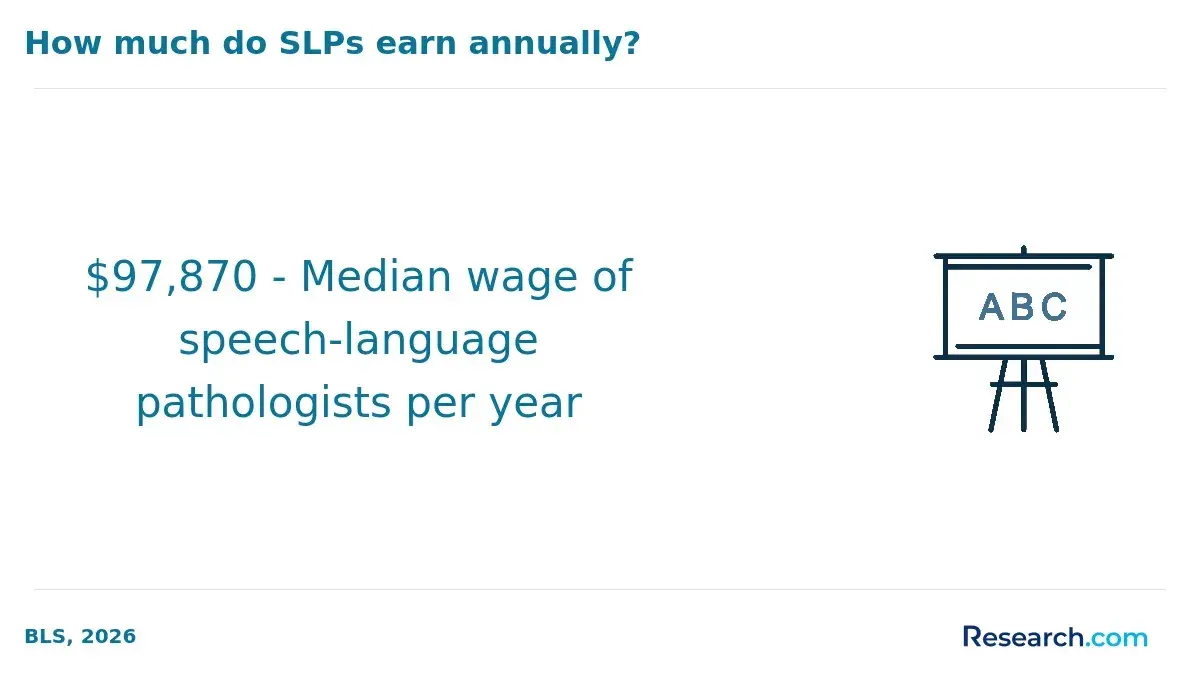
The labor market supports careful program selection rather than a one-size-fits-all academic choice. The BLS reports a median annual wage of $97,870 for speech-language pathologists in May 2025. That national figure does not predict an individual offer, because pay varies by setting, geography, experience, schedule, and employer, but it underscores why completing a licensure-eligible degree efficiently can matter financially.
For students targeting PhD study, research careers, or academia, when is a thesis track essential?
A thesis is not universally essential for PhD admission, but it is often one of the strongest ways to show that you understand the research process and can sustain an independent scholarly project. It is particularly useful for applicants who want research-intensive doctoral programs, university faculty careers, clinical research coordination, or roles involving outcomes research and grant-supported projects.
Doctoral admissions committees commonly assess research fit, methodological preparation, writing ability, faculty recommendations, and evidence that the applicant understands the realities of research. A completed thesis can provide concrete evidence in all of those areas, especially when the student can explain the project's design choices, limitations, findings, and next questions.
A thesis is most compelling when it produces meaningful preparation rather than merely another credential. Consider the thesis track if you can reasonably secure these conditions:
- A faculty mentor whose research area aligns with your intended doctoral interests.
- A feasible project scope that can be completed within the master's timeline.
- Training in research methods, statistics, ethics, and scholarly writing.
- Opportunities to present a poster, contribute to a manuscript, attend a lab meeting, or assist with an ongoing study when available.
- Clear understanding of what support the advisor provides during proposal development, analysis, revisions, and defense preparation.
Applicants without a thesis are not automatically excluded from PhD study. They can build comparable evidence through research assistant roles, independent studies, conference work, strong methods coursework, post-baccalaureate research employment, or a research-focused clinical doctorate pathway where appropriate.
Still, if doctoral study is a serious goal rather than a distant possibility, choosing a thesis early may prevent the need to create research experience after graduation.
How do thesis and non-thesis options change SLP workload, clinical hours, and time to degree?
Both pathways are demanding because the professional master's curriculum combines graduate courses, clinic responsibilities, documentation, assessment preparation, and external placements. The key workload difference is that a thesis adds an independent project with deadlines that may not align neatly with the academic calendar.
Clinical hour expectations are generally determined by program and professional training standards, not by whether a student completes a thesis. A thesis-track student must still complete the same required practica and demonstrate the same clinical competencies as peers in the non-thesis option.
This table shows the typical planning differences students should discuss with a program, not universal rules:
| Planning area | Thesis option | Non-thesis option |
| Course load | May include dedicated thesis credits or replace electives | May include a capstone or exam-preparation course |
| Clinical placements | Usually unchanged, though scheduling can become more complex | Usually unchanged and scheduled within a standard program sequence |
| Work outside class | Literature review, data management, analysis, committee revisions, defense preparation | Focused preparation for a defined assessment or applied project |
| Time-to-degree risk | Potentially higher if research milestones are delayed | Usually lower when all required courses and practica are completed on schedule |
| Flexibility after enrollment | Depends on advisor capacity and program deadlines | Depends on capstone, exam, and graduation-cycle policies |
Do not assume a non-thesis track is "easy" or that a thesis necessarily adds a full year. Some programs build a thesis into the standard sequence; others require extra credits or summer enrollment. Ask for a sample term-by-term plan for both options, including clinic hours, research credits, tuition implications, and the latest possible completion date if a final requirement must be repeated.
Students evaluating flexible SLP online programs should also ask whether synchronous sessions, campus visits, and placement schedules leave realistic time for research. Online delivery does not eliminate the intensive clinical obligations of a licensure-oriented SLP degree.
What questions should applicants ask about thesis advising, IRB approval, and completion risks in SLP programs?
The most preventable thesis problem is choosing a program based on the existence of a thesis option without confirming how students actually receive advising, access projects, and finish on time. A department may value research but still have limited faculty capacity in a particular specialty.
Ask these questions before accepting an offer, preferably in an email that you can retain alongside the graduate catalog:
- Is the thesis option available to every admitted student, or is admission to the track selective?
- When must students choose the thesis or non-thesis path, and can they change later without extending enrollment?
- How are thesis chairs assigned, and may students contact prospective mentors before committing?
- How many students does a typical faculty member supervise at one time?
- What are the usual proposal, defense, and manuscript deadlines relative to graduation?
- Does the department provide existing datasets or projects, or must students recruit participants independently?
- What types of projects require IRB review, how long does approval usually take, and may data collection begin before approval?
- What happens if a chair takes leave, a committee member departs, recruitment fails, or the thesis is not approved by the graduation deadline?
- Are thesis credits charged separately, and are summer terms commonly needed to finish?
IRB review protects research participants and institutional compliance; it is not simply paperwork. Students should never assume they can collect data first and seek approval later. When a project uses human participants, identifiable clinical information, or other regulated materials, the institution's policies and IRB determination govern the work.
Red flags include vague answers about advisor assignment, no published thesis timeline, pressure to select a project before meeting an advisor, or a claim that a thesis "should not affect graduation" without a written contingency policy. A well-managed program can explain its milestones and what support is available when research plans change.
How do supervisors and employers in schools, hospitals, and private practice view thesis versus non-thesis training?
For most entry-level clinical jobs, employers do not treat a thesis as a substitute for licensure readiness, clinical performance, or setting-specific competence. Schools often prioritize eligibility for state school credentials, collaboration skills, pediatric clinical preparation, and caseload management. Hospitals may emphasize medical placement experience, clinical reasoning, documentation, and population exposure. Private practices may focus on treatment skills, reliability, schedule needs, and client fit.
A thesis can still be an advantage when it aligns with the employer's work. It may help a candidate discuss evidence-based practice, quality improvement, specialized assessment questions, data interpretation, or research initiatives. Its value is strongest when the applicant can translate the work into practical clinical insight rather than simply listing "thesis completed" on a résumé.
The following comparison shows where each path can be most visible during hiring:
| Employment setting | What usually matters most | Potential thesis value |
| Public or private schools | State eligibility, student-centered practice, teamwork, and school-based clinical experience | Useful for data-informed intervention or future leadership, but rarely required |
| Hospitals and rehabilitation settings | Relevant medical experience, clinical judgment, documentation, and interdisciplinary communication | Can support interest in outcomes, protocols, or specialized populations |
| Private practice | Clinical skill, client communication, productivity expectations, and specialty fit | Usually secondary unless the practice is research-oriented or highly specialized |
| University or research center | Research experience, scholarly writing, methods, and long-term academic potential | Often materially helpful and sometimes expected for research-focused roles |
During interviews, discuss concrete competencies: populations served, assessments administered, interventions used under supervision, collaboration experiences, and how you use evidence. Those details usually give employers more useful information than track title alone.
How can current and prospective SLP students verify program policies on switching tracks or adding a thesis later?
Verify switching policies before enrollment, not after you have begun clinical sequencing. Schools may allow a change only at specific milestones because faculty capacity, thesis-credit registration, graduation audits, and cohort schedules can limit flexibility.
Use a document-first approach. The graduate catalog, student handbook, thesis manual, plan of study, and registrar policies may each contain part of the answer. Then ask the program director or graduate coordinator to clarify any conflict in writing.
- Locate the current catalog language for thesis, non-thesis, comprehensive examination, capstone, credit, and graduation requirements.
- Ask whether the track choice is made on application, after the first term, after advisor matching, or near graduation.
- Confirm whether switching changes total credits, tuition, clinic sequencing, financial-aid enrollment status, or expected graduation date.
- Ask whether a non-thesis student may add a thesis later and whether a faculty chair is guaranteed or merely subject to availability.
- Request the deadline for forming a committee, submitting a proposal, and enrolling in thesis credits.
- Keep written responses and compare them with the catalog year that will govern your degree.
Do not rely solely on an informal conversation with a faculty member or another student. Policies can change by catalog year, and an individual professor's willingness to supervise does not override departmental enrollment limits or graduate-school deadlines.
If you are undecided, choose a program that offers meaningful research exposure without making a thesis the only way to access a mentor. Research assistantships, lab meetings, independent studies, and electives can preserve options while you learn whether sustained research is a genuine fit.
Other Things You Should Know About Speech Language Pathology
Yes, in many programs. A thesis is commonly optional, while clinical coursework, supervised practicum, degree completion, certification steps, and state-specific licensure requirements remain essential. Confirm the exact graduation path in the university catalog.
Usually not for entry-level clinical jobs. Employers generally care more about licensure eligibility, Clinical Fellowship readiness, clinical experiences, communication skills, and fit with the setting. A thesis may be more relevant for research-oriented positions or later doctoral applications.
Yes. Many applicants demonstrate research readiness through assistantships, independent studies, conference presentations, research employment, methods coursework, or strong faculty recommendations. A thesis can strengthen an application, but it is not the only route.
It can. Costs may rise if thesis credits add to the required total, summer enrollment is needed, or delayed completion extends tuition and living expenses. Ask each school for the total required credits and whether thesis enrollment continues until final approval.
References
- Speech-Language Pathology (MS-SLP) Graduate Program https://hhs.purdue.edu/graduate-programs/speech-language-pathology-ms-slp-graduate-program/
- Thesis vs. Non-Thesis Master's Programs: Which is Right... https://potomac.edu/thesis-vs-non-thesis-masters/
- Timeline to Becoming an SLP: What to Expect at Regis https://www.regiscollege.edu/blog/speech-language-pathology/masters-speech-language-pathology-program-timeline
- SLP Thesis Track Guide: Timeline, Requirements & Career... https://www.speechpathologygraduateprograms.org/slp-thesis-track/