2027 Switching Between Full-Time and Part-Time SLP Study: Program Flexibility Compared

Co-Founder and Chief Data Scientist

Reviewed by Rhea Paul, PhD
SLP Education & Research Expert
Switching between full-time and part-time SLP study can protect your ability to stay enrolled when work, caregiving, finances, or health circumstances change. But the decision can also delay clinical placements, alter federal aid eligibility, and extend the path to licensure.
This guide explains how program flexibility works in speech-language pathology master's programs, what schools commonly permit, and which questions to get answered in writing before you choose a track or request a change.
Key Things You Should Know
- Full-time status is usually defined by each university, often around 9 graduate credits per term, while part-time enrollment may extend a typical 2-year SLP master's sequence by one or more years.
- Changing pace does not inherently jeopardize CAA accreditation, but students must still complete all required curriculum and supervised clinical education; ASHA certification standards generally include at least 400 total clinical clock hours, including 375 direct client-contact hours.
- A reduced course load can affect federal loan eligibility, assistantships, insurance, clinical sequencing, and the date you can begin the Clinical Fellowship and pursue state licensure.
How do full-time and part-time SLP programs define enrollment status, course load, and time to degree?
There is no single national definition of full-time enrollment for speech-language pathology graduate programs. Universities set their own academic and financial-aid thresholds, although 9 graduate credits per semester is a common full-time benchmark. A program's curricular sequence matters as much as its credit count because speech, language, swallowing, research, and clinical courses often must be taken in a prescribed order.
Full-time students commonly take a coordinated set of academic and clinical courses each term and finish in about two academic years, including summers when required. Part-time students generally take fewer courses each term and may need three or more years, especially if clinics are available only during particular terms.
The comparison below shows why applicants should distinguish enrollment classification from program pace. A student may be officially full-time for aid purposes while still having a schedule that is less intensive than another university's accelerated cohort.
| Factor | Full-time SLP path | Part-time SLP path |
| Typical term load | Often about 9 or more graduate credits; school-specific | Usually below the institution's full-time threshold |
| Curriculum structure | Frequently lockstep cohort sequence | May be planned part-time or built from available courses |
| Time to degree | Often about 2 years when prerequisites are complete | Often longer because prerequisites and clinic courses are sequenced |
| Weekly availability | High; coursework, preparation, and clinical commitments can occur weekdays | Lower academic load, but clinics may still require daytime availability |
| Best fit | Students able to prioritize school and reach licensure sooner | Students needing more room for work, family, or recovery needs |
Do not assume that taking fewer credits makes the workload proportionally easier. A single clinic assignment can require preparation, documentation, supervision meetings, and client care at fixed times. Ask whether the school defines a part-time curriculum at admission or merely permits occasional under-enrollment.
What kinds of flexible pacing, cohort changes, and schedule options do SLP programs typically allow?
Program flexibility exists on a spectrum. The most flexible programs publish a formal part-time plan with sequenced courses, while the least flexible use a lockstep cohort in which every student takes the same courses and begins clinical education together. Hybrid and online delivery can expand where students attend class, but it does not necessarily make clinical training or live sessions flexible.
Before relying on a program's flexibility claims, identify which of these arrangements it actually offers:
- A formal part-time curriculum with a published course map and longer completion window.
- A temporary reduced-load option for one term, followed by rejoining a later cohort.
- Summer enrollment that helps students maintain progress or make up a required course.
- Leave-of-absence policies that allow a planned pause without submitting a new application.
- Synchronous online classes offered at fixed evening or daytime times.
- Asynchronous didactic coursework paired with fixed-hour practicum obligations.
Flexibility is most valuable when it is predictable. A school that says requests are reviewed "case by case" may be supportive, but it cannot promise that a needed course, supervisor, or clinical placement will be available when you return. Students who need a stable work schedule should compare published meeting times, campus requirements, and clinical-day expectations - not just whether lectures are online.
If online delivery is central to your decision, compare the structure of available SLP online programs carefully. Admission accessibility and online delivery do not, by themselves, establish that a program permits a midstream pacing change.
When can SLP students switch between full-time and part-time tracks, and what approvals are required?
Students are most likely to switch successfully between terms, before registration and before clinical placements are assigned. Moving from full-time to part-time is often simpler early in the academic sequence than after entering advanced practicum, externship, or capstone courses. Moving from part-time to full-time can be harder because courses may have prerequisites, limited seats, and cohort-based clinic schedules.
A request commonly requires approval from the graduate program director or academic advisor, and it may also involve the clinical education coordinator, registrar, financial-aid office, international student office, and disability or student-support office when applicable. Approval is not automatic simply because tuition is charged per credit.
Use the following process before dropping a class or registering for additional credits:
- Review the catalog, student handbook, and clinical education handbook for progression and leave rules.
- Ask the program director for a revised term-by-term plan showing course prerequisites and expected graduation date.
- Confirm with the clinical coordinator how the change affects observation, campus clinic, externship, and placement eligibility.
- Ask financial aid to recalculate aid, loan eligibility, satisfactory academic progress, and cost of attendance.
- Obtain the approved plan in writing and retain it with your degree audit.
A common mistake is withdrawing after a term begins without first checking whether the course is a prerequisite for the next clinic. The better approach is to ask about academic, clinical, billing, and aid consequences together. One administrative approval does not automatically cover the others.
How does changing between full-time and part-time SLP study affect ASHA CAA accreditation compliance?
Changing your enrollment intensity does not normally affect whether a program is accredited by the Council on Academic Accreditation in Audiology and Speech-Language Pathology (CAA). Accreditation applies to the program's ability to meet standards; it is not a personal status that a student loses by studying part-time. The important question is whether your revised plan still enables you to meet all degree and clinical education requirements.
CAA-accredited SLP programs must provide a curriculum and clinical education that prepare graduates for professional practice. Students generally need documented clinical experiences, qualified supervision, and successful completion of the program's academic and clinical requirements. For the ASHA Certificate of Clinical Competence in Speech-Language Pathology, the graduate degree and clinical practicum must align with current certification standards; applicants should verify the requirements in effect when they apply rather than relying on an older checklist.
The following distinctions prevent a frequent misunderstanding about accreditation:
| Question | What changing pace means | What to verify |
| Is the degree still from an accredited program? | Usually yes, if you remain in the same accredited program and complete its requirements. | Current CAA status and any program-specific completion deadline. |
| Can clinical requirements be reduced? | No. A slower pace changes timing, not competency or hour requirements. | How supervised hours and competencies will be documented. |
| Can a student take required courses elsewhere? | Sometimes, but transfer approval can be limited. | Written approval before enrolling elsewhere. |
| Will an extended timeline matter? | It may, if policies, standards, or curriculum change before graduation. | Maximum time-to-degree and teach-out or curriculum-transition rules. |
Do not confuse institutional accreditation, programmatic CAA accreditation, and state licensure eligibility. They are related but separate safeguards. Before committing, confirm the program's current CAA status and ask how it handles students whose degree timeline extends beyond the usual cohort schedule.
In what ways do funding, cost of attendance, and financial aid eligibility change when SLP status shifts?
A part-time path can lower the tuition bill due in a given term, but it may increase the total cost of attendance because tuition increases, additional fees, lost assistantship eligibility, and more months of living expenses can accumulate over a longer timeline. Compare total expected borrowing and months without full-time earnings, not just the cost of one semester.
Federal Direct Unsubsidized Loans for graduate and professional students generally require at least half-time enrollment, but each institution determines its half-time credit threshold. Federal work-study, institutional scholarships, graduate assistantships, and health insurance can have their own enrollment rules. A student who remains half-time may retain some loan access but still lose a tuition waiver or assistantship that requires full-time status.
Ask financial aid to provide a revised award calculation before making a schedule change. The most decision-relevant items are:
- The school's full-time and half-time graduate-credit definitions for the relevant term.
- Whether your aid package, assistantship, scholarship, or tuition remission has a minimum enrollment requirement.
- How the school will adjust the cost-of-attendance budget for a longer program timeline.
- Whether withdrawing after classes begin triggers a return-of-funds calculation or a balance due.
- Whether your health insurance, housing, or dependent-care arrangements depend on full-time enrollment.
Career prospects can inform the long-term calculation, but they should not substitute for a personal budget. The U.S. Bureau of Labor Statistics reports a May 2025 median annual wage of $97,870 for speech-language pathologists and projects 17% employment growth from 2025 to 2035. Those national figures indicate strong demand, yet pay varies by setting, location, experience, and schedule; explore how much do SLPs make alongside your expected debt and state-specific opportunities.
How do full-time versus part-time SLP paths influence clinical placement sequencing and practicum hours?
Clinical education is usually the least flexible part of an SLP master's degree. Programs must coordinate client needs, supervisor qualifications, site agreements, course prerequisites, and student readiness. Even a primarily online program may require students to be available for daytime clinical experiences in their community or near campus.
ASHA certification standards generally require a minimum of 400 clinical clock hours, including at least 375 hours of direct client or patient contact and 25 hours of guided clinical observation. Individual programs may require additional hours or competencies. A part-time student still completes the same required clinical education; the hours are distributed over more terms rather than reduced.
This table highlights the operational trade-off between paths.
| Clinical factor | Full-time sequence | Part-time sequence |
| Entry into practicum | Often occurs with the assigned cohort after prerequisite courses. | May be delayed until required courses and a placement slot align. |
| Placement availability | Program can plan for a predictable cohort size. | May depend on supervisor and site capacity in a later term. |
| Work compatibility | Usually difficult once clinic intensifies. | More time between courses may help, but fixed clinical hours remain common. |
| Graduation timing | More predictable if progression is uninterrupted. | Can vary when a required placement is offered only once per year. |
| Best question to ask | "What weekday hours are expected during each clinical term?" | "Can you show when I would enter each clinical experience if I reduce my load?" |
Do not choose a part-time plan on the assumption that placements will occur evenings or weekends. Those options are limited in many communities and depend on site and supervisor availability. Ask whether the school arranges placements, what geographic radius may apply, and whether students are responsible for travel, background checks, health requirements, or site-specific costs.
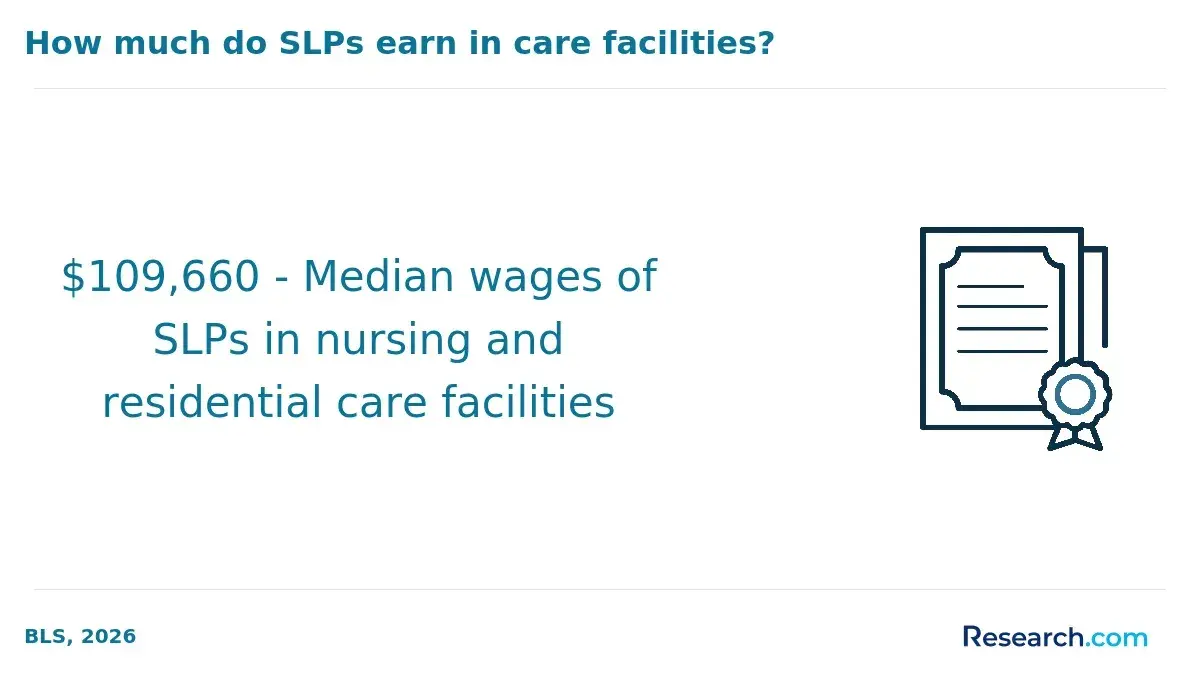
Nursing and residential care facilities $
Hospitals; state, local, and private
Offices of physical, occupational and speech therapists, and audiologists
What are the consequences for state licensure timelines when SLP students reduce or increase enrollment intensity?
A slower academic pace usually delays the earliest date you can graduate, begin a post-graduate Clinical Fellowship, apply for state licensure, and independently practice where a license is required. It does not usually change the fundamental licensing requirements, but requirements vary by state and can change while you are enrolled. Your target state - not the state where your university is located - should drive your planning.
For many graduates, the sequence is degree completion, supervised post-graduate experience such as the Clinical Fellowship where required, examination and application steps, and state board approval. Some states issue temporary, limited, or provisional credentials for supervised practice, but names and conditions differ. A longer program timeline can also affect when you may qualify for school-based credentials or begin an employer's onboarding process.
Reducing enrollment can be a sound choice when it prevents academic difficulty or clinical disruption. However, students planning around a job offer, a school-year hiring cycle, or a relocation date should obtain a revised graduation estimate and discuss it with prospective employers only after the program confirms the plan.
Accelerated choices deserve equal caution. Some combined undergraduate-graduate options can shorten the overall route for eligible students, but they have fixed prerequisite and progression rules. Review 5 year SLP programs separately from a standard master's pacing decision, since an accelerated pathway is not simply a heavier course load.
How do online, hybrid, and on-campus SLP programs differ in flexibility to alter study load midstream?
Format affects the type of flexibility available, not whether a program is inherently flexible. Online programs may reduce commuting and allow coursework from home, but many use cohort schedules, live class meetings, required immersions, and in-person clinical experiences. Campus programs may offer more local faculty access and clinic infrastructure, while hybrid programs can combine online instruction with periodic travel requirements.
Use this comparison to match format to the constraint you actually need to solve.
| Format | Potential flexibility | Common limitation | Best fit |
| Online | Reduced relocation and commuting; some asynchronous coursework. | Clinical placements, synchronous classes, and campus immersions may still be fixed. | Students who need geographic flexibility and can meet clinical availability requirements. |
| Hybrid | Some remote coursework with structured in-person learning. | Travel dates can be mandatory and difficult to change. | Students near enough to attend required intensives. |
| On-campus | Access to campus services and potentially university clinics. | Classes and clinics often occur during standard weekday hours. | Students able to live near campus and prioritize a traditional cohort experience. |
State authorization and professional licensure disclosures are particularly important for distance education. A program may be online yet unable to enroll residents of every state, or it may state that its curriculum has not been determined to meet a particular state's licensing rules. Check eligibility before applying and again before relocating during the program.
Students seeking remote coursework should also compare travel, synchronous sessions, clinical support, and part-time sequencing among the best online speech pathology programs. Lower tuition or an online label is not enough if the calendar cannot accommodate your required clinical availability.
What policies do SLP programs use for academic standing, leave of absence, and re-entry after status changes?
SLP graduate programs commonly use progression standards because later courses and clinical work build on earlier knowledge and skills. Policies often address minimum grades, cumulative GPA, remediation, professional conduct, clinical competency, maximum time to complete the degree, and conditions for repeating a course. These rules can apply regardless of whether a student is full-time or part-time.
A leave of absence is not the same as dropping to part-time. A reduced load keeps you actively enrolled; a leave pauses enrollment for an approved period. Re-entry after leave may depend on space, curriculum changes, clinical capacity, background checks, health clearances, and whether the program has altered its course sequence.
Review these policy areas before requesting a change:
- Minimum grade and GPA requirements for remaining in good standing.
- Whether a failed or withdrawn course can be repeated and how it affects the next practicum.
- Maximum time allowed to complete the degree from initial enrollment.
- Length, documentation, and approval requirements for a leave of absence.
- Whether re-entry is guaranteed or contingent on course, cohort, and clinical-placement capacity.
- Whether students returning after a curriculum revision must meet new requirements.
A red flag is a school that offers vague assurances but will not identify the written policy or the office that approves exceptions. A reasonable program may still deny a specific request because of clinical capacity, but it should clearly explain the process, deadlines, and consequences.
How should speech-language pathology students evaluate program flexibility before committing to a full-time or part-time track?
The best choice is the pace you can sustain through clinical training, not simply the fastest or least expensive option on paper. Full-time study generally fits students who can make school their primary commitment and want the most direct route to graduation. A formal part-time track may be better for students with ongoing employment, caregiving, medical, or financial responsibilities - provided the program can show exactly how clinical education will be sequenced.
Ask admissions and the program's clinical education office for answers in writing. The questions below reveal whether flexibility is a documented design feature or an informal promise.
- What are the full-time, half-time, and part-time credit thresholds for graduate students?
- Is part-time study available from admission, only by exception, or only before clinical practicum begins?
- Can you provide a term-by-term part-time course plan and estimated graduation date?
- Which courses are offered only once per year, and what happens if I postpone one?
- When do students begin clinic, how many daytime hours are expected, and can placements be delayed?
- Who arranges placements, and what travel, background-check, health, or site costs should I expect?
- How would a status change affect tuition, scholarships, assistantships, loans, insurance, and satisfactory academic progress?
- What is the leave-of-absence and re-entry policy, including the maximum time to degree?
- Does the program accept students in my state and provide a licensure disclosure for my intended state of practice?
Compare the answers against your actual calendar for the entire degree, not just the first semester. Include work shifts, dependent care, commute or travel time, unpaid clinical hours, and the period after graduation when you may need supervised practice. If a program cannot map a feasible sequence for your circumstances, a different format or a formal part-time cohort is likely the safer investment.
Other Things You Should Know About Speech Language Pathology
It may be possible during some academic terms, especially in a formal part-time program, but it is often difficult once practicum begins. Clinical placements commonly require weekday availability, preparation, documentation, and supervision meetings. Ask for expected clinical hours by term before committing to a work schedule.
Taking longer does not inherently reduce the value of an accredited degree or prevent licensure. The practical effect is usually a later graduation and Clinical Fellowship start date. Keep your clinical skills current, meet program progression standards, and verify any changed licensing requirements before graduation.
Possibly, but it depends on course availability, prerequisites, cohort capacity, and clinical placement timing. Ask whether a later cohort change is guaranteed or reviewed individually. Obtain a revised academic plan before assuming you can accelerate.
Not necessarily. Online coursework may reduce commuting, but required live classes, immersions, and in-person clinical placements can still create fixed obligations. A formal published part-time sequence is more meaningful than an online delivery label.
References
- Part-Time Plan of Study - Speech@NYU - New York University https://speech.steinhardt.nyu.edu/academics/curriculum-snapshot/part-time/
- Full-Time vs. Part-Time: Which M.S. in Speech-Language... https://acu.edu/2025/09/30/full-time-vs-part-time-which-m-s-in-speech-language-pathology/