2027 Should You Choose Accounting or General Business in a BS in Business Administration?
Audited and Verified:
Our Editorial and Data Verification Process
Research.com uses government datasets, official education statistics and primary institutional information to support its career and degree guides. Our review process checks factual accuracy, occupational definitions, source dates and the requirements associated with the credentials discussed.
How This Article Was Fact-Checked
Our editorial team verifies salary estimates, employment projections, education requirements and program information against original data providers and official organizations. Salary figures are checked against the relevant occupational definitions and reporting periods. Information about licensure, accreditation and required in-person training is reviewed separately.
Fact-checked and verified on:

Co-Founder and Chief Data Scientist
Choosing between accounting and general business can change which courses you take, which internships you pursue, and how directly your BS in Business Administration prepares you for a first job. Accounting offers a clearer route into financial reporting and related work; general business leaves more room to explore functions such as operations, marketing, and management. This guide is for students choosing a concentration or comparing degree-completion options. It explains the curriculum, career and licensing trade-offs so you can choose based on your target role - not the assumption that one concentration is universally better.
Key Things You Should Know
- Choose accounting if you want substantial accounting coursework and plan to seek accounting-related experience; choose general business if you need flexibility across business functions.
- An accounting concentration does not itself qualify you for CPA licensure. Compare its courses and credits with the requirements of the state where you intend to become licensed.
- The U.S. median annual wage for accountants and auditors was $83,680 in May 2025, but that occupation-wide figure is not an expected starting salary for either concentration.
What Is the Difference Between Accounting and General Business in a BSBA?
A BS in Business Administration (BSBA) typically combines a shared business core with electives or a formal concentration. An accounting concentration uses more of that space for accounting subjects. A general business option usually spreads it across several functions or allows more elective choice. Neither label tells you exactly how many advanced courses a school requires.
This comparison shows the practical distinction to check in a program's catalog; the official degree audit determines what applies to your own plan.
| Decision factor | Accounting concentration | General business option |
| Course emphasis | Financial reporting, accounting systems, taxation, auditing, or related subjects, depending on the program | A wider selection from management, marketing, finance, operations, and other business subjects |
| Best fit | A student who wants to test or pursue accounting work | A student exploring functions or preparing for a cross-functional role |
| Main limitation | Less elective room; courses may still fall short of CPA requirements | Fewer advanced courses in any one function unless electives are planned deliberately |
Check whether "general business" and "accounting" are official concentrations shown on the transcript or simply advising tracks. If neither matches your goal, a different specialized degree may be worth comparing; for example, shorter online bachelor's pathways in organizational leadership may interest someone focused on organizational practice rather than accounting.
Is Accounting or General Business Better for Your Career Goals?
Accounting is the stronger choice if your target jobs involve preparing or examining financial records and you want courses that build toward those tasks. General business is the stronger choice if you are still comparing functions or expect to work across budgeting, customers, people, and operations. Neither choice substitutes for relevant work experience.
Start with job postings you would realistically pursue after graduation. An aspiring accountant should look for requirements such as intermediate accounting and internship experience, then check whether the BSBA supplies them. A student aiming at operations or project coordination should look for evidence of scheduling, spreadsheet, communication, and process skills. If project work is the clear goal, comparing affordable online project management degrees may be more useful than choosing a general business concentration by default.
The recommendation can reverse when your school's curriculum changes the trade-off. An accounting track with limited advanced courses may be less useful for an accounting goal than a dedicated accounting degree. Conversely, general business can be a focused choice if it lets you assemble relevant electives and an applied project without adding credits.
What Careers Can You Pursue With Each Business Administration Option?
Accounting graduates may pursue accounting assistant, staff accountant, audit associate, or related entry-level openings, subject to each employer's course and experience requirements. Financial reporting and audit roles call for more specialized preparation than general familiarity with business finances. General business graduates may pursue roles such as operations coordinator, sales support specialist, administrative specialist, or project coordinator, depending on their skills and experience.
The paths overlap. An accounting student can work in operations, and a general business student can support budgeting or bookkeeping. But an introductory accounting course alone is unlikely to meet a posting that requires advanced accounting study. Likewise, neither concentration makes a new graduate a manager: supervisory roles generally require demonstrated responsibility and results.
If project coordination is your target and you have prior college work, compare how those credits apply before changing degree paths. Resources on colleges accepting coursework toward project management bachelor's study can help you identify programs to investigate, but only a school's evaluation can establish which requirements your credits satisfy.
Both options commonly draw on a business core that may include financial and managerial accounting, economics, statistics, finance, marketing, and management. The consequential difference is what happens after those introductory courses. Accounting students may need a sequence in intermediate accounting, tax, audit, or accounting information systems. General business students may be able to combine courses from multiple departments, sometimes with fewer prerequisite chains.
Read the course descriptions and schedule, not just the concentration name. Intermediate accounting may require earlier accounting courses, and an advanced class offered infrequently can affect graduation timing. Compare the actual projects, software exposure, internship options, and remaining elective space. If you are entering from another field, use business administration degree prerequisite planning to frame questions for an adviser; prerequisites and transfer equivalencies remain school-specific.
Possibly, but the concentration alone does not establish eligibility. CPA licensure is governed by the state board of accountancy where you apply. Education rules can address total college credits, accounting and business subject credits, course level, and other conditions; examination and experience requirements are separate. A BSBA may provide useful coursework while leaving requirements unmet.
Ask the program for a course-by-course accounting plan, including whether needed advanced courses are offered and whether additional study would be required. Then compare that plan with the relevant state board's published requirements and seek clarification from the board where needed. If you are still selecting a school, compare leading American online business degree schools as a starting point for finding programs to examine - not as evidence that their accounting tracks meet your state's rules.
A dedicated accounting bachelor's may be the more direct route if CPA preparation is your principal objective. Do not assume that a concentration title, business-school accreditation, or an adviser's informal estimate constitutes a licensure determination.
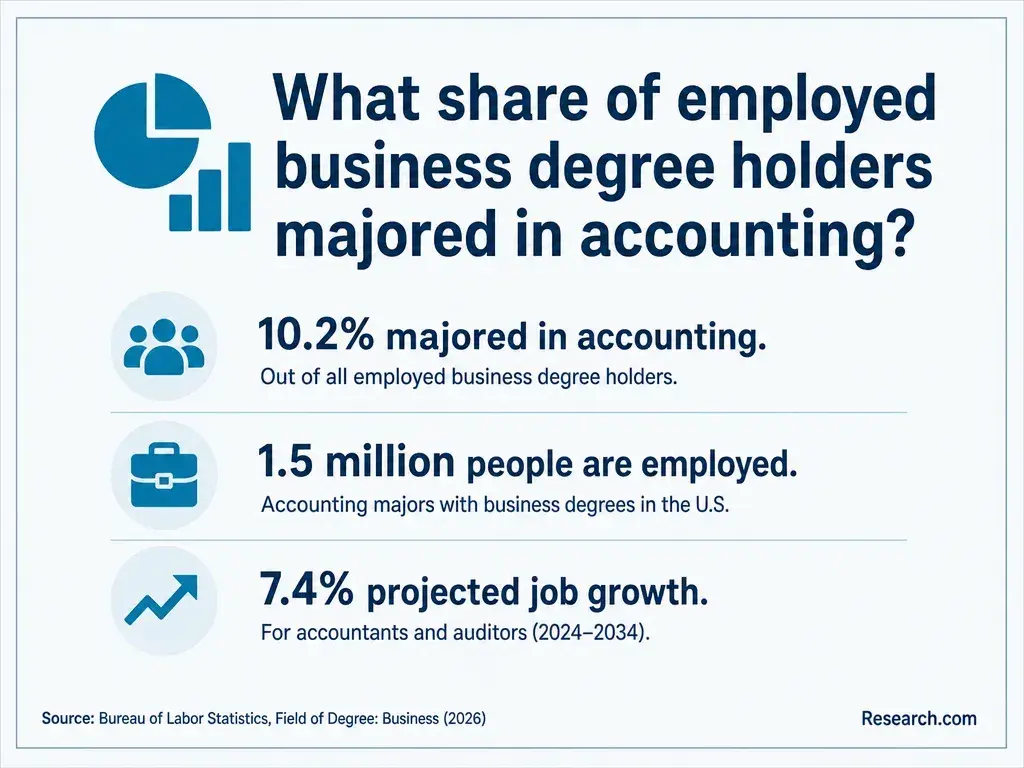
There is no single reliable salary for everyone who graduates with either BSBA option. Pay depends on the occupation entered, location, industry, experience, and responsibilities - not just the concentration printed on a transcript. The U.S. Bureau of Labor Statistics reports a $83,680 median annual wage for accountants and auditors in May 2025. That is the midpoint for workers across the occupation, not a new accounting graduate's expected offer.
General business has no comparable single occupation-wide wage because its graduates enter different functions. Compare salaries for the specific entry-level roles available to you, alongside internship access and the courses employers request. If the more specialized option adds courses or tuition, account for that expense rather than assuming a salary premium. Students managing a tight budget can investigate business administration degrees for limited tuition budgets, then request an individualized cost and credit evaluation.
BLS projects 5% U.S. employment growth for accountants and auditors from 2025 to 2035. That indicates a continuing occupation, not a guarantee of a job for any graduate. Relevant coursework, internships, employer demand, and local competition still matter.
General business has no single job-growth projection: its outlook depends on the occupation you choose. Use a target job title rather than "business graduate" when researching demand. For instance, if supply chain work appeals more than broad administration or accounting, examine the required skills and consider whether fastest online supply chain bachelor's programs offer a better-fitting curriculum. An accelerated label should not replace a review of course availability and transfer credit.
A bachelor's degree is commonly planned around four years of full-time study, but your remaining time depends on accepted credits, where those credits apply, course sequencing, and enrollment pace. An accounting concentration can take longer if prerequisites or advanced courses do not fit your remaining terms. General business may offer more scheduling flexibility, but that is a program-level question, not a universal rule.
For an accurate comparison, request a degree audit for both options. Ask for remaining required courses and credits, expected course offerings, tuition and mandatory fees, and any added terms. Include books, software, travel, and earnings you might forgo. Accepted transfer credits that fill only free electives may save less time than credits that satisfy the business core. A guide to accelerated bachelor's study can help you assess faster formats, but faster calendar completion does not automatically reduce total cost or weekly workload.
Choose the format that lets you complete the courses and experience your goal requires. Online delivery may help you study around work or caregiving, while campus study may make face-to-face recruiting and collaboration easier. Neither format is inherently stronger for accounting or general business.
Check whether required classes include live sessions, proctored exams, scheduled group meetings, or campus visits. An accounting student should also confirm access to advanced courses and accounting-related recruiting; a general business student should check how broad elective choice works online. Compare total charges, not delivery labels alone. Lists of lower-cost business degree options can narrow a search, but verify each school's current fees, course availability, and support for your concentration.
How Can You Choose an Accredited Business Administration Program?
First, verify that the institution has recognized institutional accreditation and that its exact BSBA program offers the concentration you want. Business-school or programmatic accreditation through organizations such as AACSB, ACBSP, or IACBE is a separate question: check which school or programs are covered rather than assuming every business degree shares the same status.
Next, compare the evidence that affects this decision: a current catalog and sample course sequence, written transfer evaluation, advanced accounting offerings or general-business electives, internship support, and an individualized estimate of remaining cost and time. If financing matters, investigate business administration colleges participating in federal aid programs and confirm eligibility and aid terms with each institution. Before enrolling, ask an adviser to show how your chosen concentration appears in the official degree audit - and, for a CPA goal, check the separate state-board requirements.
Other Things You Should Know About Business Administration
Often, but the school controls concentration changes. Ask for an updated degree audit first: accounting course prerequisites may add terms even if all your existing credits remain accepted.
Some schools permit it; others limit overlapping courses or do not offer both as formal concentrations. Confirm the catalog policy and whether the second concentration adds credits.
That depends on how the institution records it and what documents an employer requests. You can also identify relevant coursework and projects on a résumé, accurately describing the credential awarded.
No. Accounting relies heavily on accurate calculations, spreadsheets, rules, and interpretation rather than advanced mathematics in every role. Review your program's math requirements and be prepared to practice quantitative work consistently.
- Education Requirements - CPA Examination https://www.labor.maryland.gov/license/cpa/cpaexam/cpaexameducreq.shtml
- Education Requirements | texas.gov https://www.tsbpa.texas.gov/applicants/education/
- Is Accounting a Good Career? Salary, Job Growth & Degree Options | Edison State Community College https://www.edisonohio.edu/blog/is-accounting-a-good-career-salary-job-growth-and-degree-options
- Accounting | McNeese State Universtiy https://www.mcneese.edu/academics/undergraduate/accounting/
- CPA vs. MBA: Which Is Better for Accounting Careers? | Northern Kentucky University Online https://onlinedegrees.nku.edu/programs/business/macc/professional-track/cpa-vs-mba-salary-careers/
- CPA Exam Requirements | psu.edu https://harrisburg.psu.edu/business-administration/accounting-bs/cpa-exam-requirements
- Accountant vs. CPA: key differences and when it matters | Capella University https://www.capella.edu/blog/business/accountant-vs-cpa-key-differences-and-when-it-matters/
- How to Choose a Concentration for Your Business Administration Degree - National https://www.national.edu/2026/02/02/how-to-choose-a-concentration-for-your-business-administration-degree/
- What Internships Should Business Students Look For? | Lasell University https://www.lasell.edu/academics/lasell-insights/what-internships-should-business-students-get.html
- CPA Exam Education Qualifications - Accounting | Naveen Jindal School of Management https://accounting.utdallas.edu/program-resources/cpa-exam-information-review-course/exam-education-qualifications/