2027 Online BS in Business Administration vs. a BS in Digital Marketing: Which Route Fits Your Career Plan?
Audited and Verified:
Our Editorial and Data Verification Process
Research.com uses government datasets, official education statistics and primary institutional information to support its career and degree guides. Our review process checks factual accuracy, occupational definitions, source dates and the requirements associated with the credentials discussed.
How This Article Was Fact-Checked
Our editorial team verifies salary estimates, employment projections, education requirements and program information against original data providers and official organizations. Salary figures are checked against the relevant occupational definitions and reporting periods. Information about licensure, accreditation and required in-person training is reviewed separately.
Fact-checked and verified on:

Co-Founder and Chief Data Scientist
A business administration degree keeps several business functions in view; a digital marketing degree concentrates on reaching customers and measuring campaigns. That distinction matters if you are choosing a first career direction, changing fields, or finishing a bachelor's degree around work. This comparison shows where each route builds useful skills, which entry-level roles are realistic, and what to verify about cost, credits, and online requirements before enrolling. The better choice depends less on the degree's label than on the work you want to do and the evidence you can build while studying.
Key Things You Should Know
- Choose business administration for broader preparation in operations, finance, management, and marketing; choose digital marketing when campaigns, customer research, and marketing analytics are your clear target.
- The U.S. median annual wage for market research analysts was $78,760 in May 2025, but that occupation-wide figure is not an expected starting salary for digital marketing graduates.
- Compare actual required courses, applicable transfer credits, project opportunities, and total remaining cost: degree titles alone cannot establish which route will get you job-ready sooner.
What is the difference between an online BS in Business Administration and a BS in Digital Marketing?
An online BS in Business Administration is a general business degree delivered primarily online. It commonly combines accounting, finance, operations, management, and marketing. A BS in Digital Marketing is a specialized bachelor's degree focused more heavily on digital channels, campaign planning, content, customer behavior, and measurement. Both may include a business core; neither title guarantees a particular course or delivery schedule.
The decisive difference is breadth versus functional depth. Business administration leaves more room to pursue operations, sales, project coordination, or marketing as your interests develop. Digital marketing gives you more chances to practice a specific function, but may offer less required study in finance or operations. A business administration degree with an official marketing concentration can be a middle route; a few marketing electives do not automatically constitute a concentration. Use US rankings of online business degree programs to identify schools, then inspect each school's current catalog rather than assuming similarly named degrees teach the same material.
Which degree offers better career opportunities: Business Administration or Digital Marketing?
Neither degree wins across every job. Business administration fits someone seeking options across business functions or bringing existing customer service, administrative, or operational experience into a new role. Digital marketing fits someone committed to marketing work who wants repeated practice with audiences, campaigns, and performance data. For a career changer, an adjacent move from sales or communications into marketing may be more feasible than moving directly into an unrelated specialist role; projects and relevant experience matter alongside either degree.
The U.S. Bureau of Labor Statistics (BLS) projects 7% employment growth for market research analysts from 2025 to 2035. That signals demand in one relevant occupation, not growth for every digital marketing title or a guarantee of employment. If your target is project coordination rather than marketing, compare both degrees against transfer-friendly project management bachelor's degrees before committing to a major. First check the duties and qualifications in local job postings: the best route is the one that develops evidence for those duties without unnecessary coursework.
How do Business Administration and Digital Marketing salaries compare?
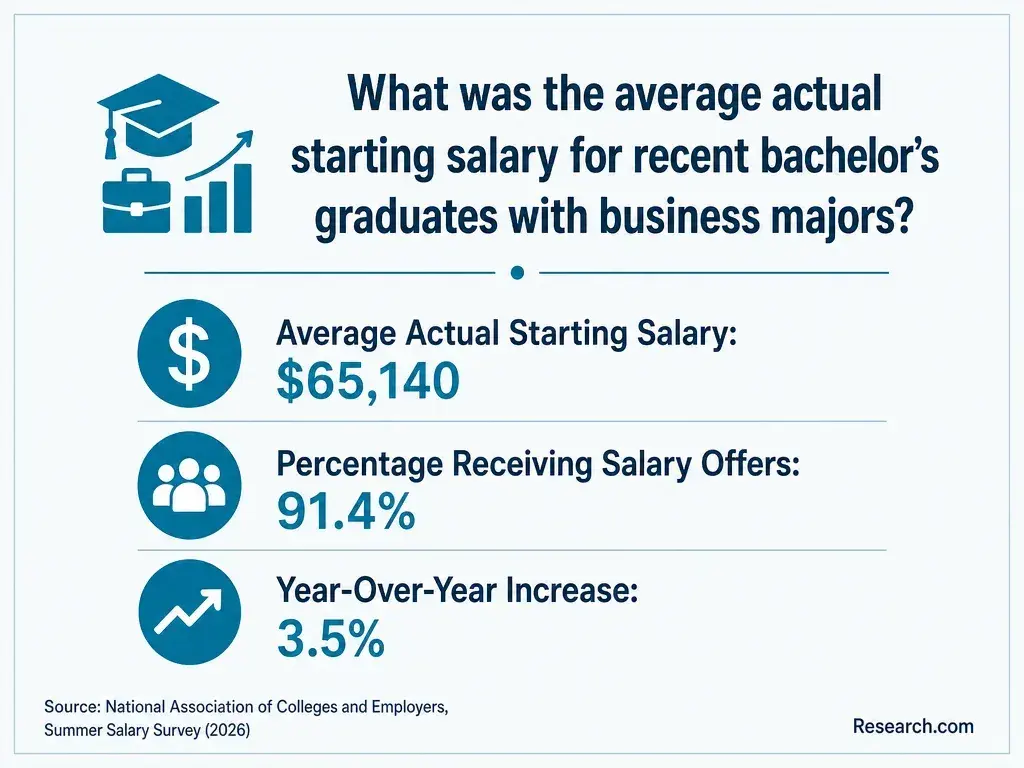
There is no dependable national starting salary for either degree title. BLS reports wages by occupation, not by undergraduate major. The figures below illustrate relevant roles, but both medians include workers with varying experience, employers, and education.
This comparison pairs an occupation often associated with marketing analysis with one accessible through broader business preparation. It helps frame possible directions, not predict what a new graduate will earn.
| Occupation | May 2025 U.S. median annual wage | Important limitation |
| Market research analyst | $78,760 | Research and analysis are not the same as every digital campaign job. |
| Human resources specialist | $75,940 | Business graduates may pursue HR, but employers can expect HR-specific preparation. |
The difference between these medians is too small to justify choosing a major on its own. Compare jobs you could plausibly qualify for, local pay, and the cost of finishing each program. Online business administration program cost-and-time comparisons can help you identify options, but calculate your own remaining cost after an official credit evaluation; an occupation-wide median is not a personal return-on-investment estimate.
Both paths generally include general education and foundational business study. Business administration usually requires more coverage across accounting, finance, economics, management, operations, and quantitative reasoning. Digital marketing typically devotes more major coursework to marketing research, digital channels, content strategy, consumer behavior, campaign analytics, and responsible use of customer data. Exact requirements vary by school.
For a marketing role, look beyond course names: can you design a campaign brief, explain how a metric relates to a business goal, and discuss what the data cannot prove? For a general business role, look for spreadsheet analysis, budgeting, process improvement, and written recommendations. Ask whether a required project uses a simulation, publicly available information, or approved workplace data; a classroom exercise is not evidence of real campaign results.
Course order also affects your timeline. A required analytics course may depend on statistics, while an advanced marketing course may require introductory marketing first. When reviewing accelerated online business degree programs, check prerequisite sequences and how often each required course runs; a shorter advertised calendar does not remove required work.
Online delivery can reduce commuting and expand school choices, while campus study may make in-person networking, recruiting events, and collaborative work easier to access. Neither format automatically provides better instruction or flexibility. An online course may still require live meetings, fixed exam windows, group presentations, proctoring, or an internship.
If you work or care for others, request a sample course calendar before enrolling. Check whether live attendance is required, when group work happens, what technology you need, and whether required courses are offered in the terms you can attend. Also ask how remote students access career services and faculty feedback. Online leadership bachelor's programs with compressed schedules provide another scheduling comparison if leadership is your goal, but a compressed schedule may demand more concentrated weekly study.
Schools commonly request prior academic records and proof that applicants meet their undergraduate admission standards. A program may also set separate conditions for entering the business major or certain upper-level courses. Requirements for prior college credits, grade standards, mathematics preparation, and application materials vary; a digital marketing major is not necessarily harder or easier to enter than business administration.
Transfer applicants should request two answers: which credits the institution accepts and which credits satisfy the chosen degree's general education, business core, and major requirements. If you have a prior bachelor's degree, ask about second-degree and residency rules. Before paying to apply, confirm the current requirements and deadlines; accredited schools with no application charge may help you compare options without adding that particular upfront cost.
A traditional bachelor's path is often planned around four academic years of full-time study, but your remaining time depends on transfer applicability, enrollment pace, prerequisites, and course availability. A specialized degree may require additional major courses even when a school accepts all your prior credits. Conversely, relevant marketing coursework may shorten the digital marketing route for some transfer students. Only the school's degree audit can establish what remains.
For a useful price comparison, ask each school for the remaining required courses and price them using its current tuition and fee schedule. Include books, software, technology or proctoring charges, any travel, and the cost of an extra term if a required class is unavailable. Compare grants and employer assistance separately from loans; eligibility and reimbursement rules need confirmation. Low-tuition pathways to a business administration degree are a starting point, not proof of your final net cost.
Business administration graduates may pursue operations coordinator, administrative specialist, sales support, procurement assistant, or project coordinator roles. Digital marketing graduates may pursue marketing coordinator, campaign assistant, content specialist, or junior marketing analyst roles. Job titles overlap: a general business graduate with strong campaign work can apply for marketing positions, while a digital marketing graduate with operational experience can pursue broader business work.
Read postings for tasks, not just titles. A campaign role may call for writing, audience research, spreadsheets, and reporting; an operations role may emphasize scheduling, vendor communication, and process documentation. Build a work sample that demonstrates those tasks through an internship, supervised project, relevant job, or clearly labeled class assignment. Do not present a simulated campaign as an employer-approved result. Managers and senior analysts usually need substantial relevant experience beyond a bachelor's degree.
If finishing quickly matters because you already have relevant experience, ranked US colleges for faster business degree completion can help you find programs to investigate. Verify your individual credit evaluation before assuming an advertised completion timeline applies to you.
A certification is most useful when it matches the tools or practices named in your target job postings. Digital marketing students might consider platform-specific training in advertising or analytics and pair it with a documented campaign-planning sample. Business administration students might pursue training in spreadsheets or a relevant business system. A course-completion certificate is not the same as an independently assessed professional certification, and neither substitutes for experience.
Project management credentials deserve particular care: eligibility, examination requirements, renewal rules, and costs depend on the issuing organization and credential. If that function is central to your plan, compare a targeted credential with the additional tuition and fees of a degree using project management program fees explained. Choose a credential for a demonstrable skill gap, not because its initials appear impressive.
How can you choose an accredited online business degree program?
First verify that the institution holds recognized institutional accreditation and that the exact degree is currently offered in the format you need. Then check whether the business school or program has AACSB, ACBSP, or IACBE accreditation, if that matters to you; such accreditation has its own scope and should not be assumed from the school's general accreditation. Accreditation supports a quality review, but does not establish that graduates secure particular jobs.
Compare the catalog and written degree audit against your target role: required courses, applied projects, transfer-credit placement, course frequency, advising, and career support are more informative than a degree name alone. Request the full cost for your expected enrollment pattern and ask whether any internship, campus visit, or live session is mandatory. If you plan to seek federal student aid, review FAFSA-accepting colleges for business administration students and confirm the specific school's participation and your eligibility directly. Choose only after you can explain how the program's requirements lead toward your intended first role.
Other Things You Should Know About Business Administration
Often, but the school determines how completed courses apply to the new major. Ask for a revised degree audit before switching so you can see any additional requirements or delay.
Usually not for entry-level marketing work. Relevant skills, experience, and a bachelor's degree that meets the employer's requirements are generally more immediate considerations.
No degree is required simply to have a business idea, and neither degree establishes that you can serve clients profitably. Practical experience, client agreements, finances, and applicable business rules matter.
Only with appropriate permission. Check employer rules on confidential information and intellectual property; otherwise, use an approved, redacted summary or a clearly identified independent project.
- Accreditation in the U.S. | ed.gov http://www.ed.gov/laws-and-policy/higher-education-laws-and-policy/college-accreditation/accreditation-in-the-us
- Marketing, Online B.B.A. Degree Completion Program | gsu.edu https://online.gsu.edu/program/marketing-online-bba-degree-completion-program/
- 9 Must-Know Digital Marketing Careers for 2025 | St. John's University https://www.stjohns.edu/news-media/johnnies-blog/digital-marketing-career-college-graduates
- Business Management vs. Marketing Degree: Which Fits You? | Gordon College https://www.gordon.edu/stories/business-management-vs-marketing-degree
- How Many Credits Do You Need to Graduate College? | snhu.edu https://www.snhu.edu/about-us/newsroom/education/how-many-credits-to-graduate-college
- 6 Types of Business Degrees and Career Paths | UMass Global https://www.umassglobal.edu/blog-news/6-types-business-degrees-and-career-paths
- Accreditation Process | AACSB https://www.aacsb.edu/educators/accreditation/accreditation-process
- Can Work Experience Count Toward a College Degree? | Whitworth Online https://online.whitworth.edu/news-articles/can-work-experience-count-toward-a-college-degree/
- Find the Right Online Degree Program by Using a Comparison Framework | Columbia Southern University https://www.columbiasouthern.edu/blog/blog-articles/2026/august/find-the-right-online-degree-program
- What Skills Do You Gain with a Marketing Degree? 10 Skills You'll Learn and How to Use Them | UC News https://www.online.uc.edu/blog/marketing-bachelors-degree-skills.html