2027 Paralegal Certificate Options for High School Graduates: Understanding Entry Requirements

Co-Founder and Chief Data Scientist
A paralegal certificate may look like a direct route from high school into legal work, but the word "certificate" does not tell you whether a program accepts first-time college students. Some do; others require college credits or a completed degree.
For recent graduates, that distinction can determine whether an application is worthwhile. This guide explains how to identify programs you can enter now, compare them with associate degree pathways, and check costs, training, and career limitations before enrolling.
Key Things You Should Know
- High school graduates can apply to some entry-level paralegal certificate programs, but other certificates require prior college coursework, an associate degree, or a bachelor's degree.
- If you have no college experience, compare an entry-level, credit-bearing certificate with a paralegal associate degree; a post-bachelor's certificate is not an immediate option.
- The Bureau of Labor Statistics reports $62,890 in May 2025 median annual pay for paralegals and legal assistants, but that occupation-wide figure is not a starting salary or a certificate-graduate outcome.
What Is a Paralegal Certificate, and Who Is It For?
A paralegal certificate is an educational award for completing a defined course of study. It is not the same as professional certification, a separate credential awarded by a professional organization or, where applicable, a state system after its requirements are met.
"Paralegal certificate" can describe different academic levels. An entry-level certificate may accept applicants with a high school diploma or equivalent. Another may require college credits, while a post-bachelor's certificate requires a bachelor's degree. A high school graduate should check the published admissions requirements rather than rely on the credential's name.
Paralegals support lawyers through work such as organizing case files, researching legal questions, and preparing draft documents under appropriate supervision. A certificate does not qualify its holder to practice law, represent clients as an attorney, or independently provide services that would constitute the unauthorized practice of law.
What Entry Requirements Do Paralegal Certificate Programs Have?
Requirements depend on the specific program. For a high school graduate, the decisive question is whether admission requires only secondary-school completion or also requires college-level study. Schools may separately request transcripts, placement results, or proof of English-language proficiency under their general admissions policies.
Read the program page and the current catalog together. In particular, distinguish a condition of admission from a course prerequisite that can be completed after enrollment. Admissions staff should be able to answer these questions in writing:
- Is a high school diploma or equivalent sufficient for admission to this specific certificate?
- Are college credits, general education courses, or a completed degree required before the first paralegal course?
- Are there separate requirements for an internship, including a background check or minimum academic standing?
- Is the certificate credit-bearing, and which courses must be taken in sequence?
Do not mistake a simpler application for a lower academic prerequisite. If you are also considering degree programs, legal studies programs without personal statement submissions may reduce one application step, but their degree-level admission requirements still apply.
Do High School Graduates Need College Experience to Become Paralegals?
Not necessarily as a legal prerequisite, but it can matter considerably when seeking a job. Employer expectations vary. The Bureau of Labor Statistics describes an associate degree in paralegal studies as a typical entry route and notes that some entrants have a bachelor's degree plus a certificate. A high school graduate can enter a suitable certificate program without prior college experience, yet should not assume every employer will treat that certificate as equivalent to an associate degree.
Examine local job postings before choosing a program. If employers you hope to work for frequently request an associate degree, a short noncredit certificate may leave an education gap. If postings accept a certificate and emphasize writing, document management, and office experience, a strong entry-level program may be a reasonable first step. In either case, supervised experience can help you demonstrate skills; enrollment alone is not a job qualification.
Which Paralegal Education Pathway Is Right After High School?
The best starting point depends on both admission eligibility and what you want the education to count toward later. This comparison separates routes that may be open immediately from one that requires a previous degree.
| Pathway | Starting point | Main advantage | Key limitation to check |
| Entry-level paralegal certificate | May accept a high school diploma or equivalent | Focused legal-support coursework | College credit and employer recognition vary |
| Paralegal associate degree | Generally designed for college entrants | Combines paralegal study with broader college coursework | Requires a larger time and tuition commitment |
| Bachelor's degree with relevant legal study | College entrant | Broader education and potential access to jobs preferring a bachelor's degree | Legal-support training may be less focused |
| Post-bachelor's paralegal certificate | Completed bachelor's degree | Focused training for someone who already has a degree | Not available directly after high school |
If you want to enter legal support promptly, compare the entry-level certificate's practical coursework and credit value with an associate program - not with a post-bachelor's option you cannot yet enter. If you are more interested in workplace policy than paralegal tasks, a broader degree may be worth considering; legal studies degree pathways focused on human resources law illustrate a different educational goal. A legal studies degree does not, by itself, qualify someone to practice law.
What Do Paralegal Certificate Programs Teach?
Curricula commonly introduce legal research and writing, court procedures, legal terminology, document preparation, and professional ethics. Courses may also address litigation or areas such as contracts and real estate. The useful question is not whether a subject appears in a course title, but whether students practice tasks employers expect: locating authority, summarizing findings, organizing records, and drafting documents for attorney review.
Compare the current course descriptions and assignments where available. Ask whether students receive feedback on legal writing, practice with research tools, and learn how confidentiality and supervision affect their work. A program that mentions software is not necessarily providing hands-on access or training. No single course makes a graduate a specialist, and legal research technology can change faster than a catalog description.
Are Online or Campus-Based Paralegal Programs Better?
Neither format is automatically better. Online delivery can reduce travel, while campus classes can offer scheduled, in-person discussion and access to local resources. An online course may still require live meetings, timed exams, campus visits, or an in-person internship; "online" does not mean self-paced.
Compare programs using the schedule you would actually have to follow. Confirm meeting times, course sequencing, technology requirements, and whether the school arranges internship placements or expects students to find their own. If work or family obligations make attendance difficult, review those commitments before exploring paralegal certificate options. A flexible course format will not solve a placement requirement you cannot meet.
How Long Do Paralegal Certificate Programs Take and Cost?
There is no reliable universal timeline or price: certificate length, credit requirements, tuition, and fees differ by school and by whether the program is credit-bearing. A short program may appear less expensive while offering fewer transferable credits or less supervised practice. An accelerated schedule can also require more study hours each week, making it harder to maintain paid work.
Request a complete, current cost estimate for the specific program. Compare tuition alongside mandatory fees, books, research-platform access, computer requirements, travel, and any internship expenses. Ask how many terms completion takes at the course load you can sustain, especially when required courses are offered only at certain times. These checks matter when exploring accelerated online paralegal education.
Do not assume a certificate qualifies for federal student aid. Eligibility depends on the institution, the specific program, and the student's circumstances; noncredit status is an important warning to investigate. Ask the financial aid office whether this exact certificate is eligible before treating aid as part of your budget.
Is Paralegal Certification or Licensing Required After Graduation?
A school-issued certificate does not automatically make you a professionally certified paralegal. National professional credentials have their own eligibility and assessment rules, set by the organization awarding them. For example, NALA awards the Certified Paralegal credential; completing any particular school certificate does not, by itself, establish eligibility.
There is no single nationwide paralegal license that every graduate must obtain. State rules and employer expectations can differ, including rules for particular legal-service roles. Before paying for an optional professional credential, check the issuing organization's current eligibility requirements and the rules applicable where you intend to work. Keep attorney supervision and unauthorized-practice limits separate from questions about certification.
What Jobs and Salaries Can Paralegal Certificate Graduates Expect?
Graduates may seek paralegal or legal assistant positions, though the credential and experience an employer expects will vary. An applicant without college experience may also consider legal secretary, records, or other legal-office support work while building research and document-management skills. A certificate alone does not assure a paralegal title or a particular salary.
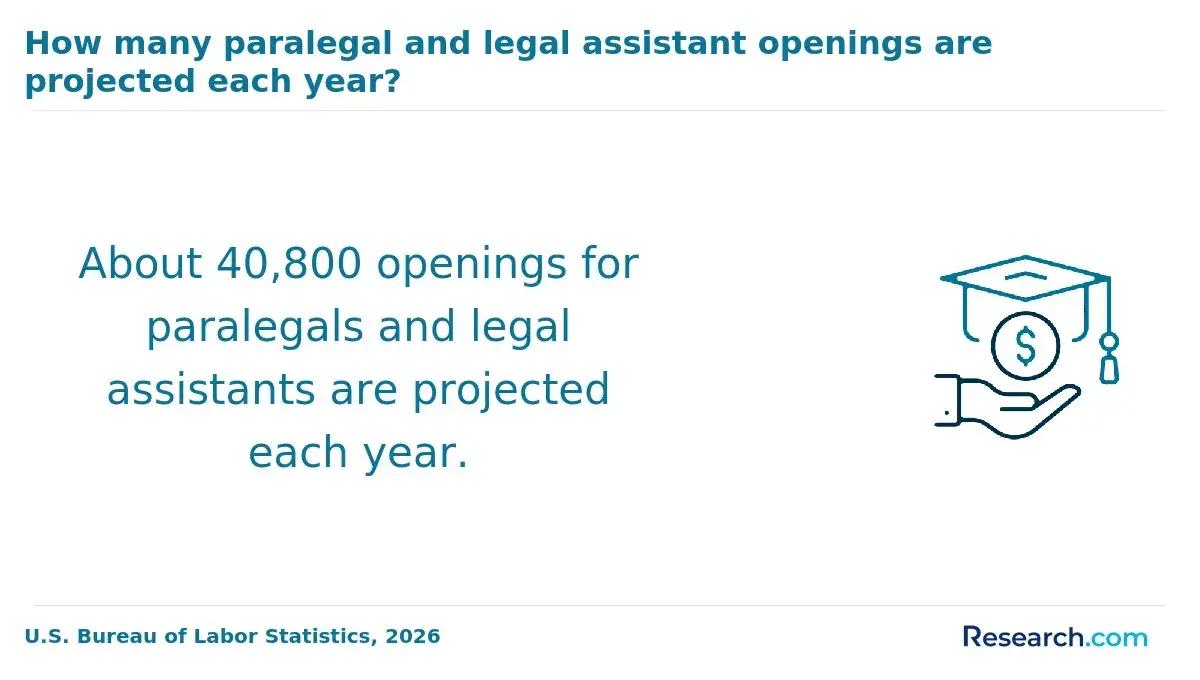
The Bureau of Labor Statistics reports median annual pay of $62,890 in May 2025 for the combined occupation of paralegals and legal assistants. That is an occupation-wide midpoint, not an entry-level wage or a result measured specifically for certificate graduates. BLS projects 0% growth from 2025-2035 but about 40,800 openings per year, largely reflecting workers who leave the occupation. Those openings still require applicants to compete on education, skills, experience, and local employer needs.
How Can Students Choose an Accredited Paralegal Program?
First, verify two different statuses. Institutional accreditation applies to the school or accredited institution; ABA approval applies to a qualifying paralegal education program. ABA approval is not institutional accreditation, and the ABA does not certify individual graduates. Not every legitimate paralegal program is ABA-approved, so check the status of the specific program rather than assuming it from the school's name.
Use the school's current catalog and disclosures to confirm the credential, admissions threshold, credit status, required courses, delivery schedule, and total costs. Verify institutional accreditation through the recognized accreditor and ABA approval, if advertised, through the American Bar Association's current paralegal program directory. When comparing most affordable ABA-approved online paralegal programs, check whether each listed credential actually admits students directly from high school and whether its online format includes scheduled or in-person obligations.
Finally, ask any institution where you may later study whether it would accept the certificate's credits. The receiving institution decides whether and how credits apply; accreditation alone does not guarantee transfer. A good enrollment decision is one you can support with written answers about entry eligibility, costs, scheduling, practical training, and the credential you will receive.
Other Things You Should Know About Law & Paralegal
Possibly. Some colleges offer dual-enrollment opportunities, but access to a particular paralegal course depends on that school's policy, course prerequisites, and permission requirements. Ask whether the course would count toward the certificate after graduation.
A completed educational award ordinarily remains part of your academic record. That differs from a professional certification, which may have renewal or continuing-education rules set by its issuer. Ask the school how to obtain official proof of completion later.
It can, depending on an internship site, employer, or applicable state rule. Admission to a school does not guarantee access to every placement or job. Ask about placement screening before enrolling if this may affect you.
You can present an educational certificate to employers elsewhere, but hiring preferences and rules for specific legal-service roles may differ. Check the requirements for the role and state you are considering; the certificate is not a nationwide license.
References
- School-Determined Requirements - FSA Partner Connect https://fsapartners.ed.gov/knowledge-center/fsa-handbook/2023-2024/vol1/ch1-school-determined-requirements
- 5 CFR Part 362 Subpart B -- Internship Program | ecfr.gov https://www.ecfr.gov/current/title-5/chapter-I/subchapter-B/part-362/subpart-B
- Dual Enrollment | Virginia Department of Education https://www.doe.virginia.gov/teaching-learning-assessment/advanced-learning/dual-enrollment
- Program: Legal Studies - Paralegal (LSPAR) https://www.mccneb.edu/p/LSPAR
- Certified Paralegal (Voucher Included) | TCAT Elizabethton https://tcatelizabethton.edu/business-industry/certified-paralegal-voucher-included
- Do You Need ABA Approval for a Paralegal Program? | Bryan University Online© https://bryanuniversity.edu/faq/aba-approval-accreditation-paralegal-programs/
- How Long Does It Take to Become a Paralegal? | Pepperdine Caruso School of Law https://law.pepperdine.edu/blog/posts/how-long-to-become-paralegal.htm
- Becoming a Paralegal: What You Need to Know | B&SC https://www.bryantstratton.edu/blog/paralegal/becoming-a-paralegal-what-you-need-to-know/
- Online and Hybrid Learning | hcc.edu https://catalog.hcc.edu/content.php
- Online Certified Paralegal Training | Owens Community College https://careertraining.owens.edu/training-programs/certified-paralegal/