2027 How to Verify Whether a Paralegal Certificate Accepts Your Prior College Credits

Co-Founder and Chief Data Scientist
Prior college coursework could shorten a paralegal certificate - or leave your schedule unchanged if a school accepts the credits but does not apply them to certificate requirements. That distinction matters when you are comparing tuition, prerequisites, and time away from work. This guide is for prospective students with general education, legal studies, or previous paralegal coursework. It explains what schools review, which questions to ask, and how to get a written credit evaluation before committing to a program.
Key Things You Should Know
- The receiving school decides whether prior coursework applies to its paralegal certificate; admission to the program and acceptance of transfer credit are separate decisions.
- Ask for a written, course-by-course evaluation showing which certificate requirements are satisfied, what remains, and whether any credits count only as electives.
- Check the program's transfer limit, minimum credits that must be completed there, grade rules, and total remaining cost before enrolling; policies vary by school and certificate type.
How do you verify whether a paralegal certificate accepts prior college credits?
Start with the certificate's current catalog requirements, not a general statement that the college "accepts transfer credits." A certificate may be credit-bearing college coursework or noncredit continuing education. Ask whether the specific program awards academic credit, permits transfer into its curriculum, and reviews credits before or only after admission.
Use this sequence to turn a preliminary answer from admissions into a decision you can rely on:
- Identify the exact certificate and obtain its current required-course list, admissions prerequisites, transfer policy, and minimum in-program credit requirement.
- Send unofficial transcripts for an initial discussion if the school permits it; identify any course you believe matches a required class.
- Ask who makes the binding decision - typically a registrar, department, or program director - and what documents that reviewer needs.
- Request a written evaluation naming each accepted course, the certificate requirement it satisfies, and the courses still required.
- Confirm when that evaluation becomes final, whether it depends on admission or enrollment, and how to appeal or request a second review.
Do not treat a transferable-credit estimate as a completion plan. A school might accept a course onto its transcript without letting it replace a required paralegal course. If you are also considering a different legal-education route, a legal studies graduate certificate and master's comparison can help you decide which type of program merits a transcript review; graduate admissions and transfer rules are separate from undergraduate paralegal certificate rules.
What types of college credits transfer into a paralegal certificate program?
Potentially relevant credits include general education courses, legal studies classes, and prior paralegal coursework. Their usefulness depends on the receiving program's curriculum: a course may meet an admission prerequisite, replace a certificate requirement, count as an elective, or receive no credit. The table distinguishes those outcomes so you can ask about the right kind of recognition.
| Prior coursework | Possible use | Main limitation |
| Writing, communication, or other general education | Admission prerequisite, general education requirement, or elective | Some certificates have no general education requirements to replace |
| Introductory legal studies or business law | Required course or elective if content closely matches | Similar titles do not establish equivalent coverage |
| Paralegal research, writing, or practice courses | Required paralegal course, subject to faculty review | Core-course and in-program completion rules may restrict substitution |
| Noncredit training or professional experience | Possible consideration under a separate prior-learning policy | It is not automatically college transfer credit |
Course content matters more than the label. For example, a previous business law class may cover useful legal concepts without replacing a certificate's legal research class. Readers comparing a broader degree route can also explore using college transfer credits for business law study; confirm that program's rules separately.
Does accreditation affect paralegal certificate transfer-credit eligibility?
Institutional accreditation may be one factor in a school's transfer policy, but it does not require another school to accept a course. The receiving institution determines equivalency, grades, credit limits, and how accepted coursework applies to its certificate. Check the prior school's institutional accreditation and the receiving school's published policy, then obtain the receiving school's decision in writing.
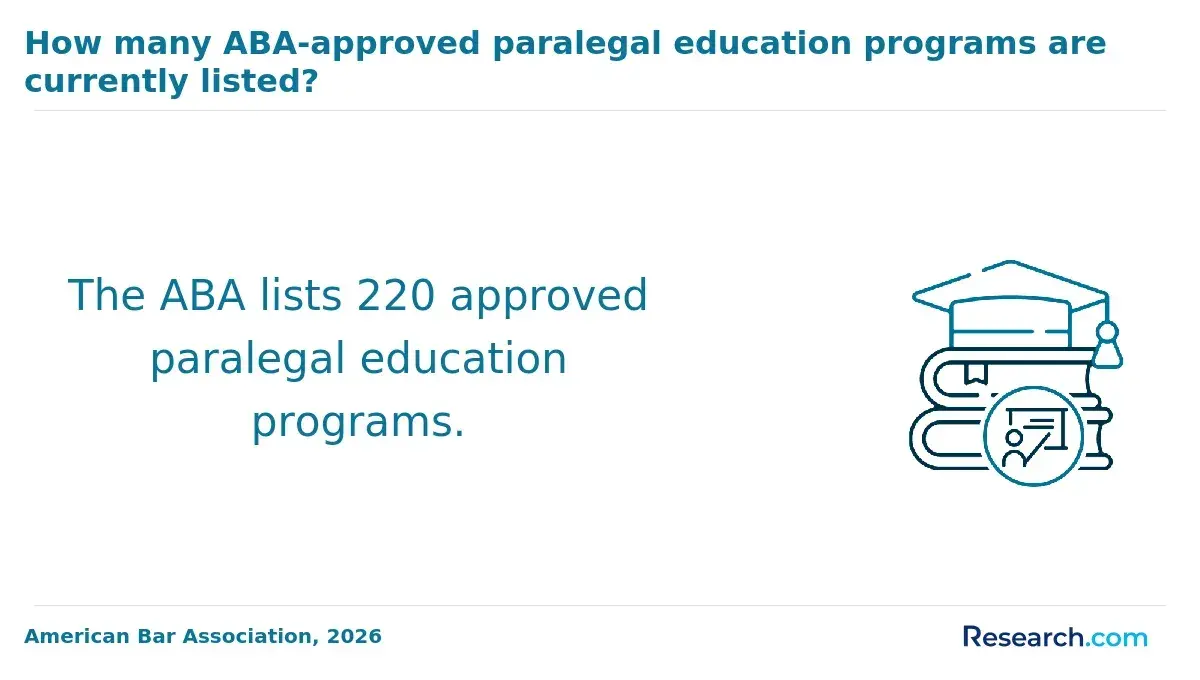
Keep institutional accreditation separate from American Bar Association (ABA) approval. The ABA approves qualifying paralegal education programs; it does not institutionally accredit colleges or certify individual graduates. If ABA program approval matters to you, check the current ABA paralegal program directory and ask the program whether its approval-related curriculum rules affect transfer of core courses. Approval by itself does not establish whether your particular credits will transfer.
How do schools evaluate transcripts for paralegal certificate transfer credit?
A transcript review usually starts by establishing where and when you took a course, its credit value, level, and final grade. An academic reviewer can then compare its documented content with a specific certificate requirement. Schools may also examine learning outcomes, instructional hours, or whether a course included the research and writing work expected in their curriculum.
The most useful result is a course-by-course certificate audit, not merely a total of accepted credits. It should show whether each prior course replaces a named requirement, fills an elective slot, or counts only toward admission. If a decision is still preliminary, ask what could change it - for example, an official transcript, a syllabus, or faculty approval.
Can general education courses satisfy paralegal certificate requirements?
Yes, if the certificate includes general education requirements and the receiving school approves equivalent courses. Writing or communication coursework may also satisfy an admissions prerequisite without reducing the number of certificate credits you must complete. In a post-degree certificate that requires a prior degree, general education may already be part of the entry requirement rather than coursework you can transfer into the certificate itself.
Compare the actual remaining courses, not just the credit total on your old transcript. If you need substantial general education alongside legal coursework, online legal studies associate program comparisons may help you assess a different academic route. Ask any receiving program how your existing classes would apply before assuming an associate degree or certificate will be faster.
Can prior paralegal courses transfer into a certificate program?
They can, but a close course-title match is not enough. A program may compare topics, assignments, credit hours, and learning outcomes before allowing a prior class to replace legal research, legal writing, ethics, or another required course. It may require some core instruction to be completed through its own faculty even when other transfer credit is allowed.
Send the prior syllabus and ask for a decision on each proposed substitution. If the course is denied, request the specific reason: insufficient content overlap, an in-program rule, a grade threshold, or a transfer-credit cap lead to different next steps. A paralegal certificate documents education; completing one does not automatically grant professional paralegal certification.
What grades and course age limits apply to transfer credits?
There is no single grade cutoff or course-age limit for all paralegal certificates. Schools may set a minimum transfer grade, apply a stricter standard to required courses, or review older coursework individually. Some distinguish enduring subjects, such as writing fundamentals, from courses whose legal procedures or research methods may have changed.
Ask whether the policy measures a course's age when you apply or when you enroll, and whether a syllabus can support an exception. Also check whether pass/fail coursework qualifies and whether a repeated course changes the evaluation. Rely on the receiving program's current written rule rather than assuming that a course's appearance on an accredited college transcript settles the issue.
How many credits can transfer into a paralegal certificate?
The maximum depends on the particular certificate. Three separate rules can constrain your result: a cap on transferable credits, a minimum number of credits you must earn at the receiving institution - often called a residency requirement - and restrictions on substituting required paralegal courses. Even if many of your credits are accepted, course sequencing may prevent an equally large reduction in completion time.
Ask for both the maximum permitted and your evaluated amount, then compare the remaining course schedule. If speed is your priority, best accelerated online paralegal programs can provide alternatives to investigate. Confirm their current credit policies and scheduled commitments directly; "accelerated" does not mean your previous courses will apply or that classes are self-paced.
What documents do schools require for a transfer-credit review?
Schools commonly require official college transcripts for a final review and may request syllabi or course descriptions when equivalency is unclear. For courses with substantial research or writing components, a program may ask for additional evidence of what you studied. Check whether unofficial copies are acceptable for an early estimate and where official records must be sent.
Gather records before paying a deposit, particularly if an older syllabus could be difficult to obtain. Ask whether the school needs a separate transfer-credit application, who reviews supporting materials, and when a final decision will be available. Keep the written evaluation with your enrollment and advising records.
How can you compare paralegal certificate programs before enrolling?
Compare programs using the remaining path after evaluation: required courses, available start dates, course sequencing, delivery and scheduled attendance, internship obligations, and total out-of-pocket cost. Tuition alone may omit mandatory fees, books, technology, prerequisite classes, travel, or time away from work. Check whether the specific certificate is credit-bearing and eligible for any aid you intend to use; do not assume every certificate qualifies for federal financial aid.
For career context, the Bureau of Labor Statistics reports median annual pay of $62,890 in May 2025 for paralegals and legal assistants. That occupation-wide figure is not an entry-level salary estimate or a promise that a certificate will repay its cost. Weigh the additional time and expense against the courses and practical skills you still need.
Choose the program that gives you a clear written credit decision and a feasible remaining schedule, not the one advertising the largest possible transfer allowance. If you are considering graduate legal study instead, budgeting for an online master's in legal studies addresses a different cost decision; a non-JD legal studies degree does not qualify someone to practice law.
Other Things You Should Know About Law & Paralegal
No. A certificate records completion of an educational program. Professional certification is a separate credential granted under the rules of a certifying organization or state system, where applicable.
No. A paralegal certificate does not qualify its holder to practice as an attorney. Paralegals work within applicable law and professional supervision requirements; rules vary by state.
Possibly, if the courses carry college credit and the later degree-granting school accepts and applies them. Noncredit certificate coursework generally needs a separate prior-learning arrangement, if one is available.
Only if the program has a prior-learning or waiver policy that covers the relevant requirement. Ask what evidence it accepts and whether a waiver reduces required credits, tuition, or neither.
References
- School-Determined Requirements | 2024-2025 Federal Student Aid Handbook https://fsapartners.ed.gov/knowledge-center/fsa-handbook/2024-2025/vol1/ch1-school-determined-requirements
- Transfer Dispute - Texas Higher Education Coordinating Board https://www.highered.texas.gov/transfer-dispute/
- Transfer Credits | Brooklyn College https://www.brooklyn.edu/admissions-aid/transfer/transfer-credits/
- Online Paralegal Certificate Program | Purdue Global https://www.purdueglobal.edu/degree-programs/legal-studies/pathway-to-paralegal-certificate/
- Law and Paralegal | Elgin Community College (ECC) https://catalog.elgin.edu/degree-programs-certificates/career-technical/career-technical-degrees-certificates/law-paralegal/
- Undergraduate Transfer Credit Policy | nyu.edu https://www.nyu.edu/about/policies-guidelines-compliance/policies-and-guidelines/UndergraduateTransferCreditPolicy.html
- Transfer Credit - SUNY Empire Academic Catalog https://catalog.sunyempire.edu/undergraduate/transfer-credit/
- FAQs - UNC-Chapel Hill Paralegal Certificate Program https://paralegal.web.unc.edu/faqs/
- Transfer Credits | fitnyc.edu https://www.fitnyc.edu/academics/courses-and-registration/registrar/transfer-credits/index.php