2027 MLS Programs for Community Health Organization Directors

Co-Founder and Chief Data Scientist
Community health directors make decisions about patient information, funding conditions, partnerships, and staff practices that can carry legal consequences. A Master of Legal Studies (MLS) may help them recognize risks and work more effectively with counsel, but it requires a substantial investment and does not qualify graduates to practice law. This guide explains what to look for in a healthcare law program, when a shorter credential may be enough, and how to compare costs, schedules, and likely career value before applying.
Key Things You Should Know
- An MLS is a non-JD legal-knowledge degree, not a requirement for community health leadership or a route to attorney licensure.
- Prioritize coursework in healthcare regulation, privacy, employment, contracts, and nonprofit governance; confirm that relevant courses are offered when you can take them.
- The Bureau of Labor Statistics reports median pay of $80,730 in May 2025 and 4% projected growth for compliance officers in 2025-2035, but those figures do not predict an MLS graduate's pay or a director's salary.
What is an MLS degree for community health organization directors?
An MLS is a graduate degree designed to teach legal reasoning and the rules that affect professional decisions without preparing students for attorney licensure. Schools may use names such as Master of Studies in Law (MSL) or Master of Jurisprudence for related non-JD degrees. What matters to a community health director is the actual curriculum, not the initials.
Directors may oversee clinics, outreach programs, grants, employees, and relationships with government agencies or care partners. A relevant MLS helps them identify when a proposed practice raises a legal issue, document a sound response, and know when to involve an attorney. It does not authorize them to give legal advice or replace counsel.
Do not assume that a program advertised as "healthcare law" has a formal concentration. It may instead offer health-related electives or an embedded certificate. Check the catalog for the credential awarded and the courses required to earn any concentration designation. Paralegal education serves a different legal-support career path; if that is your intended pivot and payment timing matters, you can compare tuition payment plans for online paralegal programs rather than assuming those arrangements apply to an MLS.
Why should community health directors earn an MLS in healthcare law?
The strongest reason is a recurring responsibility that demands more than occasional policy training. A director who reviews data-sharing arrangements, supervises compliance staff, negotiates service agreements, or responds to funding requirements could benefit from studying how regulations are interpreted and applied. Legal literacy can improve the questions the director asks counsel and the way the organization implements advice.
An MLS is less compelling when the immediate gap is narrow. Employer training may address a specific privacy procedure; a graduate certificate may cover a defined regulatory area with less time away from work; and an MPH or healthcare administration degree may fit better when the priority is program evaluation, population health, or operations. Experienced directors should first compare those options with the work they actually want to do next.
Consider opportunity cost as well as tuition. Graduate study can reduce the time available for leadership work, even when classes are online. Before applying, identify a concrete use for the coursework - such as taking greater responsibility for contracts or compliance - and ask whether your employer would support that transition.
What careers can an MLS in healthcare law prepare community health directors for?
An MLS can support advancement into roles where health operations and regulatory judgment overlap. It is usually an addition to sector experience, not a substitute for it. The examples below distinguish plausible responsibilities from outcomes the degree cannot promise.
| Potential role | Relevant work | What else typically matters |
| Community health executive | Oversees organizational policies, partnerships, and risk decisions | Leadership, budgeting, and community health experience |
| Healthcare compliance manager | Monitors requirements, investigates concerns, and coordinates corrective action | Hands-on compliance experience and knowledge of the employer's setting |
| Privacy or policy lead | Develops information-handling practices and trains staff | Operational familiarity with records, technology, and applicable rules |
| Grants or contracts director | Manages funding conditions and agreement workflows | Grant administration and contract-management experience |
A director moving toward one of these roles should compare job postings with their current skills before choosing a degree. If the goal is instead an entry-level legal-support position, our guide to paralegal associate programs addresses a different educational route; an MLS should not be treated as the default way to become a paralegal.
What courses do MLS healthcare law programs typically include?
Useful MLS curricula usually combine an introduction to legal research and analysis with courses tied to the director's duties. Health law offerings may address healthcare regulation, privacy and information security, employment law, contracts, administrative law, nonprofit governance, or organizational compliance. Course titles alone are insufficient: a "health law" elective focused on litigation may be less useful to a director than a course built around operational decisions.
Read current course descriptions and recent schedules together. For example, a privacy course should help you assess information-sharing practices, while a contracts course should help you recognize issues to raise before an agreement is signed. Neither course makes a graduate a privacy attorney or independently qualified legal adviser.
Ask whether relevant courses are required or elective, how often electives run, and whether a capstone permits a supervised project tied to community health operations. If a school advertises training in legal research platforms or other technology, distinguish a classroom demonstration from student access and hands-on assignments.
What are the admission requirements for an MLS healthcare law program?
MLS programs generally seek applicants who already hold a bachelor's degree, but each school sets its own rules for academic records, recommendations, professional experience, essays, and possible standardized tests. A JD or prior legal employment is not inherently necessary for a non-JD program. Treat a published requirement differently from a preferred qualification.
For a working director, the application should connect existing responsibilities to a specific learning goal - for example, improving oversight of contracts or regulatory processes. If writing an admissions essay is a practical barrier, legal studies application options without a personal statement may help narrow the search, but confirm the requirements of the particular MLS program and application term.
Before paying an application fee, check whether the school accepts your prior degree, whether it requires prerequisite coursework, and whether professional references may substitute for academic ones. Admission policies can differ even among programs at the same university.
How do online and campus-based MLS programs compare?
Online study can remove a commute without removing scheduled obligations. The comparison below highlights commitments that matter to directors managing staff and community programs.
| Factor | Online MLS | Campus-based MLS |
| Class meetings | May be live, asynchronous, or a mixture | Usually tied to scheduled campus sessions |
| Travel | May still require visits or in-person activities | Regular travel to campus is generally expected |
| Peer interaction | Depends on live classes and group-work design | Often includes face-to-face discussion |
| Workplace fit | Depends on deadlines, course rotation, and time zones | Depends on commute and class times |
Ask for a sample term schedule, not just an "online" label. Confirm whether attendance is mandatory, when exams occur, whether a capstone requires on-site work, and who arranges any required placement. Directors seeking a faster calendar can review accelerated online legal studies master's options, then check whether the course load is realistic alongside full-time leadership duties.
How long do MLS programs take and how much do they cost?
Completion time depends on required credits, course availability, enrollment pace, and whether a capstone must be completed in sequence. Full-time study may shorten the calendar but increase weekly demands; part-time study can preserve working hours while extending them across more terms. Ask each school for a course-by-course plan at the pace you expect to maintain.
No single price represents all MLS programs. Compare each school's current published tuition using the same unit - per credit or full program - and add mandatory fees, books, technology costs, and any required travel. Request the total cost for your intended enrollment pattern, including how tuition might change before you finish. A lower advertised tuition figure is not necessarily the lower total cost.
For a starting list, cheapest online legal studies master's degrees can help identify programs to investigate. Verify current prices directly with each institution and compare their healthcare law coursework before treating a lower-cost option as a good fit. Ask the financial aid office whether the specific degree and your enrollment status qualify for federal aid, and ask your employer about reimbursement; neither should be assumed.
How do you verify MLS program accreditation and academic quality?
Institutional accreditation is a baseline check, not proof that a particular healthcare law curriculum fits your work. The American Bar Association's approval process for qualifying paralegal education programs is separate from institutional accreditation and is not the standard for judging an MLS.
Use the following checks before committing to a program. Together, they test both the legitimacy of the institution and whether you can complete the coursework you want.
- Confirm the institution's current accreditation through its recognized accreditor and, if needed, the U.S. Department of Education's institutional records.
- Compare the current academic catalog with the program page to confirm the degree name, requirements, and any formal health law concentration.
- Request a recent course schedule and ask who teaches the healthcare law subjects you intend to take.
- Ask for the policies on course substitutions, transfer credit, academic support, and capstone supervision in writing.
A common mistake is choosing a program because it lists attractive electives without checking whether they run before your expected graduation. The receiving institution also decides whether any prior graduate credit transfers and how it applies; accreditation alone does not make credit transferable.
Does an MLS qualify graduates for legal licensure or certification?
No. An MLS is a non-JD degree and, by itself, does not qualify a graduate to practice law, represent clients, or take a bar examination. Attorney licensure follows jurisdiction-specific rules; directors should refer legal interpretations and advice to appropriately licensed counsel.
An MLS is also not a professional certification. A school-issued certificate records completion of an educational program, while a professional certification is awarded under a separate organization's or regulator's eligibility and assessment rules. Employers may value particular compliance credentials, but requirements vary by role and organization. If a credential is your primary goal, check its issuing body's current eligibility rules before assuming MLS coursework will count.
What salaries and job outlook can MLS graduates expect?
There is no reliable national salary figure specifically for community health directors with an MLS. Pay depends on the role, employer, location, experience, and scope of responsibility; a degree alone does not establish a salary increase.
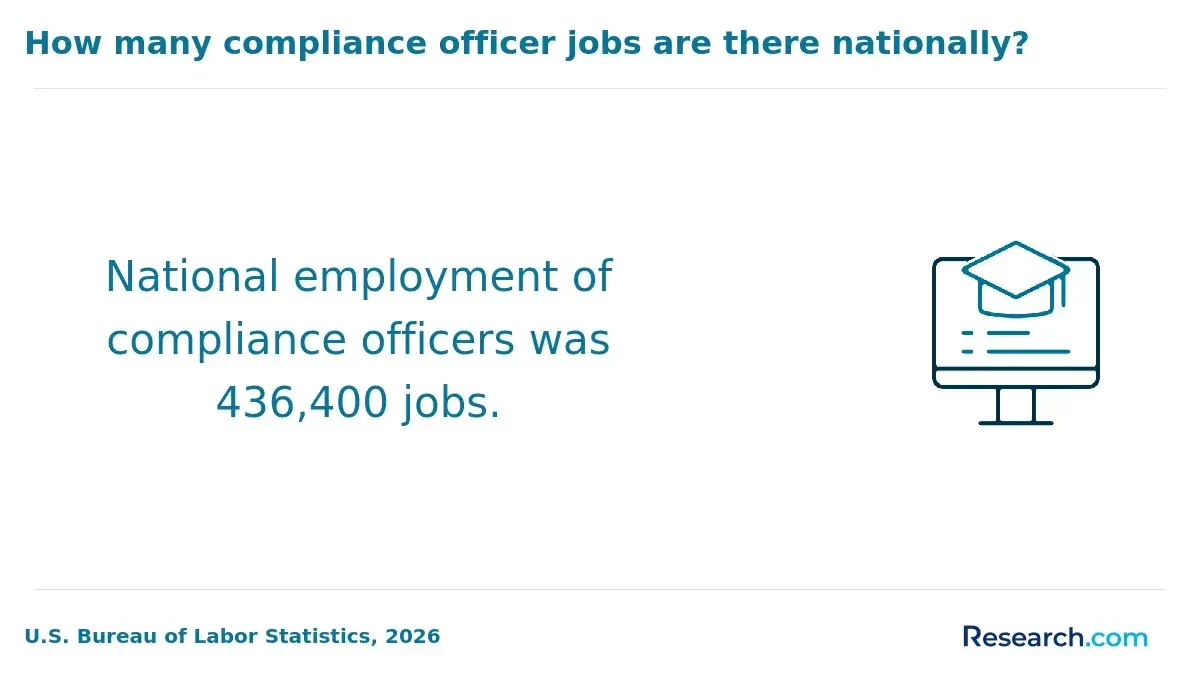
For one related occupation, the Bureau of Labor Statistics reports median annual pay of $80,730 in May 2025 for compliance officers, with 4% projected job growth in 2025-2035. It projects about 32,700 openings per year. This is an occupation-wide benchmark - not a forecast for MLS graduates, healthcare compliance specialists, or community health directors.
For a personal return-on-investment estimate, compare the full cost and time commitment with actual jobs you could pursue. Look for evidence that employers value legal studies graduate work alongside your leadership experience, and weigh that evidence against a shorter course, certificate, or employer training that might meet the same goal.
Other Things You Should Know About Law & Paralegal
Some schools allow nondegree enrollment or offer graduate certificates, but availability and later credit application vary. Obtain written confirmation that a course could count toward the MLS before paying for it.
Ask both your employer and the instructor first. Confidential patient, personnel, or contract information may need to be excluded or appropriately de-identified; being enrolled in a course does not override workplace obligations.
Not automatically. The relevant state licensing board determines acceptable continuing education. Check its rules before enrolling if maintaining a clinical license is part of your plan.
Board oversight does not ordinarily require an MLS. Board training and access to qualified counsel may be more proportionate unless the member also has substantial, ongoing professional responsibilities involving healthcare regulation.
References
- Types of Financial Aid: Grants, Work-Study, and Loans | studentaid.gov https://studentaid.gov/understand-aid/types
- Public Health Law Academy | cdc.gov https://www.cdc.gov/phlp/php/trainingandeducationalresources/public-health-law-academy.html
- DAPIP | Homepage - Office of Postsecondary Education (OPE) https://ope.ed.gov/dapip/
- Online Health Law Certificate Program | Hofstra University https://onlinelaw.hofstra.edu/programs/certificate-health-law-policy
- Online Master's in Health Care Compliance, MLS | ASU Online https://asuonline.asu.edu/online-degree-programs/graduate/masters-in-healthcare-compliance/
- Grad school requirements: Everything you need to apply | About the University of Cincinnati https://www.uc.edu/blog/grad-school-requirements.html
- Healthcare Policy & Regulatory Compliance | Online Course | Washington Technical Institute https://www.washingtontech.edu/online-course/healthcare-policy-regulatory-compliance/
- Six Ways Healthcare Administrators Benefit from an M.L.S. Program | miami.edu https://news.miami.edu/law/stories/2024/04/six-ways-healthcare-administrators-benefit-from-an-mls-program.html
- How Do Transfer Credits Work When You Go Back to School? | Whitworth Online https://online.whitworth.edu/news-articles/how-do-transfer-credits-work-when-you-go-back-to-school/
- Online Hybrid JD | vermontlaw.edu https://www.vermontlaw.edu/onlinejd