2027 MLS Programs for Mortgage Compliance Professionals: Courses to Compare

Co-Founder and Chief Data Scientist
Mortgage compliance professionals must translate lending rules into policies, reviews, and decisions that withstand scrutiny. A Master of Legal Studies (MLS) can deepen that work, but a degree with a broad legal curriculum may be less useful than one with the right courses. This guide is for compliance staff, mortgage operations professionals, and career changers comparing non-lawyer graduate programs. It shows which courses matter for particular roles, what to check beyond the course titles, and when shorter training may be the more sensible investment.
Key Things You Should Know
- Prioritize courses in consumer lending, fair lending, servicing, privacy, and regulatory investigations; confirm that mortgage-specific assignments are actually available.
- An MLS is not required to work in mortgage compliance and does not qualify its holder to practice law. Compare it with employer training or a focused certificate before paying for a graduate degree.
- Compliance officers had median annual pay of $80,730 in May 2025, with 4% projected job growth from 2025-2035, according to the Bureau of Labor Statistics. Those occupation-wide figures are not an MLS salary forecast.
What is a Master of Legal Studies degree for mortgage compliance professionals?
An MLS is a graduate legal-knowledge degree designed primarily for people who do not intend to become attorneys. Schools may use names such as Master of Studies in Law (MSL) or Master of Jurisprudence for related non-JD degrees. For a mortgage compliance professional, its value lies in learning to interpret regulations, document a defensible analysis, and work effectively with legal counsel - not in acquiring authority to give legal advice.
Mortgage compliance work may involve reviewing loan disclosures, monitoring fair-lending risks, testing servicing procedures, responding to examinations, or updating policies when rules change. Someone who already performs those tasks may benefit from graduate legal study if the curriculum goes beyond general legal concepts and permits substantial work on consumer finance. Applicants without a bachelor's degree generally need to address undergraduate eligibility first; transferring toward a bachelor's in legal studies is a separate decision, subject to the receiving school's credit policies.
Do mortgage compliance professionals need a law degree or professional license?
Mortgage compliance officers generally do not need a JD or attorney license to perform internal monitoring, policy, testing, and reporting duties. Employers set their own education and experience requirements. Legal interpretation for the organization, representation, and advice that constitute the practice of law belong with appropriately licensed counsel under applicable state rules.
Licensing depends on the activity, not the MLS: a person acting as a mortgage loan originator may face Nationwide Multistate Licensing System (NMLS) and state requirements that do not arise merely from working on a compliance team. Verify the duties of the intended position before pursuing a license.
A paralegal program serves a different legal-support goal. Readers seeking that route can compare ABA-approved paralegal education on a budget, but American Bar Association approval of a paralegal program is neither an MLS requirement nor a substitute for institutional accreditation.
Which courses should mortgage compliance MLS programs include?
Start with the work you want to do. Course titles differ by school, so compare syllabi, assignments, and elective availability rather than assuming a course called "financial regulation" covers mortgage lending. The table connects useful subject areas to common compliance responsibilities.
| Course area to look for | Mortgage compliance use | What to verify in the syllabus |
| Consumer financial protection and lending | Reviewing origination disclosures and lending procedures | Coverage of the Truth in Lending Act, Real Estate Settlement Procedures Act, and implementing regulations |
| Fair lending | Assessing policies, exceptions, and potential disparate outcomes | Work with the Equal Credit Opportunity Act, Fair Housing Act, and lending data |
| Mortgage servicing and default | Testing borrower communications, error resolution, and loss-mitigation procedures | Servicing rules and realistic case exercises |
| Privacy, data security, and reporting | Managing consumer information and reviewing reporting controls | Applicable privacy rules and the Home Mortgage Disclosure Act |
| Administrative law and investigations | Preparing for examinations and explaining regulatory findings | Agency authority, enforcement processes, and written response assignments |
A formal concentration has published requirements; a few relevant electives do not automatically amount to one. Ask whether the courses run often enough to fit your schedule and whether a capstone can address a mortgage compliance problem. For a servicing role, servicing and consumer protection deserve more weight than corporate transactions. For a fair-lending role, data analysis and fair-lending coursework deserve more.
Are online MLS programs effective for mortgage compliance careers?
Online study can be effective when students practice applying rules to facts, receive substantive feedback, and can take the relevant electives. Delivery format alone does not establish those features. "Online" also does not necessarily mean asynchronous: scheduled discussions, live classes, proctored exams, group projects, or campus visits may still be required.
Ask for a recent syllabus and the course rotation, then check whether assignments involve regulatory research, policy writing, testing plans, or examination responses. Confirm whether required tools are supplied and whether a capstone can use a simulated problem if your employer cannot release confidential records. If the goal is legal-support work rather than graduate-level compliance analysis, paralegal programs designed for accelerated completion represent a different, potentially shorter route - not an equivalent MLS credential.
What accreditation should you verify when comparing MLS programs?
Verify that the university has institutional accreditation from an accreditor recognized by the U.S. Department of Education, and confirm that the advertised MLS is an active degree in the current academic catalog. Institutional accreditation concerns the institution; it does not certify that a particular mortgage compliance concentration is strong.
Do not mistake American Bar Association accreditation of a law school's JD program for separate ABA approval of its MLS. Likewise, ABA approval of qualifying paralegal education programs is a distinct status. Compare the MLS curriculum, faculty, course access, and required work directly rather than treating any of these labels as a quality guarantee for mortgage coursework.
What are the admission requirements for mortgage compliance MLS programs?
MLS applicants typically need a bachelor's degree, but each school sets its own rules for transcripts, academic standing, résumé, statement of purpose, recommendations, and possible test waivers. A JD or prior legal coursework is generally not the point of an MLS; mortgage experience may strengthen an application without being a universal prerequisite.
Check the current admissions page for the exact degree, not a different graduate program at the same school. Ask whether an employer-sponsored applicant has the same requirements and whether prerequisite or transfer credit is permitted. If you have not completed a bachelor's degree, associate-level paralegal programs online are one possible undergraduate starting point, but they do not by themselves meet a bachelor's-level MLS admission requirement.
How long do mortgage compliance MLS programs take and cost?
Completion time depends on required credits, course sequencing, enrollment pace, and whether relevant electives run when needed. Compare the school's published full-time and part-time plans with your actual work schedule; an advertised fast completion path may not be feasible if a key course is offered infrequently.
For a reliable cost comparison, request each school's 2026-27 tuition and mandatory-fee schedule and apply it to the credits your plan requires. Include books, technology or legal-research charges, and any required travel. Published per-credit tuition is not a total-program price. Ask the financial aid office whether the specific degree and your enrollment pattern qualify for the aid you intend to use, and compare the net cost after any employer reimbursement.
Time has a cost, too. If your immediate need is to learn one servicing rule or improve fair-lending testing, employer training or a focused graduate certificate may address it sooner. An MLS makes more sense when you need sustained study across several regulatory areas and can use the degree's broader curriculum.
What careers can an MLS degree lead to in mortgage compliance?
Relevant roles include mortgage compliance analyst, fair-lending analyst, servicing compliance specialist, compliance testing or audit specialist, regulatory change manager, and compliance manager. Actual titles and qualifications vary by employer. Analysts may test files and document findings; managers may oversee controls, coordinate examinations, and escalate legal questions to counsel.
Mortgage operations experience can be a strong entry route because it provides context for how loans are originated or serviced. An MLS may help an experienced worker move toward regulatory analysis or leadership, but it does not replace product knowledge, sound judgment, or evidence of effective compliance work. Someone considering a broader workplace-compliance pivot can also explore legal studies degree pathways focused on human resources law; that curriculum serves a different regulatory specialty.
How much do mortgage compliance professionals earn?
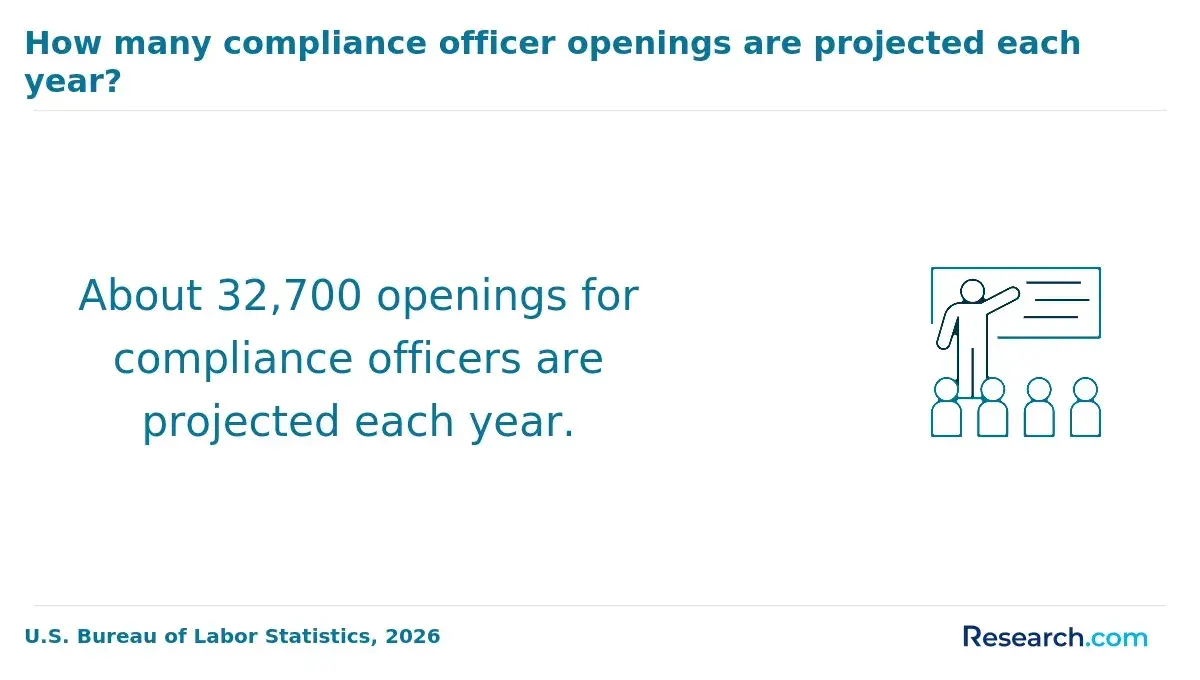
The Bureau of Labor Statistics reports median annual pay of $80,730 in May 2025 for compliance officers and projects 4% growth from 2025-2035, with about 32,700 openings per year. This is the closest broad occupational benchmark, not a mortgage-industry wage or a measure of the return on an MLS.
Pay for a particular job can differ with location, employer, responsibility, and experience. When evaluating a degree, compare the positions you could realistically pursue now with those for which graduate legal study would add a meaningful qualification; the occupation-wide median cannot show whether a specific program will pay for itself.
What certifications strengthen a mortgage compliance career after an MLS?
A professional certification can demonstrate knowledge in a narrower area than an MLS, but eligibility, exams, experience rules, and renewal requirements come from the issuing organization. The Certified Regulatory Compliance Manager (CRCM) credential from the American Bankers Association may be relevant to broader financial-institution compliance. The Certified Anti-Money Laundering Specialist (CAMS) credential from ACAMS is more targeted to financial-crime work; its usefulness depends on the position.
Neither credential automatically follows from completing an MLS. Check the issuer's current requirements and compare them with job postings in your target segment of mortgage lending. For a professional already working in one specialty, a relevant certification plus experience may be a more direct next step than a full degree; for someone seeking stronger legal analysis across multiple specialties, an MLS may offer more breadth.
Other Things You Should Know About Law & Paralegal
Only with your employer's permission and the school's approval. Borrower information and internal examination materials can be sensitive; a simulated or properly authorized project is often safer.
Do not assume so. The receiving law school decides whether any prior coursework applies, and an MLS is not a substitute for a JD. Get a written policy before counting on transfer credit.
Possibly. Check your employer's eligibility, grade, reimbursement, and continued-employment rules before enrolling, and confirm what expenses the benefit actually covers.
Underwriting evaluates whether a loan meets applicable credit and program criteria. Compliance assesses whether lending activities follow legal requirements and internal controls. The teams interact, but their primary responsibilities differ.
References
- Program Eligibility, Written Arrangements, and Distance Education | 2024-2025 Federal Student Aid Handbook https://fsapartners.ed.gov/knowledge-center/fsa-handbook/2024-2025/vol2/ch2-program-eligibility-written-arrangements-and-distance-education
- Accreditation in the U.S. | ed.gov http://www.ed.gov/laws-and-policy/higher-education-laws-and-policy/college-accreditation/accreditation-in-the-us
- Real Estate Settlement Procedures Act (Regulation X) | NCUA https://ncua.gov/regulation-supervision/manuals-guides/federal-consumer-financial-protection-guide/compliance-management/lending-regulations/real-estate-settlement-procedures-act-regulation-x
- Master of Legal Studies (MLS) Program | Goodwin College of Professional Studies https://drexel.edu/law/academics/masters-certificate-programs/mls/
- MLS vs Graduate Certificate: What's the Better Career Investment? | wsulaw.edu https://www.wsulaw.edu/news/why-choose-a-master-of-legal-studies-over-a-graduate-certificate/
- Instructions for Graduate Applicants | Graduate School https://gradschool.unc.edu/admissions/instructions/
- MLS vs J.D.: Which Legal Degree Fits Your Career Goals? | UC Law San Francisco MLS https://mls.uclawsf.edu/articles/mls-vs-jd/
- Master of Legal Studies (MLS) vs. JD: What's the Difference? | SMU Online Master of Legal Studies https://onlinemasterlegalstudies.smu.edu/articles/mls-vs-jd/
- Difference Between M.L.S. and LL.M.: How to Choose the Right Program for You | miami.edu https://news.miami.edu/law/stories/2024/06/difference-between-mls-and-llm.html