2027 Paralegal Certificate Admissions With Pass/Fail or Competency-Based College Credits

Co-Founder and Chief Data Scientist
A transcript full of "pass," "satisfactory," or competency-based credits can make paralegal certificate admissions hard to predict. Those credits may satisfy a program's entry requirement without counting toward its required courses - or may need an individual review. This guide is for prospective students deciding whether to apply, request an evaluation, or choose a different credential. It explains how to check credit policies, compare program formats and costs, and avoid enrolling before you know what your prior learning actually counts for.
Key Things You Should Know
- Some paralegal certificate programs may accept pass/fail or competency-based college credits for admission, but the receiving school decides whether those credits also satisfy prerequisites or certificate requirements.
- Ask for separate written decisions on admission eligibility, grade-point-average treatment, and credit applied to the certificate; acceptance in one category does not establish acceptance in the others.
- A certificate is education, not professional certification or a job guarantee. The U.S. median pay for paralegals and legal assistants was $62,890 in May 2025, a career benchmark rather than an expected starting salary.
What Is a Paralegal Certificate With Pass/Fail or Competency-Based Credits?
It is a paralegal certificate program considering prior college work that does not carry conventional letter grades. Pass/fail credit records a passing result rather than an A-F grade. Competency-based education awards credit when a student demonstrates required knowledge or skills; its transcript may use terms such as "satisfactory," mastery, or pass. The certificate itself is ordinarily the school's educational award, not a special credential created for students with these transcripts.
The distinction between admission and credit application matters. A program might count prior coursework toward the college credits needed to apply, yet require you to complete all of its legal specialty courses. It might also accept a course as an elective without accepting it as a particular prerequisite. If you need a broader entry route rather than a certificate, you can compare online associate degrees in legal studies, then ask each institution how it evaluates your transcript.
Do Paralegal Certificate Programs Accept Pass/Fail or Competency-Based College Credits?
Some do, but there is no universal acceptance rule. The receiving institution determines whether previous work is college-level, whether its recorded outcome meets a minimum grade requirement, and whether the course matches a program requirement. An admissions approval is not a promise of transfer credit.
These transcript entries can trigger different reviews. The table separates the questions so you can request a useful decision rather than a general assurance that credits are "accepted."
| Prior learning shown | What the school needs to establish | Possible limitation |
| College course marked pass/fail | Whether "pass" meets any minimum-grade rule and whether the course content matches a requirement | No letter grade may be available for a grade-point-average calculation |
| Competency-based college credit | Whether the transcript awards credit and provides enough detail to establish course equivalence | A broad competency may not match a specific legal course |
| Noncredit training or skills badge | Whether the institution has a separate prior-learning assessment policy | Completion alone may not be transferable college credit |
For a fair evaluation, obtain an official transcript and, if requested, course descriptions or competency assessments. Ask whether the school evaluates credits before enrollment and whether its decision identifies exactly which certificate requirements remain.
What Are the Admission Requirements for a Paralegal Certificate Program?
Requirements vary by program. Some certificates are designed for people who already hold a bachelor's degree; others admit applicants with an associate degree, a specified amount of college coursework, or a high school credential. A school may separately require general education courses, a minimum grade-point average, or particular grades in prerequisite classes. Do not infer a requirement from the word "certificate."
Read the current catalog's admission criteria alongside its transfer and grading policies. If your transcript has no conventional grades, ask how the program calculates eligibility - or whether it reviews applicants individually. Also confirm whether it requires a personal statement, references, or a placement assessment. If application paperwork is your main obstacle and you are open to a different credential, online legal studies programs with simplified essay requirements offer another route to investigate; they are not substitutes for paralegal training without comparing their curricula.
Does Accreditation Matter for Paralegal Certificate Admissions and Career Preparation?
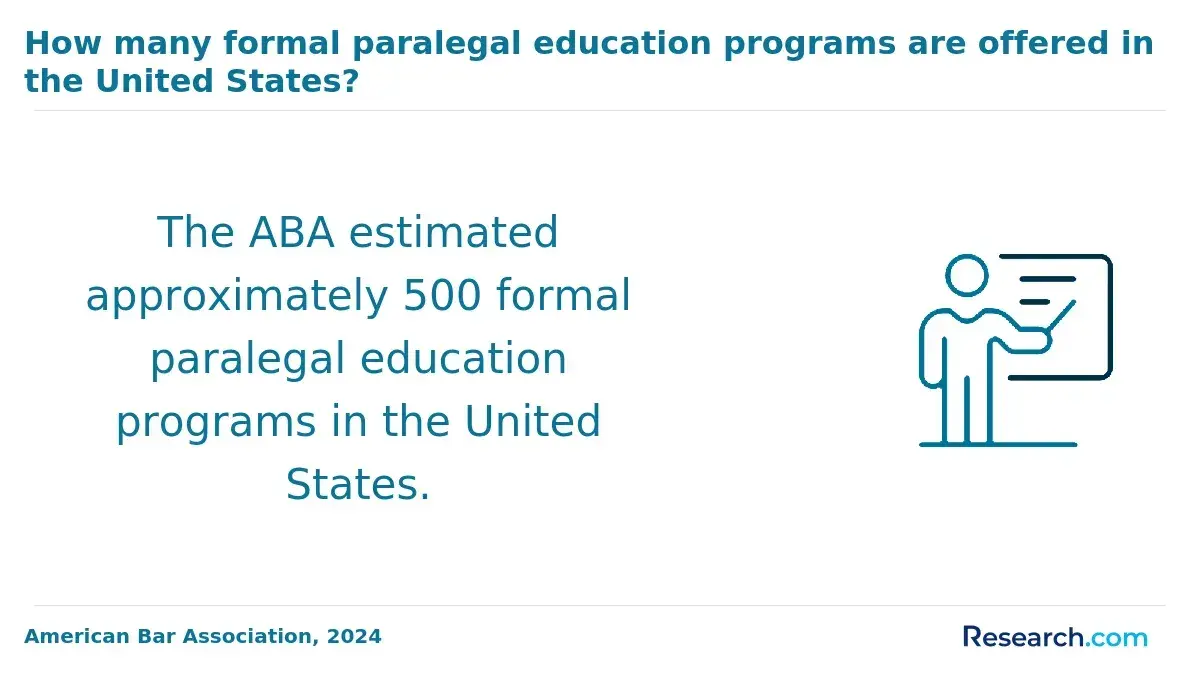
Yes, but two different statuses are often confused. Institutional accreditation concerns the college or other educational institution. American Bar Association (ABA) approval concerns a qualifying paralegal education program; it is not institutional accreditation. Not every reputable paralegal program is ABA-approved, and approval does not mean the ABA certifies its graduates.
Check the school's current institutional accreditation and, if ABA approval matters to you, confirm the specific program in the ABA's current paralegal program directory. Then ask the program whether approval or its own academic rules affect how pass/fail and competency-based credits can satisfy required coursework. Employer preferences and requirements for further study vary, so check any stated credential requirement for your target job rather than assuming approval alone will determine eligibility.
How Do Online and Campus-Based Paralegal Certificate Programs Compare?
Delivery format does not establish a credit-acceptance policy: online and campus students may face the same institutional rules, or a program may impose format-specific requirements. Compare the actual schedule and practical training before choosing. "Online" does not necessarily mean asynchronous or self-paced.
For an online program, check scheduled class meetings, proctored assessments, campus visits, course sequencing, and whether any internship must be completed locally. For a campus program, account for commuting and class times. In either format, ask who arranges an internship and whether existing employment can fulfill it. Students prioritizing remote study can review paralegal certificates offered through online study, but should verify each program's current attendance and placement rules directly.
What Courses Do Paralegal Certificate Programs Typically Include?
Curricula commonly cover legal research and writing, civil litigation, legal ethics, and the organization of the U.S. legal system. Programs may add contracts, business law, real estate, family law, e-discovery, or an internship. A course title alone does not tell you whether students practice drafting documents, finding and checking authority, managing case files, or using legal research tools.
If you hope to apply prior competency-based work, compare its documented learning outcomes with each required course. A general writing competency, for example, may not replace legal research and writing. Ask whether any required legal specialty courses must be completed through the certificate program even when similar prior credits appear on your transcript. Paralegals work under attorney supervision and cannot use coursework as authority to practice law independently.
How Long Do Paralegal Certificate Programs Take and What Do They Cost?
Completion time depends on required courses, the academic calendar, course availability, and any internship - not just how many credits appear on your old transcript. A credit evaluation may shorten a program if prior work fulfills certificate requirements; credits accepted solely for admission may not shorten it at all.
Compare the current program price with mandatory fees, books, technology or legal research charges, prerequisite coursework, travel, and internship expenses. Ask for a written estimate based on your remaining requirements. Federal aid eligibility depends on the institution, the specific program, and the student; a credit-bearing certificate is not automatically aid-eligible. If substantial prerequisites make the certificate nearly as long or costly as a degree, choosing a paralegal bachelor's pathway by cost and duration may be worth considering instead. Compare credentials and total costs on equivalent terms before deciding.
Can Paralegal Certificate Graduates Earn Professional Certification or Meet Employer Standards?
A school-issued paralegal certificate and professional certification are different. Organizations such as NALA and the National Federation of Paralegal Associations award their own voluntary credentials under their own eligibility and examination rules. Completing a certificate does not automatically qualify someone for every exam or confer a professional designation.
Employers may value a certificate, an associate or bachelor's degree, relevant experience, practical skills, or a combination. Some may prefer graduates of ABA-approved programs, but that is not a universal hiring requirement. Before enrolling for a particular credential or job, compare its current published education criteria with the exact certificate and prior college credits you would have when you finish.
What Jobs, Salaries, and Career Paths Are Available After a Paralegal Certificate?
Certificate holders may pursue paralegal or legal assistant positions supporting attorneys with research, document preparation, case organization, and deadlines. Entry-level duties and hiring standards vary by employer. Experience can open paths into particular practice areas or senior support roles; a certificate alone does not guarantee placement or advancement.
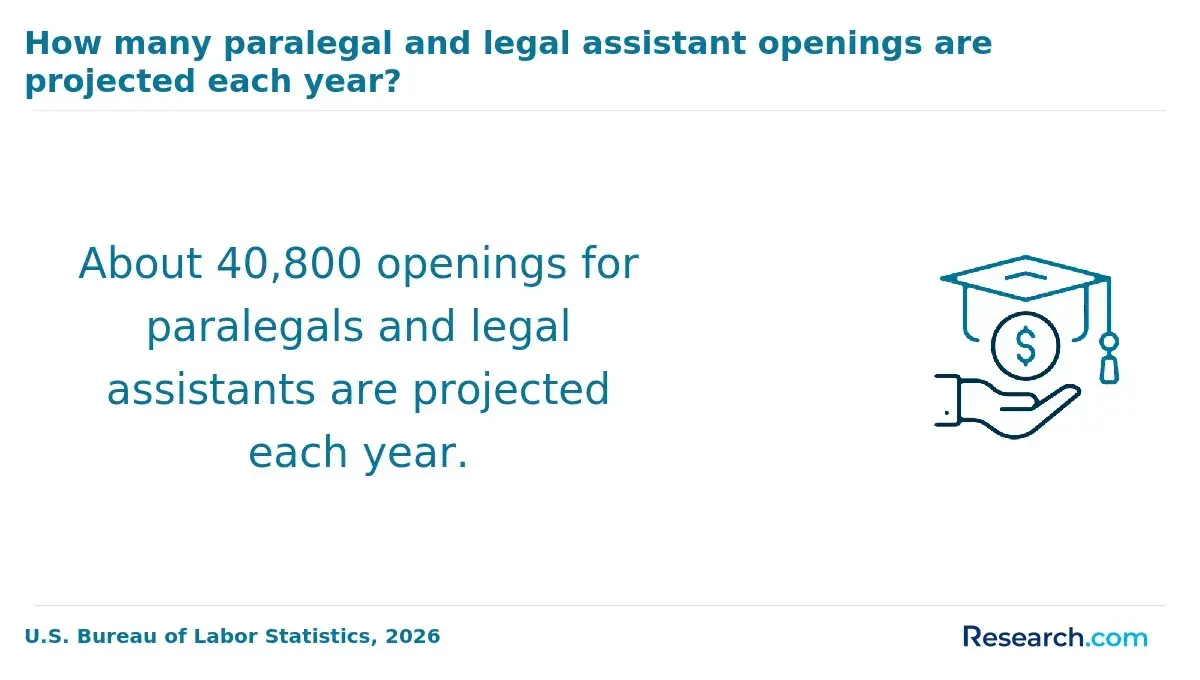
The Bureau of Labor Statistics reports median annual pay of $62,890 in May 2025 for paralegals and legal assistants, with 0% projected growth, 2025-2035, and about 40,800 openings per year. That median covers workers at different experience levels, not just new certificate graduates. The openings projection also reflects replacement needs despite little or no net growth.
If your goal is regulatory or compliance work rather than supporting attorneys, compare job postings before paying for paralegal training. Some roles may place greater value on industry experience or broader legal study. For readers considering that different route, finding a low-cost online master's in legal studies can inform a cost comparison; such a non-JD degree does not qualify someone to practice law.
How Do You Choose a Reputable Paralegal Certificate Program?
Start with the decision that most affects your time and cost: what, precisely, will the program do with your existing credits? Request a written evaluation before paying a deposit if the school offers one. Use the same questions with each school so that admission, remaining coursework, and price are genuinely comparable.
These checks address the mistakes most likely to leave a student with unexpected prerequisites or an unusable schedule:
- Confirm the exact certificate's admission prerequisite and whether your pass/fail or competency-based transcript meets it.
- Request a separate determination of which prior courses satisfy certificate requirements, including any minimum-grade or residency rules.
- Verify institutional accreditation and, if relevant to your goal, the specific program's current ABA approval.
- Review required course schedules, hands-on assignments, and internship placement responsibilities rather than relying on an "online" label.
- Compare a personalized total-cost estimate and remaining completion time with the jobs or further credentials you intend to pursue.
Be cautious if a school promises that all prior credits will transfer without reviewing them, calls graduates "ABA-certified," or cannot explain how its certificate differs from professional certification. If a written evaluation leaves most coursework outstanding, compare another certificate or degree route before committing.
Other Things You Should Know About Law & Paralegal
There is no universal expiration rule. A program may accept older general education credit while requiring recent or program-specific coursework. Check its current catalog and ask for an evaluation of older credits.
Only if the institution offers an applicable prior-learning assessment or course-waiver policy. Experience by itself is not automatically college credit, and a waiver may not reduce the credits required to earn the certificate.
Some institutions have an appeal or reconsideration process. Ask for the reason for denial and whether a syllabus, competency record, or other documentation would permit another review.
A paralegal certificate is not a Juris Doctor degree or a license to practice law. Law schools set their own admission requirements; check those requirements directly if becoming an attorney is your goal.
References
- Direct Assessment (Competency-Based) Programs | ed.gov http://www.ed.gov/laws-and-policy/higher-education-laws-and-policy/higher-education-policy/direct-assessment-competency-based-programs
- Educational Program Standards | North Carolina State Bar https://www.ncbar.gov/paralegal-certification/educational-program-standards/
- Law & Paralegal Studies | ccp.edu https://www.ccp.edu/college-catalog/degree-programs/associate-applied-science-aas/law-paralegal-studies
- Paralegal Program Policies | sac.edu https://sac.edu/division/business/legalstudies/policies.php
- Do You Need ABA Approval for a Paralegal Program? | Bryan University Online© https://bryanuniversity.edu/faq/aba-approval-accreditation-paralegal-programs/
- Prior Learning Assessment - Transcripts | Pikes Peak State College https://www.pikespeak.edu/admissions/records/transcripts/cpl.php
- Paralegal Certificate vs. Degree: Which Is Right for You? | Online Paralegal Studies Certificate Program https://paralegalonline.bu.edu/articles/paralegal-certificate-vs-degree/
- Academic and Instructional Standards - CVCC Catalog https://mycatalog.cvcc.edu/content.php
- College Credit for Students and Learners | acenet.edu https://www.acenet.edu/Programs-Services/Pages/Credit-Transcripts/Students.aspx
- Credit for Prior Learning (CPL) Glossary | NCCCS https://www.nccommunitycolleges.edu/credit-for-prior-learning-glossary/