2027 Online RN-to-MSN and ADN-to-MSN Programs for Nurses in Nevada: Entry Routes, Costs, and Practicum
Audited and Verified:
Our Editorial and Data Verification Process
Research.com uses government datasets, official education statistics and primary institutional information to support its career and degree guides. Our review process checks factual accuracy, occupational definitions, source dates and the requirements associated with the credentials discussed.
How This Article Was Fact-Checked
Our editorial team verifies salary estimates, employment projections, education requirements and program information against original data providers and official organizations. Salary figures are checked against the relevant occupational definitions and reporting periods. Information about licensure, accreditation and required in-person training is reviewed separately.
Fact-checked and verified on:

Co-Founder and Chief Data Scientist
For a Nevada RN with an associate degree, an online MSN can look like a direct route to graduate study - but the bridge, specialty track, and local practicum may be less straightforward than the online label suggests. This guide explains how to compare RN-to-MSN and ADN-to-MSN options, what to ask about tuition and clinical placement, and which credentials lead to advanced practice. Use it to identify a route that fits your current license, intended role, and ability to complete supervised work in Nevada before committing to a program.
Key Things You Should Know
- Both RN-to-MSN and ADN-to-MSN routes generally assume an existing RN license; neither is an initial RN-licensure program. Whether the school awards a BSN along the way is a separate question.
- Check three distinct things before enrolling: institutional accreditation, nursing-program accreditation, and whether the school can enroll and place you for your intended track in Nevada.
- Online coursework does not eliminate in-person practicum. For a cost comparison, calculate bridge and MSN credits together, then add fees, placement travel, and any reduction in paid work hours.
What are online RN-to-MSN and ADN-to-MSN programs in Nevada?
Online RN-to-MSN programs combine upper-division nursing study with master's-level coursework for licensed RNs who do not already hold a BSN. "ADN-to-MSN" usually describes the same route more precisely for an RN whose qualifying nursing degree is an associate degree. A diploma-prepared RN may also be eligible for some RN-to-MSN programs, but must check the school's entry rules.
"Online" usually refers to didactic coursework, not the entire degree. A Nevada resident may study with a Nevada-based or out-of-state school if the institution accepts Nevada students and the track's required supervised experiences can be completed at approved sites. Some bridges confer a BSN before the MSN; others award only the MSN. Ask for the degree sequence in writing, particularly if a prospective employer requires a BSN specifically.
These are postlicensure routes. Someone without an RN license needs an initial nursing education pathway instead; comparing online MSN entry options for non-nurses addresses a different admissions decision.
What are the admission requirements for Nevada online RN-to-MSN programs?
Admission commonly starts with an unrestricted RN license and an associate degree or nursing diploma from an acceptable program. Schools may also review prior college transcripts, GPA, statistics or other prerequisite coursework, professional experience, references, and a statement of goals. An APRN specialty can have additional entry or progression requirements; admission to the university does not necessarily guarantee a seat in that track.
Before applying, send admissions staff your transcripts and ask for a course-by-course degree evaluation. Confirm which prior credits satisfy bridge requirements, whether any science or statistics course has a recency limit, and whether your RN license must be issued by Nevada or simply authorize practice at the proposed clinical site. Also ask when background screening, immunizations, and site-specific onboarding become necessary. These conditions may affect placement even after academic admission.
If your academic record is the obstacle, less restrictive nursing admission options can provide context, but published admission flexibility is no substitute for confirming this particular graduate track's standards and Nevada enrollment eligibility.
How do ADN-to-MSN programs differ from RN-to-MSN programs?
The labels overlap: ADN-to-MSN identifies the applicant's starting degree, while RN-to-MSN identifies the applicant's license and destination. The consequential differences are the school's bridge curriculum, intermediate award, and specialty - not the marketing label. The comparison below shows what to verify on a degree plan.
| Route | Typical starting point | Credential sequence to verify | Best fit |
| ADN-to-MSN | Licensed RN with an associate degree | Bridge courses followed by MSN; BSN may or may not be awarded | ADN-prepared RN ready to commit to a defined graduate specialty |
| RN-to-MSN | Licensed RN with an eligible associate degree or diploma | School-specific bridge and MSN sequence | RN seeking a combined route rather than separate applications |
| RN-to-BSN, then MSN | Licensed RN without a BSN | Separate BSN and, if later admitted, MSN | RN who needs a BSN now or wants time to choose a graduate specialty |
A combined bridge may reduce duplicated coursework, but it can also lock you into a specialty before you are ready. If the immediate goal is a bachelor's credential or a more flexible first step, consider RN-to-BSN project-based learning options. Confirm whether "no clinicals" refers only to that BSN curriculum; a later APRN program will still require its own approved clinical preparation.
Check accreditation at two levels. The university should hold recognized institutional accreditation, and its nursing master's program should hold applicable programmatic accreditation, commonly through the Commission on Collegiate Nursing Education (CCNE) or Accreditation Commission for Education in Nursing (ACEN). Verify the accredited degree and any relevant campus or delivery scope in the accreditor's directory rather than relying on a general school statement.
Accreditation is not the same as authorization to enroll a Nevada resident or approval of a Nevada clinical site. Nor does accreditation alone establish eligibility for a particular national certification exam or Nevada APRN license. Ask the school to document its Nevada enrollment status, the track's certification alignment, and its process for approving placements in your area.
Apply those checks to every candidate, including schools found through online NP program affordability comparisons. A lower advertised price is useful only if the exact track meets your educational and geographic requirements.
Bridge coursework typically addresses upper-division nursing subjects such as evidence-based practice, population health, leadership, and research appraisal. The MSN portion depends on the track. Education, leadership, and informatics programs prepare nurses for different responsibilities than a nurse practitioner (NP) track; an MSN in one of those non-APRN fields does not itself qualify its graduate for NP certification.
An NP curriculum generally adds advanced assessment, pharmacology, and pathophysiology, followed by supervised experiences aligned with a specified patient population. Family and psychiatric-mental health preparation are distinct tracks, not interchangeable concentrations. Ask for the actual course sequence, population focus, clinical-hour requirements, and whether any classes are live or require campus attendance.
An RN who already has an MSN in a non-APRN field may be better served by a qualifying post-master's route than by repeating a full master's degree. Short PMHNP certificate pathways for nurses are worth evaluating only after the receiving school reviews prior graduate work and identifies the required specialty and clinical gaps.
There is no reliable Nevada-wide completion time: the total depends on accepted transfer credits, required bridge courses, specialty curriculum, enrollment intensity, course rotation, and when an approved practicum site is available. A published MSN duration may count only graduate coursework and omit the RN-to-MSN bridge.
Request a term-by-term plan that starts with your evaluated transcript and ends at graduation. Mark synchronous classes, campus visits, clinical days, and courses offered only once a year. An accelerated schedule may be feasible academically but difficult alongside full-time shifts or caregiving, especially when clinical hours must occur during a preceptor's working hours.
When reviewing online MSN-PMHNP completion timelines, compare the stated starting credential with your own. A timeline designed for BSN-prepared RNs is not automatically an ADN-to-MSN timeline.
No single tuition figure represents online RN-to-MSN study for Nevada nurses. Schools may charge by credit or term, set different bridge and graduate rates, and add program, technology, or clinical fees. For a usable quote, request both the remaining bridge credits after transcript review and all MSN credits in your chosen track.
The following prices are illustrative arithmetic, not published program rates. They show why the credit count matters before fees and other expenses are added.
- 30 credits at an assumed $600 per credit: $18,000 in tuition.
- 45 credits at the same assumed $600 per credit: $27,000 in tuition.
Add required books, screening, immunizations, certification-related exams, travel or lodging for visits and clinical shifts, and income lost if you reduce work hours. Compare financial aid and employer reimbursement against the actual enrollment schedule; reimbursement may depend on grades, annual caps, or a postgraduation service commitment. For a psychiatric-mental health track, planning the cost of PMHNP education should include the bridge and the full specialty sequence, not just the advertised MSN tuition.
Online coursework does not make an MSN practicum virtual. Students normally complete track-specific, supervised learning at sites approved by their school. An NP placement must provide appropriate patients, a qualified preceptor, faculty oversight, and documented experiences that satisfy the program and relevant certification requirements. Education or leadership tracks may use different practice activities, but an RN's ordinary paid shifts do not automatically count.
Placement responsibility is a decisive comparison point. Ask whether the school finds sites, provides leads, or requires you to secure a willing preceptor; who signs agreements; how far ahead approval must occur; and what happens if a site withdraws. Confirm that a proposed Nevada site can accommodate the required population and schedule before relying on it in a graduation plan.
Family nurse practitioner programs with placement services may reduce the search burden, but "placement assistance" should be defined in writing. It is not necessarily a guaranteed site near your home or on evening and weekend shifts.
Career outcomes depend more on the completed track, license, certification, and experience than on the MSN title alone. This comparison separates plausible destinations so an RN does not mistake an occupational wage figure for a promised graduate salary.
| MSN direction | Potential work | Important qualification boundary |
| NP population-focus track | Advanced patient assessment and care in settings consistent with the certified focus | Requires applicable national certification and Nevada APRN licensure before APRN practice |
| Nursing education | Staff development, clinical teaching, or academic instruction | Faculty and employer requirements vary; an MSN does not guarantee a teaching appointment |
| Leadership or informatics | Operations, quality improvement, clinical workflows, or health-information projects | Employers may prioritize relevant RN, supervisory, or systems experience |
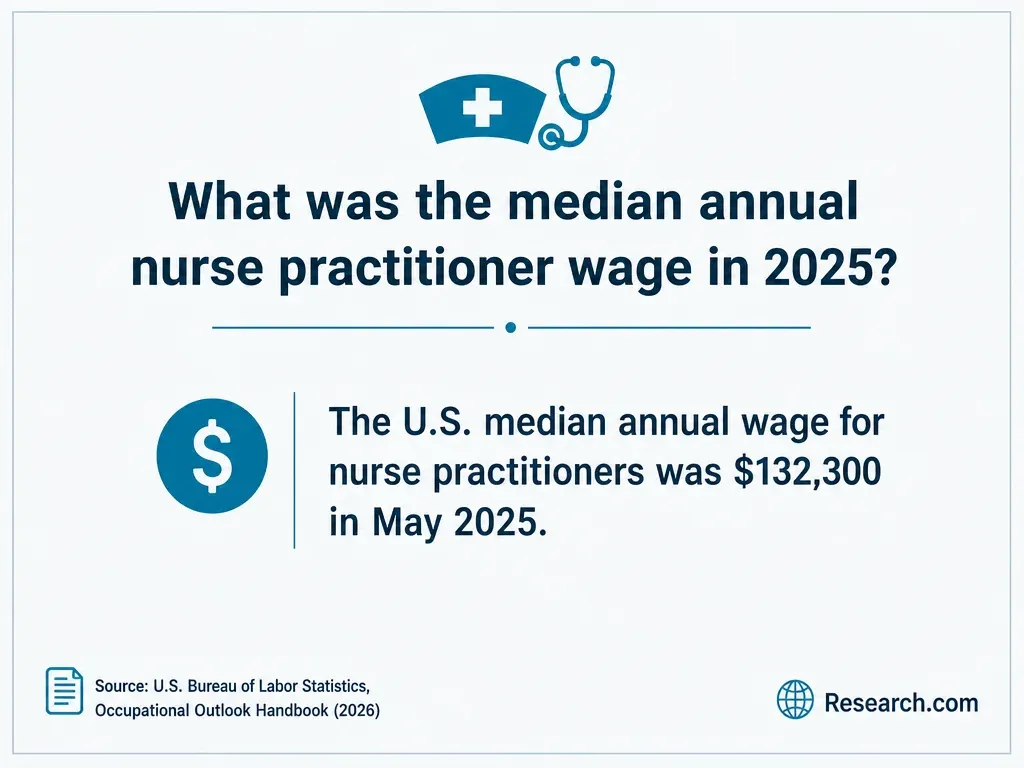
The U.S. Bureau of Labor Statistics reports wages for occupations, including registered nurses and nurse practitioners, rather than a universal "MSN graduate" salary. Use its latest occupation-specific median and outlook as market context, then compare actual Nevada job postings, required experience, schedules, and offers for your intended role. A shorter course of study can look attractive when considering short family nurse practitioner program options, but an RN-to-MSN applicant must establish whether the quoted duration includes the bridge and all required clinical preparation.
How do Nevada MSN graduates qualify for APRN licensure and certification?
For an APRN goal, select the intended role and population focus before selecting a bridge. After completing an appropriately aligned graduate track, the nurse must meet the relevant national certifying organization's examination requirements and apply to the Nevada State Board of Nursing for APRN licensure. Graduation, exam eligibility, certification, and state authorization are separate milestones; an active RN license remains part of the planning picture.
Before enrollment, ask the program which certification examination its graduates are prepared to pursue and whether its supervised experiences meet that certifier's requirements. Confirm current Nevada application and practice requirements with the board. If you already hold a graduate nursing degree, the school should formally evaluate prior courses and clinical documentation rather than assuming your MSN replaces a new population-focus track. Accelerated FNP certificate admissions and requirements may offer a more direct route for an eligible MSN-prepared nurse, but only an individualized evaluation can establish what remains to complete.
Other Things You Should Know About Nursing
Possibly. Confirm that the school accepts Nevada residents into the exact track and will approve Nevada-based practicum sites before applying.
Not necessarily. Some programs award a BSN en route to the MSN; others do not. Check the written degree plan if a BSN matters to your employer.
Coursework may fit around shifts, but live sessions and supervised practicum hours may not. Ask for a term-by-term schedule before committing to full-time work.
Coverage depends on the employer's policy, eligible institution and degree, reimbursement limits, and any service agreement. Obtain written confirmation for both bridge and graduate courses.
- Nursing Leadership - Master of Science In Nursing (MSN) | Nevada State University https://nevadastate.edu/program/master-of-science-in-nursing-msn-nursing-leadership/
- Online Nursing Certificates | 6 Advanced Specializations | University of Nevada, Reno https://nevadaonline.unr.edu/academics/graduate/nursing-certificates
- How the BSN Online Clinical Experience Works | Chamberlain University https://www.chamberlain.edu/academic-resources/bsn-online-clinical-experience
- RN-to-MSN: Registered Nurse to Master of Science in Nursing | University of Maryland School of Nursing https://www.nursing.umaryland.edu/academics/grad/registered-nurse-to-masters/
- Nursing Certification and Licensure - Academic Guides | Academics at Walden University https://academicguides.waldenu.edu/certification-licensure/nursing
- MSN in RN-to-MSN Nursing Education | Online Master's Degree | Capella University https://www.capella.edu/online-nursing-degrees/msn-nursing-program/masters-rn-to-msn-nursing-education/
- Master of Science - Nursing | Academics | UNLV https://www.unlv.edu/degree/msn
- Best ADN-to-MSN Bridge Programs For Nurses | nursejournal.org https://nursejournal.org/degrees/msn/best-adn-to-msn-bridge-programs/
- RN to BSN vs. Direct-Entry MSN: Which Path Fits You? | RegisteredNursing.org https://www.registerednursing.org/articles/rn-to-bsn-vs-msn/