2027 Online Ed.D. in Leadership and Learning in Organizations: Degree Fit for Leaders Tackling Knowledge Loss When Experienced Employees Retire
Audited and Verified:
Our Editorial and Data Verification Process
Research.com uses government datasets, official education statistics and primary institutional information to support its career and degree guides. Our review process checks factual accuracy, occupational definitions, source dates and the requirements associated with the credentials discussed.
How This Article Was Fact-Checked
Our editorial team verifies salary estimates, employment projections, education requirements and program information against original data providers and official organizations. Salary figures are checked against the relevant occupational definitions and reporting periods. Information about licensure, accreditation and required in-person training is reviewed separately.
Fact-checked and verified on:

Co-Founder and Chief Data Scientist
When an experienced employee retires, an organization may lose more than documented procedures. It can lose judgment about unusual cases, relationships that keep work moving, and the ability to teach a successor. For leaders responsible for that risk, an online Ed.D. in Leadership and Learning in Organizations may offer a way to study succession, workplace learning, and organizational change. This guide explains what the degree could contribute, what it cannot fix by itself, and how to decide whether doctoral study - or a more immediate knowledge-transfer effort - fits your responsibilities.
Key Things You Should Know
- An Ed.D. is most useful when you have authority to improve how an organization identifies, transfers, and evaluates critical knowledge - not merely a need to record one retiring employee's procedures.
- Diagnose the risk before choosing training: undocumented decisions, limited successor practice, and incentives that discourage sharing call for different responses.
- The US Bureau of Labor Statistics reports a $133,000 median annual salary for training and development managers in 2025; that occupational figure is not an expected salary or return on an Ed.D.
What is an online Ed.D. in Leadership and Learning in Organizations?
An Ed.D. in this area is a practice-oriented doctorate concerned with how people learn, lead, and improve organizations. The exact degree name and curriculum vary by institution. Online delivery describes where much of the instruction occurs; it does not establish that classes are self-paced or that all work can be completed remotely.
For retirement-related knowledge loss, the useful distinction is between information that can be documented and capability that develops through observation, practice, feedback, and relationships. An Ed.D. may help a leader investigate why knowledge is concentrated in a few people, design a response across teams, and evaluate whether successors can perform the work. It will not, on its own, produce an accurate process manual or persuade an unwilling organization to change.
A practice-focused Ed.D. generally differs from a PhD oriented toward producing disciplinary research and from a business-focused DBA. If your goal is limited to running a knowledge-capture project, targeted organizational-development training may be more direct. See comparing Doctor of Education program types to examine those distinctions without assuming programs with similar names have identical requirements.
Who is an online Ed.D. in Leadership and Learning in Organizations designed for?
The strongest fit is an experienced leader or learning professional who can influence succession, employee development, and work design - and wants to investigate a recurring organizational problem. A talent-development manager might examine whether successors receive enough supervised practice. An operations leader might investigate why exceptions are resolved through one person's informal network. A public-sector or nonprofit leader may need to do the same work within tighter staffing, governance, or budget constraints.
The degree is a weaker fit when the immediate task is narrow, urgent, or outside your decision authority. If a specialist leaves soon, start with a manager-approved handoff, documented decisions, and successor practice rather than waiting for doctoral coursework. If you cannot change workflows or obtain appropriate evidence, seek a project sponsor before committing to a workplace-based research plan.
These routes serve different scopes of responsibility; none substitutes for employer support and access to the work.
| Route | Best-matched need | Important limitation |
| Ed.D. in leadership and learning | Lead and evaluate sustained, cross-functional learning or change efforts | Requires substantial study and may depend on access to an appropriate applied project |
| Targeted training or consulting support | Design a handoff, interview experts, or improve a specific process now | May not develop the leader's broader research and change capabilities |
| Employer-sponsored succession project | Give successors assignments, coaching, and protected practice time | Needs management commitment and continuity after the retiree leaves |
What careers can you pursue with this online Ed.D.?
Graduates with relevant experience may pursue or advance in learning and development, organizational development, talent management, workforce development, or organizational consulting. In these roles, the retirement challenge may involve identifying critical expertise, designing successor learning, advising managers, and checking whether new staff can handle real cases - not simply delivering training sessions.
The doctorate is most credible alongside evidence of leadership: a documented needs assessment, a responsibly evaluated development initiative, or experience coordinating operations, HR, and subject-matter experts. Employers still set their own experience and technical requirements. Higher education has distinct governance and hiring practices; readers considering that sector can use comparing Ed.D. organizational leadership study for higher education to examine its program fit. A general organizational leadership doctorate does not automatically qualify someone for a licensed school-administrator role.
Relevant study may include adult learning, organizational learning, systems thinking, change leadership, and applied research or evaluation. For knowledge loss, their value lies in connecting diagnosis to implementation. A course on learning transfer, for example, is useful if it helps you distinguish a successor who has read instructions from one who can make sound decisions under unusual conditions.
Consider a hypothetical team in which a retiring employee alone knows how to resolve a recurring exception. The leader would first establish what work is at risk and who currently makes those decisions. Possible responses include recording decision criteria, pairing the successor with the expert, creating practice cases, or changing a workflow that depends on personal contacts. Measures might include successful completion of representative cases, escalation patterns, and time to independent performance. None of those measures, by itself, proves that training caused an improvement.
Compare actual syllabi and doctoral project requirements rather than assuming every program teaches knowledge management or permits this project. Before collecting interviews, recordings, or employee-performance information for academic work, confirm employer permission, confidentiality safeguards, and the institution's applicable research-review process. A workplace evaluation is not automatically exempt from review.
Requirements depend on the institution. Programs may assess prior graduate education, academic performance, professional responsibilities, recommendations, a statement of purpose, and readiness for doctoral writing and inquiry. An education degree or a senior title is not a universal requirement. For this topic, a persuasive application would describe decisions you have actually influenced, the organizational learning problem you want to investigate, and the limits of your access - not claim results that have not occurred.
Ask admissions staff whether your prior degree meets eligibility rules and whether any earlier coursework can separately count toward Ed.D. requirements. Those are different decisions; neither admission nor prior graduate study guarantees transfer credit or a shorter program. Applicants resuming unfinished doctoral study can also review online Ed.D. study for returning doctoral applicants, then request a written evaluation from the institution they intend to attend.
Completion time depends on required credits, course sequencing, enrollment pace, and the final project or dissertation. Ask each program for its published study plan and completion rules rather than relying on a general estimate. An applied project involving retirement-related knowledge transfer may also depend on the employer's timing: access to a departing employee, successor practice, and follow-up evidence may not align neatly with an academic term.
Before enrolling, check when the doctoral project begins, whether a different project site is allowed if you change jobs, and how a leave or delayed project affects progression. A shorter advertised course sequence is less useful if you cannot secure the approvals or observation period needed to finish the required work.
There is no reliable single price for this degree category. Request an institution-specific estimate covering required credits, tuition, mandatory fees, any campus travel, and charges that could continue if the final project takes longer than planned. Include time away from paid work or caregiving costs where they apply. Compare that full commitment with the cost of a focused succession initiative or employer-supported professional development.
Employer reimbursement is particularly relevant when the organization benefits from the project, but eligibility, annual limits, continued-employment conditions, and repayment rules must be checked in writing. For ways to investigate aid alongside employer support, see financial support for online higher education leadership doctorates. Do not count unconfirmed aid or a future promotion as a return on your investment.
For a working leader, the meaningful comparison is whether the format permits sustained participation and a feasible organizational project. Online study can reduce routine travel, but live classes, group meetings, and campus convenings may still be required. Campus-based study may offer more in-person contact while demanding a workable commute or relocation. Neither format guarantees better access to retiring employees at your workplace.
Confirm each program's attendance rules, required visits, faculty supervision, and project-site policies before comparing total costs. A lower advertised tuition can lose its advantage when travel or delayed completion is included; cost-conscious routes to a leadership doctorate provide a starting point for that comparison, not a substitute for a current institutional estimate.
Verify that the university holds institutional accreditation recognized by the US Department of Education or the Council for Higher Education Accreditation, and confirm that the advertised online doctorate is an official degree offered by that university. Check the institution's own program description for the exact award, curriculum, delivery requirements, and doctoral project.
Accreditation establishes an important institutional baseline; it does not mean a particular course specializes in knowledge management, that a proposed workplace project will be approved, or that the degree meets state educator-licensure requirements. If licensure matters to your career, obtain confirmation from the program and the relevant state authority.
What salaries and job outlook can Ed.D. graduates expect?
The US Bureau of Labor Statistics reports a 2025 median annual salary of $133,000 for training and development managers. That is a median for an occupation - not for Ed.D. graduates - and management positions generally require relevant experience and responsibility. It should not be used to forecast the salary of someone entering learning and development for the first time.
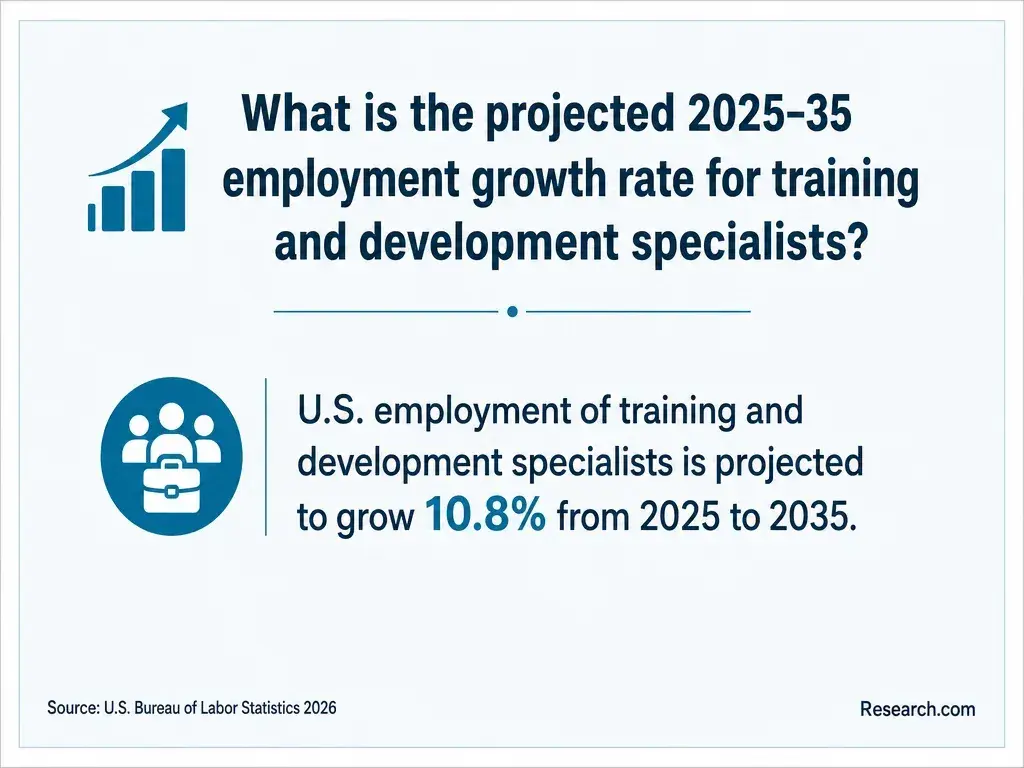
BLS projects 10.8% employment growth for training and development specialists from 2025 to 2035. That outlook describes demand for an occupation, not demand for this doctorate. For your own decision, compare openings and qualifications in your target sector with your current experience, and ask whether the Ed.D. would enable work you could not reasonably pursue through a sponsored succession project or shorter training.
Other Things You Should Know About EdD Leadership
That is an employer contracting decision. Set the scope, compensation, confidentiality terms, and availability in writing before relying on post-retirement help; do not make it the organization's only continuity plan.
It can assist with drafting or searching approved material, but an authorized expert should check accuracy, missing exceptions, and outdated advice. Review privacy and tool-use rules before entering recordings or employee information.
Documents alone may not preserve it. Arrange appropriate introductions, clarify who owns each ongoing relationship, and give successors opportunities to handle interactions while the experienced employee is still available.
Policies, employment agreements, collective bargaining terms, and confidentiality obligations may limit what can be requested or recorded. Work with HR and counsel when those boundaries are unclear, and create protected time for knowledge sharing rather than treating it as an extra task.
- Succession Planning Desk Guide | usgs.gov https://www.usgs.gov/human-capital/succession-planning-desk-guide-0
- The Role of Continuing Professional Training or Development in Maintaining Current Employment: A Systematic Review https://pmc.ncbi.nlm.nih.gov/articles/PMC10647344/
- Eligibility Requirements | Federal Student Aid https://studentaid.gov/understand-aid/eligibility/requirements
- School-Determined Requirements - FSA Partner Connect https://fsapartners.ed.gov/knowledge-center/fsa-handbook/2025-2026/vol1/ch1-school-determined-requirements
- Employer-offered educational assistance programs can help pay for college | Internal Revenue Service https://www.irs.gov/newsroom/employer-offered-educational-assistance-programs-can-help-pay-for-college
- Career Paths in Human Resources | Orfalea College of Business https://orfalea.calpoly.edu/student-services/career-readiness/career-paths/career-paths-in-hr
- Exploring Careers in Talent Development | Webster University https://enroll.webster.edu/exploring-careers-in-talent-development/
- Online Ed.D. in Leadership and Learning in Organizations | VU-EDU https://peabodyonline.vanderbilt.edu/edd-in-organizational-learning/
- What is an Ed. D. in Educational Leadership Degree | nl.edu https://nl.edu/blog/archives/2026/what-is-an-ed-d-in-educational-leadership-degree/
- Ed.D. in Organizational Leadership | University of La Verne https://education.laverne.edu/edd/