2027 Is an Online Ed.D. in Leadership and Learning in Organizations a Good Fit for Professional Society Leaders?
Audited and Verified:
Our Editorial and Data Verification Process
Research.com uses government datasets, official education statistics and primary institutional information to support its career and degree guides. Our review process checks factual accuracy, occupational definitions, source dates and the requirements associated with the credentials discussed.
How This Article Was Fact-Checked
Our editorial team verifies salary estimates, employment projections, education requirements and program information against original data providers and official organizations. Salary figures are checked against the relevant occupational definitions and reporting periods. Information about licensure, accreditation and required in-person training is reviewed separately.
Fact-checked and verified on:

Co-Founder and Chief Data Scientist
Professional society leaders often oversee more than conferences and membership. They may also be responsible for continuing education, volunteer development, and organizational change - work that makes a leadership and learning doctorate worth considering. An online Ed.D. could strengthen those capabilities, but it is a substantial commitment and may not be the most direct route to your goal. This guide helps society executives, education directors, and emerging leaders assess the degree against their responsibilities, career plans, and resources.
Key Things You Should Know
- An online Ed.D. is most useful when you can apply leadership, adult-learning, and evaluation methods to sustained challenges in a professional society - not simply when you want a more senior credential.
- Compare the doctorate with targeted training or a business-focused degree before committing; the right choice depends on whether your main gap is organizational inquiry, functional expertise, or executive experience.
- The U.S. median annual pay for training and development managers was $133,000 in May 2025, but that occupational figure is not an Ed.D. graduate salary or a forecast of your earnings.
Is an online Ed.D. in Leadership and Learning in Organizations right for professional society leaders?
It can be a good fit if you already lead consequential work and want to investigate how your society develops people, shares knowledge, and implements change. A society education director might examine why members complete courses but do not apply new practices. An executive might study how volunteer leaders are prepared to govern chapters. Both problems call for more than producing another webinar: they require stakeholder input, organizational diagnosis, and credible evaluation.
The fit is weaker if your immediate goal is a promotion that primarily requires fundraising, association finance, membership sales, or board-management experience. A doctorate does not replace a record of managing budgets, staff, volunteers, and competing member interests. Nor does it automatically make a society's continuing education eligible for credit from an external regulator or certifying body.
The comparison below starts with the capability you need, rather than the prestige of a credential.
| Path | Strongest fit for a society leader | Main limitation |
| Leadership and learning Ed.D. | Leading sustained learning or change initiatives and evaluating them through applied inquiry | Requires substantial study; does not substitute for executive experience |
| MBA or association-focused executive development | Strengthening finance, strategy, operations, or governance | May offer less depth in adult learning and applied organizational research |
| Focused certificate or employer-supported project | Closing a defined gap in instructional design, evaluation, or change management | Usually narrower than doctoral study |
| Research-oriented PhD | Pursuing original scholarship or a research-intensive academic path | May be less aligned with improving a society's immediate practices |
Before applying, identify a problem you have authority to influence, the evidence you could responsibly access, and the decision you hope better evidence will inform. If you cannot name all three, a smaller project may be a better first step. If cost is a deciding factor, compare lower-tuition online leadership doctorate options against their actual curriculum and project requirements, not tuition alone.
What is an online Ed.D. in Leadership and Learning in Organizations?
An Ed.D., or Doctor of Education, in leadership and learning in organizations is a practice-oriented doctorate focused on how people learn, how organizations change, and how leaders use evidence to improve practice. "Online" describes delivery, not a universal curriculum or a promise of self-paced study. Universities use different degree titles and may require a dissertation, dissertation in practice, capstone, or another approved research project.
For professional societies, the organizational setting matters. Members are often not employees, volunteer leaders have limited time, and a society may need to serve both novices and experienced practitioners. A useful program should let you examine those realities rather than assume that every learning problem occurs in a corporate training department or school system.
What careers can an online Ed.D. prepare professional society leaders for?
The degree may support advancement toward society education director, chief learning officer, executive director, or organizational-development responsibilities. It can also complement work in association consulting, professional development, or program evaluation. The credible transition depends on your existing scope: designing member courses is different from leading an education portfolio, managing a society, or advising multiple organizations.
Build evidence employers can assess: a needs assessment, a redesigned learning pathway, an evaluation plan, or a documented change initiative. Describe your own decisions and the limits of the evidence; do not claim that a project caused improved member outcomes without a design capable of supporting that conclusion. For leaders considering university or association-adjacent roles, employer tuition support for higher education leadership study offers a useful financing comparison, but benefits and repayment rules must be confirmed with your employer.
Relevant study may include adult learning, leadership and organizational culture, change implementation, research methods, and program evaluation. For a society leader, the value lies in connecting them: identifying a member or volunteer learning need, testing whether the proposed response addresses it, and interpreting results without confusing participation or satisfaction with improved professional practice.
Look closely at the required methods sequence and applied project. If your goal is to improve continuing education, ask whether you can study learning transfer and evaluation - not merely take a general leadership course. If you hope to use member records, course data, or interviews, confirm what permissions, privacy safeguards, faculty oversight, and institutional review procedures apply before treating the society as a project site.
Online study can let a society leader remain employed and investigate a problem in their own organization. It does not necessarily reduce scheduled commitments: live classes, cohort meetings, group assignments, and campus convenings may still be required. Campus-based study can make in-person faculty and peer contact easier, but may demand commuting or a larger change to work arrangements.
Request a sample term schedule, attendance policy, convening calendar, and description of project-stage workload. Compare those obligations with conference season, board meetings, and membership-renewal cycles. When screening low-cost Doctor of Education programs online, check whether travel and time away from work change the apparent price advantage.
Requirements vary by institution and entry term. Programs may ask for a completed graduate degree, transcripts, recommendations, a statement of purpose, and evidence of relevant professional experience; some also specify grades, interviews, or research preparation. A society title alone may not show leadership readiness. Explain the decisions you have made, whom they affected, and how you handled an organizational problem.
Check whether your proposed society-based inquiry is feasible, but distinguish a promising application topic from an approved doctoral project. If you have prior doctoral work, ask admissions and the program office separately whether it supports admission and whether any credits can satisfy degree requirements. Education doctorate completion after a doctoral study break is a distinct pathway; prior credits should not be assumed to shorten a new Ed.D.
Completion can take several years, depending on the required credits, enrollment pace, course sequence, and time needed to finish the approved doctoral project. Obtain the program's published completion expectations and ask what happens if your society changes leadership, restricts data access, or can no longer host your project.
For a defensible cost comparison, request a written estimate covering tuition, mandatory fees, required travel and lodging, and any continuation charges after coursework. Add the personal cost of time away from work. Employer reimbursement can help, but check eligibility, annual limits, grade conditions, and repayment obligations before counting it as funding. A guide to education doctorate fees and total study costs can help you identify expense categories; the institution must confirm your actual charges.
Confirm that the degree-awarding institution is accredited by an accrediting agency recognized by the U.S. Department of Education or the Council for Higher Education Accreditation. Check the accreditor's directory and the university's official listing, including any status details. Then confirm that the advertised Ed.D. is the degree you would receive; institutional accreditation does not establish that a particular program has specialized recognition.
Ask the university whether any additional programmatic accreditation applies and what, precisely, it covers. Accreditation is an important quality and eligibility check, but it does not certify that the curriculum fits professional-society work or qualifies you for a regulated occupation.
Professional society leadership generally does not require an Ed.D.-specific license. The degree also does not automatically award an association-management credential, authorize a society to grant professional continuing education credit, or qualify its holder for teacher or school-administrator licensure.
Keep the credentials separate. Your own professional certification may have eligibility and renewal rules, while a member education program may need approval from a different certifying organization or regulator. If you intend to move into a licensed education role, check the program's licensure disclosures and the relevant state authority before enrolling.
What salary and job outlook can Ed.D. graduates expect?
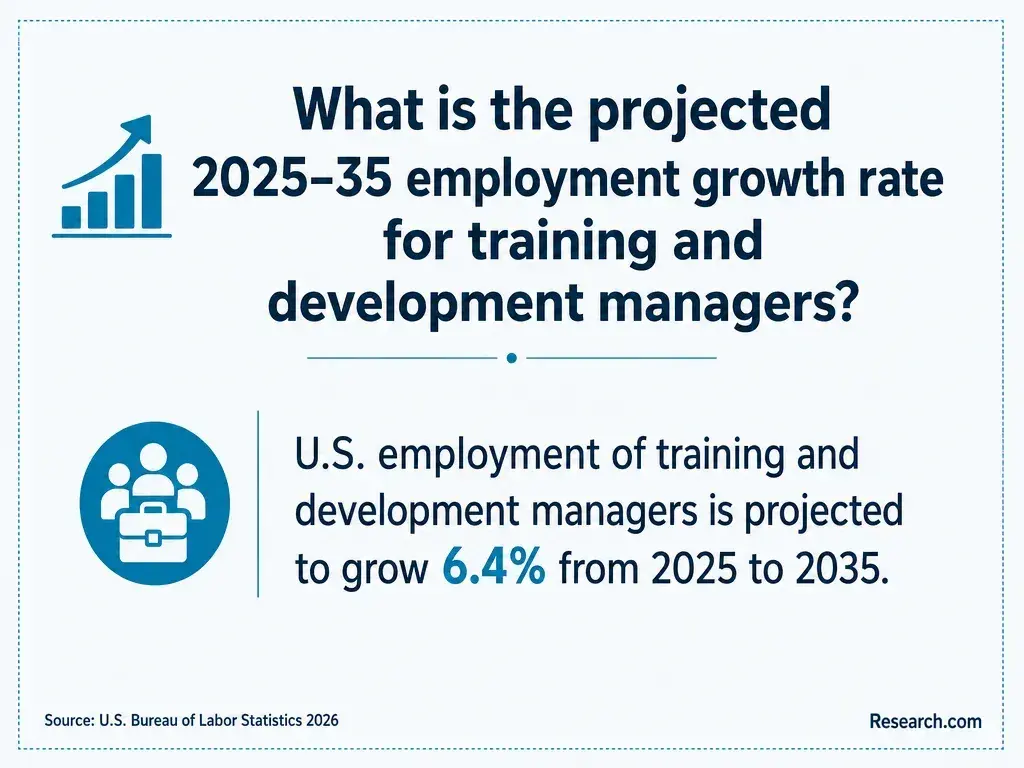
There is no single salary or employment forecast for professional society leaders with this Ed.D. The closest published occupation depends on the work performed, not the degree held. U.S. Bureau of Labor Statistics figures put the May 2025 median annual pay for training and development managers at $133,000, with employment projected to grow 6.4% from 2025 to 2035. Those figures describe an occupation across employers; they do not predict society salaries or a return on doctoral tuition.
For a personal decision, compare actual openings, compensation ranges, and promotion criteria in societies of similar size and specialty. Ask whether the roles you want value doctoral-level inquiry, require proven executive management, or favor a different qualification. Enroll only if the education advances work you expect to do - not on the assumption that the credential will produce a raise.
Other Things You Should Know About EdD Leadership
Not necessarily. Board approval for tuition support, use of staff time, or access to society information is a separate matter from university admission. Get written authorization from whoever controls each resource you need.
Possibly, but your employment access does not automatically authorize research use. Check consent, data-use rules, confidentiality, and university review requirements before recruiting participants or analyzing identifiable records.
Project size alone does not determine suitability. Ask the program whether a carefully scoped evaluation, an external partner, or another approved setting would meet its requirements without overstating what a small group can establish.
If your near-term gap is association operations or a specific hiring preference, a relevant credential or supervised leadership experience may be more direct. An Ed.D. is better justified by a sustained need for advanced learning, change, and applied-inquiry skills.
- Maximizing the Impact and ROI of Leadership Development | nih.gov https://pmc.ncbi.nlm.nih.gov/articles/PMC11505461/
- Cost of Attendance (Budget) | 2025-2026 Federal Student Aid Handbook https://fsapartners.ed.gov/knowledge-center/fsa-handbook/2025-2026/vol3/ch2-cost-attendance-budget
- Understanding College Costs | studentaid.gov https://studentaid.gov/resources/prepare-for-college/students/choosing-schools/consider-costs
- EdD vs. PhD in Education: Choosing the Right Program | Goodwin College of Professional Studies https://drexel.edu/soe/resources/career-path/edd-vs-phd/
- Admissions Requirements for Whitman Online Programs | Syracuse University Whitman School of Management https://whitman.syracuse.edu/graduate-programs/online-masters-programs/admissions-requirements-for-whitman-online-programs
- Academics: Section 4: Academic Calendar, Admission, and Enrollment: Admission Requirements https://academics.waldenu.edu/handbook/registration-admission-enrollment/admission-requirements
- EdD vs PhD: What's the Difference? | Belmont University https://www.belmont.edu/stories/articles/2025/edd-vs-phd-whats-the-difference.html
- EdD vs. PhD in Education: What's the Difference? | Northeastern University Charlotte https://charlotte.northeastern.edu/news/edd-vs-phd-in-education-whats-the-difference/
- EdD vs. PhD in Education: Key Differences, Careers & Salary | Alverno College https://edd.alverno.edu/articles/professional-doctorate-vs-phd/