2027 Online Ed.D. in Leadership and Learning in Organizations After a Master of Science in Nursing: Admission and Credit Questions
Audited and Verified:
Our Editorial and Data Verification Process
Research.com uses government datasets, official education statistics and primary institutional information to support its career and degree guides. Our review process checks factual accuracy, occupational definitions, source dates and the requirements associated with the credentials discussed.
How This Article Was Fact-Checked
Our editorial team verifies salary estimates, employment projections, education requirements and program information against original data providers and official organizations. Salary figures are checked against the relevant occupational definitions and reporting periods. Information about licensure, accreditation and required in-person training is reviewed separately.
Fact-checked and verified on:

Co-Founder and Chief Data Scientist
An MSN can be strong preparation for an online Ed.D. in leadership and learning in organizations, but it does not automatically satisfy every admission rule - or reduce the doctoral credits you must complete. For nurses considering leadership beyond clinical practice, that distinction affects applications, cost, and time away from work. This guide explains how schools evaluate an MSN, which prior courses might count, and what to request in writing before enrolling. It also helps you judge whether this doctorate fits your intended work in healthcare education, workforce development, or organizational change.
Key Things You Should Know
- A completed MSN may meet an Ed.D. program's master's-degree requirement even if the program is not nursing-specific; the institution decides whether the degree, grades, and experience satisfy its rules.
- Admission eligibility, prerequisite waivers, and transfer credit are separate decisions. Do not budget for fewer doctoral courses until the program issues a written credit evaluation.
- Compare the required doctoral curriculum with your MSN transcript, then confirm the program's applied-project requirements and your access to an appropriate organizational setting.
What Is an Online Ed.D. in Leadership and Learning in Organizations?
An Ed.D. in leadership and learning in organizations is a practice-oriented doctorate focused on how people learn, how organizations change, and how leaders use evidence to improve practice. An online program delivers substantial coursework remotely, but it may still require live meetings, group work, or campus visits. The exact degree name and requirements vary by institution.
For an MSN-prepared nurse, the connection might be improving staff development, evaluating an onboarding initiative, or leading learning across a health system. It is not necessarily a nursing doctorate or a route to advanced nursing practice. Check whether the curriculum addresses the organizational problems you want to lead - not merely whether its title includes "leadership."
Can an MSN Qualify You for an Online Ed.D. in Leadership?
Programs that accept a completed master's degree from a recognized institution without requiring an education major may consider an MSN. Others specify a relevant discipline, particular graduate preparation, or professional experience. Only the admitting institution can determine whether your MSN meets its policy for your entry term.
Your strongest application connects nursing work to organizational learning. Examples include responsibility for nurse onboarding, preceptor development, quality improvement, interprofessional training, or implementation of a practice change.
Describe what you decided, whom you worked with, and how you assessed the problem; a managerial title alone does not establish doctoral readiness. If your MSN emphasized clinical practice rather than research methods or adult learning, ask whether the program requires bridging coursework or permits you to develop those skills in the doctorate.
Do Online Ed.D. Programs Accept Transfer Credits From MSN Programs?
Some may, but a completed MSN does not create an automatic block of transferable Ed.D. credit. Schools may restrict transfer to particular course levels, grades, dates, institutions, or equivalents in the doctoral curriculum. Nursing research, statistics, or education courses may be worth reviewing; clinical practicum hours and specialty nursing courses may have no matching Ed.D. requirement.
The distinctions below explain why a school can accept your MSN for admission while requiring you to complete its full doctoral sequence.
| Decision | What it means for an MSN applicant | Who confirms it |
| Admission eligibility | The MSN satisfies a required prior-degree condition. | Admissions office or program |
| Prerequisite or course waiver | Prior preparation excuses a requirement or permits another course; it may not lower total credits. | Program director or designated academic authority |
| Transfer credit | An approved MSN course counts toward a specified Ed.D. requirement, subject to institutional limits. | Registrar and program under published policy |
Send official transcripts, course descriptions or syllabi, credit-hour information, and evidence of any research or education coursework. If your MSN uses quarter credits, request the school's conversion and equivalency assessment. Ask for a written degree audit showing which requirements, if any, change - and whether the decision reduces tuition or completion time.
Requirements vary, but schools commonly review prior degrees and transcripts, academic performance, professional experience, recommendations, and a statement explaining the applicant's goals. Some request an interview, writing sample, or evidence of an organizational problem suitable for applied study. Entrance-test and minimum-experience rules must be checked at each program rather than assumed.
For an MSN applicant, the useful questions are specific:
- Does the program accept nursing as a relevant master's field?
- How does it define qualifying leadership experience?
- Are graduate research or statistics courses required before entry?
- Can a project be conducted in a healthcare organization, and what approvals would that require?
Request answers tied to the intended entry term, especially if admission is conditional.
If your goal is leadership in a college or university, investigate funding separately from admission. A review of higher education leadership doctoral scholarships can suggest funding questions to ask, but eligibility and award availability require confirmation with each school and employer.
Confirm the institution's current accreditation through its published information and the accreditor's directory, including whether the accreditation covers the period in which you would study. Then verify that the advertised online program leads to the stated Ed.D. degree. Institution-level accreditation does not mean that a general leadership doctorate has nursing program accreditation or qualifies someone for educator or school-administrator licensure.
If a lower-priced program interests you, use inexpensive organizational leadership doctoral pathways as a comparison starting point, not proof of accreditation or equivalence. Ask the institution how its exact degree is recorded on a transcript, whether it makes any licensure claims, and whether your target employer recognizes that credential for the role you want.
Relevant coursework may cover adult learning, organizational change, leadership, research methods, and evaluation. For an MSN graduate, the added value depends on what the MSN did not already teach.
A nurse educator with strong instructional-design experience might benefit more from organizational diagnosis and implementation methods; a clinical manager might need deeper preparation in learning assessment and qualitative or quantitative inquiry.
Examine required courses rather than assuming every program covers each subject in depth. Also confirm the final deliverable: a dissertation in practice, another dissertation model, or an approved capstone can demand different kinds of research preparation and organizational access. Online Ed.D. final project format comparisons can help frame questions, but the program's handbook governs what you must complete.
There is no reliable universal timeline or price for an MSN-to-Ed.D. pathway. Required credits, course sequencing, enrollment pace, project approval, and any accepted transfer credit determine the schedule. Compare online Ed.D. degree options by study length against the time you can actually devote to coursework and applied research; an advertised fast track may not fit a nurse's shifts or project access.
Request a program-specific estimate that separates tuition, mandatory fees, technology charges, and any campus-travel costs. Then check whether employer assistance covers an Ed.D., when reimbursement is paid, and whether leaving the job triggers repayment. An MSN course should not be treated as a cost saving until the school confirms that it replaces a required doctoral credit.
Online study may preserve your ability to work in healthcare while studying, but location flexibility is not the same as schedule flexibility. Ask about live-session attendance, clinical-shift conflicts, group meetings, required convenings, faculty access, and whether your applied project can use a healthcare site. A campus program may be preferable if its mentoring, local partnerships, or timetable better support your goal.
Compare the full financial commitment, not delivery mode alone. Tuition-focused education doctorate program choices can help you identify candidates, but travel, fees, time off, and project-related expenses belong in your comparison as well.
Potential directions include healthcare learning and development, nurse professional development leadership, organizational improvement, consulting, and some higher-education administration roles. The realistic next step depends on your existing nursing responsibilities, management experience, and the employer's qualifications - not the doctorate alone.
An Ed.D. may fit an MSN-prepared professional who wants to design and evaluate learning across teams or lead organization-wide change. If the goal is advanced clinical practice, a nursing-specific pathway is likely more direct.
If you mainly need to qualify for a near-term training or management opening, relevant project leadership, mentorship, or targeted study may offer a less costly route. Confirm separately any nursing license, faculty qualification, or state-specific requirement attached to the job.
What Salary and Job Outlook Can Ed.D. Graduates Expect?
There is no single Ed.D.-graduate salary. The US Bureau of Labor Statistics reports a May 2025 median annual salary of $133,000 for training and development managers. That figure describes an occupation - not new Ed.D. graduates or healthcare education leaders specifically - and those jobs typically depend on substantial relevant experience.
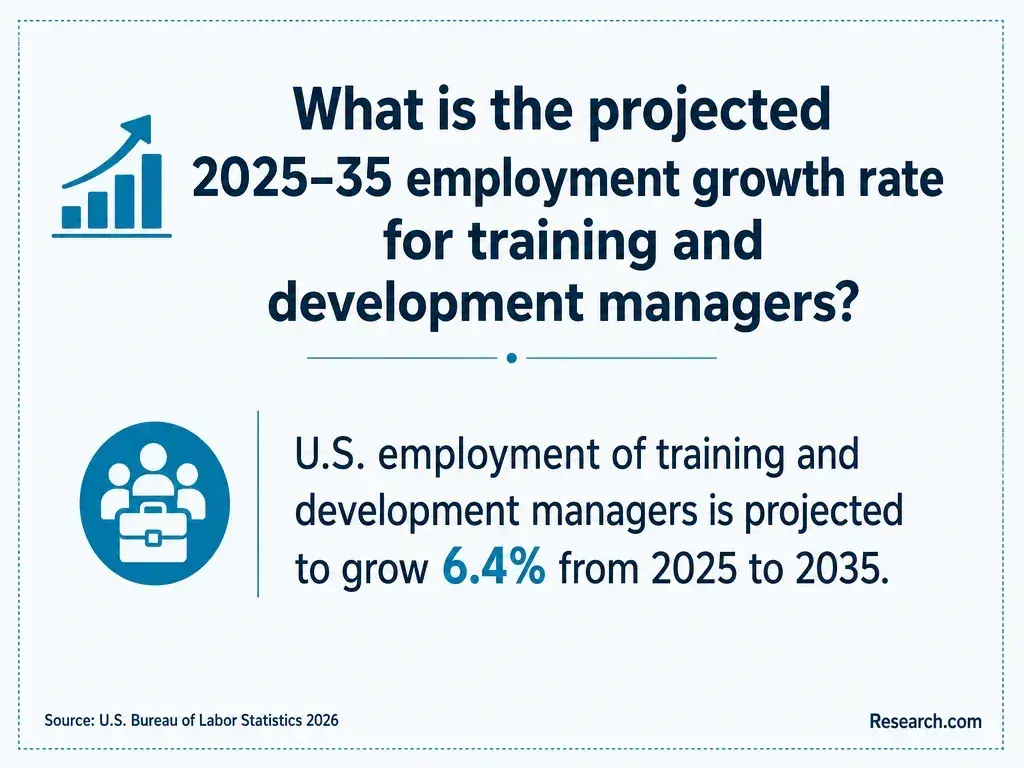
BLS projects 6.4% employment growth for training and development managers from 2025 to 2035. Use occupational figures to assess a target role's market, then examine actual job postings, your experience, and your employer's pay structure before estimating what a doctorate might change for you.
Other Things You Should Know About EdD Leadership
No. A DNP is a nursing practice doctorate; an Ed.D. in leadership and learning focuses on educational and organizational practice. Compare the required curriculum with the work you want to do.
Not necessarily. A general leadership Ed.D. may not require one, but a nursing role or employer may. Check program admission rules and the requirements of your intended job separately.
It may provide a starting question, but prior work is not automatically an approved doctoral deliverable. Ask faculty about originality, scope, site permission, data access, and required review before proposing it.
You can explore programs first, but discuss feasibility early if the doctorate requires workplace inquiry. Employer support for enrollment does not itself authorize access to staff, records, or organizational data.
- Tuition and Financial Aid - UNC-Chapel Hill Online https://online.unc.edu/online-doctoral-programs/online-edd-organizational-learning-and-leadership/admissions/tuition-financial-aid/
- Undergraduate Transfer Credit Policies - University Registrar https://registrar.vanderbilt.edu/transfer-credit/policies/
- Ed.D. Admissions - Peabody | Vanderbilt University Online https://peabodyonline.vanderbilt.edu/edd-in-organizational-learning/admissions/
- EdD in Instructional Leadership for Nurse Educators - UA Online https://online.ua.edu/degrees/edd-in-instructional-leadership-concentration-in-nurse-education/
- Program: Doctor of Education, EdD - National University https://catalog.ncu.edu/preview_program.php
- Doctor of Education in Educational Leadership | National University https://www.nu.edu/degrees/educational-leadership/programs/doctor-of-education-in-educational-and-organizational-leadership/
- Doctor of Education with a Major in Nursing Education | westga.edu https://www.westga.edu/academics/program_details.php
- Transfer Credits for Graduate Program | rutgers.edu https://catalogs.rutgers.edu/generated/nursing_1921/pg28.html