2027 Online BA in Psychology - Mental Health for Food Assistance Program Staff: Compare Transferable Skills and Degree Requirements
Audited and Verified:
Our Editorial and Data Verification Process
Research.com uses government datasets, official education statistics and primary institutional information to support its career and degree guides. Our review process checks factual accuracy, occupational definitions, source dates and the requirements associated with the credentials discussed.
How This Article Was Fact-Checked
Our editorial team verifies salary estimates, employment projections, education requirements and program information against original data providers and official organizations. Salary figures are checked against the relevant occupational definitions and reporting periods. Information about licensure, accreditation and required in-person training is reviewed separately.
Fact-checked and verified on:

Co-Founder and Chief Data Scientist
Food assistance staff often help people facing financial stress, but helping a client access services is different from providing mental health treatment. If you are considering an online BA in psychology, the decision is whether it will strengthen your current work or help you move into a specific new role.
This guide connects your existing skills to psychology coursework, compares degree and transfer requirements, and explains costs, career options, and professional boundaries. You can use it to decide whether a full degree - or more targeted training - is the better next step.
Key Things You Should Know
- A psychology BA can strengthen communication, referral, and program-evaluation skills; it does not authorize diagnosis, psychotherapy, or independent clinical assessment.
- Compare how accepted transfer credits satisfy the major, not just the total accepted. Many bachelor's degrees require about 120 semester credits, but each school controls its own requirements.
- For a faster improvement in an existing food assistance role, employer-supported training in mental health referrals, crisis procedures, and confidentiality may be more useful than a full degree.
What is an online BA in psychology, and how does it prepare food assistance staff for mental health work?
An online Bachelor of Arts in psychology is an undergraduate degree focused on behavior, development, psychological science, and research. A BA generally includes broad general education and electives, but the BA label alone does not tell you how much statistics, science, or applied learning a program requires.
For food assistance staff, its strongest application is nonclinical support: recognizing when distress may affect access to services, communicating respectfully, following an agency's escalation procedures, and making appropriate referrals. Learning about mental health conditions does not make a student qualified to identify a client's diagnosis.
Choose a broad BA if you want flexibility for community-service work or later study. If substance-use outreach is the specific goal, compare the actual course requirements of accredited online addiction psychology bachelor's programs; a concentration's name does not establish counseling eligibility.
Which transferable psychology skills help food assistance program staff support client mental health?
You may already practice skills that psychology programs develop further. Explaining eligibility rules without judgment, listening to a client's priorities, coordinating with partner agencies, and documenting a referral all have value in behavioral-health-adjacent work. Psychology study can add a stronger understanding of stress, behavior, research evidence, and the limits of what an observation can tell you.
The distinction is between supporting access and providing treatment. A staff member can explain available services, ask what type of assistance a client wants within agency policy, and connect them with qualified providers. They should not turn a benefits interview into a mental health assessment or promise that a referral will resolve a crisis.
If you want to move specifically into substance-use counseling rather than improve referral work, compare the education and supervised-experience requirements for that occupation before choosing a major. Inexpensive undergraduate substance use counseling degree choices may be relevant, but a low tuition price matters only if the program fits your state's credential rules.
What degree requirements should you compare in online psychology bachelor's programs?
Start with an official degree audit, especially if you have an associate degree or previous college study. A school may accept a course as elective credit without using it to satisfy psychology statistics, research methods, general education, or an upper-level major requirement. The receiving institution makes the final equivalency decision.
These comparisons reveal whether a program builds the skills you need without adding avoidable time:
- Credits still required: Separate accepted transfer credits from credits that actually fulfill each graduation requirement, including any minimum credits earned at the institution.
- Course sequence: Check whether introductory psychology or statistics must precede research methods, and when required courses are offered.
- Applied requirements: Confirm whether a capstone, internship, research project, or campus visit is mandatory and whether your current job could be approved as a site.
- Relevant electives: Look for developmental psychology, health psychology, community psychology, or mental health systems rather than relying on a concentration label.
Request a written, program-specific audit before paying a deposit. If finishing sooner is essential, compare options for speeding up an online psychology degree against the time you can actually devote to coursework and any required placement.
Online delivery can remove a commute without removing scheduled obligations. Campus study may make it easier to meet faculty and join local research activities, while an online program may better accommodate agency shifts. Neither format automatically provides a suitable community placement.
The comparison below focuses on demands that can affect a working food assistance employee.
| Feature | Online BA | Campus-based BA |
| Course schedule | May offer asynchronous work, but deadlines and live meetings can still apply | Usually involves scheduled travel and class attendance |
| Applied experience | May require arranging an approved local site and supervisor | May offer nearby faculty or agency connections; placement is not guaranteed |
| Research access | Remote projects may be available, depending on faculty and program design | In-person research teams may be easier to access |
Ask for a sample term schedule and placement policy, not just a statement that the degree is "online." Selecting an online psychology bachelor's program is most useful when you check those details against your shifts, caregiving responsibilities, and local opportunities.
Typical core areas include introductory psychology, statistics, research methods, development, social behavior, and biological or cognitive psychology. Programs differ in their required courses, electives, and whether students complete a capstone or internship. For food assistance work, research methods is especially useful for judging whether a claimed intervention has evidence behind it; statistics helps you interpret service reports without treating correlation as proof of cause.
Developmental and social psychology can inform communication across ages and communities. Abnormal psychology may introduce diagnostic concepts, but it is academic study - not training to diagnose clients. If you are drawn to a specialty outside your current work, compare its full curriculum rather than assuming an elective changes your qualification. For example, forensic psychology degree formats and academic requirements address different goals from routine food assistance referrals.
Verify that the institution holds accreditation from an accreditor recognized by the U.S. Department of Education or the Council for Higher Education Accreditation, and confirm that the online BA is offered by that institution. Institutional accreditation matters for federal aid eligibility and may affect how other schools review transfer work, although it never guarantees that credits will transfer.
Do not expect American Psychological Association accreditation for a general psychology BA: APA accreditation applies to specified professional psychology training programs, not ordinary bachelor's majors. Similarly, a mental health or addiction concentration is not proof of eligibility for a state credential. Verify those requirements with the relevant state authority if certification is your goal.
Accreditation is a threshold, not a reason to overlook poor transfer fit or unaffordable tuition. When finding an affordable psychology degree route, compare only programs that meet your accreditation and academic needs.
Requirements vary for first-year and transfer applicants. Schools commonly request a high school record or equivalent for first-year admission and official transcripts from every college attended for transfer review. Some also set a minimum GPA or separate requirements for entering the psychology major. Admission to the university does not mean all prior courses will satisfy the major.
Ask admissions which documents establish eligibility, then ask a transfer or psychology advisor for a degree audit showing where each prior course applies. If later graduate study is part of your plan, protect room for statistics and research methods rather than assuming a specialized undergraduate title is necessary. For example, time-to-degree planning for forensic psychology graduate students is a separate decision from meeting BA admission requirements.
A traditional full-time bachelor's plan is often described as four academic years, but your remaining time depends on the school's degree audit, course availability, enrollment pace, and any approved prior credit. Online study does not bypass prerequisites or a required capstone. Part-time enrollment may fit an agency schedule better while extending completion time.
For a meaningful cost comparison, multiply each school's tuition rate by the credits you still need there, then add required fees, books, technology, and any placement-related travel or unpaid time. Do not use an advertised per-credit price as a total-degree price. Ask your employer whether education assistance covers psychology coursework and what service or grade conditions apply.
Complete the aid process for schools you are seriously considering and compare their actual offers. Guidance on tuition assistance routes for substance abuse counseling undergraduates can help identify questions about grants and employer support, but eligibility and award amounts depend on your circumstances and chosen program.
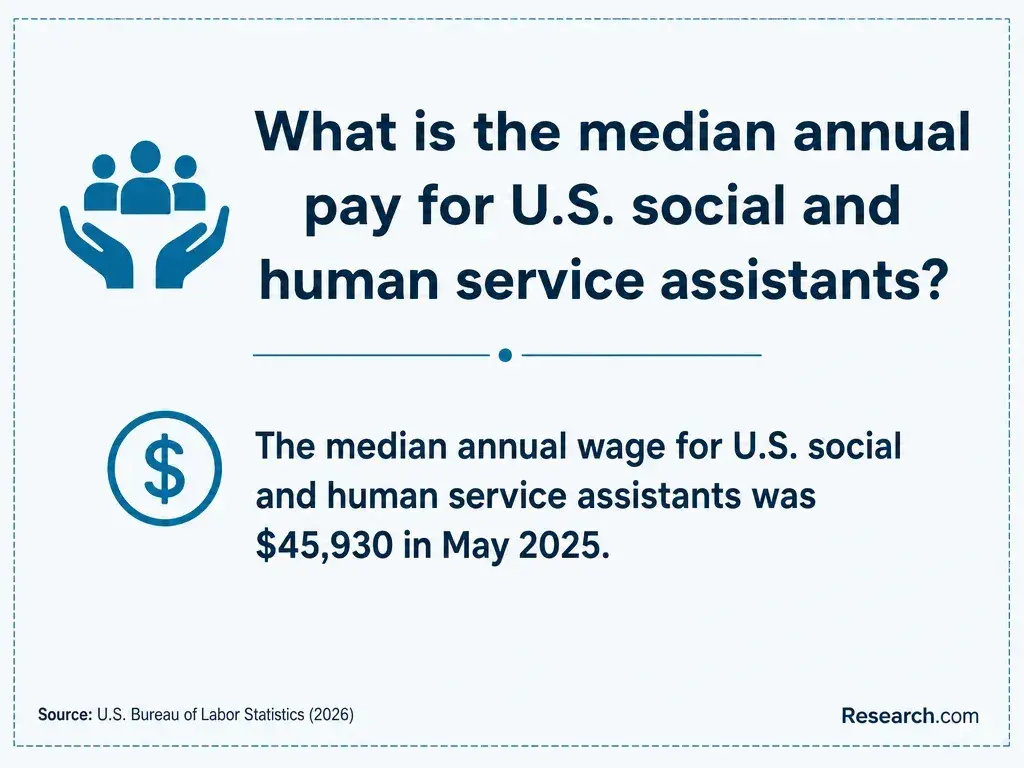
Relevant nonclinical roles include benefits or intake coordinator, social and human service assistant, community outreach worker, and behavioral-health referral or program-support staff. Duties may involve explaining services, arranging appointments, tracking referrals, and maintaining records under agency policy. Advancement often depends as much on experience, language skills, supervision, and the employer's hiring rules as on the degree's title.
The U.S. Bureau of Labor Statistics reported a $41,410 median annual wage in 2023 for social and human service assistants. That occupation-wide figure is a reference point for one relevant job category - not a predicted salary for psychology graduates or food assistance staff. Compare actual local postings, especially if a move from a public agency would change your benefits or pay structure.
A BA may also support applications to more specialized nonclinical graduate study, but the work changes with the specialty. Graduate forensic psychology job options and qualifications, for instance, should not be mistaken for the qualifications needed for food assistance or routine mental health referrals. If your aim is to improve your current service coordination rather than change occupations, targeted employer training may offer a more direct return.
Does an online psychology bachelor's degree lead to mental health licensure or certification?
No. A psychology BA, whether online or campus-based, does not by itself qualify someone to practice psychotherapy, diagnose mental health conditions, perform independent clinical assessment, or use a protected clinical title. Requirements for counselors, clinical social workers, psychologists, addiction counselors, and peer-support credentials differ by state and occupation.
If your goal is licensed counseling, identify the state and license first, then check the board's education, supervised-practice, and examination rules. A licensure-oriented counseling master's is distinct from a general psychology BA or nonclinical psychology master's; online mental health counseling master's timelines are relevant only after you verify that a particular program meets your jurisdiction's requirements.
For immediate workplace needs, ask your supervisor which approved training covers referral procedures, confidentiality, safety escalation, and role boundaries. Those skills can improve client support without suggesting that food assistance staff are acting as clinicians.
Other Things You Should Know About Psychology
Possibly, but get faculty and agency approval before using workplace activities or information. A project about public service resources may be feasible without client records; access to client data requires separate permission and safeguards.
No. It is targeted training, not a bachelor's degree or clinical qualification. It may nevertheless be a better first step if your immediate task is recognizing concerns and following referral procedures.
It may be if you want a social-work career rather than broad psychology study. Compare the specific job's requirements and, for clinical social work, the qualifying graduate and state licensure pathway.
Follow agency confidentiality rules. In class discussions and applications, describe the skill or process in general terms rather than sharing identifiable details or assuming that removing a name makes a case safe to disclose.
- Your financial path to graduation | consumerfinance.gov https://www.consumerfinance.gov/paying-for-college/your-financial-path-to-graduation/
- Accreditation in the U.S. | ed.gov http://www.ed.gov/laws-and-policy/higher-education-laws-and-policy/college-accreditation/accreditation-in-the-us
- Requirements Related to the Practice of Counseling - NCBI https://www.ncbi.nlm.nih.gov/books/NBK259170/
- Bachelor's Completion Transfer Policies | Northeastern University College of Professional Studies https://cps.northeastern.edu/admissions-aid/admissions-policies/bachelors-completion-transfer-policies/
- Why APA Accreditation Matters https://accreditation.apa.org/why-accreditation-matters
- Online Bachelor's in Psychology | University of Louisville https://online.louisville.edu/programs/bachelors/online-bachelor-of-science-in-psychology
- Online Psychology Bachelor's Degree | University of West Florida https://uwf.edu/programs/online/psychology-ba/
- Transferable Skills: Examples for Psychology Graduates | East Carolina University https://onlineprograms.ecu.edu/blog/transferable-skills-examples/
- What Degree Do I Need to Become a Counselor or Therapist? | Palo Alto University https://paloaltou.edu/resources/blog/what-degree-do-i-need-become-counselor-or-therapist
- Bachelor of Arts in Psychology - Degree Completion | Notre Dame de Namur University https://www.ndnu.edu/psychology/ba-completion-psychology.html