2027 Online BA in Psychology - Addictions for Work in Recovery Advocacy Organizations: Compare Degree Fit and Hiring Requirements
Audited and Verified:
Our Editorial and Data Verification Process
Research.com uses government datasets, official education statistics and primary institutional information to support its career and degree guides. Our review process checks factual accuracy, occupational definitions, source dates and the requirements associated with the credentials discussed.
How This Article Was Fact-Checked
Our editorial team verifies salary estimates, employment projections, education requirements and program information against original data providers and official organizations. Salary figures are checked against the relevant occupational definitions and reporting periods. Information about licensure, accreditation and required in-person training is reviewed separately.
Fact-checked and verified on:

Co-Founder and Chief Data Scientist
If you want to work for a recovery advocacy organization, an online BA in psychology with an addictions focus may be useful - but it may not be the qualification an employer values most. Recovery organizations hire for outreach, peer support, service coordination, and program work, each with different expectations.
This guide compares the degree with those job requirements, explains where supervised experience or a state credential matters more, and shows how to check an online program before committing time and money.
Key Things You Should Know
- An addictions-focused psychology BA can prepare you for nonclinical advocacy and program roles, but it does not authorize addiction counseling, diagnosis, or therapy.
- Hiring requirements depend on the job: peer-support positions may require a state-recognized credential, while outreach and coordination roles may emphasize relevant experience and communication skills.
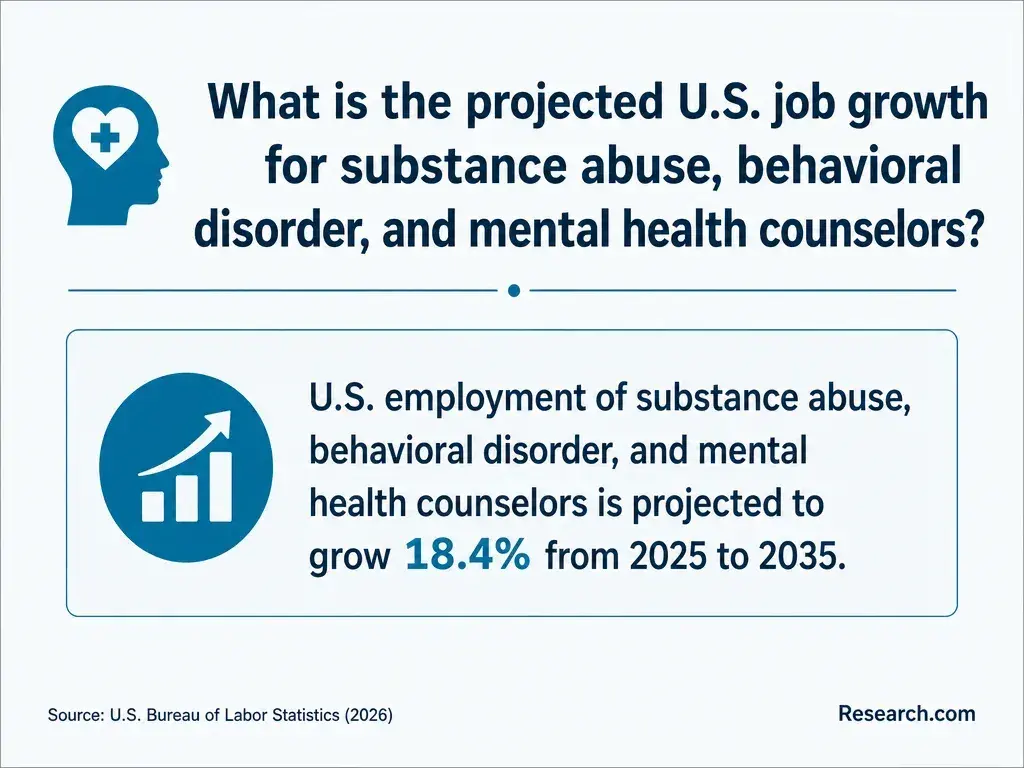
- The U.S. Bureau of Labor Statistics projects 17% employment growth for substance abuse, behavioral disorder, and mental health counselors from 2024 to 2034; that projection covers a broader, differently qualified occupation - not recovery advocates specifically.
What Is an Online BA in Psychology With an Addictions Focus?
It is a bachelor of arts degree built around psychology coursework, with additional study of substance use, behavior change, prevention, and recovery. The addictions focus might be an officially named concentration, a minor, or simply a set of electives. Check the transcript designation and required courses rather than relying on the program's marketing description.
For recovery advocacy work, the degree's value lies in understanding evidence, communicating without stigma, and recognizing when someone needs a referral to a qualified professional. It is not clinical training. If you already have substantial nonprofit or community-service experience, compare the specific skills you lack with online bachelor's program choices in psychology before deciding that a second degree is necessary.
What Jobs Can You Get in Recovery Advocacy Organizations With This Degree?
A BA may support applications for several nonclinical positions, but eligibility depends on the employer, your experience, and any state rules. This comparison connects common job tasks to evidence you could develop during school or community work.
| Role | Typical work | Evidence employers may seek |
| Outreach or recovery advocacy coordinator | Build community partnerships, share resources, organize events, and document outreach | Public communication, local service knowledge, and event or volunteer experience |
| Recovery-support or peer-support worker | Offer goal-oriented, nonclinical support and connect people with services | Relevant lived experience where required, approved training or certification, and strong boundaries |
| Intake or resource navigator | Explain services, collect permitted information, and arrange referrals | Confidential documentation, accessibility awareness, and knowledge of referral procedures |
| Program assistant or evaluation coordinator | Track activities, support reporting, and summarize program information | Spreadsheet, research-methods, writing, and data-handling skills |
Job titles are not standardized. An "advocate" position could be mainly public policy work, direct client support, or fundraising, so read its duties before judging degree fit. For a broader view of professional pathways in recovery organizations, compare the work itself - not just the title - with your experience and interests.
What Hiring Requirements Do Recovery Advocacy Organizations Expect?
Requirements often divide into three categories: education, demonstrated service skills, and credentials tied to particular duties. A psychology BA may satisfy a posting's bachelor's-degree requirement without satisfying its peer-certification or counseling requirement.
Before applying, review postings from organizations where you would actually work. Compare the following requirements with evidence you can document:
- Service experience: Outreach, volunteering, navigation, or supervised support work with clear examples of what you did.
- Role-specific training: Employer-required instruction in confidentiality, crisis escalation, safeguarding, or peer-support practice.
- Operational skills: Accurate records, accessible communication, partnership-building, and grant-related activity tracking.
- State or employer credentials: Peer certification or an addiction-counselor credential when the position expressly requires one.
Ask whether a listing's "counselor" duties involve regulated treatment; if so, request the exact state credential and supervision requirements. Someone targeting those duties should compare online addiction counseling degree programs with the state board's rules rather than assuming a psychology concentration qualifies.
Delivery format matters less to employers than relevant skills and credible experience, but it can change how easily you obtain that experience. The comparison below highlights the practical differences to investigate at each school.
| Decision factor | Online program | Campus-based program |
| Scheduling | May offer recorded coursework, but live sessions and deadlines can still be fixed | Often has scheduled classes and commuting requirements |
| Recovery-organization connections | May require you to identify and secure a local opportunity | May offer nearby partnerships; access is not guaranteed |
| Research and applied work | May provide remote projects or locally supervised placements | May offer in-person labs or community projects |
| Total expense | Compare tuition and fees alongside technology and placement costs | Compare tuition and fees alongside travel or relocation costs |
Ask each program who approves a local advocacy placement, whether one is required, and whether your existing job can qualify. An accelerated schedule may shorten coursework without shortening the time needed to arrange experience; compare accelerated BA and BS psychology pathways against your actual work and caregiving schedule.
Common foundations include introductory psychology, statistics, research methods, developmental and social psychology, and courses on psychological disorders. An addictions focus may add substance-use science, prevention, health behavior, community resources, and the social conditions affecting access to recovery services. Exact requirements vary by school.
For advocacy, prioritize courses that teach you to evaluate claims about interventions, communicate across cultures, protect confidential information, and distinguish screening or referral from diagnosis. A supervised, nonclinical community project can make those skills more concrete, but obtain school and organization approval before using client information.
Specialization should follow the target job. For example, online forensic psychology tuition admissions and outcomes are more relevant to someone comparing legal-system careers than to someone seeking recovery outreach; the shared psychology core does not make the concentrations interchangeable.
Check that the degree-granting institution holds recognized institutional accreditation and that the status covers the school offering the online degree. Use the accreditor's directory and the institution's current disclosures, not an advertisement alone. Institutional accreditation is important for educational quality oversight and can affect aid or future transfer, but it does not certify that a BA meets a state addiction-counselor standard.
Do not expect APA accreditation for a general psychology bachelor's degree: APA's professional accreditation has a different scope. If counseling licensure is the eventual goal, investigate the required graduate program and the intended state's educational rules separately. Comparisons of funding options for accredited mental health counseling programs concern a distinct professional pathway, not an accreditation endorsement of an undergraduate addictions focus.
Schools commonly request prior academic records and have separate procedures for first-year and transfer applicants. Some also specify minimum academic standing or prerequisite coursework. Admission to the university does not necessarily mean admission to a particular major or concentration.
If you have college credit, ask for a written degree audit showing which courses satisfy general education, psychology, statistics, addictions-focus, and remaining institutional requirements. Credits accepted as electives may not shorten the required course sequence. The final decision belongs to the receiving institution; use its published rules alongside comparisons of psychology program transfer policies.
Completion time depends on accepted credits, course sequencing, enrollment pace, and whether required courses run every term. "Online" does not eliminate fixed schedules for a placement or capstone. Obtain a term-by-term plan, particularly if you will continue working at a recovery organization.
For a useful cost comparison, request the tuition rate, mandatory fees, remaining credits, and expected terms in writing. Add books, technology, travel to any placement, and potential lost work hours. Compare that estimate with low-cost online psychology degrees, but judge affordability by the cost of finishing your own degree, not an advertised rate in isolation. If the desired job accepts your existing education plus targeted training, that may be the less costly route.
Graduation alone grants neither an addiction-counselor license nor a peer-support certification. State-recognized peer credentials may require approved training, relevant experience, supervision, or examination; requirements vary by jurisdiction. Addiction-counselor credentials follow a separate set of state rules governing education, supervised practice, and permitted duties.
Start with the exact credential named in a local job posting, then check the responsible state board or certifying body before enrolling. A role focused on treatment may be better served by a counseling-specific route; compare budget-friendly substance abuse counseling bachelor's study only after confirming that a particular program's courses meet the jurisdiction's rules. A clinical counseling or social-work career can require a qualifying graduate degree and further supervised experience.
What Are the Salary and Job Outlook for Recovery Advocacy Careers?
There is no single reliable national wage figure for "recovery advocate": organizations use that title for different jobs, and pay varies by location, funding, duties, and credentials. Compare salary ranges in current local postings for the specific roles you want, separating peer support and outreach from licensed counseling.
For context - not a forecast for BA graduates or advocacy jobs - the U.S. Bureau of Labor Statistics projects 17% growth for substance abuse, behavioral disorder, and mental health counselors from 2024 to 2034. That occupational group includes jobs with different educational and credential requirements. Its outlook can signal demand for behavioral-health services, but it cannot tell you what an advocacy organization will pay or whether its budget supports a new position.
If higher-paid clinical work is your long-term aim, compare the additional education and supervision with the likely benefit before choosing this BA as a stepping stone. Faster clinical mental health counseling graduate pathways may still involve state-specific requirements that cannot be shortened by an undergraduate addictions focus.
Other Things You Should Know About Psychology
Not for every role. Peer positions may specify lived-experience criteria, while outreach or program jobs may not. Share personal information only as required by the role and as you choose within the employer's hiring process.
Some administrative or communications tasks can be remote, but outreach and service-navigation jobs may require local meetings. Confirm travel, hours, and client-contact expectations in the posting.
Yes, when an organization serves communities that use those languages. Employers may still assess your ability to explain resources accurately and follow their interpretation and confidentiality policies.
Describe your responsibilities, training, and approved, non-identifying work samples. A public resource guide or a project using authorized aggregate information can show useful skills without exposing anyone's recovery history.
- Accreditation in the U.S. | ed.gov http://www.ed.gov/laws-and-policy/higher-education-laws-and-policy/college-accreditation/accreditation-in-the-us
- Peer Support Specialist Careers | mass.gov https://www.mass.gov/info-details/peer-support-specialist-careers
- NCDAC Behavioral Health Services Practicum, Internship & Field Opportunities https://www.dac.nc.gov/html/ncdac-behavioral-health-services-practicum-internship-field-opportunities
- Code of Virginia Code - Chapter 35. Professional Counseling https://law.lis.virginia.gov/vacodefull/title54.1/chapter35/
- Behavioral Health Career Descriptions | samhsa.gov https://www.samhsa.gov/about/careers/behavioral-health-workforce/careers-by-state/descriptions
- Behavioral Health Policies, Standards, and Billing References | colorado.gov https://hcpf.colorado.gov/bh-policies
- Recruitment and Employment of People in Recovery | dol.gov https://www.dol.gov/agencies/eta/RRW-hub/Getting-started/Recruitment-employment
- Chapter 6 - How To Become a Peer Specialist - NCBI https://www.ncbi.nlm.nih.gov/sites/books/NBK596268/
- Applied Psychology: Addictions Studies, B.S. - CPS, CPSO | University of New Hampshire https://www.unh.edu/program/bachelor-science/applied-psychology-addictions-studies
- Earn Your B.S. in Addiction Studies Online | SUNY Empire https://sunyempire.edu/academics/undergraduate-academics/addiction-studies.html