2027 Online BA in Psychology - Addictions Admissions with a Transcript with Remedial Courses: What to Ask Before Applying
Audited and Verified:
Our Editorial and Data Verification Process
Research.com uses government datasets, official education statistics and primary institutional information to support its career and degree guides. Our review process checks factual accuracy, occupational definitions, source dates and the requirements associated with the credentials discussed.
How This Article Was Fact-Checked
Our editorial team verifies salary estimates, employment projections, education requirements and program information against original data providers and official organizations. Salary figures are checked against the relevant occupational definitions and reporting periods. Information about licensure, accreditation and required in-person training is reviewed separately.
Fact-checked and verified on:

Co-Founder and Chief Data Scientist
Remedial courses on a college transcript do not necessarily prevent admission to an online BA in psychology with an addictions focus. The bigger risk is assuming those courses will count toward graduation - or overlooking a prerequisite they were meant to prepare you for. If you are transferring or returning to college, this guide explains what admissions and academic advisers need to evaluate, which written decisions to request, and how remaining coursework can affect your time and cost. It also helps you check whether the degree fits your intended work in addiction services.
Key Things You Should Know
- A remedial course on your transcript is not an automatic admissions disqualifier; ask separately whether it transfers, satisfies a requirement, or affects your calculated GPA.
- Many bachelor's degrees require about 120 semester credits, but accepted credits may still leave general education, psychology-major, or residency requirements unfinished.
- Before paying an enrollment deposit, obtain a program-specific degree audit and confirm any statistics prerequisite, placement obligation, and state credential requirements for your target job.
What Is an Online Bachelor's Degree in Psychology With an Addictions Focus?
It is an undergraduate psychology degree that combines study of behavior and psychological research with coursework about substance use, prevention, treatment systems, or recovery. "Addictions focus" might mean an official concentration printed on an academic record, a prescribed group of electives, or simply courses the student selects. Ask which it is; the labels are not interchangeable.
An online BA may appeal to a returning student who wants to finish a psychology degree while working. Compare the actual major and elective requirements, not just the concentration name. A general psychology program with accessible addiction-related electives could fit better than a branded concentration that requires additional credits or infrequently offered courses. A guide to comparing online psychology degree curricula can help frame that comparison, but the current catalog and your individual audit control what you would need to complete.
Online describes course delivery, not necessarily the entire student experience. Ask whether live meetings, exams, a capstone, or an agency-based experience have fixed times or require travel. Studying addiction does not, by itself, qualify a graduate to diagnose a substance use disorder or provide counseling.
Can You Apply to an Online Addictions Psychology Program With Remedial Courses?
Usually, you can apply, but only the receiving institution can determine how your record affects eligibility. Remedial, developmental, or pre-college-level courses are designed to build readiness for college-level work. Schools may treat them differently for admission GPA, transferable credit, financial-aid purposes, and prerequisite placement. A passing grade does not establish that a course will count toward a BA.
Send admissions and the transfer-credit office a complete transcript, even if the remedial work was taken years ago. Include course descriptions or syllabi if the title is unclear, plus records of later college-level math, writing, or statistics work. Ask for separate written answers to these questions:
- Does the remedial grade enter the admission or transfer GPA calculation, and does later coursework change how it is considered?
- Will the course transfer for any credit, and if so, does that credit apply to a specific degree requirement?
- Does a later course, placement assessment, or approved substitution satisfy the entry requirement for college-level statistics or writing?
- If a prerequisite remains, may you enroll while completing it, or must you finish it before admission to the major?
An admissions decision, transfer-credit award, and approved degree audit answer different questions. For a fuller explanation of planning a psychology degree with previous college study, use the receiving school's written evaluation as the final authority - not a general transfer estimate.
What Admission Requirements Do Online Addictions Psychology Programs Have?
Requirements depend on whether you are applying as a first-year student, a transfer student, or a degree-completion applicant. An institution might admit you before confirming entry to the psychology major. Its published minimum GPA, transcript rules, application materials, and deadlines should be checked for your intended entry term.
The distinctions below help you ask the right office the right question; they are not universal admission rules.
| Decision | Who generally determines it | What to confirm |
| Admission to the institution | Undergraduate admissions | Application category, transcript requirements, and treatment of developmental grades |
| Admission to the major or concentration | Psychology department or academic advising | GPA or course prerequisites and when they must be met |
| Transfer equivalency | Registrar or transfer-credit office | Whether each prior course earns credit and its assigned equivalent |
| Application toward graduation | Degree-audit office and department | Which general education, major, elective, and residency requirements remain |
If you are comparing addictions with another concentration, do not carry an admissions answer from one program into the other. For example, tuition and eligibility for forensic psychology programs may differ even at schools that offer online psychology study. More importantly, ask whether the addictions courses you want are available to BA students in your entry term.
Check that the institution holds recognized institutional accreditation and that the accreditation covers the institution awarding your degree. Confirm its status through the accreditor's directory and the U.S. Department of Education's accreditation records, then match the institution and program name to the current university catalog. A directory listing does not establish how your transfer courses will apply.
Do not look for APA accreditation as a test of an undergraduate psychology BA: APA accreditation applies to specified professional psychology doctoral programs and internships, not general psychology bachelor's degrees. Likewise, institutional accreditation does not mean an addictions concentration meets a state addiction-counselor credential standard.
When reviewing accredited college pathways in addiction psychology, verify the awarding institution, exact BA title, concentration status, and any required local experience directly with the school. If a particular state credential is your goal, take the course list to that state's responsible board or credentialing body before enrolling.
A psychology BA commonly includes introductory psychology, research methods, statistics, and subject areas such as development, social behavior, or abnormal psychology. An addictions focus may add coursework in substance use, prevention, recovery, or service systems. Actual course titles and required sequences vary, so ask for a degree audit that identifies both required courses and electives available in your planned terms.
For an applicant with remedial math, the most consequential sequence may be developmental math, college-level quantitative preparation, and then statistics. Ask whether you still need each step, whether prior college-level work replaces one, and how often the next course runs. A remedial writing course may raise a similar question about eligibility for research-intensive classes. These are scheduling issues as well as admissions issues: one unmet prerequisite can delay later major courses even when the school accepts you.
Coursework about counseling approaches is academic study, not supervised treatment training. If your aim is to become a licensed therapist, investigate qualifying graduate education and its placement obligations separately; intensive schedules in accredited mental health counseling study illustrate why an online clinical pathway should not be assumed to have the same requirements as an undergraduate addictions focus.
The answer depends on requirements remaining, not just credits accepted. Many bachelor's degrees are built around roughly 120 semester credits, but a student may reach a high credit total and still need a statistics prerequisite, a particular major course, or credits completed at the degree-granting institution. Quarter-credit conversions and courses offered only in certain terms can also change the schedule.
Request a term-by-term plan after the official audit. It should show your proposed course load, prerequisite order, course availability, any live sessions or placement hours, and what happens if you pause enrollment. If you work or care for family, ask how a lighter course load changes the graduation estimate rather than relying on an advertised fastest-completion timeline.
Acceleration claims for a different specialty are not evidence about this degree. For instance, fast-track bachelor's study in forensic psychology may use different transfer limits and course sequences. Compare an accelerated option only after both schools map your transcript to their requirements.
Calculate cost from the credits you must actually take at the receiving school, not its advertised price for a full degree or your total previous credits. Request the per-credit or per-term tuition applicable to your residency and online status, mandatory fees, and the cost of any prerequisite that does not count toward graduation. Include books, technology, travel, and potential unpaid placement time if the program requires them.
A remedial-course history matters financially in two ways: a replacement or prerequisite may add coursework, and eligibility for aid on preparatory classes depends on the applicable program and aid rules. Ask financial aid to review your proposed courses and enrollment intensity, rather than assuming every course on a schedule is aid-eligible. Guidance on paying for a substance abuse counseling bachelor's degree can help you identify questions about grants and scholarships; the school must determine your actual package.
For an honest comparison, ask each institution for a written remaining-credit estimate and an itemized cost estimate based on the same pace of study. Do not treat a provisional transfer estimate as a guaranteed final price.
Depending on the employer and state, graduates may pursue nonclinical positions involving outreach, service coordination, program support, referrals, or recovery-related administration. In these roles, useful preparation includes respectful communication, documentation, knowledge of referral boundaries, and the ability to read evidence about prevention and recovery. Prior human-services employment may matter as much as the concentration label for a specific vacancy.
A course project or approved agency experience can help demonstrate relevant skills, but it should not be described as clinical practice. If an online program advertises an internship, ask who secures the site, what supervision is provided, whether your current workplace can be approved, and whether in-person hours are required. Explore recovery services employment pathways alongside actual local job postings to compare required experience, credentials, and duties.
If your immediate goal is a support role that does not require a bachelor's degree, relevant employment or a state-recognized training pathway may be more direct. If the goal is independent counseling, this BA is preparation for further qualification, not the endpoint.
That depends on the job title, duties, employer, and state. Outreach or administrative support may have different requirements from peer recovery support or substance-use-disorder counseling. States can specify education, supervised experience, examinations, and permissible duties for addiction counselors; employers may impose additional requirements. A psychology BA with addictions coursework is not itself a counseling license or certification.
Start with the job you want and identify the state body responsible for its credential. Ask whether it accepts this degree and its specific courses, how any supervised hours must be documented, and whether the credential permits the duties in the job posting. Do this before choosing electives or assuming an undergraduate internship will satisfy professional supervision rules.
If your target is licensed mental health counseling rather than a bachelor's-level support role, evaluating shorter mental health counseling graduate pathways is a separate decision. Confirm the graduate program's applicable professional recognition and the requirements of the state where you intend to practice; a short timeline alone is not proof of licensure eligibility.
What Salary and Job Outlook Can Psychology Addictions Graduates Expect?
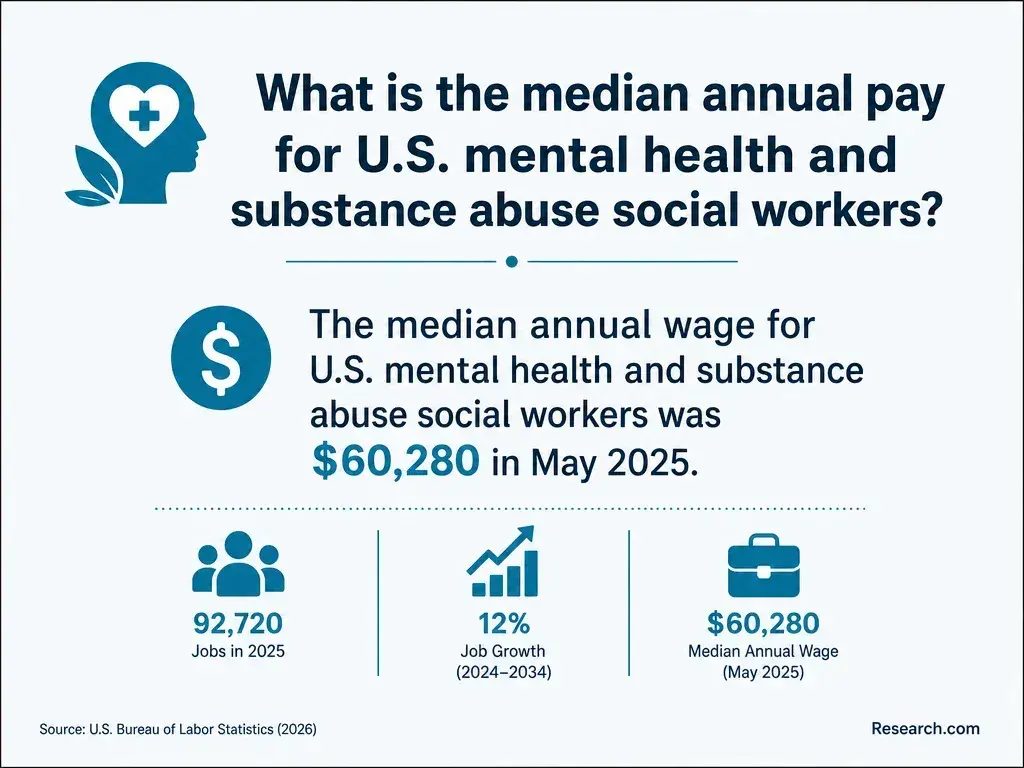
There is no single salary or employment-growth figure for graduates of an addictions-focused psychology BA. Outcomes vary with the occupation entered, location, experience, employer, and any required credential. The U.S. Bureau of Labor Statistics reported a 2024 median annual wage of $59,190 for the combined occupation of substance abuse, behavioral disorder, and mental health counselors, with 17% projected employment growth from 2024 to 2034. That occupation includes workers with qualifications beyond a BA; its median is not a starting salary forecast for this degree.
For your own decision, compare wages in local postings for jobs you could qualify for at graduation, then weigh them against the school's estimate of your remaining cost and time. If the BA mainly completes a degree you have already begun, investigate lower-cost online psychology study pathways as well as the addictions focus. The better-value choice is the one that meets your actual academic and career requirements without unnecessary repeated coursework.
Other Things You Should Know About Psychology
Only if the application invites additional academic context or your record needs clarification. Keep the explanation brief and factual, then point to later college-level work that better demonstrates your preparation.
Some schools offer a preliminary review. Ask whether it is available and whether its findings are binding; a final evaluation may require an application and official transcripts.
Not necessarily. The original grade usually remains on the issuing school's transcript, while the receiving school sets its own admission-GPA, repeat-credit, and degree-audit policies.
Ask when you will receive an official audit, whether you can delay an enrollment commitment until then, and what appeal process applies if a course is assigned differently than expected.
- .14 Evaluation and Review Process for Transfer of Courses and Credits. | Library of Maryland Regulations https://regs.maryland.gov/us/md/exec/comar/13B.06.02.14
- Rule 3352-3-01 | Undergraduate admission. https://codes.ohio.gov/ohio-administrative-code/rule-3352-3-01
- School-Determined Requirements | 2024-2025 Federal Student Aid Handbook https://fsapartners.ed.gov/knowledge-center/fsa-handbook/2024-2025/vol1/ch1-school-determined-requirements
- Remedial/Noncredit Study - HESC - NY. Gov https://hesc.ny.gov/dictionary/tap-coach/term/remedialnoncredit-study
- Transfer Students | New York State Education Department https://www.nysed.gov/standards-instruction/transfer-students
- Failing at Remediation? College Remedial Coursetaking, Failure and Long-term Student Outcomes - PMC https://pmc.ncbi.nlm.nih.gov/articles/PMC7967031/
- Grades and Grade Point Average (GPA) Calculation | University of Arizona Office of the Registrar https://registrar.arizona.edu/records-enrollment/enrollment/grades/grades-and-grade-point-average-gpa-calculation
- Frequently Asked Questions | The University of Chicago https://college.uchicago.edu/new-student-advising/faqs
- Academic Policies and Procedures | ggc.edu https://catalog.ggc.edu/content.php
- University Academic Regulations | Oklahoma State University Catalog https://catalog.okstate.edu/university-academic-regulations/