
2027 Online BA in Psychology - Addictions vs. a BS in Behavioral Health: Compare Curriculum, Cost, and Career Fit

Co-Founder and Chief Data Scientist
An online psychology degree with an addictions focus and a behavioral health degree can both lead toward community service work, but they may prepare you for different tasks - and neither automatically qualifies you to provide counseling. If you are choosing between them, the useful comparison is not BA versus BS alone. It is how each program develops research skills, substance-use knowledge, service experience, and eligibility for your intended next step.
This guide shows what to compare in the curriculum, full cost, and career requirements before you enroll.
Key Things You Should Know
- Choose the psychology-addictions BA for stronger psychological-science preparation if its actual requirements include statistics, research methods, and substantial addiction coursework; favor the behavioral health BS when its verified curriculum better matches service coordination and supervised applied work.
- Neither degree alone authorizes independent addiction counseling, psychotherapy, or diagnosis. Check the credential rules in the state where you intend to work before choosing either program.
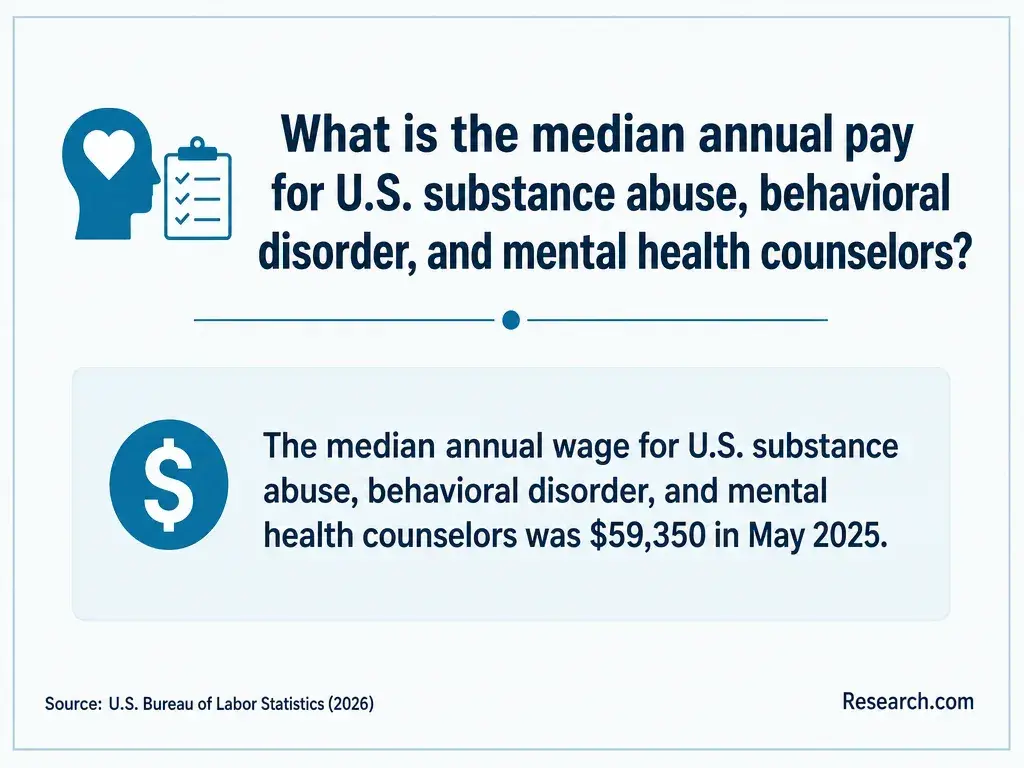
- Compare the price of remaining credits and required fieldwork, not advertised tuition alone. For context, the U.S. Bureau of Labor Statistics reports a $59,190 median annual wage for substance abuse, behavioral disorder, and mental health counselors in 2024 - not a salary promised to bachelor's graduates.
What Is the Difference Between an Online BA in Psychology-Addictions and a BS in Behavioral Health?
A BA in psychology-addictions is typically a psychology major with designated coursework on substance use and recovery. A BS in behavioral health is typically organized around behavioral-health services, systems, and applied support. These are descriptions, not universal curricular rules: institutions decide what their BA, BS, and concentrations require.
The comparison below identifies what to check in two actual degree plans. It does not substitute for a school's catalog or an approved transfer evaluation.
| Decision point | Psychology-addictions BA | Behavioral health BS |
| Academic center | Psychological theory and research, with an addictions focus | Behavioral-health needs, services, and applied settings |
| Potential strength | Preparation for psychology research or psychology-focused graduate prerequisites | Preparation for support, outreach, and service-coordination tasks |
| Most important unknown | How many addiction, methods, and applied courses are required? | How much psychology, statistics, and supervised experience are required? |
| Professional status | Not an addiction-counselor license | Not an addiction-counselor license |
Start with the job or next degree you want, then compare required courses rather than degree initials. A directory of accredited college pathways in addiction psychology can help you identify programs to investigate, but confirm each program's current name and requirements with its institution.
Which Degree Has the Better Curriculum for Addiction and Behavioral Health Careers?
Neither curriculum is inherently better. For addiction research, prevention evaluation, or a psychology graduate application, give weight to statistics, research design, psychological science, and opportunities to work with faculty. For intake, outreach, recovery-service support, or case coordination, look for instruction in service systems, documentation, referral boundaries, cultural responsiveness, and appropriately supervised experience.
Ask for the degree map and identify which relevant courses are required, rather than merely available as electives. An addiction-themed BA with little required substance-use coursework may be less targeted than a behavioral health BS with substantial addiction content. Conversely, a service-focused BS may leave a future research applicant needing additional methods courses. Compare both against undergraduate substance use counseling study on a budget if the specific goal is a state-recognized counseling pathway; the cheapest option only makes sense if its coursework meets that pathway's rules.
How Much Do Online Psychology-Addictions and Behavioral Health Degrees Cost?
There is no defensible single price for either degree type. Schools may charge by credit or term, apply different rates to online or out-of-state students, and assess technology or other mandatory fees. Transfer credit changes the number of credits you pay for, but accepted credits do not always satisfy major requirements.
Request a written estimate based on your transcript: remaining required credits × applicable tuition rate + mandatory fees + expected placement, travel, and materials costs. Compare the estimate at a pace you can sustain; taking fewer courses may change both completion time and aid eligibility. A required unpaid placement may also carry a meaningful earnings cost even when classes are online.
Submit the FAFSA if eligible, then check school aid, employer assistance, and undergraduate addiction counseling grants and scholarships. Confirm eligibility and renewal terms before subtracting any award from your projected cost.
A psychology-addictions BA may require introductory psychology, statistics, research methods, developmental or abnormal psychology, and courses on substance use, prevention, or recovery. A behavioral health BS may combine psychology foundations with behavioral-health systems, health or human-services coursework, ethics, and applied practice. Individual catalogs determine the actual mix, prerequisites, and whether an internship or capstone is mandatory.
Look beyond course titles. A class about counseling approaches teaches concepts; it does not grant permission to counsel clients. Likewise, a course on screening does not qualify a student to administer or interpret restricted clinical assessments. For either degree, an applied project examining publicly available prevention evidence can demonstrate useful reasoning without involving confidential client records.
Course sequence also matters. Statistics may be required before research methods, and a placement may be offered only in certain terms. Use accelerated psychology curriculum planning as a comparison point, then ask whether the faster schedule still leaves room for the courses and experience your goal requires.
Verify that the institution holds recognized accreditation and that the credential offered is the degree you intend to earn. Institutional accreditation matters for academic recognition and can affect federal aid eligibility and future credit or graduate-school review. It does not establish that a bachelor's curriculum satisfies addiction-counselor licensing requirements.
Do not reject an undergraduate program because it lacks American Psychological Association accreditation: APA accreditation applies to specified professional psychology programs and training, not general psychology bachelor's degrees. If your long-term goal is licensed mental health counseling, compare the applicable graduate program's recognition and state eligibility separately; an accredited mental health counseling program cost guide addresses that different educational decision. Ask the bachelor's institution and the relevant state board to confirm any claimed credential pathway in writing.
First-time applicants generally need evidence of secondary-school completion; transfer applicants generally submit prior college transcripts. A school may have separate rules for admission to the institution, entry into a major, and acceptance of transfer courses. GPA thresholds, application materials, and prerequisite policies vary, so neither the BA nor BS label predicts admission difficulty.
If you have prior college work, request a degree audit showing where each accepted credit applies: general education, major, electives, or neither. Ask specifically about statistics equivalency and remaining residency credits. If you already hold a bachelor's degree, check whether the target job actually requires a second one. For example, online forensic psychology programs and graduate outcomes concern a different specialization; an existing graduate's next step should be chosen for the intended role, not because another psychology-related degree sounds broadly relevant.
Time to completion depends primarily on credits remaining, course availability, enrollment pace, and any required placement - not on BA versus BS. An advertised accelerated schedule may assume substantial transfer credit or a course load that conflicts with employment and caregiving.
Ask an advisor for a term-by-term plan based on your approved audit. Confirm whether classes are asynchronous, whether live meetings have fixed times, and whether fieldwork requires an approved local site or daytime supervision. If you already have a bachelor's degree, even a faster online forensic psychology master's completion route addresses a different goal; compare its prerequisites and career relevance before assuming any shorter credential is the better use of time.
Either degree may help an applicant compete for nonclinical roles in behavioral-health outreach, intake support, recovery programs, prevention, or service coordination. Employers may also require relevant experience, background checks, training, or a separate credential. Duties can include documenting contacts, explaining available services, coordinating referrals, and supporting program operations - not independently diagnosing or treating a substance-use disorder.
For an early-career applicant, supervised experience can be more persuasive than the degree title. Compare local postings with your coursework and document skills such as accurate records, respectful communication, confidentiality, and recognizing when to refer a person to qualified staff. Explore recovery-focused roles and qualifications to distinguish support work from positions with counseling or certification requirements.
Requirements depend on the state, credential level, job duties, and employer. A state may distinguish supervised substance-use counseling roles from independently licensed practice, with different educational, supervised-experience, examination, and application requirements. Peer-support certification is another pathway with its own rules; it is not interchangeable with a counseling license.
Before enrolling, find the state regulator's requirements for the specific job title you want. Ask whether either degree's required courses count, what supervised hours must be completed and under whom, and whether an online program can support any required in-person training. Obtain the answer from the responsible board or credentialing authority rather than relying on a program's general career description.
If your goal is licensed mental health counseling rather than an addiction-specific credential, a qualifying graduate pathway may be necessary. Assess the additional education and supervision alongside the mental health counseling master's investment and pay outlook; neither bachelor's degree alone completes that pathway.
Which Degree Offers Better Salary Potential and Job Outlook?
There is no reliable salary premium attributable to the BA or BS title alone. Pay depends more directly on the occupation, location, employer, experience, and credentials. The U.S. Bureau of Labor Statistics reports a 2024 median annual wage of $59,190 for the combined occupation of substance abuse, behavioral disorder, and mental health counselors, with employment projected to grow 17% from 2024 to 2034. That occupation includes workers with different qualifications; its median is not an entry-level offer or a bachelor's-program outcome.
Use the labor-market figures to assess demand for a defined occupation, then read local job postings to see which education and credentials employers require. If advancement would require graduate study, include that future cost and time in your comparison. Online psychology master's completion planning may help with a nonclinical or research goal, but a general psychology master's should not be mistaken for a license-qualifying counseling degree.
Other Things You Should Know About Psychology
Possibly. Ask for a revised degree audit first: courses that count as electives in one major may not satisfy requirements in the other, delaying graduation.
Diploma wording is set by the institution. Ask the registrar for a sample or its written policy rather than assuming online delivery appears - or does not appear - on the credential.
Only if the program approves the site, duties, and supervision. Existing employment does not automatically count as academic fieldwork.
It may be if you already meet the target role's degree requirements and need specific knowledge or training. Check employer postings and state credential rules before paying for a second degree.
- Academic Years, Academic Calendars, Payment Periods, and Disbursements | 2025-2026 Federal Student Aid Handbook https://fsapartners.ed.gov/knowledge-center/fsa-handbook/2025-2026/vol3/ch1-academic-years-academic-calendars-payment-periods-and-disbursements
- Counselor Certification - DHCS - CA.gov https://www.dhcs.ca.gov/providers-partners/counselor-certification/
- Master of Addiction Counseling in Psychology and Social Work (MACPSW) - Social Work https://www.chhs.colostate.edu/ssw/programs-and-degrees/master-of-social-work/master-of-addiction-counseling-in-psychology-and-social-work/
- Tuition and Fees | maricopa.edu https://www.maricopa.edu/students/tuition-payment-information/tuition-fees
- Social Work Field Practicum | Methodist University https://www.methodist.edu/academics/program/social-work/field-practicum/
- Applied Psychology: Addictions Studies, B.S. - CPS, CPSO | University of New Hampshire https://www.unh.edu/program/bachelor-science/applied-psychology-addictions-studies
- B.S. in Psychology - Behavioral Health Degree Online https://online.ecok.edu/online-degrees/bs-bachelors-psychology-behavioral-health/
- Online Bachelor's Degree in Psychology in Addictions | Purdue Global https://www.purdueglobal.edu/degree-programs/psychology/bachelor-psychology-addictions/
- BA vs. BS in psychology: key differences explained | Capella University https://www.capella.edu/blog/psychology/ba-vs-bs-in-psychology-key-differences-explained/
- Tuition Costs and Fees | ASU https://tuition.asu.edu/cost/tuition-fees


