2027 Online BA in Psychology - General Psychology: Choosing a Degree When You Are Interested in Both HR and Research
Audited and Verified:
Our Editorial and Data Verification Process
Research.com uses government datasets, official education statistics and primary institutional information to support its career and degree guides. Our review process checks factual accuracy, occupational definitions, source dates and the requirements associated with the credentials discussed.
How This Article Was Fact-Checked
Our editorial team verifies salary estimates, employment projections, education requirements and program information against original data providers and official organizations. Salary figures are checked against the relevant occupational definitions and reporting periods. Information about licensure, accreditation and required in-person training is reviewed separately.
Fact-checked and verified on:

Co-Founder and Chief Data Scientist
An interest in both human resources and research can make a specialized major feel premature. An online BA in general psychology may keep both directions open, but its value depends on the methods courses, electives, and practical opportunities you can actually access. This guide is for prospective and returning students weighing that flexibility against a more targeted degree. You'll learn how to evaluate programs for HR and research preparation, what the degree does not qualify you to do, and when another route may be more direct.
Key Things You Should Know
- A general psychology BA can support both HR and research exploration, but neither career follows automatically from the degree; look for statistics, research methods, relevant electives, and supervised experience.
- Compare online programs by actual access to faculty-led projects and HR-relevant experience, not delivery format alone. A typical bachelor's degree requires about 120 semester credits, but transfer evaluations determine what remains.
- For perspective, the U.S. Bureau of Labor Statistics reports a May 2024 median wage of $72,910 for human resources specialists. That occupation-wide figure is not an expected salary for a new psychology graduate.
What Is an Online BA in General Psychology?
An online Bachelor of Arts in general psychology studies behavior and mental processes through broad coursework rather than a narrow professional specialization. Depending on the school, a BA may leave more room for electives outside psychology than a BS, but the letters alone do not establish how much science or statistics the program requires.
For someone interested in HR and research, the advantage is room to combine social and organizational psychology with research design, statistics, and business-related electives.
Compare the actual degree plan: a general major with an organizational psychology elective and an accessible research project may fit better than a specialized-sounding program with few opportunities to practice either skill set.
General psychology is also different from a formal focus on substance use or mental health. Students whose interests shift toward that subject can examine addiction psychology degree options for undergraduate students, while checking whether any advertised focus is a named concentration, a collection of electives, or a separate degree.
Is an Online Psychology Degree Useful for HR and Research Careers?
Yes, if you use it to build evidence of the work employers need. HR roles may involve recruiting, training, employee relations, and workforce records; research roles may involve literature searches, participant coordination, data cleaning, and reporting.
Psychology connects the two through the study of behavior and measurement, but an HR course is not research experience, and a statistics grade is not proof that you can manage a workplace project.
The comparison below shows where a general psychology BA needs supplementation. Use the column for your likely first job - not an eventual job title - to judge which opportunities matter most.
| Initial direction | Useful psychology preparation | Experience to seek | Possible more direct route |
| HR coordinator or recruiting support | Social psychology, motivation, communication, basic statistics | HR internship, recruiting work, training administration | HR or business major when you are committed to HR |
| Research assistant or coordinator support | Research design, statistics, scientific writing, research ethics | Faculty project, supervised data work, research internship | Research-intensive psychology or another methods-heavy major |
| People analytics or organizational research support | Measurement, statistics, organizational behavior | Supervised survey or reporting project and data-tool practice | HR analytics, statistics, or business analytics coursework |
If you already work in recruiting or administration, a few targeted methods courses and a supervised project may fill your gap more efficiently than another bachelor's degree. Conversely, someone with research experience but little workplace exposure should prioritize an HR placement. If your interests move toward community-facing support instead, comparing recovery support occupations can help distinguish those duties from both HR and research work.
What Accreditation Should an Online Psychology Bachelor's Program Have?
Check that the institution holds recognized institutional accreditation and that the accreditation covers the institution offering the online degree. Confirm its status through the accreditor or the U.S. Department of Education's accreditation database, then ask the school how that status applies to your enrollment location and program.
Do not expect American Psychological Association accreditation for a general psychology BA: APA accreditation applies to specified professional psychology training programs, not general undergraduate majors.
Institutional accreditation supports a basic quality check, but it does not prove that research mentoring, internships, or particular courses are available online. The distinction matters across specializations, including when reviewing online forensic psychology programs and graduate outcomes.
Before committing, request the current online course rotation and ask who supervises undergraduate research, whether remote students can participate, and whether any required activity takes place on campus. Those answers are more informative for this decision than accreditation alone.
Requirements vary, but general psychology majors commonly cover introductory psychology, statistics, research methods, and several areas such as developmental, cognitive, social, and biological psychology. General education and electives complete the degree. For your particular goal, methods depth and elective access matter more than a long catalog of psychology topics.
Look for statistics followed by research design and, ideally, an advanced methods, measurement, or data-analysis course. Social and organizational psychology can help you interpret workplace behavior; business communication, management, or HR electives can provide workplace context. A course on testing should teach measurement limits, not be mistaken for permission to administer restricted psychological assessments.
Ask whether prerequisites allow you to take methods early enough to contribute to a faculty project before graduation. If you later consider a licensed counseling career instead, its required graduate curriculum is a different question; clinical counseling master's course sequencing should not be treated as interchangeable with undergraduate psychology electives.
Online study can make coursework accessible without relocating, but it does not automatically make research participation or internships flexible. A program may offer asynchronous lectures while requiring live group meetings, scheduled faculty supervision, or daytime placement hours. Campus study may make it easier to encounter research teams and local employers, though access still depends on the individual school.
Ask online programs for examples of how students join research projects, receive feedback on analyses, and obtain approved HR-related placements. Also check whether exams, orientations, or other activities require travel.
If you work or provide care for others, compare these obligations against your actual weekly availability rather than the word "online." Professional graduate programs can have substantially different attendance and placement demands; accredited clinical counseling timelines for working students are not a reliable proxy for BA flexibility.
First-year applicants generally submit evidence of secondary-school completion and whatever application materials the institution requires. Transfer applicants usually submit transcripts from every prior college; schools may set separate standards for admission to the institution and entry into the psychology major. Confirm the requirements for your intended start term.
If you have prior credits, request a degree audit showing which courses satisfy general education, psychology, statistics, research methods, electives, and in-residence requirements. Accepted credits do not necessarily replace required courses. Ask whether a prior statistics course meets the major's requirement and whether prerequisite sequencing could delay your first research course.
An accelerated program is useful only if its credit decisions and course schedule work for you. That applies even when comparing faster forensic psychology undergraduate options with a general BA: request a school-specific evaluation before assuming a shorter advertised timeline applies to your record.
A bachelor's degree commonly totals about 120 semester credits and takes roughly four years of full-time study from the beginning. Your remaining time depends on approved transfer credits, enrollment pace, prerequisite order, and how often required online courses run. Part-time study may be easier to sustain alongside work but usually extends the calendar timeline.
Compare costs using the school's published charge per credit or term and your remaining required credits, then include mandatory fees, books, technology, and any travel or unpaid internship costs.
Do not estimate savings from transferred coursework until the school confirms how those credits apply. Ask financial-aid staff how your planned enrollment pace affects eligibility and whether an employer offers tuition assistance.
Compare this investment against your target role, not just the lowest advertised tuition. For example, bachelor's-level substance use counseling tuition and career value involves different job and, potentially, state credential considerations than an HR-and-research-focused BA.
Possible entry points include HR assistant or coordinator, recruiting coordinator, training support, and research assistant roles. Some graduates pursue market research or program-evaluation support, particularly when they can demonstrate data and reporting skills. Employers set their own degree and experience requirements; a psychology BA alone does not qualify you for every position bearing one of these titles.
Match your application to the work: for HR, show scheduling, records accuracy, communication, and discretion; for research, show documented methods training, careful data handling, and clear writing.
A supervised internship, faculty project, or relevant job can provide stronger evidence than a concentration label. Research support work may also involve participant privacy and approved data access, even when the role is nonclinical.
A later master's degree may be worthwhile for a defined research specialty, but it is not a default requirement for every entry-level role. Options such as forensic psychology master's intensive study options address a different specialization; choose further education only after checking the qualifications in jobs you actually want.
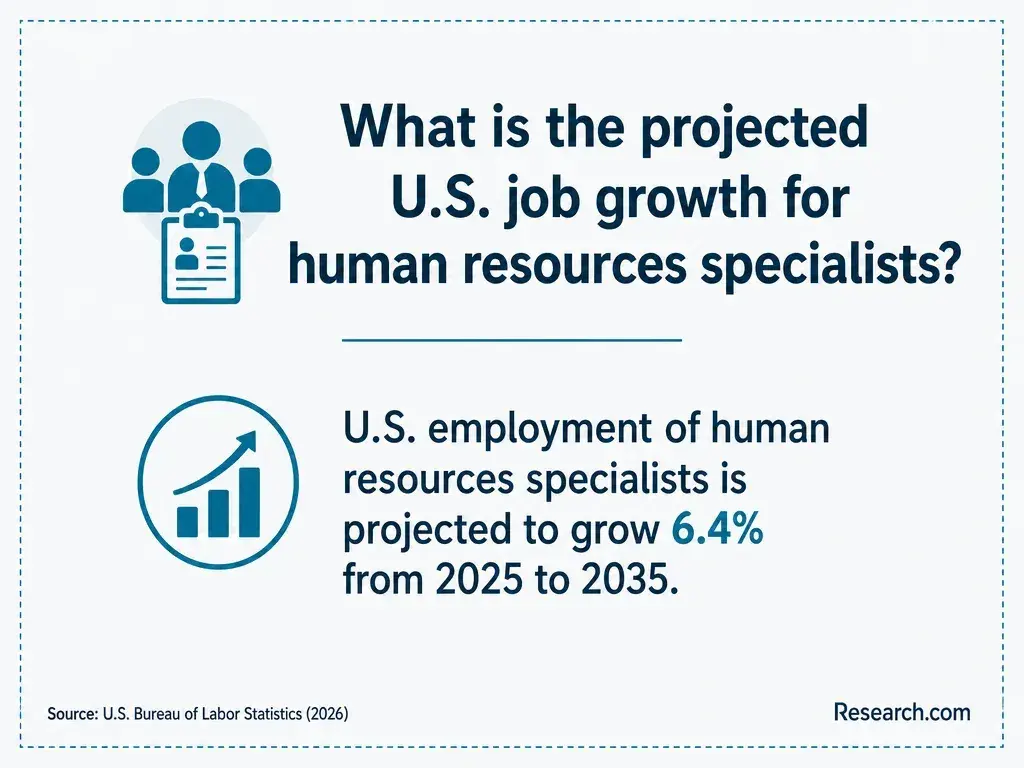
There is no single salary or outlook for general psychology BA graduates because HR and research lead to different occupations. The U.S. Bureau of Labor Statistics reports a May 2024 median annual wage of $72,910 for human resources specialists and projects 6% employment growth from 2024 to 2034.
These figures describe the occupation across experience levels and degree backgrounds; they are neither an entry-level offer nor an outcome for a particular BA program.
For a research-oriented comparison, identify the precise role first. A university research assistant, market research analyst, and organizational researcher may work with data but have different employers, qualifications, and pay. Compare local postings for each role's required tools and experience before using occupational figures to assess return on investment.
If a specific graduate credential repeatedly appears in your target postings, weigh its incremental benefit against the full cost of attendance. Comparing prices for online psychology master's degrees can inform that next-stage decision, but a master's should not be assumed necessary for an initial HR or research support job.
Does a Psychology Bachelor's Degree Lead to Licensure or Certification?
A general psychology BA does not, by itself, authorize psychotherapy, diagnosis, independent psychological assessment, or use of the licensed psychologist title. HR and many research support jobs are nonclinical and do not require a psychology license, although an employer may value an HR certification or require specific training. Check a certification provider's eligibility rules before budgeting for an exam.
If your interests change toward counseling, investigate the applicable state board's qualifying degree, supervised practice, and examination rules before choosing a program. A general BA can be academic preparation, but it is not a substitute for qualifying professional training. The financial commitment can also be substantial; mental health counseling tuition fees and financial aid belong in that separate career calculation.
Other Things You Should Know About Psychology
Yes. A well-documented, nonconfidential workplace research proposal can show how you define a question, choose measures, consider bias, and communicate findings. Label a proposal as proposed work; do not present it as completed research.
Not without appropriate employer permission and guidance from your instructor. Check privacy, data-use, consent, and institutional review requirements before accessing or sharing responses; removing names alone may not resolve those obligations.
Not universally. Check each program's admissions criteria. Substantive research assistance, strong methods work, and a recommendation from someone who has evaluated your research ability may also help demonstrate readiness.
Start with the tools named in realistic entry-level postings and available in your courses. Being able to clean data, explain a basic analysis, and document your decisions is more useful than listing software you have barely used.
- Psychology Education and Work Readiness Integration: A Call for Research in Australia | nih.gov https://pmc.ncbi.nlm.nih.gov/articles/PMC8062732/
- Accreditation in the U.S. | ed.gov http://www.ed.gov/laws-and-policy/higher-education-laws-and-policy/college-accreditation/accreditation-in-the-us
- Transfer - Ky. Council on Postsecondary Education https://cpe.ky.gov/ourwork/transfer.html
- Paying For College | The Ohio Department of Higher Education https://highered.ohio.gov/wps/portal/gov/odhe/students/pay-for-college
- What jobs can you get with a psychology degree bachelor | University of Bridgeport https://www.bridgeport.edu/news/high-paying-jobs-with-a-bachelors-in-psychology-degree/
- Differences Between BA and BS in Psychology | ASU Online https://asuonline.asu.edu/newsroom/online-learning-tips/online-psychology-degree-bachelor-arts-or-bachelor-science/
- Psychology careers guide | apa.org https://www.apa.org/education-career/guide/careers
- Research and Internships | University of Maryland https://cmns.umd.edu/undergraduate/current-students/career-support/research-and-internships
- Online Bachelor's in Psychology | University of Kansas https://online.ku.edu/undergraduate-programs/online-bachelors-psychology
- Transfer Credit Policies and Processes - The College | UVA College of Arts & Sciences https://college.as.virginia.edu/transfer-credit-policies-and-processes