
2027 Online BA in Psychology - Addictions for Certified Nursing Assistants: What to Check Before Changing Careers
Audited and Verified:
Our Editorial and Data Verification Process
Research.com uses government datasets, official education statistics and primary institutional information to support its career and degree guides. Our review process checks factual accuracy, occupational definitions, source dates and the requirements associated with the credentials discussed.
How This Article Was Fact-Checked
Our editorial team verifies salary estimates, employment projections, education requirements and program information against original data providers and official organizations. Salary figures are checked against the relevant occupational definitions and reporting periods. Information about licensure, accreditation and required in-person training is reviewed separately.
Fact-checked and verified on:

Co-Founder and Chief Data Scientist
As a certified nursing assistant, you already work with people whose health and daily lives may be affected by substance use. An online psychology BA with an addictions focus could help you move toward recovery services, but it may not be the shortest route to the job you want.
Before giving up shifts or paying tuition, you need to know which roles accept a bachelor's degree, which require a separate credential, and whether your existing education will count. This guide helps you compare those requirements with the program's coursework, schedule, and total cost.
Key Things You Should Know
- A psychology BA can support a move from CNA work into nonclinical recovery, outreach, or service-coordination roles; it does not itself qualify you to provide addiction counseling.
- Check your state's credential rules and actual job postings before enrolling: some addiction-counselor roles require specified coursework, supervised hours, an exam, or a qualifying graduate degree.
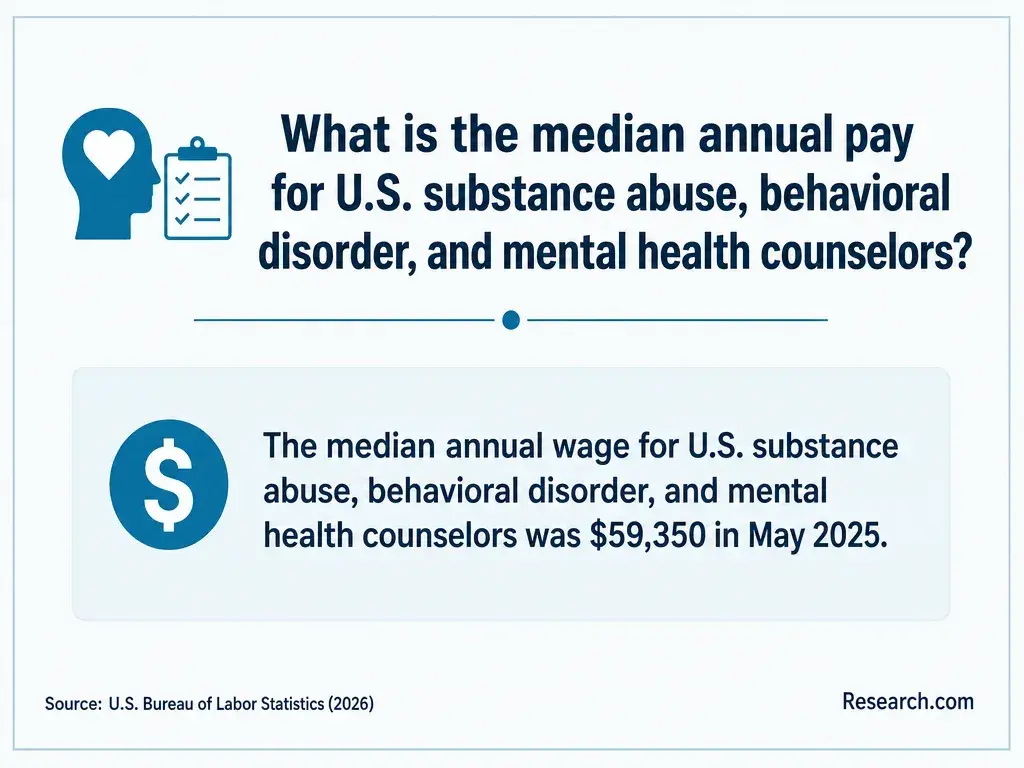
- The U.S. Bureau of Labor Statistics reports a May 2024 median wage of $59,190 for substance abuse, behavioral disorder, and mental health counselors; that occupation-wide figure is not an expected salary for a new psychology BA graduate.
What is an online bachelor's degree in psychology with an addictions focus?
It is an undergraduate psychology degree that combines broad study of behavior and research with coursework on substance use, prevention, treatment systems, or recovery. The focus might be a formally named concentration, a certificate, or simply a set of electives. Those distinctions matter: ask what will appear on your transcript and whether the addiction courses meet any requirements for your intended credential.
A BA generally includes general education, psychology methods and theory, and electives. "Online" describes course delivery, not necessarily every requirement: a program may still schedule live classes, exams, or local experiential work. When reviewing bachelor's study in addiction psychology online, compare the published curriculum with the job or credential you actually want rather than relying on the concentration's name.
Can a CNA use an online psychology degree to change careers?
Yes, but the most realistic first move is usually toward a supervised support or coordination role, not independent treatment. CNA experience can demonstrate rapport, observation, documentation, teamwork, and respect for privacy. It does not automatically substitute for substance-use training, case-management experience, or counselor-supervised practice.
Before choosing a degree, collect three local job postings that interest you and separate their required qualifications from preferred ones. If they call for a state addiction credential, check that pathway first. If they emphasize outreach or intake experience, ask your employer about an internal transfer or supervised opportunity. A peer-support or employer-training route may be more direct than a four-year degree for some goals; peer credentials have their own eligibility rules.
If you have previous college study, request an official degree audit rather than assuming accepted credits shorten the major. A guide to moving existing credits into psychology study can help you frame questions about where those credits apply.
What careers can an addictions-focused psychology bachelor's degree prepare you for?
The degree is most useful when paired with evidence that you can perform a particular job's tasks. The following distinctions help a CNA identify plausible transitions without confusing support work with counseling.
| Potential role | Typical work | What to verify |
| Recovery-services or outreach worker | Explain services, support engagement, and make referrals | Employer training, peer-credential rules, and limits on client advice |
| Intake or service coordinator | Gather permitted information, schedule services, and coordinate referrals | Documentation skills, privacy training, and employer degree requirements |
| Program or research assistant | Support prevention programs, data collection, or evaluation | Methods skills, data permissions, and relevant experience |
| Addiction counselor | Provide services within a regulated credential's permitted scope | State education, supervision, examination, and licensing rules |
For a CNA, a supervised role at a hospital, community organization, or recovery provider may build more relevant evidence than coursework alone. Understanding career progression in addiction recovery can help you distinguish an entry role from a later counseling goal.
Check that the institution holds accreditation recognized by the U.S. Department of Education or the Council for Higher Education Accreditation, and confirm that the accreditation covers the institution awarding the online degree. Institutional accreditation matters for matters such as federal aid eligibility and credit recognition, although another college still decides whether to accept transferred work.
Do not look for APA accreditation as a condition for a general psychology BA: APA accreditation applies to specified professional psychology training programs, not ordinary undergraduate psychology majors. More importantly, institutional accreditation does not establish that an addictions concentration meets your state's counselor-credential rules. Request a written course-by-course explanation from the program and compare it with the state authority's requirements.
The same distinction applies when weighing another specialty. A comparison of online forensic psychology degree costs versus career outcomes may be useful if your interests extend to justice settings, but neither specialty label proves eligibility for a regulated role.
Expect to look for introductory and advanced psychology, statistics, research methods, and courses addressing substance use, health behavior, development, and social context. Programs vary: some examine prevention and recovery systems, while others offer fewer dedicated addiction courses. A class about counseling techniques teaches concepts; it does not grant permission to counsel clients.
For a CNA, research methods and statistics are worth more than they may first appear: they help you assess claims about treatment and prevention without overreading a small study. Compare the catalog's required courses, prerequisites, and how often each course runs. If you are choosing between addictions and another focus, listings of undergraduate forensic psychology programs by completion time illustrate why a faster specialty should not replace the coursework your addiction-related goal requires.
Requirements depend on whether you apply as a first-year student or a transfer student. Schools commonly request prior transcripts and evidence of high-school completion or its equivalent; some have separate transfer-credit or major-entry policies. CNA certification is relevant experience, but it normally is not a substitute for college coursework.
Ask admissions for the entry requirements, then ask a transfer evaluator for a degree audit showing which prior courses satisfy general education, psychology, statistics, and residency requirements. Also ask when required courses are available. If counseling is your eventual goal, confirm the later qualifying program's prerequisites rather than assuming any psychology BA - or an accelerated graduate degree - will qualify. Comparisons of forensic psychology master's completion time comparisons concern a different postgraduate pathway, not a shortcut to addiction-counselor eligibility.
Your remaining courses, transfer evaluation, enrollment pace, and course sequence determine the timeline. Online delivery does not remove prerequisites or guarantee that every class is offered each term. Working CNAs should budget for study time alongside shifts and check whether any internship requires daytime availability.
Compare schools using a remaining-degree estimate, not an advertised per-credit price alone. Request written figures for remaining tuition, mandatory fees, books or technology, and any placement-related travel or reduced work hours. Ask whether your employer offers education assistance and check aid eligibility with each school's financial-aid office. Listings of low-cost online psychology degrees are a starting point; your approved degree audit determines whether a seemingly cheaper option actually costs less to finish.
For a CNA with rotating shifts, online study may reduce commuting and make recorded coursework easier to fit around work. It is better only if its live sessions, group assignments, exams, and any approved placement fit your schedule. Campus study may offer easier access to faculty, research teams, or local service organizations; either format can be a poor fit if it cannot support the experience your target employer expects.
Ask for a sample term schedule and the placement policy before enrolling. If your long-term plan is licensed therapy, investigate a qualifying professional graduate program separately: even accredited counseling study with accelerated schedules can involve supervised, scheduled clinical training. An online undergraduate BA cannot eliminate that later requirement.
There is no single nationwide addiction-counselor license. States distinguish among credential levels, titles, permitted duties, required education, supervised experience, and examinations. A bachelor's degree may help meet an educational requirement in one pathway yet be insufficient for another, especially for independent clinical practice.
Start with the state licensing board or recognized credentialing authority where you intend to work. Identify the exact job title and credential, then obtain its current education and supervision rules. Ask the school whether its specific courses satisfy those rules, and get clarification from the authority when necessary. Supervised work as a CNA should not be assumed to count as supervised counseling experience.
If the state requires a qualifying counseling master's degree for your intended scope of practice, compare the full pathway rather than only the BA's price. Resources on mental health counseling tuition fees and financial aid can inform that later cost comparison, but program eligibility still requires state-specific verification.
What salary and job outlook can psychology graduates expect?
There is no single wage or outlook for graduates of an addictions-focused psychology BA. Pay depends on the occupation, location, employer, experience, and credential. The Bureau of Labor Statistics reports a May 2024 median wage of $59,190 for the combined occupation of substance abuse, behavioral disorder, and mental health counselors and projects 17% employment growth from 2024 to 2034. Those figures describe an occupation with varied entry and licensing requirements - not what a newly graduated CNA will earn in an outreach or intake role.
For a practical return-on-investment check, compare wages in local postings you qualify for now with postings you could reasonably qualify for after the degree. Include tuition, likely lost work hours, and any later credential costs. A condensed online psychology master's study option should be evaluated against the same target job; an additional psychology degree is not automatically a counseling license or a pay increase.
Other Things You Should Know About Psychology
Yes, if you meet your state's renewal requirements. Check continuing education and work-hour rules with the agency that regulates your CNA credential.
Possibly. The academic program must approve the site, supervisor, duties, and learning objectives. Your existing CNA duties may not qualify on their own.
No automatic access exists. Follow workplace privacy rules and obtain required institutional and academic approvals; do not use identifiable patient information in assignments without authorization.
Ask about employer training, approved volunteer roles, or an introductory psychology course. Compare what you learn with local job requirements before committing to a full BA.
- Cost of Attendance (Budget) | 2026-2027 Federal Student Aid Handbook https://fsapartners.ed.gov/knowledge-center/fsa-handbook/2026-2027/vol3/ch2-cost-attendance-budget
- Employer-offered educational assistance programs can help pay for college | Internal Revenue Service https://www.irs.gov/newsroom/employer-offered-educational-assistance-programs-can-help-pay-for-college
- "Culturally Responsive" Substance Use Treatment - PMC - NIH https://pmc.ncbi.nlm.nih.gov/articles/PMC12834561/
- Types of Financial Aid: Grants, Work-Study, and Loans | studentaid.gov https://studentaid.gov/understand-aid/types
- Military Transfer Credit - NCU Catalog - National University https://catalog.ncu.edu/content.php
- Nurse Aide Certificate (0007) - Harrisburg https://www.hacc.edu/ProgramsandCourses/Nurse-Aide-Certificate-0007.cfm
- Applied Psychology: Addictions Studies, B.S. - CPS, CPSO | University of New Hampshire https://www.unh.edu/program/bachelor-science/applied-psychology-addictions-studies
- Psychology careers guide | apa.org https://www.apa.org/education-career/guide/careers
- Credit for Previous Training | ACC Catalog https://americancareercollege.edu/catalog/current/admissions-information/credit-for-previous-training
- Practicum Education | Columbia MSSW https://onlinemsw.socialwork.columbia.edu/practicum-education/


