
2027 Online MS in Psychology - Forensic Psychology for Patient Access Representatives: Choosing a Program Without Leaving Your Job
Audited and Verified:
Our Editorial and Data Verification Process
Research.com uses government datasets, official education statistics and primary institutional information to support its career and degree guides. Our review process checks factual accuracy, occupational definitions, source dates and the requirements associated with the credentials discussed.
How This Article Was Fact-Checked
Our editorial team verifies salary estimates, employment projections, education requirements and program information against original data providers and official organizations. Salary figures are checked against the relevant occupational definitions and reporting periods. Information about licensure, accreditation and required in-person training is reviewed separately.
Fact-checked and verified on:

Co-Founder and Chief Data Scientist
Patient access representatives already navigate sensitive conversations, documentation, and referrals. An online forensic psychology master's may help you move toward justice-related support or research, but its value depends on the job you want and whether the program fits around your shifts.
Online does not necessarily mean self-paced, and a forensic degree does not qualify you to practice as a psychologist. This guide helps you compare career fit, academic requirements, scheduling, costs, and credible programs before committing to graduate study.
Key Things You Should Know
- A forensic psychology master's can support a move into nonclinical justice-related work, but it does not by itself authorize therapy, forensic assessment, or practice as a psychologist.
- For a working patient access representative, required live classes, placement hours, and campus visits matter more than an "online" label; confirm each requirement before applying.
- Compare the full degree cost with the qualifications in actual job postings. If your goal is intake, advocacy, or service coordination, experience or targeted training may be a more direct route.
What Is an Online Forensic Psychology Master's Degree?
An online forensic psychology master's is graduate study of psychological science in legal and justice contexts. Depending on the school, it may be an MS or MA in forensic psychology or a psychology degree with a forensic concentration. The distinction matters: a concentration may represent a limited group of courses rather than the depth of a separately named degree.
Programs may emphasize research, legal-system applications, or support services. None of those emphases should be mistaken for professional training in independent forensic evaluation. If you do not yet hold a bachelor's degree, a master's is not the immediate next step; compare undergraduate requirements first. Three-year online forensic psychology degree options can help frame that earlier decision, but confirm how any prior credits would apply before relying on a completion estimate.
Can Patient Access Representatives Benefit From a Forensic Psychology Master's?
Yes, if the degree develops skills required for a specific move you intend to make. Your experience explaining procedures, protecting information, working with distressed patients, and coordinating referrals is relevant to some victim-services and justice-adjacent support roles. It is not, by itself, experience conducting psychological assessments or managing justice-system cases.
The best educational route changes with the destination. This comparison separates roles where forensic study may add value from goals that call for different preparation.
| Goal | Likely value of a forensic psychology master's | Important gap to check |
| Advance in hospital registration or access operations | Often limited unless the role includes justice-related programs or research | Employer-specific operations, leadership, or revenue-cycle qualifications may matter more |
| Move into victim-services intake or coordination | May strengthen understanding of trauma, research, and legal settings | Employers may prioritize direct advocacy experience and local training |
| Provide counseling or psychological evaluations | Not a stand-alone qualifying route | Applicable professional degree, licensure, and supervised training |
If your primary interest is substance-use services rather than legal settings, compare substance use counseling program pathways against your state's requirements instead of assuming a forensic specialization will meet them.
Is an Online Forensic Psychology Master's Degree Accredited and Licensure-Eligible?
Accreditation and licensure eligibility are separate questions. Check that the university holds recognized institutional accreditation and that the accreditation applies to the institution awarding your degree. Then check the exact program against the requirements of any credential you want. Institutional accreditation establishes neither a particular curriculum nor eligibility for professional licensure.
The American Psychological Association does not accredit general, nonclinical forensic psychology master's degrees as a blanket category. A course in assessment, psychopathology, or counseling does not grant permission to diagnose, provide therapy, administer restricted tests, or use a protected professional title.
If counseling is your goal, examine a qualifying counseling program and your state board's rules; accreditation checks for accelerated counseling programs illustrate why program recognition and state eligibility must be checked separately.
Relevant coursework may cover psychological research methods, statistics, ethics, behavior in legal settings, victimization, correctional systems, and the limits of psychological evidence. Compare required courses rather than relying on a concentration's name: a program with substantial methods training and a supervised project serves a different goal from one centered on coursework alone.
For a patient access representative, useful applied learning might include reviewing research on barriers to services or developing a proposal for a referral-process evaluation. Any project involving patient information needs employer authorization, appropriate privacy safeguards, and a determination of applicable academic or institutional review requirements. Employment in a hospital does not grant a student access to records for coursework.
If addiction services, rather than legal settings, are what interest you most, online undergraduate addiction psychology program comparisons can help clarify how subject-focused academic study differs from preparation for a regulated counseling role.
Online delivery can remove a commute without removing fixed commitments. The useful comparison is how each program's actual timetable interacts with your work schedule, access to faculty, and opportunities for approved experience.
| Feature | Online program | Campus-based program |
| Class schedule | May combine recorded work with mandatory live sessions | Usually requires travel for scheduled classes |
| Projects and placements | May require arranging a local approved site or remote collaboration | May offer nearby contacts, but site hours can still conflict with work |
| Research access | Depends on remote mentoring, datasets, and faculty availability | May provide more on-site collaboration, depending on the program |
Ask for a sample term schedule, including group meetings, exams, residencies, and placement hours. If you are still considering a bachelor's or need prerequisite coursework, inexpensive distance learning psychology options may be a more proportionate first step than enrolling in a master's.
Programs typically require a bachelor's degree, but they differ on acceptable majors, GPA policies, prerequisite courses, recommendations, statements, and entrance tests. A patient access representative with a degree outside psychology should not assume they are ineligible - or that healthcare work substitutes for a required statistics or research-methods course.
Request the current admissions requirements for your intended entry term. Ask which psychology and quantitative courses are mandatory, whether outstanding prerequisites can be completed before or after admission, and whether your work experience is considered in review. In your application, describe specific responsibilities - such as accurate documentation and appropriate escalation - without disclosing patient information or suggesting clinical duties you did not perform.
If you still need a bachelor's degree and are comparing service-oriented fields, bachelor's-level substance use counseling tuition and career value offers a different route to examine. Check the actual entry requirements of your target jobs before choosing an undergraduate major.
Completion time depends on required credits, course availability, enrollment pace, and whether a thesis, capstone, or placement must be completed on a fixed schedule. Part-time study may protect your income while extending the time before you can use the qualification. A published completion estimate is only useful if it matches the course load you can sustain alongside your shifts.
Calculate the price from your own program plan: required credits multiplied by the applicable tuition rate, plus mandatory fees, books, technology, travel, and any placement-related expenses. Ask whether tuition changes with residency or enrollment status and whether employer assistance requires a minimum grade, continued employment, or repayment if you leave.
Compare written cost estimates with finding a lower-cost psychology master's degree; a cheaper program is not better value if it lacks the coursework or scheduling your goal requires.
Possible nonclinical directions include victim-services coordination, justice-program support, research assistance, and service evaluation. Duties and hiring standards vary: an advocacy employer may seek direct client-support experience, while a research role may require evidence of statistics, interviewing, or data-management skills. The degree can strengthen an application, but it does not replace those requirements.
Start by reviewing openings in your commuting area or for genuinely remote positions. Compare their required credentials with your current experience, then seek appropriate supervised experience - perhaps through an approved agency project - before paying for a degree solely to change job titles. If your preferred work is recovery support rather than forensic services, explore career options in recovery services and check any state-specific credential rules.
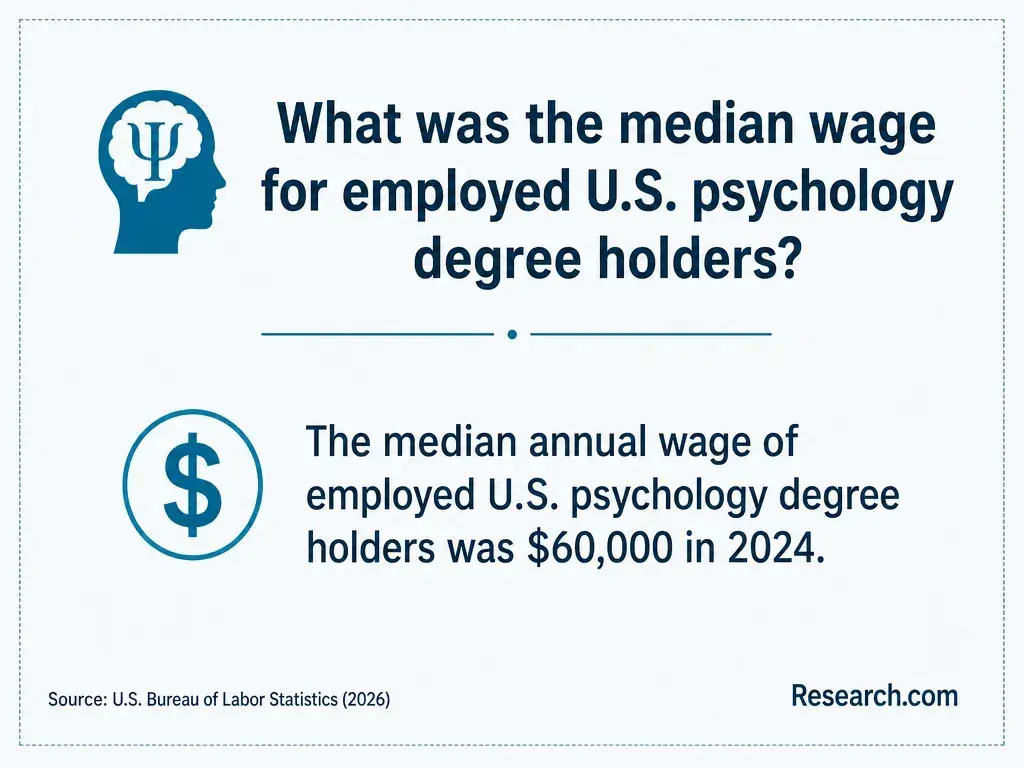
There is no reliable occupation-wide salary or job-growth figure for "forensic psychology master's graduates." The US Bureau of Labor Statistics reports by occupation, not by degree concentration. Its psychologist figures should not be treated as this degree's expected outcome: psychologist roles generally require additional professional education and, for independent practice, licensure.
For a useful estimate, identify the actual jobs you would pursue - such as a social and human service assistant or a particular research-support role - and consult the corresponding Bureau of Labor Statistics occupation and local postings.
Compare their pay ranges and entry requirements with your current compensation, potential tuition expense, and any lost hours. Exploring better-paid roles related to forensic psychology can suggest careers to investigate, but a high-paying title is not evidence that a new graduate qualifies for it.
How Can You Choose a Reputable Online Forensic Psychology Program?
Choose backward from a target role, then verify that the program's curriculum, schedule, and outcomes support it. A school's promise of flexibility is less useful than written answers about when you must be available and what you will be qualified to do afterward.
Use this sequence to narrow your choices before paying an application fee:
- Collect local job postings and separate required credentials from preferred degrees and experience.
- Confirm institutional accreditation, the exact degree and concentration name, and any credential rules relevant to your goal.
- Request a sample part-time course sequence and written details on live sessions, campus visits, project supervision, and placement approval.
- Obtain an itemized cost estimate and ask for outcomes defined by cohort, completion period, and response rate.
- Compare the remaining programs with a lower-cost course, workplace experience, or a different qualifying degree.
When comparing schools, online forensic psychology degree costs versus career outcomes can provide a starting framework. Confirm every consequential claim with the university and, where relevant, the employer or licensing authority. For many patient access representatives, the right decision is to build targeted experience first and enroll only when a specific program closes a demonstrated gap.
Other Things You Should Know About Psychology
Not without the required employer permission and academic review. Removing names alone may not make information safe or authorized to use. A project based on public sources or an approved hypothetical workflow may be more feasible.
Give concrete examples of documentation, referrals, de-escalation within your role, and communication across teams. Do not describe registration work as counseling, forensic interviewing, or clinical assessment.
Ask which programs qualify, when reimbursement occurs, what grades or enrollment status are required, and whether leaving the job triggers repayment. Get the policy in writing before budgeting around it.
Ask the program about section choices, recorded-session policies, reduced course loads, and leave rules before enrolling. Do not assume a mandatory live class can be replaced with an assignment.
- Forensic Services | Colorado Department of Human Services https://cdhs.colorado.gov/behavioral-health/forensic-services
- Cost of Attendance (Budget) | 2025-2026 Federal Student Aid Handbook https://fsapartners.ed.gov/knowledge-center/fsa-handbook/2025-2026/vol3/ch2-cost-attendance-budget
- Training, practice, and career considerations in forensic... - PMC https://pmc.ncbi.nlm.nih.gov/articles/PMC11638730/
- License Requirements for Psychology - Office of the Professions https://www.op.nysed.gov/professions/psychology/license-requirements
- Accreditation in the U.S. | ed.gov http://www.ed.gov/laws-and-policy/higher-education-laws-and-policy/college-accreditation/accreditation-in-the-us
- Chapter 7 | ojp.gov https://ovc.ojp.gov/sites/ovc/files/publications/infores/probparole/chap7.htm
- Frequently Asked Questions - California Board of Psychology https://www.psychology.ca.gov/licensees/faq.shtml
- Do I Need a Degree in Psychology to Apply to Graduate School? | William James College https://www.williamjames.edu/news/do-i-need-a-degree-in-psychology-to-apply.html
- What is Forensic Social Work? Exploring the Intersection of Justice and Social Work | Cleveland State University https://onlinelearning.csuohio.edu/blog/what-forensic-social-work-exploring-intersection-justice-and-social-work
- Clinical Forensic Psychology MA | Fairleigh Dickinson University https://www.fdu.edu/program/ma-forensic-psychology/


