2027 Online MS in Psychology - Forensic Psychology: What to Ask About Research Mentorship for Online Graduate Students
Audited and Verified:
Our Editorial and Data Verification Process
Research.com uses government datasets, official education statistics and primary institutional information to support its career and degree guides. Our review process checks factual accuracy, occupational definitions, source dates and the requirements associated with the credentials discussed.
How This Article Was Fact-Checked
Our editorial team verifies salary estimates, employment projections, education requirements and program information against original data providers and official organizations. Salary figures are checked against the relevant occupational definitions and reporting periods. Information about licensure, accreditation and required in-person training is reviewed separately.
Fact-checked and verified on:

Co-Founder and Chief Data Scientist
An online forensic psychology master's may teach research methods without giving students sustained access to a research mentor. That difference matters if you want to complete a thesis, build evidence of research ability, or apply to doctoral programs.
This guide is for prospective online graduate students comparing programs, not just course lists. It explains how mentorship works at a distance, which opportunities require separate approval, and what to ask faculty and program staff before committing tuition and time.
Key Things You Should Know
- Ask whether an eligible faculty member will supervise your specific research interest, how often you can meet, and what happens if that mentor becomes unavailable.
- Distinguish a required methods course from a thesis or research-team position; neither participant access nor permission to use justice-system records follows automatically from enrollment.
- Compare the full cost of reaching your research goal: required credits and fees, possible thesis-continuation charges, travel, and time away from paid work, not tuition alone.
What is an online MS in psychology with a forensic psychology concentration?
It is a psychology master's degree with coursework focused on behavior in legal and justice settings. Depending on the institution, forensic psychology may be a formally designated concentration, a set of electives, or the name of a separate degree. Check the catalog and transcript designation rather than relying on an advertisement.
Courses may examine eyewitness memory, violence research, victimization, corrections, and the interpretation of psychological evidence. The degree's research value depends less on the concentration label than on access to methods training, faculty projects, and supervised independent work.
For a broader starting point, psychology degree planning for prospective online students can help you distinguish broad psychology preparation from a specialized graduate goal.
Forensic coursework does not grant authority to conduct criminal investigations, provide expert testimony, or perform licensed psychological evaluations. Those activities involve separate employer, legal, and professional qualifications.
How does research mentorship work for online forensic psychology graduate students?
Research mentorship is sustained guidance from a qualified faculty member on a question, study design, ethical obligations, analysis, writing, and scholarly next steps. It is more than receiving comments on a final paper.
In an online program, meetings might occur by video, with shared drafts and secure research systems between meetings; their frequency and availability depend on program policy and faculty capacity.
These common arrangements offer different levels of continuity. Ask which one actually applies to students in the concentration:
| Arrangement | Likely research experience | Key limitation to check |
| Course-based supervision | An instructor guides a project during a defined course. | Support may end when the course ends. |
| Thesis advisor | A faculty member oversees a longer independent project and revisions. | Advisor matching and thesis eligibility may be conditional. |
| Research-team mentorship | A student contributes to an existing study under a faculty lead. | Positions, responsibilities, and authorship vary. |
Ask whether meetings are scheduled individually or only during fixed live sessions, what response times are expected, and whether evening meetings are possible. An accelerated calendar can narrow the time available to refine a question or obtain approvals; compare psychology graduate programs with compressed schedules against the research milestones you hope to reach.
Can an online forensic psychology master's prepare you for doctoral study?
Yes, if it helps you demonstrate research reasoning, methodological competence, strong writing, and a credible fit with prospective doctoral faculty. An online format is not itself the deciding factor.
Doctoral admissions committees may weigh your actual contributions to a study, the quality of a thesis or other writing sample, and a recommendation from someone who observed your work over time.
Ask prospective doctoral programs what preparation they expect. A master's degree, thesis, or publication is not universally required for admission.
If your intended doctorate emphasizes experimental research, seek statistics, research design, and a substantial supervised project. If you hope to become a licensed forensic psychologist, check the requirements for the relevant doctoral training and state license; a nonclinical forensic MS is not a substitute.
If your goal is psychotherapy rather than psychological research or forensic assessment, a qualifying counseling degree may be more direct. Even when comparing fast-track mental health counseling master's formats, verify the program's licensure fit and supervised training requirements in your state.
A useful program should describe opportunities precisely, including who may participate and what support is available remotely. A methods assignment, faculty research-team role, thesis, and agency evaluation project are different experiences; none should be inferred from the presence of a "research-focused" course description.
Request written answers about the opportunities most relevant to your goal:
- Independent work: Is a thesis available, required, or restricted by grades, faculty capacity, or application? Who approves the proposal and final work?
- Team participation: Can online students apply to faculty projects, what tasks might they perform, and are positions paid, credit-bearing, or voluntary?
- Data and oversight: Who obtains agency permission, data-use agreements, and any required institutional review before recruitment or analysis begins?
- Outputs: Can students submit a poster or writing sample, and how are authorship and confidential material handled?
Public datasets or published studies can support a rigorous project when restricted court, correctional, or client records are unavailable. Even deidentified data can carry use restrictions, and a student should not assume access through an employer.
When considering forensic psychology graduate programs with shortened study plans, check whether the schedule leaves time for approvals, analysis, and revision.
Look for alignment between your question and a faculty member's current work, then verify that the person mentors online master's students. A publication on eyewitness testimony, for example, does not establish that its author is taking advisees or can supervise your proposed method.
Send a short description of your interests and ask the graduate director or potential mentor these questions before enrolling:
- Which faculty members are eligible to supervise online MS students, and how are advisees assigned?
- How frequently do mentors ordinarily meet students during project planning and analysis?
- What methods and data sources can the faculty member realistically supervise?
- Who provides feedback if the primary mentor is on leave, changes institutions, or cannot continue?
- What are the program's policies on project ownership, authorship discussions, and letters of recommendation?
Where possible, ask to speak with a current online student about feedback quality and scheduling. A list of faculty interests is useful evidence of potential fit, not a promise of supervision. Likewise, online psychology programs ranked by affordability can inform a budget comparison but cannot establish mentor availability.
Verify that the university holds institutional accreditation from an accreditor recognized by the U.S. Department of Education, and confirm that the accreditation covers the institution awarding the degree.
Then check the specific program's catalog entry, online delivery status, and any state authorization conditions that apply to your location.
Do not require APA accreditation of a general, nonclinical psychology MS: APA accreditation applies to specified professional psychology doctoral programs, internships, and postdoctoral residencies, not every psychology master's or forensic concentration.
Institutional accreditation also does not establish that this MS satisfies a state's requirements for psychologist or counselor licensure.
If your actual objective is licensed counseling, investigate the applicable state board rules and the recognition relevant to counseling programs. Compare those requirements alongside financial planning for accredited counseling degrees, rather than treating a forensic psychology concentration as an equivalent credential.
Curricula vary, but a research-oriented forensic psychology MS may combine psychological theory in legal contexts with statistics, research design, ethics, and a capstone or thesis. Read the required course sequence, not just the elective list: an appealing topic course cannot replace the methods preparation needed for your project.
For eyewitness-memory research, useful preparation might include experimental design, measurement, sampling, and analysis of competing explanations.
For an evaluation of a victim-services program, survey design, qualitative interviewing, or program-evaluation methods may be more relevant. Studying risk assessment as a research topic is distinct from being qualified to administer or interpret restricted clinical instruments.
If your interests instead center on substance-use recovery, compare the actual curriculum with a bachelor's-level addiction psychology program guide before paying for a forensic specialization. Subject overlap does not make the programs interchangeable, and neither concentration alone establishes clinical authority.
Requirements are set by each program. Typically, applicants should expect a completed bachelor's degree and an application documenting academic preparation and purpose; a school may also request transcripts, recommendations, a statement, writing samples, or specified prerequisite coursework.
Check its current admissions page for GPA rules, statistics or psychology prerequisites, test policies, and deadlines rather than assuming a uniform standard.
A criminal justice, sociology, health, or other non-psychology background need not rule out admission. The more important research-mentorship question is whether you can show readiness to read studies, work with evidence, and learn the methods your intended project needs. Ask admissions which gaps are formal prerequisites and which can be addressed before or during enrollment.
If you have not yet completed a bachelor's degree, accelerated BA and BS psychology pathways may help you compare undergraduate completion options. Confirm how any prospective coursework will satisfy the particular MS program's requirements before enrolling in it.
There is no reliable single price or duration for this concentration. The starting tuition calculation is required credits multiplied by the applicable per-credit rate; add mandatory fees, materials, software, and any travel or campus visits.
Ask for the rate applicable to your entry term and location, and whether thesis credits, continuation enrollment, or extra courses could change the total.
Time to completion depends on course availability, enrollment pace, and research milestones. A thesis may extend beyond the last taught course if approvals, data access, or revisions take longer than expected. Request a sample plan showing when a student selects a mentor, submits a proposal, collects or obtains data, and completes the final assessment.
Use graduate psychology tuition and program value as a comparison starting point, then obtain program-specific written figures. For a research-focused applicant, the less expensive option is not necessarily better value if the desired supervised project is unavailable or requires additional enrollment.
What careers, salaries, and licensing options follow this degree?
A forensic psychology MS may support applications for nonclinical research, program evaluation, victim-services, or justice-agency support roles when the graduate also meets the employer's experience and skill requirements.
Responsibilities might include literature reviews, approved data analysis, service coordination, or research administration - not independent diagnosis or forensic evaluation.
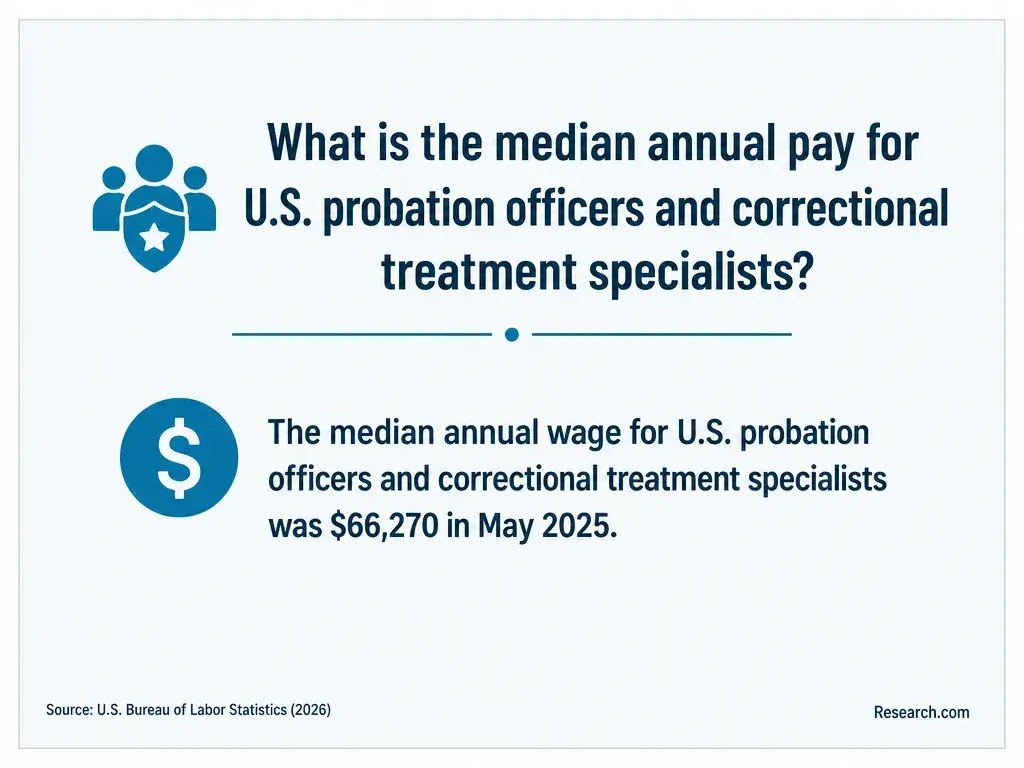
Do not use a "psychologist" salary as the expected return on this MS. U.S. Bureau of Labor Statistics occupational wage figures describe workers in defined occupations, not graduates of a particular concentration.
For a realistic estimate, identify target job titles, check local postings for required credentials and experience, and compare the relevant occupation's published wage data with your likely entry level.
Licensed psychologist practice generally requires further qualifying education, supervised experience, and state approval. Other regulated positions have different rules.
If your target is substance-use counseling rather than forensic research, compare the state's credential requirements and alternatives such as substance abuse counseling bachelor's tuition and earning potential before assuming this MS is the most direct route.
Other Things You Should Know About Psychology
Often, yes, but conference participation and funding are separate questions. Check eligibility for student submissions, whether virtual attendance is offered, and whether the university reimburses registration or travel.
An agency researcher may be able to collaborate or serve in a secondary role, but the university decides who can formally supervise and grade graduate work. Obtain approval before building a project around an external advisor.
That depends on the university's deposit and embargo policies. Ask about access restrictions before proposing work involving sensitive agency information or material you hope to publish elsewhere.
Follow the program's academic-integrity rules and the research team's data-security requirements. Do not enter confidential participant or agency information into an external tool without explicit authorization, and verify any generated citations or analysis yourself.
- Responsible Conduct Research: Mentoring | The Office of Research Integrity https://ori.hhs.gov/education/products/columbia_wbt/rcr_mentoring/foundation/index.html
- Building and sustaining mentor interactions as a mentee - PMC https://pmc.ncbi.nlm.nih.gov/articles/PMC8490489/
- Research with Children FAQs | hhs.gov https://www.hhs.gov/ohrp/regulations-and-policy/guidance/faq/children-research/index.html
- Know What To Look for When Choosing a Mentor | NIAID https://www.niaid.nih.gov/grants-contracts/choose-mentor
- FERPA | Protecting Student Privacy - Department of Education https://studentprivacy.ed.gov/ferpa
- A Career in Forensic and Public Service Psychology | apa.org https://www.apa.org/education-career/guide/subfields/forensic/education-training
- Selecting Research Mentors - McNair Scholars Program - UMBC https://mcnair.umbc.edu/selecting-a-research-mentor/
- How Do I Find a Research Mentor? | ucsd.edu https://ugresearch.ucsd.edu/students/research-mentor.html
- Step 7 - Institutional Review Board (IRB) https://libguides.kean.edu/c.php
- Mentoring Resources: Roles & Expectations | Taubman College Intranet https://intranet.tcaup.umich.edu/knowledge-base/mentoring-resources-roles-expectations/