2027 Online BA in Psychology - Addictions for Patient Navigators: Choosing a Program Without Leaving Your Job

Co-Founder and Chief Data Scientist
If you already help patients find services, an online psychology bachelor's degree may deepen your understanding of substance use and recovery without requiring you to leave your job. But "online" does not guarantee a workable schedule, and an addictions focus does not qualify you to provide treatment. This guide shows patient navigators how to compare coursework, transfer policies, costs, and any in-person requirements against the skills their current or next role actually demands.
Key Things You Should Know
- Start with the job you want: a psychology BA can strengthen navigation and referral skills, but it does not confer an addiction-counseling license.
- Use a written degree audit to check how prior credits apply toward the bachelor's degree; a 120-credit program can still require substantial major coursework after transfer.
- Before enrolling, verify live classes, placement hours, course availability, and total remaining cost - not just whether classes are labeled online.
What is an online psychology degree in addictions for patient navigators?
It is typically a psychology bachelor's degree with an addictions concentration, track, or set of electives - not a separate professional license. The degree studies behavior and psychological research; addictions coursework adds subjects such as substance use, prevention, recovery, and service systems. Schools use these labels differently, so check whether "addictions" appears on the degree or transcript, or simply describes optional courses.
For a working patient navigator, the strongest fit connects that academic study to nonclinical tasks: explaining referral options, recognizing barriers to care, communicating respectfully, and evaluating information about services. If your goal is specifically to become a substance use counselor, compare the psychology curriculum with addiction counseling academic preparation and your state's credential rules before choosing a major. A counseling-oriented program may align more directly with those rules; neither program's title establishes eligibility by itself.
Is an online psychology degree in addictions accredited?
Accreditation belongs first to the institution: confirm that the college holds recognized institutional accreditation and that it awards the advertised bachelor's degree. Then check the program catalog for the exact major, concentration, and graduation requirements. Online delivery does not change those checks. APA accreditation does not generally apply to psychology bachelor's degrees, and institutional accreditation does not establish eligibility for an addiction-counselor credential.
If a school advertises a route into counseling, ask it to identify the specific state requirements its curriculum addresses and any separate professional accreditation that applies to the actual program. These distinctions matter when comparing a BA with a later counseling degree; financial planning for accredited counseling degrees is a separate calculation from paying for an undergraduate addictions focus. Get the school's answer in writing, particularly if you expect to work across state lines.
What careers can an addictions-focused psychology bachelor's degree prepare you for?
Your navigation experience may be more immediately useful than a new concentration label. A BA can support applications for nonclinical service-coordination, outreach, intake, and program-support positions when its coursework fills gaps in your current skills. Hiring standards still depend on the employer, funding contract, and duties.
The distinctions below help you compare a prospective job description with what the degree can reasonably prepare you to do.
| Target work | How the BA may help | What to check separately |
| Patient navigation or intake coordination | Behavioral science, communication, and evidence appraisal | Employer experience and documentation requirements |
| Recovery or community support | Knowledge of substance use and service barriers | Peer or other state-recognized credential rules, if applicable |
| Addiction counseling or psychotherapy | Possible academic foundation | Qualifying education, supervised practice, examinations, and state authorization |
A navigator serving people involved with the justice system may encounter forensic topics, but that does not make a forensic psychology master's the next required step. Compare the actual duties of a target position before committing to another degree; forensic psychology master's careers and earning potential concern a different set of career decisions, not automatic advancement from navigation.
Expect a psychology foundation that may include developmental and social psychology, statistics, research methods, and the study of psychological disorders, alongside general education requirements. An addictions focus may add substance-use science, prevention, recovery systems, and related electives. Compare required courses rather than course titles alone: a program that teaches how to evaluate evidence and understand service barriers may serve a navigator better than one with numerous clinically named electives but little relevant applied work.
Ask whether an internship or capstone is required, whether it can be completed at your current workplace, and who must approve the site and supervisor. Employment does not automatically count as academic fieldwork. If your long-term aim is a research-oriented graduate degree, prioritize methods and statistics preparation; shorter completion routes for psychology master's students are worth considering only after confirming that their coursework and research opportunities fit that aim.
Requirements vary by school and by whether you apply as a first-year or transfer student. An institution may request prior transcripts and proof of secondary-school completion or an equivalent credential; transfer applicants may face additional credit or GPA policies. Admission to the college, admission to a major, and application of prior courses toward graduation are separate decisions.
For a navigator returning to school, request an official degree audit before relying on an estimated finish date. Ask specifically whether prior statistics, psychology, and general education courses satisfy requirements; how an associate degree or workplace-related learning is evaluated; and how many credits must be taken at the awarding institution. A course can transfer as elective credit without replacing a required course. Use guidance on remaining coursework after transferring into psychology to frame those questions, but rely on the receiving school's written evaluation.
Many bachelor's programs are built around 120 credits, but the time remaining depends on credits that apply to requirements, course sequencing, and the pace you can sustain while employed. A school's advertised accelerated timeline may assume a heavier load than your work schedule permits. Check whether required addictions electives run every term; an unavailable course can delay graduation even when you have enough total credits.
Compare a written estimate of remaining tuition and mandatory fees, not just the price per credit. Include books or software, any placement-related travel, and the effect of part-time enrollment on financial aid. Employer tuition assistance may reduce your cost, but verify covered courses, grade conditions, annual limits, and repayment obligations. For a counseling-focused alternative, compare the cost and duration of substance abuse counseling bachelor's degrees using the same remaining-credit assumptions.
Yes, if the program's actual obligations fit your shifts and responsibilities. Asynchronous lectures can help, but fixed-time discussions, group projects, proctored exams, and placements may still conflict with work. Online classes also require regular study time; a flexible login policy does not mean a flexible assignment deadline.
Before accepting an offer, obtain sample course schedules for the next several terms and ask when required courses are offered. Confirm any campus visits, placement hours, leave options, and the minimum enrollment needed for your aid or employer benefit. If you might eventually pursue clinical counseling, examine that future program's supervised training demands separately: shortening the path through a clinical counseling master's does not necessarily make its placements compatible with a full-time job.
What salary and job outlook can psychology graduates expect?
No occupation-wide wage is a reliable prediction for graduates of one psychology BA. Patient-navigation titles span employers and may be classified differently in labor statistics, so compare local postings for the duties and credentials you can actually meet. Pay may also be constrained by a nonprofit's funding or a public employer's salary schedule.
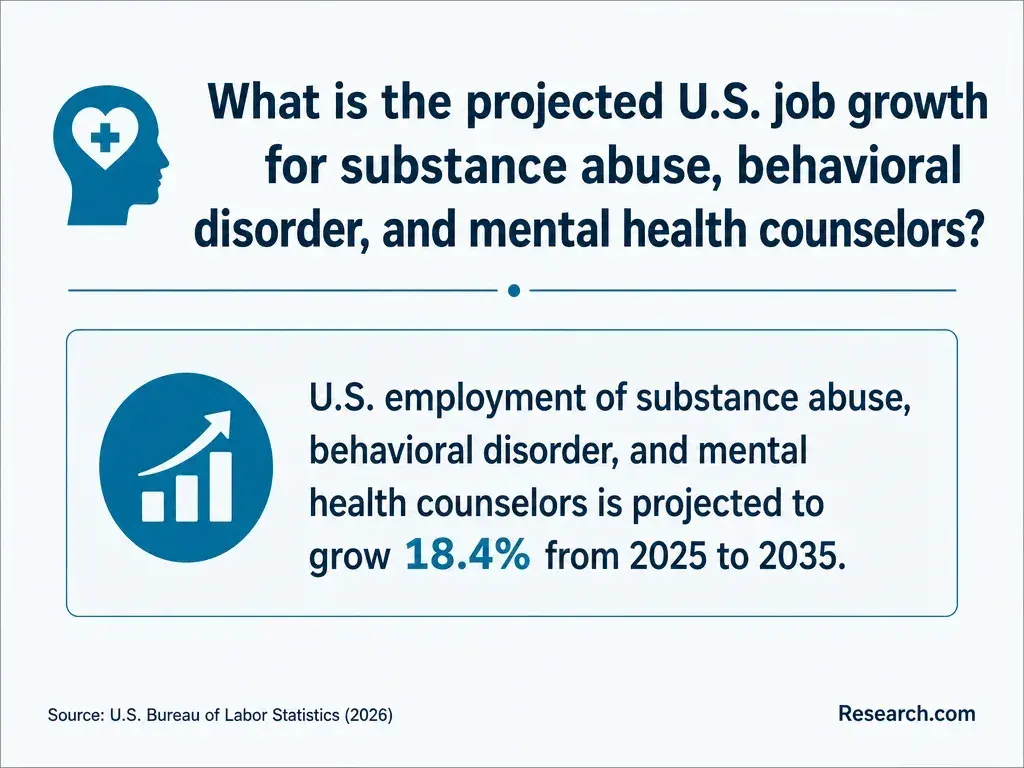
For context - not as a navigator salary - the U.S. Bureau of Labor Statistics reports a May 2024 median annual wage of $59,190 for substance abuse, behavioral disorder, and mental health counselors and projects 17% employment growth for that occupation from 2024 to 2034. That category includes jobs with different qualification requirements, commonly beyond a psychology BA. It shows demand for counseling services, not what a navigator will earn or whether the degree will lead to a counseling job.
Evaluate a program against likely local pay changes, your remaining education cost, and whether your employer offers advancement. Avoid treating a higher-paying graduate occupation as a return on this BA without counting the additional qualification. The same caution applies when comparing costs of one-year forensic psychology master's pathways: speed and an occupation's advertised earnings cannot establish the value of a degree for a patient-navigation role.
Other Things You Should Know About Psychology
Compare required courses, not the letters. Either degree may be suitable; choose the curriculum that covers your skill gaps and fits your transfer credits and schedule.
Possibly. Ask the institution whether it accepts students in your state and whether any required field experience can be completed locally.
Do not use identifiable patient information without the permissions and safeguards required by your employer and school. Ask your instructor about approved alternatives, such as a fictional scenario.
If you already meet the education requirements for your target job and need only a specified skill or credential, check employer training, a relevant course, or the applicable certification pathway before funding a full degree.
- Accreditation in the U.S. | ed.gov http://www.ed.gov/laws-and-policy/higher-education-laws-and-policy/college-accreditation/accreditation-in-the-us
- The Role of Patient Navigators in Eliminating Health Disparities | nih.gov https://pmc.ncbi.nlm.nih.gov/articles/PMC4121958/
- Behavioral Health Career Descriptions | samhsa.gov https://www.samhsa.gov/about/careers/behavioral-health-workforce/careers-by-state/descriptions
- Types of Financial Aid: Grants, Work-Study, and Loans | studentaid.gov https://studentaid.gov/understand-aid/types
- Cost of Attendance (Budget) | 2026-2027 Federal Student Aid Handbook https://fsapartners.ed.gov/knowledge-center/fsa-handbook/2026-2027/vol3/ch2-cost-attendance-budget
- Academic Rules and Regulations | American University https://www.american.edu/provost/undergrad/undergrad-rules-and-regulations.cfm
- 9 Mental Health Careers You Can Pursue with a BA | New England College https://www.nec.edu/news/9-mental-health-careers-you-can-pursue-with-a-ba
- Credit for What You Know | Online https://cps.unh.edu/online/apply-register/transfer-credit-evaluation/credit-what-you-know
- Course Credit Hours and Student Workload Expectations | umn.edu https://evcaa.d.umn.edu/course-credit-hours-and-student-workload-expectations
- Employment-Based Practicum Placements | charlotte.edu https://socialwork.charlotte.edu/practicum-education/employment-based-practicum-placements/