2027 Online BA in Psychology - Addictions: Degree Options for Recovery Employment and Housing Navigation
Audited and Verified:
Our Editorial and Data Verification Process
Research.com uses government datasets, official education statistics and primary institutional information to support its career and degree guides. Our review process checks factual accuracy, occupational definitions, source dates and the requirements associated with the credentials discussed.
How This Article Was Fact-Checked
Our editorial team verifies salary estimates, employment projections, education requirements and program information against original data providers and official organizations. Salary figures are checked against the relevant occupational definitions and reporting periods. Information about licensure, accreditation and required in-person training is reviewed separately.
Fact-checked and verified on:

Co-Founder and Chief Data Scientist
Recovery employment and housing navigators help people turn treatment and recovery goals into practical next steps: finding work, locating housing, and connecting with services. If you are considering an online BA in psychology with an addictions focus, the key decision is whether it offers more value for that work than direct service experience or a targeted credential. This guide explains the roles, relevant coursework, degree options, costs, and professional boundaries so you can choose a path that fits your background and the jobs available in your area.
Key Things You Should Know
- An addictions-focused psychology BA can prepare you for nonclinical navigation and coordination work, but it does not authorize addiction counseling, diagnosis, or therapy.
- Many bachelor's programs require about 120 credits; transferred credits reduce the time and cost only when they satisfy the receiving school's degree requirements.
- Before enrolling, compare local job postings with the program's coursework and placement options. For some navigator roles, relevant experience and employer training may be a more direct route than another degree.
What is an online bachelor's degree in psychology with an addictions focus?
It is an undergraduate psychology degree that combines foundational study of behavior and research with coursework on substance use, prevention, and recovery. The addictions focus might be a formally designated concentration, a minor, or simply a set of electives. Those distinctions matter: an elective does not appear on a transcript as a separately awarded credential unless the school says it does.
A BA usually includes broad general education and psychology requirements. A BS may require more science or quantitative coursework, but the actual curriculum matters more than the letters on the diploma. Compare accredited addiction psychology undergraduate education by checking the exact award, required courses, and opportunities to work with community organizations - not just the concentration's name.
For a navigator, the degree's value lies in understanding behavior without reducing a person to a diagnosis, reading evidence critically, communicating respectfully, and recognizing when to refer someone to a qualified specialist. Online classes do not necessarily mean remote field experience: a program may require live meetings or an approved local placement.
What careers can an addictions psychology degree prepare you for?
The closest matches are nonclinical roles in recovery organizations, community agencies, housing programs, and workforce services. Titles vary by employer, so read the duties and required credentials rather than assuming every "recovery" job has the same scope. The table separates related roles by the work they actually perform.
| Role | Typical contribution | Qualification to verify |
| Recovery employment navigator | Helps clients set work goals, connect with training or employers, and coordinate referrals | Workforce-service experience, documentation skills, and any employer-required training |
| Housing navigator | Helps clients understand applications, contact housing providers, and coordinate with case teams | Knowledge of local housing systems, privacy procedures, and agency requirements |
| Recovery support worker | Offers practical support and connection to services within an assigned role | Whether the position requires a state-recognized peer credential or lived-experience qualification |
| Substance use counselor | Provides regulated counseling services within the applicable credential's scope | State-specific education, supervised experience, examination, and credential rules |
A psychology BA can strengthen an application, but hiring may depend more heavily on experience with referrals, benefits systems, landlords, employers, or community partnerships. If you already work in human services, compare those transferable skills with professional pathways in recovery organizations before paying for a new degree. If you are entering the field, supervised outreach, intake support, or workforce-program work can provide relevant evidence of readiness.
Can you work in recovery employment or housing navigation with this degree?
Yes, if a particular employer accepts your education and experience for its nonclinical navigator position. A navigator might help someone identify suitable job openings, prepare for an appointment, gather housing-application documents, or reach the agency responsible for an eligibility decision. The navigator does not independently diagnose a substance use disorder, provide psychotherapy, guarantee a housing placement, or decide benefits eligibility.
These roles sit at the intersection of systems with different rules. Employment support may require coordination with vocational rehabilitation or benefits specialists; housing support may involve waitlists, landlord requirements, and agency privacy policies. A useful job-posting test is to identify who makes eligibility decisions, who supervises the navigator, what records the worker can access, and which tasks require a separate credential.
For someone moving from corrections or justice services into housing navigation, even twelve-month forensic psychology graduate study pathways are not a substitute for learning the local housing and referral system. Seek supervised experience with those systems first unless a target position explicitly requires graduate study.
Programs differ, but a useful curriculum for navigation combines psychology fundamentals with service-system knowledge. Research methods and statistics help you assess claims about recovery programs; developmental and social psychology inform communication; addictions courses examine substance use and recovery without making students clinicians. Courses in ethics, cultural responsiveness, and community services can help with referrals and professional boundaries.
Look beyond course titles for assignments that resemble the work: evaluating a public program report, mapping referral options, or writing a deidentified service-resource brief. Ask whether supervised, nonclinical applied learning is available and whether your proposed site would need advance approval. When comparing psychology degree schools and online formats, confirm which courses are actually offered online each term and whether live sessions, group work, or placements fit your schedule.
A full-time bachelor's path commonly spans about four academic years, while transfer students may finish sooner. Your actual timeline depends on how accepted credits apply to general education, psychology prerequisites, the addictions focus, and the school's minimum in-residence credits. An accepted statistics course, for example, may count as an elective without satisfying the major's statistics requirement.
Request a written degree audit and a term-by-term course plan before relying on an advertised completion time. Ask when required courses run and whether an internship has fixed hours or local-site requirements. Online psychology completion programs and pacing can be useful comparisons, but faster terms do not remove prerequisite sequences or fieldwork obligations. If you work in recovery services now, ask whether your job could be considered for a placement; do not assume it will be approved.
There is no reliable single price for this degree type. Compare the tuition charged for your remaining credits, mandatory online and technology fees, books, and any placement-related travel or reduced work hours. A lower per-credit price can still produce a higher total bill if fewer of your prior credits meet degree requirements.
For each school, obtain a degree audit and calculate remaining required credits × your applicable tuition rate + required fees. Then check financial-aid eligibility and whether your employer offers education assistance. A counseling degree is a different, potentially costlier decision; use accredited counseling program affordability comparisons only if your intended role actually requires that professional pathway. Do not borrow for clinical training merely to qualify for a nonclinical navigator job.
First-year applicants generally provide evidence of secondary-school completion, while transfer applicants submit college transcripts. Schools set their own GPA, application, and transfer policies; admission to the university does not necessarily mean admission to a particular major or concentration. Ask whether any addictions courses have prerequisites and whether prior coursework must be reviewed by the psychology department.
Returning students should collect transcripts, course descriptions or syllabi for possible psychology and statistics equivalents, and any documentation the school requests for other prior learning. In psychology degree transfer pathways, the decisive document is the receiving institution's evaluation showing where each credit applies. Request clarification or an appeal before enrolling if a course you expected to satisfy a requirement appears only as an elective.
Start by confirming that the institution holds recognized institutional accreditation and that the online BA and advertised addictions focus are offered to students in your location. Institutional accreditation is important, but it does not establish that the curriculum meets addiction-counselor credential rules. APA accreditation is not the standard to seek for a general undergraduate psychology major.
Then compare what matters for the target job: local placement approval, courses on service coordination and addiction, faculty or site supervision, scheduling, transfer-credit application, and the complete cost to finish. Ask for the current catalog and whether the school can identify graduates' outcomes for the specific program; do not treat institution-wide marketing claims as evidence of navigator employment. Broader psychology degree schools and online formats comparisons are a starting point, not a substitute for checking the program's current policies.
Not by itself. Studying addiction does not authorize diagnosis, psychotherapy, or independent substance use counseling. State addiction-counselor credentials may specify coursework, supervised hours, examinations, and permitted duties; peer-support credentials follow different rules and may have lived-experience requirements. Check the responsible state board or certifying organization against the exact job title you want.
If your goal is clinical counseling rather than navigation, investigate a qualifying professional degree and its state-specific requirements. Accredited clinical mental health counseling completion pathways address a different outcome from a psychology BA. Likewise, a general psychology MS may deepen academic knowledge without meeting counseling-license requirements. Ask a program to identify, in writing, the credential its graduates are prepared to seek and in which jurisdictions.
What are the salary and job outlook for addictions psychology careers?
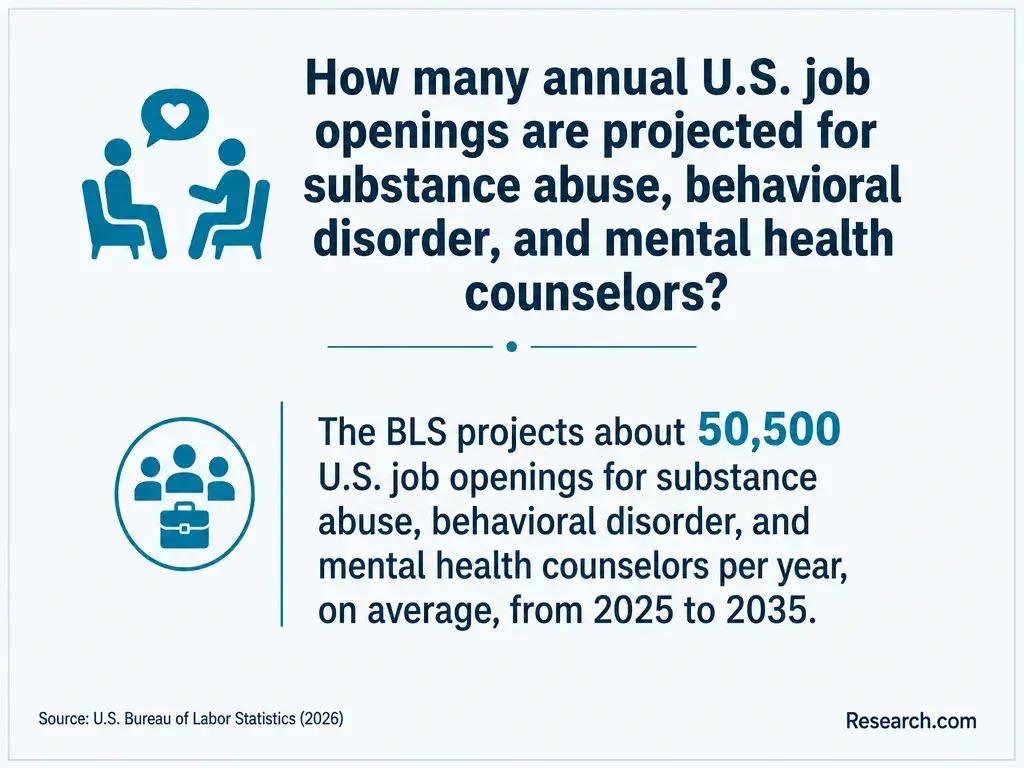
Pay depends on the occupation, employer, location, and required credentials - not on the addictions focus alone. The U.S. Bureau of Labor Statistics reports a May 2024 median annual wage of $59,190 for the combined occupation of substance abuse, behavioral disorder, and mental health counselors. That figure covers counselor jobs with varying entry requirements; it is not an expected salary for a BA graduate or a housing navigator.
For a navigator decision, compare wages in local postings that match your likely duties and qualifications, including nonprofit, public-agency, and contracted positions. Check whether a posted salary assumes a credential or experience you do not yet have. Before comparing accelerated MS psychology options as a way to increase earnings, verify that the positions you want require that degree; additional tuition does not automatically change your job title, scope, or pay.
Other Things You Should Know About Psychology
No. Programs can differ in eligibility, services, tenancy arrangements, and length of stay. Learn the specific rules of each local provider before presenting an option to a client.
No. A navigator can explain the process and help with applications, but the housing provider or employer makes the decision. Communicate uncertainty and deadlines clearly.
That is the applicant's decision, subject to the circumstances of the job and applicable law. A navigator should not disclose personal information without authorization and should refer legal questions to a qualified resource.
A navigator can connect the person with an authorized benefits counselor or relevant agency. Benefits rules are individualized, so an unsupported estimate could lead to a harmful decision.
- Types of Financial Aid: Grants, Work-Study, and Loans | studentaid.gov https://studentaid.gov/understand-aid/types
- Peer Training and Certification - Arkansas Department of Human Services https://humanservices.arkansas.gov/divisions-shared-services/shared-services/office-of-substance-abuse-and-mental-health/arkansas-peer-recovery/peer-training-and-certification/
- Chapter 6 - How To Become a Peer Specialist - NCBI https://www.ncbi.nlm.nih.gov/sites/books/NBK596268/
- Cost of Attendance (Budget) | 2026-2027 Federal Student Aid Handbook https://fsapartners.ed.gov/knowledge-center/fsa-handbook/2026-2027/vol3/ch2-cost-attendance-budget
- Housing First | pdx.edu https://omeka.pdx.edu/housingfirst
- Certification and licensure - ASU Department of Psychology https://psychology.asu.edu/admission/masters-admission/ms-addiction-psychology/licensure
- Applied Psychology: Addictions Studies, B.S. - CPS, CPSO | University of New Hampshire https://www.unh.edu/program/bachelor-science/applied-psychology-addictions-studies
- Directory of Addiction Study Programs (DASP) | icuddr.org https://icuddr.org/education/directory-of-addiction-studies-programs/
- How Online Degree Tuition Is Calculated: Compare Total Cost Before You Enroll | GetEducated https://ai.geteducated.com/how-online-degree-tuition-is-calculated