
2027 Leading vs Lagging Indicators in Healthcare Operations

Co-Founder and Chief Data Scientist
A hospital can meet its staffing target today and still face a rise in patient harm next month. Conversely, a poor outcome reported weeks later may arrive too late to prevent the next case. Healthcare administrators need both early signals and confirmed results to manage quality, access, capacity, and finances.
This guide explains how to classify operational metrics, pair them on a useful dashboard, and test whether they support a real decision. It also shows where these skills fit in healthcare careers - and when further education is worth considering.
Key Things You Should Know
- Leading indicators track conditions or actions that may influence future results; lagging indicators show results already observed. Neither label means a metric is automatically predictive or useful.
- Pair an actionable early measure with an outcome measure - for example, timely discharge planning with length of stay - and check whether the relationship holds locally.
- Define each measure's population, denominator, reporting delay, owner, and response threshold before putting it on a dashboard; apparent improvement can otherwise reflect a change in case mix or data capture.
What are leading and lagging indicators in healthcare operations?
A leading indicator measures a process, condition, or behavior early enough that a team might intervene before a desired result is known. A lagging indicator measures an outcome or completed result, such as a recorded infection, a discharged patient's length of stay, or a closed billing period's collections. "Leading" describes a metric's position in a decision chain, not proof that it causes the outcome.
For example, the share of discharge plans completed before the expected discharge date can signal whether a unit is preparing patients to leave safely. Actual length of stay becomes known after discharge. Both measures can be affected by patient complexity and placement availability, so administrators should examine them together rather than assume that improving the first will necessarily improve the second.
Responsibility also shapes metric choice. An operations leader may manage the discharge process, while a health information professional focuses on the completeness and integrity of the records used to measure it. Readers weighing those roles can compare health information management versus administration program fit.
How do leading and lagging indicators differ in healthcare performance management?
The practical difference is when a measure becomes available and what a manager can do with it. Leading measures can prompt a near-term response, but they may be weak predictors. Lagging measures confirm what happened, but reporting delays and small sample sizes can limit their value for daily decisions.
A metric's classification depends on the decision. Emergency department boarding time is a lagging result of an earlier bed-allocation decision. The same observed boarding trend can be a leading warning of congestion later in the shift. State the decision and time horizon before labeling the measure.
This distinction is a useful test of graduate study, too. A program that teaches students to choose, interpret, and improve measures may be more useful for an operations role than one that only teaches dashboard software. Compare that emphasis when selecting an online master's in health administration; an MBA's broader management core serves a somewhat different purpose.
Which healthcare operations metrics are leading and lagging indicators?
The pairs below illustrate how an administrator might monitor an operational process alongside its result. They are examples, not universal predictor-outcome relationships; local validation matters.
| Operational goal | Possible leading indicator | Related lagging indicator | Interpretation to check |
| Safe, timely discharge | Discharge tasks completed by the planned date | Length of stay; subsequent readmissions | Earlier discharge should not come at the expense of safe transitions. |
| Reliable staffing | Unfilled shifts identified before the schedule begins | Overtime hours; reported safety events | Patient acuity and reporting practices can affect both results. |
| Appointment access | Near-term appointment slots available | Completed visits; time from request to visit | Unused slots may reflect a mismatch in location, service, or timing. |
| Revenue-cycle performance | Claims passing pre-submission checks | Denials; cash collections | Payer rules and payment timing can delay the observed result. |
Someone entering the field may first learn these measures through scheduling, billing, or quality-support work rather than a management title. If a bachelor's degree is the next step, budgeting for an online healthcare administration bachelor's should account for total program costs, not just the opportunity to study dashboards.
Leading indicators help only when a team can respond before the risk becomes an outcome. If a unit tracks unfinished discharge tasks, its manager can review the exceptions with case management and address barriers such as transportation or placement. Counting unfinished tasks without assigning a response does not prevent delays.
A practical prevention cycle is to define the risk, choose an observable early signal, specify who reviews it and when, act on exceptions, and then compare later outcomes. Preserve a balancing measure: if a throughput intervention shortens stays but coincides with more return visits, the apparent gain needs investigation. Staff should also be able to report why a target was missed; otherwise, pressure to improve the number can conceal the operational problem.
Professionals who want to practice this kind of process improvement without committing to a graduate degree may compare employer training with faster online study routes in healthcare administration. The useful test is whether the learning includes work with real processes and defensible measures, not merely a faster completion date.
Lagging indicators show whether the organization achieved a result. Quality measures may include confirmed healthcare-associated infections or readmissions; efficiency measures may include completed length of stay or operating-room utilization over a closed period; financial measures may include finalized denials and collected revenue. Definitions matter: a recorded readmission rate is not a pure measure of one unit's discharge work.
Compare results over a consistent period and population, and examine relevant context such as service line, patient complexity, and changes in coding or reporting. A low event count can also swing sharply from period to period. External measures from agencies such as the Centers for Medicare & Medicaid Services may be valuable for accountability, but their specifications and reporting schedules do not necessarily suit a daily unit huddle.
Learning to interpret these results does not require the most expensive credential available. If a master's degree would support a specific management goal, compare curriculum and employer support alongside affordable master's programs in healthcare administration; a lower tuition figure alone does not establish program fit.
Start with a decision the dashboard must support, such as reducing avoidable discharge delays without compromising patient safety. A compact display should show an early process measure, the intended outcome, and a balancing measure that could reveal unintended harm. Add a financial or capacity measure only if it changes the same decision.
For each metric, document its definition, data source, update frequency, accountable owner, and the action prompted by an exception. Show trends and relevant breakdowns rather than a single organization-wide average that hides variation between units. Review whether action on the leading measure is followed by the intended outcome; replace measures that consume attention without improving decisions.
Program accreditation is a separate consideration from dashboard quality, but it can matter when choosing formal preparation for this work. Applicants considering an MHA can examine CAHME-accredited MHA universities and program options while checking the actual coursework in quality improvement and analytics.
Select indicators for decision value, not because data are easy to extract. A strong measure has an unambiguous numerator and denominator, a defined patient or service population, timely and sufficiently complete data, and an owner who can influence the process. It should be sensitive enough to detect a meaningful change without rewarding behavior that undermines care.
Before adopting a proposed leading indicator, ask whether the team can explain a plausible link to the desired outcome and test that link locally. Before acting on a lagging indicator, check reporting delays, changes in documentation, and whether differences in case mix make comparisons misleading. Set response rules with clinical and operational stakeholders; an automatic target can be unsafe when exceptions represent appropriate care.
Advanced study may help leaders design and evaluate measurement systems, but a doctorate is not a prerequisite for selecting sound indicators. If that credential is part of a longer-term plan, compare its expected role with healthcare administration doctorate fees and completion costs before treating it as the default next step.
Electronic health records can supply timestamps, orders, documentation, and clinical events. Scheduling and staffing systems support access and capacity measures. Claims and revenue-cycle systems provide denials and payment results, often later than operational systems. Incident-reporting systems and patient surveys add important perspectives but reflect what people report or answer - not a complete count of every problem.
Joining these sources requires consistent patient, encounter, unit, and date definitions. Administrators should work with clinical, finance, and data-governance teams to check access permissions, missing records, duplicate encounters, and the delay between an event and its appearance in a report. Protect patient information under applicable privacy and organizational rules; a dashboard rarely needs identifiable detail for every viewer.
Experience reconciling these data sources can be more immediately useful than another credential. Professionals considering doctoral study for research or senior leadership should weigh healthcare administration doctorate timeline planning against opportunities to build measurement experience at work.
For someone already working in healthcare, demonstrating that they can define a metric, investigate a change, coordinate a response, and assess its result can support progression into operations, quality improvement, service-line management, or revenue-cycle leadership. A move from a clinical or technical role into administration also requires budgeting, communication, and authority to work across teams; dashboard familiarity alone is not a management qualification.
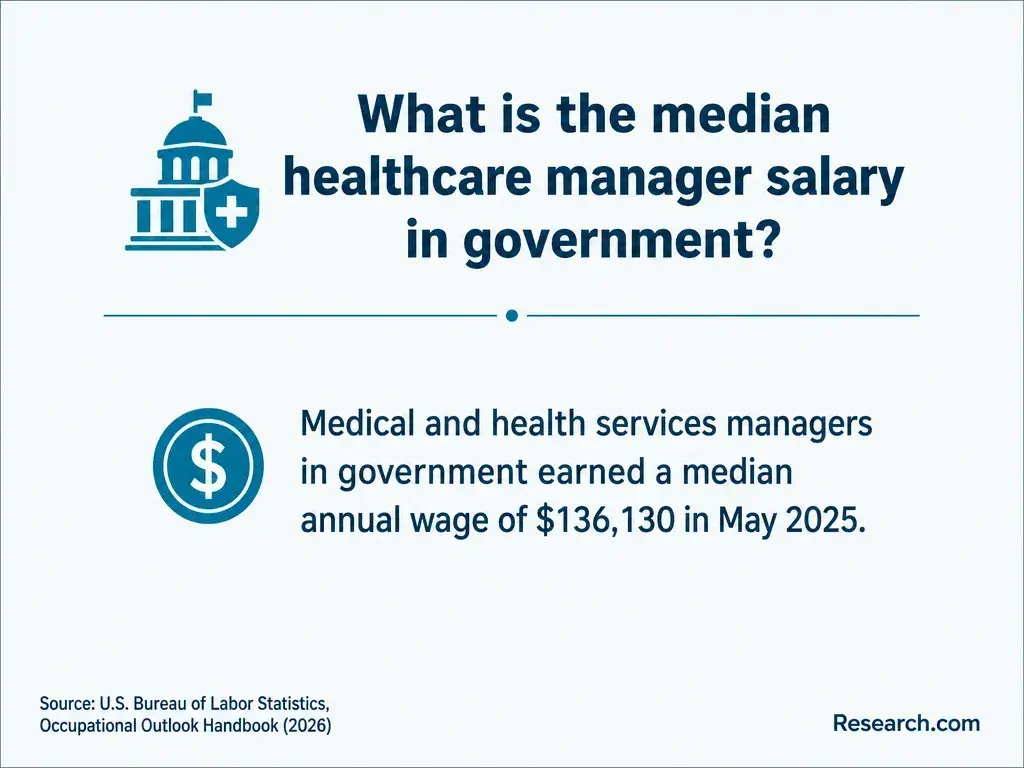
For salary context, the US Bureau of Labor Statistics reports a $126,520 median annual wage for management occupations in May 2025. That figure covers many industries and management jobs; it is not a healthcare-administrator salary or an expected return on a degree. Readers should evaluate the requirements and compensation of the specific roles available in their market.
Senior leadership or research-oriented paths may justify further education after substantial experience. Compare the work and credential actually required for a target position before considering accelerated doctoral education for healthcare leadership roles; a shorter program does not substitute for a record of operational responsibility.
What skills and education prepare professionals to manage healthcare performance metrics?
Useful skills include basic statistics, measure definition, data-quality checks, process mapping, financial interpretation, and communicating uncertainty to clinical and nonclinical colleagues. Equally important is knowing when a measure exceeds one's expertise: clinical interpretation belongs with qualified clinicians, and technical data issues may require informatics or analytics specialists.
An MHA generally centers healthcare administration; an MBA provides a broader management core in areas such as finance, operations, and organizational leadership. A healthcare-focused MBA course or concentration may add sector context, but its depth varies by program. For an experienced healthcare professional seeking broader business responsibility, online MBA planning for an accelerated healthcare management pathway can be useful - provided the schedule, total cost, and actual healthcare coursework fit the goal. For a narrowly defined analytics gap, an applied course, employer project, or specialized training may be more direct than either degree.
Before enrolling, identify a target role and ask what evidence of performance improvement its employer values. Then compare programs on applied projects, measurement coursework, access to relevant peers or employers, and total cost. The strongest preparation lets you explain not only whether a number moved, but whether the underlying care or operation improved.
Other Things You Should Know About Healthcare Administration
No. A leading indicator is an early measure that may inform action. A predictive model estimates a future outcome using a defined method and requires separate validation before use.
Yes, if the questions, response group, and timing are consistent. Interpret results alongside staffing and outcome data, since survey responses may not represent everyone affected.
Match the update cycle to the decision and the source's reporting delay. A shift-level staffing decision needs fresher data than a review of finalized claims.
Check definitions, data timing, and patient or service mix first. Then investigate whether the process changed without affecting the outcome - or whether another factor is influencing it.
- Leading Indicators | Occupational Safety and Health Administration http://www.osha.gov/leading-indicators
- Hospitals - Timely & effective care | Provider Data Catalog https://data.cms.gov/provider-data/topics/hospitals/timely-effective-care
- Requirements for a quality dashboard: Lessons from National Clinical Audits - PMC https://pmc.ncbi.nlm.nih.gov/articles/PMC7153077/
- Constructs of leading indicators: A synthesis of safety literature - ScienceDirect https://www.sciencedirect.com/science/article/pii/S0022437523000531
- Healthcare Capacity Management: A Practical Guide | Cleffex https://www.cleffex.com/blog/healthcare-capacity-management/


