2027 Federal vs State Healthcare Oversight: What BS Students Should Learn

Co-Founder and Chief Data Scientist
A healthcare administrator may need to follow federal Medicare rules, state facility-licensing requirements, and employer policies at the same time. Understanding who sets each rule - and who enforces it - is essential to managing a healthcare organization responsibly.
For students considering a BS in healthcare administration, this guide explains the oversight system, the courses that build useful compliance skills, and how to evaluate a program's cost, format, and career fit. It also distinguishes what a bachelor's degree can prepare you to do from responsibilities that require experience or a professional license.
Key Things You Should Know
- Federal agencies oversee matters such as Medicare participation, health information privacy, and workplace safety; states license healthcare professionals and facilities and set many operating rules.
- Choose a BS program that teaches students to identify the applicable rule, responsible regulator, and operational response - not just memorize agency names.
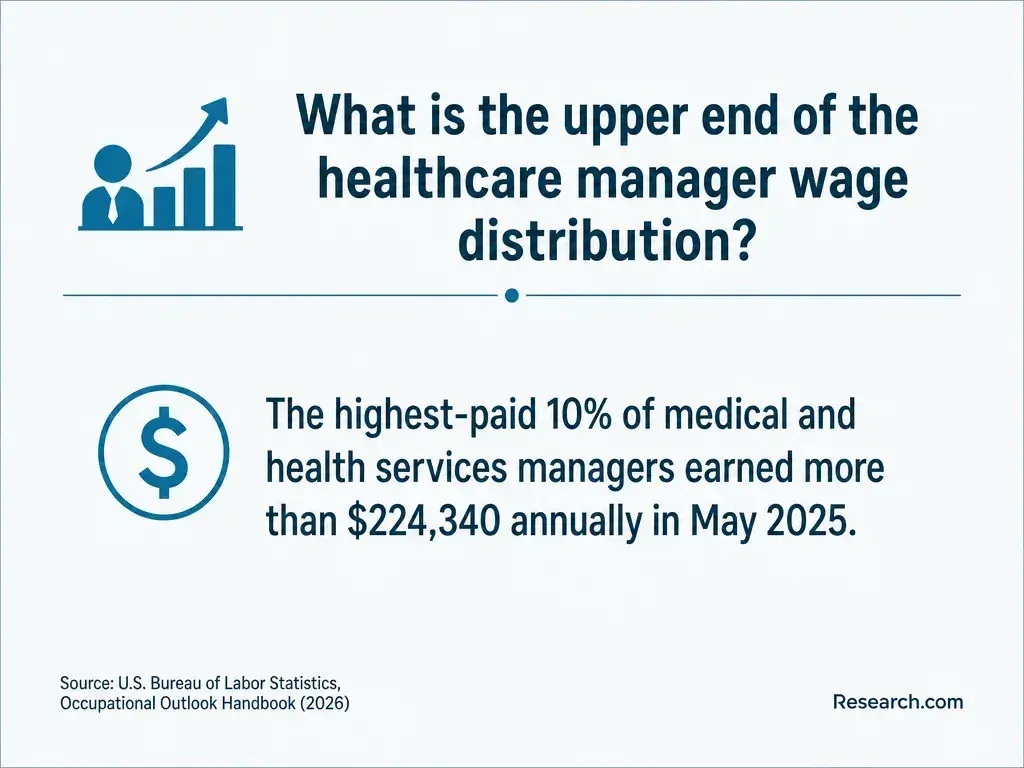
- The May 2025 median wage for all management occupations was $126,520, according to the Bureau of Labor Statistics (BLS); it is not an entry-level salary or a healthcare administration graduate outcome.
What roles do federal and state governments play in healthcare oversight?
Federal oversight establishes and enforces requirements within federal authority, including rules tied to Medicare and Medicaid participation, federal health information privacy law, and workplace safety. State oversight commonly governs professional licenses, facility licenses, and state-specific operating standards. Local authorities may add requirements, such as building or fire codes. A single hospital or clinic can answer to several regulators for different aspects of its work.
The distinction is not simply "federal rules versus state rules." Federal law can set a baseline while state law adds protections or imposes separate obligations. For example, an organization may need to evaluate both federal privacy requirements and a state's health information rules before changing how it handles patient records. Students drawn to records and data governance can explore choosing between healthcare administration and health information management; the fields overlap in compliance but emphasize different work.
A useful classroom exercise starts with an operational decision - opening a service, reporting an incident, or changing a records workflow - and asks which jurisdiction, agency, license, and written policy apply. That approach is more useful than assuming one regulator controls the entire decision.
Which federal agencies regulate healthcare organizations and programs?
Federal agencies have distinct responsibilities. The Centers for Medicare & Medicaid Services (CMS) administers Medicare and works with states on Medicaid; its participation requirements affect organizations that serve program beneficiaries. Within the Department of Health and Human Services, the Office for Civil Rights enforces federal health information privacy and security rules, while the Office of Inspector General investigates fraud and abuse involving HHS programs. Other relevant regulators include the Food and Drug Administration for products within its jurisdiction and the Occupational Safety and Health Administration for workplace safety.
For an aspiring administrator, the practical skill is routing a problem correctly. A suspected billing issue, a patient-record disclosure, and a hazardous workplace condition call for different expertise and response procedures. A BS can establish that foundation, but progression into specialized policy or compliance leadership usually depends on experience. Students considering graduate study after building that foundation can examine accredited MHA options for applicants new to healthcare rather than assuming a graduate degree is a prerequisite for every entry-level role.
How do state laws affect healthcare licensing and facility operations?
States determine who may hold many clinical and facility licenses, what services a licensed facility may provide, and how it must meet applicable state standards. Requirements vary by facility type and jurisdiction; a nursing home, hospital, and outpatient clinic should not be treated as if they share one licensing checklist. State agencies may inspect facilities, investigate complaints, and impose corrective actions under state law. States also administer Medicaid within federal requirements, creating another important state-federal intersection.
For students, the lesson is to check the law where an organization actually operates. An administrator planning a new service should confirm whether it needs a facility license, an amendment to an existing license, approval from another authority, or staff with particular professional credentials. Students moving between colleges should also check using prior college credits toward healthcare administration: transferred credits may shorten a degree, but they do not replace learning the rules of the state where they intend to work.
A strong undergraduate introduction covers the difference between statutes, regulations, agency guidance, contracts, and organizational policy. Students should learn how privacy, reimbursement, fraud-and-abuse, employment, and licensing rules can affect routine decisions. They should also practice recognizing when to escalate a question to a compliance officer, attorney, clinician, or licensed facility leader. A BS does not qualify its holder to provide legal advice.
Applied assignments are particularly valuable: students might map the obligations involved in a privacy incident or identify approvals needed before a facility expands. When comparing programs, look for legal concepts connected to case studies and operational decisions rather than an agency-name survey alone. If affordability is the constraint, compare this coursework alongside tuition and fees when considering cost-conscious choices for a healthcare administration degree; the least expensive option is less useful if it omits the preparation needed for your target role.
Course titles vary, but healthcare law and ethics, health policy, healthcare finance, quality improvement, health information systems, and organizational management each contribute to compliance work. Finance helps students understand reimbursement and billing controls; information systems courses introduce record access and data governance; quality courses connect incidents and performance measures to operational improvement.
Look beyond the catalog title to the assignment. A course that asks students to analyze a process failure, document a risk, and propose a feasible control offers more directly applicable practice than one assessed only through terminology quizzes. An internship or capstone can help, provided the school explains who arranges placements and whether remote students can participate locally. When evaluating accelerated healthcare administration degrees, check whether the shorter schedule still leaves room for these applied experiences.
A BS in healthcare administration is an academic degree, not a clinical or facility-administrator license. Students generally should verify that the institution holds recognized accreditation and confirm that the particular degree meets their educational and financial-aid needs. Specialized programmatic accreditation may also be worth considering where available, but it is distinct from institutional accreditation and is not a universal requirement for healthcare administration bachelor's programs.
Do not confuse graduating from an accredited college with eligibility for a regulated job. Nursing home administrator roles, for example, are subject to state licensing requirements that must be checked with the relevant board. If graduate study is part of your plan, evaluate the graduate program on its own terms rather than assuming the BS program's accreditation carries over. That distinction matters when you later review affordable graduate healthcare administration degrees.
Either format can teach the same core concepts, but delivery changes how students participate and obtain practical experience. The comparison below highlights questions that matter more than the "online" or "campus" label alone.
| Consideration | Online BS | Campus-based BS |
| Schedule | May reduce travel, but can still require live sessions and fixed deadlines | Usually requires attendance at scheduled classes |
| Applied experience | May require a locally arranged internship or remote project | May provide access to nearby placements; availability still varies |
| Interaction | Often relies on discussion platforms and virtual meetings | Offers regular in-person contact during classes |
Ask each school whether courses are asynchronous, how group work is scheduled, and who helps secure internships. A working student may benefit from online delivery, but should not mistake it for self-paced study. If the BS is intended as a step toward graduate education, consider whether the schedule leaves room to gain relevant work experience; healthcare management master's completion planning is a separate decision from how quickly to finish the bachelor's degree.
First-year applicants typically need a secondary-school credential and application materials specified by the college; transfer applicants must also submit prior college records. Requirements differ by institution. A full-time bachelor's path commonly takes about four years, while transfer credits, part-time enrollment, and course availability can change the timeline. Ask for a degree audit rather than assuming all previous credits will satisfy major requirements.
Compare the total cost to completion: tuition, mandatory fees, books or software, and any travel or placement expenses. Request a written estimate based on your transferable credits and planned course load, and check financial-aid eligibility with each school. If you are considering an MBA later, do not bundle that hypothetical expense into the BS price; evaluate it separately using cost comparisons for online healthcare-focused MBA programs. An MBA adds broad management training but is not required to begin most healthcare administration career paths.
A BS can support applications for roles such as healthcare operations coordinator, practice administrator assistant, patient services supervisor, quality improvement coordinator, or compliance support specialist. Duties vary by employer and may include scheduling resources, monitoring procedures, preparing reports, and coordinating responses to operational problems. A student with prior clinical, billing, or office experience may qualify for different responsibilities than a graduate entering healthcare for the first time.
Management titles often require demonstrated experience supervising people, budgets, or a service line; the degree alone does not confer those responsibilities. Seek internships and projects that show you can interpret a requirement and improve a real process. For later advancement, an MHA or healthcare-focused MBA may suit operational leadership goals, while healthcare management doctoral degree options online are more relevant to some research, teaching, or advanced leadership goals. None substitutes for a professional license where a role requires one.
What salaries and job outlook can healthcare administration graduates expect?
There is no single salary for a healthcare administration BS graduate. Pay depends on the position, location, employer, and prior experience. For context, BLS reports a $126,520 median annual wage for all management occupations in May 2025. That broad figure includes experienced managers across industries; it should not be used as a starting-salary estimate for healthcare administration graduates.
BLS projects management occupations overall to grow faster than the average for all occupations from 2025 to 2035. This is a broad outlook, not a forecast for every healthcare administration job. Compare local postings for roles you could realistically qualify for, noting their pay ranges and experience requirements. Before paying for an advanced degree in hopes of higher earnings, weigh the positions it could help you pursue against its cost and time commitment; understanding time-to-completion in healthcare administration doctorates is especially important if you are considering that longer-term path.
Other Things You Should Know About Healthcare Administration
No. Whether federal law displaces a state requirement depends on the particular laws involved. Organizations should assess both sets of obligations rather than assume one automatically cancels the other.
Many administrative tasks can be performed across locations, but the organization must still meet requirements in each state where it operates. A role that requires an individual license calls for a separate eligibility check.
Not universally. Review the qualifications in postings for your target role; foundational experience with records, billing, quality, or operations may be more useful initially.
Follow the employer's reporting procedure and promptly involve its designated compliance or privacy personnel. Students and new employees should not try to resolve a suspected violation alone.
- Nursing Homes | cms.gov https://www.cms.gov/medicare/health-safety-standards/certification-compliance/nursing-homes
- Medicare Conditions Of Participation And Accreditation... - NCBI https://www.ncbi.nlm.nih.gov/books/NBK235473/
- Administration | MACPAC https://www.macpac.gov/medicaid-101/administration/
- Summary of the HIPAA Privacy Rule | hhs.gov https://www.hhs.gov/hipaa/for-professionals/privacy/laws-regulations/index.html
- Health Care Professionals | Georgia Attorney General's Consumer Protection Division https://consumer.georgia.gov/consumer-topics/health-care-professionals
- HIPAA versus State Laws - ONC https://healthit.gov/privacy-security/hipaa-basics/hipaa-versus-state-laws/
- NPDB Guidebook, Chapter B: Eligible Entities, Defining Eligible Entities | hrsa.gov https://www.npdb.hrsa.gov/guidebook/BDefiningEligibleEntities.jsp
- Explainer: What is the role of the federal government in managing health care? | Harvard Kennedy School https://www.hks.harvard.edu/faculty-research/policy-topics/health/explainer-what-role-federal-government-managing-health-care
- How, and when, federalism is good for public health | Harvard T.H. Chan School of Public Health https://hsph.harvard.edu/news/how-and-when-federalism-is-good-for-public-health/
- How Is Public Health Governed and Delivered in the U.S.? | KFF https://www.kff.org/other-health/health-policy-101-u-s-public-health/