2027 From Hospital Volunteer to Healthcare Administration Major

Co-Founder and Chief Data Scientist
Hospital volunteering can reveal problems that affect patients but are solved outside the exam room: confusing intake processes, staffing gaps, and delays in coordinating services. If that work interests you, healthcare administration may be a better academic fit than clinical training. This guide is for prospective students and career changers deciding whether to major in healthcare administration.
It explains how to turn volunteer experience into useful preparation, compare degree paths and learning formats, and judge career prospects without assuming that volunteering - or a degree - leads directly to a management job.
Key Things You Should Know
- Hospital volunteering can help you test your interest in healthcare operations and build examples for applications, but it rarely substitutes for an internship or paid administrative experience.
- A bachelor's degree can support entry-level administrative work; management roles generally require relevant work experience, and some employers prefer a graduate degree.
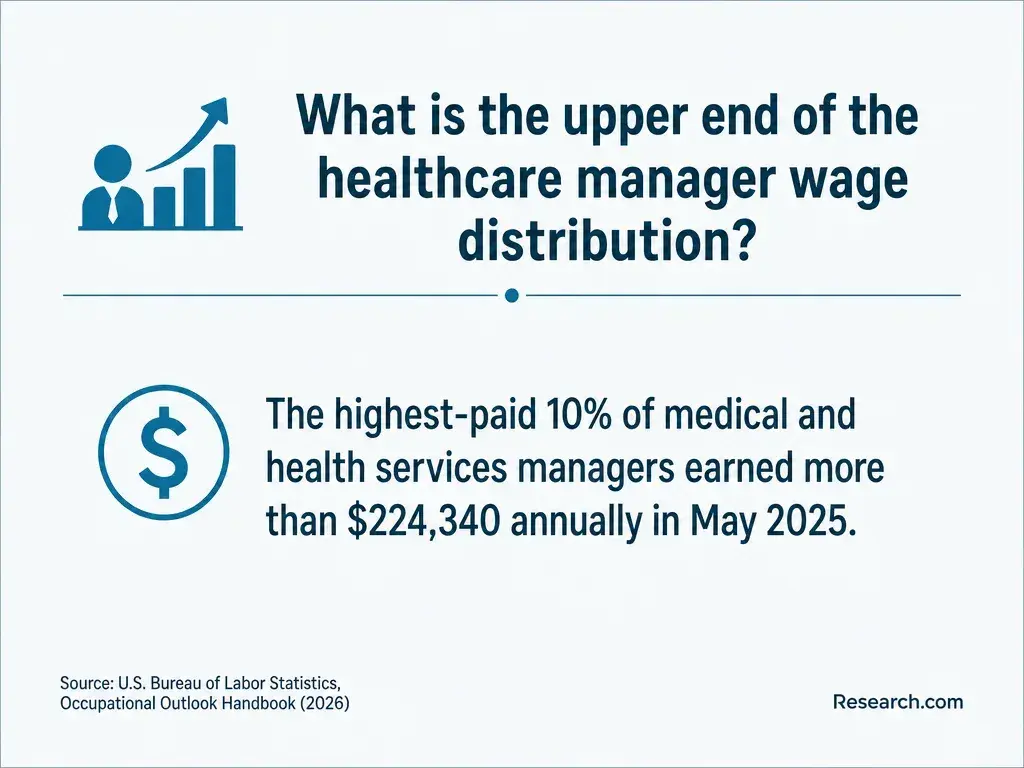
- The U.S. Bureau of Labor Statistics reports a May 2025 median wage of $126,520 for management occupations overall - not for new healthcare administration graduates or healthcare administrators specifically.
What Is a Healthcare Administration Major?
A healthcare administration major prepares students to help run healthcare organizations rather than provide clinical care. Its focus may include budgets, staffing, quality improvement, policy, and the coordination of services across hospitals, clinics, and other care settings. Schools may call a similar major healthcare management or health services administration; compare required courses and applied experiences rather than relying on the name.
The distinction matters when choosing a degree. Healthcare administrators use information to make operational decisions, while health information management programs typically focus more directly on health records, data governance, coding, and information systems. If records and data are what caught your attention while volunteering, compare how healthcare administration differs from an HIM degree before declaring a major.
How Can Hospital Volunteer Experience Lead to Healthcare Administration?
Volunteer work is most useful when it helps you identify an operational question worth exploring. A person helping visitors navigate a hospital might notice how signage and check-in procedures affect access. Someone supporting a community program might see the coordination required to schedule staff, space, and supplies. Those observations can guide your course choices, informational interviews, and applications, even if the volunteer role itself carries no management authority.
Ask a volunteer coordinator whether you can learn about a permitted, nonclinical improvement project. Record what you did, the process you observed, and questions you would investigate; do not collect patient information or claim responsibility for outcomes you could not measure.
Then seek a supervised internship, campus project, or entry-level administrative role that lets you build on that interest. If you already have college credit and want a shorter path to graduation, evaluate planning an accelerated online health administration degree against the time needed for meaningful field experience.
What Degree Do You Need for Healthcare Administration Careers?
The right degree depends on the job you want next, not the most senior title in the field. This comparison separates an entry point from credentials that may become useful after you have healthcare experience.
| Education path | Potential fit | Important limitation |
| Associate degree or certificate | Exploring administrative support work or preparing to transfer | May not meet bachelor's-degree preferences for advancement |
| Bachelor's in healthcare administration or a related field | Seeking entry-level operations, coordination, or analyst roles | Does not itself qualify a graduate to manage a department |
| Master of health administration (MHA) | Building specialized healthcare leadership knowledge, often alongside experience | Cost and placement opportunities vary by program |
| MBA with relevant healthcare coursework | Developing broader business skills for healthcare management | Healthcare depth varies; an elective is not necessarily a formal concentration |
A bachelor's degree does not have to carry the healthcare administration label: employers may consider related business, public health, or health information backgrounds, depending on the role. If you start at a community college, review planning a healthcare administration bachelor's transfer before choosing electives. Confirm how credits will apply to the major, not just whether the university accepts them.
Neither format is inherently better. An online program may make sense if you need to keep working or live far from a campus, while campus study may make it easier to attend in-person events or pursue local placements. Either way, ask how students obtain internships, meet employers, work with classmates, and get help when a required course is unavailable.
Online does not always mean self-paced: courses may require live meetings, group work, or scheduled field placements. Compare those obligations with your work and volunteer schedule. When reviewing online healthcare administration bachelor's degrees at accredited universities, check institutional accreditation, the exact program requirements, transfer policies, and whether experiential opportunities are accessible where you live.
Bachelor's coursework commonly introduces healthcare systems, accounting or finance, organizational behavior, policy, ethics, and quality improvement. Assignments may ask students to interpret a budget, map a service process, or recommend a change while considering patient access and organizational constraints. Look for opportunities to practice with realistic problems, not just read about leadership.
Graduate study generally builds on that foundation. An MHA emphasizes healthcare organizations and their operating environment; an MBA teaches a broader management core and may offer healthcare electives or a formal concentration. The distinction is important if volunteering has led you toward a specific hospital operations goal. Compare online MHA programs and degree requirements with an MBA's actual healthcare coursework before paying for either degree.
Bachelor's applicants generally need to satisfy a university's undergraduate admission or transfer rules; individual majors may set additional prerequisites. Graduate programs typically review prior academic work and may request a résumé, statement, recommendations, or evidence of professional experience. Test policies and prerequisite courses vary.
A nonbusiness bachelor's degree does not automatically rule out an MHA or MBA, but applicants may benefit from preparation in accounting, statistics, or management.
Use your volunteer experience to explain a specific interest in healthcare operations, not as a substitute for required qualifications. Before applying, confirm prerequisites, field-placement expectations, and accreditation claims directly with the school. For a graduate MHA, online CAHME-accredited MHA programs offer one way to investigate specialized program accreditation; verify the current status and coverage of the particular program you are considering.
A bachelor's degree commonly takes about four years of full-time study from the start of college, but accepted transfer credits, course availability, and enrollment pace can change that timeline. Graduate timelines depend on the program and whether you study full time or part time. An accelerated calendar is useful only if you can complete required courses and practical experience without undermining either.
Published tuition is not the complete price. Request a written estimate covering required credits, mandatory fees, books and software, travel or placement expenses, and any tuition changes that could apply before graduation. Then subtract confirmed grants or employer assistance and consider the income you may give up to study.
An affordable healthcare administration master's program comparison can help you build a shortlist, but confirm current charges and the full required curriculum with each school.
Early roles may include patient access coordinator, administrative assistant, operations coordinator, or support roles in quality improvement. Duties vary widely by employer: a coordinator may track schedules and resolve process problems, while an analyst may need stronger spreadsheet and data skills. Hospital volunteering can make your interest credible, but paid experience, internships, and demonstrated skills often matter when competing for these jobs.
With relevant experience, professionals may pursue practice management, department operations, or broader health services management. Those positions can involve staffing, budgets, compliance, and accountability for service performance.
If your goal is to move into management quickly, compare internal training and supervised work experience with healthcare management business degrees on a faster timetable. A faster MBA is valuable only if its curriculum and cost fit a realistic next role; it does not replace healthcare or supervisory experience.
Pay depends heavily on the position, employer, location, and level of responsibility. The U.S. Bureau of Labor Statistics reports that the median annual wage across all management occupations was $126,520 in May 2025, compared with $50,980 across all occupations. That broad management figure is useful context, not an estimate of what a new healthcare administration graduate - or a particular hospital manager - will earn.
For a more useful personal estimate, compare current local job postings for positions you could qualify for now with postings for roles you could plausibly reach after gaining experience. Check their required skills and published pay where available. If you are considering choosing a faster healthcare management master's program, weigh its total cost against that realistic progression rather than assuming a management-level wage will follow graduation.
Do Healthcare Administrators Need Licenses or Certifications?
There is no single license required for every healthcare administrator. Requirements depend on the job and setting. For example, nursing home administrators generally face state licensure requirements, while many hospital operations and clinic administrative positions do not require an administrator-specific license. Check the applicable state board and job description before treating any credential as mandatory.
Voluntary professional certifications may help demonstrate experience or specialized knowledge, but eligibility rules differ and they do not replace a required state license. A doctorate is not a general entry requirement for healthcare administration, either. If you are considering one for an academic, research, or senior leadership goal, use healthcare administration doctorate timeline planning to assess that separate commitment rather than adding it automatically to your career path.
Other Things You Should Know About Healthcare Administration
Possibly. Hospitals set their own minimum ages, schedules, screening procedures, and permitted duties. Ask the volunteer office about openings before making plans around a particular placement.
Not automatically. If you hope to use a placement for internship credit, get your academic department's approval and supervision requirements before starting the hours you want counted.
Some organizations offer remote support tasks, but availability and duties vary. Confirm how volunteers are trained and what information they may access; remote work does not remove privacy obligations.
That is a useful discovery. Compare the education and licensure requirements for the clinical role that interests you rather than choosing an administration major solely because your experience took place in a hospital.
- Patient Rights and Ethics - StatPearls - NCBI Bookshelf https://www.ncbi.nlm.nih.gov/books/NBK538279/
- Quality Improvement Activities FAQs | hhs.gov https://www.hhs.gov/ohrp/regulations-and-policy/guidance/faq/quality-improvement-activities/index.html
- Volunteer Management | ASPR TRACIE - HHS.gov https://asprtracie.hhs.gov/technical-resources/74/volunteer-management/0
- Challenges and opportunities in healthcare volunteer management: insights from volunteer administrators - PubMed https://pubmed.ncbi.nlm.nih.gov/23822549/
- Guidelines for Volunteers | nih.gov https://www.cc.nih.gov/volunteers/guidelines
- Internships: Key Benefits for Students & Employers | The College of St. Scholastica https://www.css.edu/about/blog/the-importance-of-internships-how-students-employers-both-reap-the-benefits/
- Admissions | ucsf.edu https://healthleadership.ucsf.edu/admissions
- Health Management Degree vs. Healthcare Administration | Lindenwood University https://www.lindenwood.edu/blog/healthcare-management-vs-healthcare-administration/
- Healthcare Administrator Career Guide & Degree Paths | News & Updates from the Antioch University Community https://commonthread.antioch.edu/healthcare-administrator-career-guide-degree-paths/
- Admissions | SHP - Health Services Administration | The University of Alabama at Birmingham https://www.uab.edu/shp/hsa/graduate/residential-msha/admissions