2027 Panel Data in Health Administration Doctoral Study

Co-Founder and Chief Data Scientist
Panel data can help health administrators study what changes after a hospital adopts a new staffing policy, payment model, or quality initiative. But a doctoral program is worthwhile only if its research training, data access, and degree format fit the question you want to answer. This guide is for healthcare professionals considering a DHA or PhD, particularly those planning to use repeated observations of organizations or populations. It explains the methods you will need, how to evaluate programs, and when a doctorate offers more value than a shorter management qualification.
Key Things You Should Know
- Panel data follows the same hospitals, clinics, regions, or other units over time; it can reveal patterns that a single-year comparison misses, but it does not establish causation by itself.
- A DHA generally emphasizes applying research to leadership problems, while a PhD generally emphasizes producing research for scholarly audiences. For either degree, verify access to longitudinal data and qualified methods supervision.
- Budget for the entire research period, not just coursework. The U.S. Bureau of Labor Statistics reports a $126,520 median annual wage for management occupations in May 2025, but that figure is not a salary estimate for health administration doctorate graduates.
What Is a Doctoral Degree in Health Administration?
A doctoral degree in health administration is advanced study of how healthcare organizations are led, financed, evaluated, and improved. Depending on the school, the credential may be a Doctor of Health Administration (DHA), a PhD in health administration or a closely related field, or another doctorate with a healthcare leadership focus. Program titles alone do not establish the depth of research training.
Panel data is a research structure, not a degree or concentration: it contains repeated observations of the same units across multiple time periods. A doctoral researcher might track hospitals' staffing levels and quality measures annually, or follow clinics before and after an operational change. Patients can also be the units if records permit appropriate longitudinal tracking. The advantage is the ability to examine change within a unit rather than comparing only different units at one point in time.
These doctorates usually suit experienced administrators, clinicians moving into systems leadership, or researchers with a defined healthcare question. They are not required for most administrative jobs. Someone still establishing an undergraduate foundation should first compare online healthcare administration bachelor's degrees at accredited universities; a doctorate is a later, substantially different commitment.
How Does a DHA Compare With a PhD in Health Administration?
Both degrees can support rigorous panel-data work, but they usually differ in the problems students are expected to address and the audiences for their final research. These are tendencies, not universal rules; examine each program's dissertation or applied-project requirements.
The comparison below shows which features matter most if longitudinal analysis is central to your goals.
| Consideration | DHA | PhD in health administration or a related field |
| Typical emphasis | Applying evidence to organizational leadership and practice | Developing and testing research questions for scholarly contribution |
| Panel-data fit | Evaluating an operational or policy change, if the program supports appropriate methods | Investigating longitudinal relationships, methods, or causal claims in greater research depth |
| Final research | May be an applied dissertation or doctoral project | Usually a research dissertation |
| Critical question to ask | Can the project use multiyear organizational data and receive statistical supervision? | Are faculty available to supervise the proposed question and data design? |
If your goal is to manage services rather than conduct doctoral research, a comparison of online MHA degree programs may identify a more direct route. An MBA can also develop broad management skills, but neither an MHA nor an MBA should be assumed to provide doctoral-level training in longitudinal research.
What Are the Admission Requirements for Health Administration Doctoral Programs?
Requirements vary by institution. Programs may request a relevant bachelor's or master's degree, professional experience, transcripts, recommendations, a résumé, and a statement of purpose. Some assess proposed research interests or quantitative preparation; testing and prerequisite policies must be checked school by school. A clinical license is not a universal admission requirement.
For a prospective panel-data researcher, the strongest application explains a feasible question, identifies the unit and time period of observation, and acknowledges how data access would be secured. Experience in statistics, evaluation, finance, health informatics, or quality improvement can help, but it does not replace a program's official requirements. Ask whether applicants need an approved dataset at entry or may develop one during coursework.
If you are deciding whether to earn a master's degree before applying, investigate the academic and professional fit of CAHME-accredited education for aspiring healthcare administrators. CAHME accreditation of a master's program does not, by itself, certify a separate doctoral program or guarantee admission to one.
Coursework may cover healthcare finance, policy, organizational leadership, quality improvement, ethics, research design, and quantitative or qualitative methods. For panel-data research, check the actual syllabus: a general research-methods course may not teach longitudinal modeling in enough depth for a dissertation.
Researchers must choose a unit of analysis and explain what each observation represents. A hospital-by-year panel, for example, cannot automatically answer a patient-level question. Fixed-effects models can account for stable differences between hospitals, while other designs may address changes over time; neither removes every source of bias. Policy evaluations may also require defensible comparison groups and checks on whether outcomes were already trending differently before an intervention.
Data management matters as much as modeling. Changes in reporting definitions, hospital mergers, missing years, and patient-mix differences can produce misleading results. Access to identifiable records may require privacy safeguards, agreements, and institutional review; whether a quality-improvement project requires review depends on its design and applicable rules. Students interested primarily in coding, records governance, and clinical information systems should also examine HIM degree pathways compared with healthcare administration, since those are related but distinct areas of preparation.
Online delivery can support rigorous doctoral work, but effectiveness depends on supervision, research infrastructure, and the student's access to suitable data - not the delivery label. A strong online option gives students reliable contact with methods faculty, opportunities for research feedback, library and statistical-software support, and clear procedures for dissertation or project approval.
Ask admissions staff which sessions are live, whether campus residencies are required, how often students meet supervisors, and who can help troubleshoot a longitudinal dataset. An employed administrator should also determine whether their workplace will permit research use of organizational data; an employer's permission to view records for work is not necessarily permission to use them for a doctorate.
Online formats serve different educational stages. Healthcare administration bachelor's pathways with flexible entry dates may help someone begin the field, but rolling undergraduate starts should not be taken as evidence that a doctoral program offers flexible research milestones or supervision.
Completion time varies with required coursework, enrollment pace, research design, data approval, and the dissertation or applied-project process. A published minimum represents a possible path under stated conditions, not a dependable completion date for every student. Longitudinal projects can take longer if data agreements stall or if records require extensive cleaning.
Compare a program's required credits with its research milestones and maximum time-to-degree policy. Ask when students select an advisor, obtain proposal approval, secure data access, and begin analysis. An existing, usable panel may shorten preparation, but it cannot eliminate required academic reviews. Accelerated online healthcare leadership doctorate programs warrant particular scrutiny: confirm that the faster schedule still provides adequate methods training and time for your specific project.
There is no reliable single price for a health administration doctorate. Published tuition may be charged per credit, term, or program; total expense also depends on mandatory fees, research-stage enrollment, software, data access, required travel, and financing. A shorter advertised schedule is not necessarily cheaper if tuition is charged differently or additional research terms are needed.
Request a written estimate based on your expected enrollment pace. Multiply required credits by the applicable per-credit rate only when that is how tuition is assessed, then add mandatory charges and an allowance for possible extra research terms. Ask whether funding or employer assistance applies during the dissertation stage and whether continuing enrollment is required.
Cost should be weighed against the work you intend to do. If your goal is healthcare management rather than original research, cost-conscious MBA pathways for healthcare professionals may be worth comparing alongside an MHA or targeted courses. A lower-priced credential is valuable only if it supplies the skills your target role needs.
A doctorate can complement substantial experience in hospital or health-system leadership, quality and safety, policy analysis, consulting, or teaching and research. The plausible next role depends on what you have already managed or studied. A clinician with service-line responsibility might use a DHA project to evaluate operational changes; an experienced analyst seeking a research faculty role may need the publication training and scholarly fit of a PhD.
Neither degree automatically qualifies someone to run a hospital or obtain a faculty appointment. Employers may prioritize budget responsibility, clinical or regulatory knowledge, publications, teaching experience, or a record of implementing change. For a broader view of positions and the experience they entail, review healthcare administration employment paths and advancement.
Before enrolling, compare job descriptions for your target role with your current qualifications. If the main gap is executive experience, supervised operational responsibility may be more useful than another degree. If the gap is the ability to design and defend research, examine doctoral methods courses, faculty expertise, and alumni research rather than relying on the program title.
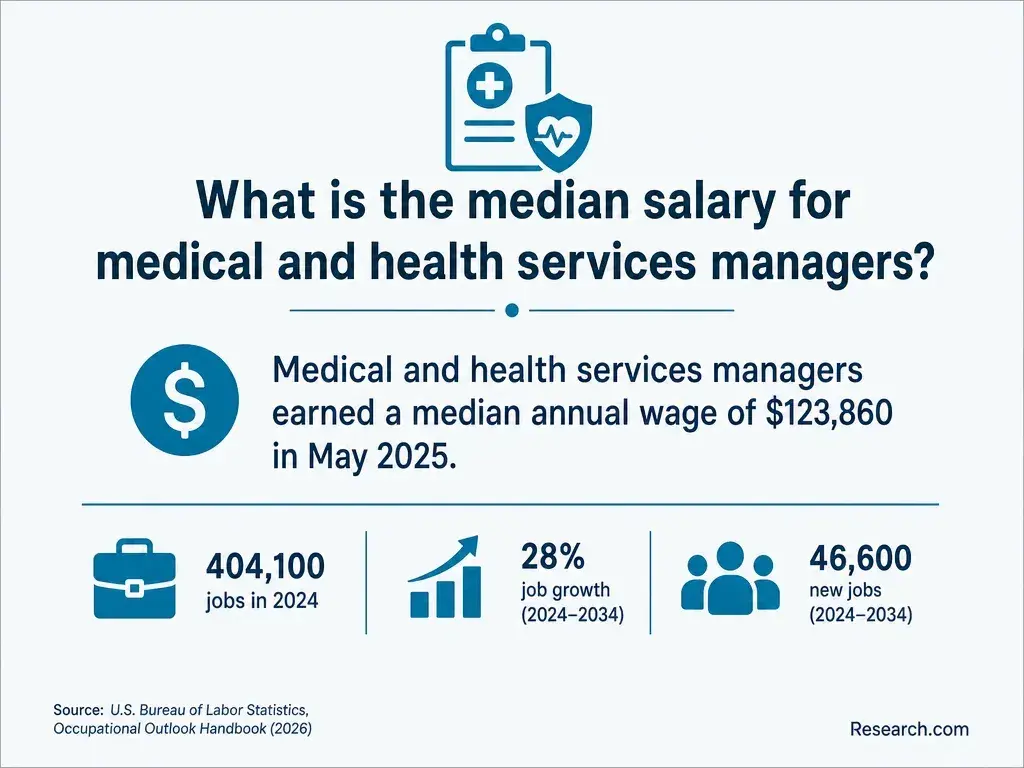
No single salary figure accurately represents health administration doctoral graduates. Compensation depends on occupation, employer, location, responsibility, and prior experience; published occupational wages do not isolate the effect of a doctorate. The U.S. Bureau of Labor Statistics reports a $126,520 median annual wage for management occupations in May 2025. That broad U.S. figure is useful context for management careers, but it includes many industries and education levels and should not be used as a doctoral pay projection.
For a personal financial decision, compare compensation for roles you could realistically pursue with and without the doctorate, then consider tuition, time, and any earnings you would forgo. Avoid attributing the full pay of a senior administrator to the degree when years of leadership experience may have been essential to obtaining the job.
Career stage changes the comparison. Someone considering undergraduate healthcare administration programs with compressed terms is evaluating an entry-stage qualification, not the salary return of doctoral research training; keep those decisions and their likely job markets separate.
Does a Health Administration Doctorate Require Licensure or Certification?
The doctorate itself does not create a general license to practice healthcare administration. Requirements attach to particular occupations and jurisdictions: a clinician must maintain the license required for clinical work, and certain facility-administrator roles may have state-specific licensing rules. Professional certifications may be valued by an employer, but they are not interchangeable with a doctorate or a state license.
Check the licensing board and employer requirements for the exact position and state you have in mind before selecting a program. Academic progression is a separate question: transferring associate degree credits into healthcare administration can help someone build toward a bachelor's degree, but transferring credits does not confer occupational licensure or establish eligibility for doctoral study.
Other Things You Should Know About Healthcare Administration
No. If each survey samples different people and cannot track the same units over time, it is generally repeated cross-sectional data. A hospital-level panel may still be possible if the same hospitals can be identified in each year.
Possibly. First check whether the data identifies consistent units across years, contains the measures you need, and permits your intended use. Public availability does not guarantee a workable panel or eliminate institutional research requirements.
Look for expertise in your healthcare question and access to appropriate quantitative-methods support. Ask how the advisor has supervised projects involving longitudinal data, missing observations, or policy evaluation.
You must decide whether observations before and after the change represent the same unit and document that decision. Ownership changes may also affect reporting, staffing, and outcomes, so treating them as routine observations without checking can distort an analysis.
- The prevention and handling of the missing data - PMC - NIH https://pmc.ncbi.nlm.nih.gov/articles/PMC3668100/
- What Is Ethics in Research & Why Is It Important? | National Institute of Environmental Health Sciences https://www.niehs.nih.gov/research/resources/bioethics/whatis
- Data Sources for Health Care Quality Measures | Agency for Healthcare Research and Quality https://www.ahrq.gov/talkingquality/measures/understand/index.html
- Difference-in-Difference Estimation | Columbia University Mailman School of Public Health https://www.publichealth.columbia.edu/research/population-health-methods/difference-difference-estimation
- Online Doctor of Healthcare Administration (DHA) | Walden University https://www.waldenu.edu/online-doctoral-programs/doctor-of-healthcare-administration
- Causal models for longitudinal and panel data: a survey | oup.com https://academic.oup.com/ectj/article/27/3/C1/7701402
- Doctor of Health Administration (DHA) | National University https://www.nu.edu/degrees/healthcare-leadership/programs/doctor-of-health-administration-dha/
- Doctor of Health Administration - Online | MUSC College of Health Professions https://chp.musc.edu/programs/doctor-health-administration-online
- Using fixed and random effects models for panel data in Python | Pew Research Center https://www.pewresearch.org/decoded/2019/12/03/using-fixed-and-random-effects-models-for-panel-data-in-python/
- Difference-in-Difference and Panel Methods | urban.org https://www.urban.org/research/data-methods/data-analysis/quantitative-data-analysis/impact-analysis/quasi-experimental-methods/difference-difference-and-panel-methods