2027 Healthcare Administration BS for Parents: Budgeting for Childcare During Internships

Co-Founder and Chief Data Scientist
An online healthcare administration bachelor's program may fit around family life - until an internship requires fixed hours away from home. For parents, that placement can change childcare needs, work income, and the true cost of finishing a degree.
This guide shows you how to build an internship childcare budget, compare programs before enrolling, and check whether the degree's costs and career possibilities fit your household. The goal is to help you choose a workable path, not merely an online program that sounds flexible.
Key Things You Should Know
- Budget for the internship's full time away from home, including travel, onboarding, and backup care - not just scheduled placement hours.
- Before enrolling, confirm whether an internship is required, who finds the placement, whether paid work can satisfy it, and whether your childcare arrangement covers the site's hours.
- A healthcare administration bachelor's degree can support entry into administrative roles, but management salaries are not a reliable estimate of a new graduate's earnings.
What Is a Healthcare Administration Bachelor's Degree for Parents?
A healthcare administration bachelor's degree prepares students for the business and organizational side of healthcare: coordinating services, working with budgets and information systems, understanding regulations, and improving operations. It does not qualify graduates to provide clinical care or guarantee a management position. Programs may use names such as healthcare administration or healthcare management; compare their actual courses and experiential requirements rather than relying on the title.
For a parent, the defining program feature may be a required internship, practicum, or capstone. An internship typically involves work at an approved organization under supervision, while a capstone may be a project that does not require the same on-site schedule. Ask each school which requirement applies, whether it can be completed locally or at your current employer, and what happens if a placement falls through.
Students who already have college credit should also ask for a written transfer evaluation before committing. An associate degree transfer into healthcare management study may reduce remaining coursework, but transferred credits do not necessarily replace an internship or other upper-level requirements.
How Can Parents Budget for Childcare During Healthcare Internships?
Start with a placement schedule, not a tuition estimate. Childcare must cover the time from when you leave home until you return, and an unpaid placement may also reduce hours at your regular job. Because sites and schools set different requirements, obtain the expected hours and placement dates in writing before making a childcare commitment.
Use this sequence to turn the requirement into a household plan:
- Map every placement shift, commute, orientation session, and required meeting against the care you already have.
- Price the additional care needed during those hours, including any minimum booking period, deposit, and backup-care arrangement.
- Calculate income you may lose if placement hours replace paid work, and identify bills that will still come due during the placement.
- Ask the financial aid office whether documented dependent-care expenses can be included in your cost of attendance and whether any aid remains available; ask about campus childcare assistance and local subsidies separately.
- Agree on a contingency plan with your program and caregiver for illness, site schedule changes, or a delayed placement.
A cost-of-attendance adjustment may change the amount of aid you can receive, but it is not a childcare grant or a promise of additional funding. If you need to align an internship with a school-year care arrangement, flexible start dates for healthcare administration bachelor's study may help. Confirm when internship courses are actually offered: a rolling program start does not guarantee a flexible placement start.
How Much Does a Healthcare Administration Bachelor's Degree Cost?
The relevant figure is your remaining total cost, not the advertised tuition rate. It depends on accepted transfer credits, required credits, fees, course load, and whether an internship affects your earnings. Request a school-specific estimate after your credits have been evaluated.
The table separates expenses that schools commonly quote from costs parents may need to calculate themselves.
| Cost component | What to verify |
| Tuition and mandatory fees | Rate per credit or term, remaining required credits, online fees, and any additional internship-course charge |
| Learning and placement expenses | Books, software, transportation, site-related requirements, and required campus visits, if any |
| Household impact | Additional childcare, reduced work income, and costs caused by extending enrollment |
| Funding | Grants, scholarships, employer assistance, payment-plan terms, and loans for which you qualify |
Compare the resulting estimate with less expensive healthcare administration degree options, but check accreditation, transfer policies, placement support, and scheduling before choosing the lowest quoted tuition. Borrowing may spread payments out; it does not reduce the amount borrowed or the interest that may accrue.
Separate childcare you already pay for from additional care caused by school. That distinction helps you see what the degree changes and gives a financial aid office a clearer account of your needs.
Include regular care during class or study time, extra coverage for internship shifts and travel, registration or deposit charges, school-break care, and backup care when a child is sick or a provider closes - where those costs apply to your family. Check whether a provider charges for reserved hours even if a placement ends early. If another adult usually provides care, plan for the hours when that person is working or unavailable rather than treating informal help as unlimited.
Keep receipts and written schedules. A school can explain its dependent-care allowance and documentation rules, while a state or local childcare agency can explain subsidy eligibility; neither source should be treated as a guaranteed payment. Keep any possible graduate degree in a separate future budget. If that is part of your long-term plan, you can compare affordable health administration graduate schools later without understating the childcare cost of the bachelor's degree you are considering now.
Online coursework can eliminate a campus commute, but it does not eliminate the need for uninterrupted study time or childcare during an on-site internship. The better format is the one whose required schedule works for your household, not simply the one labeled online.
These format differences matter most when comparing otherwise similar programs.
| Program feature | Potential benefit | Constraint to check |
| Asynchronous classes | More choice over when to view lessons and complete work | Fixed deadlines, group work, and exams may still require coordination |
| Live online classes | Scheduled interaction with instructors and classmates | Evening or weekend sessions may overlap with family routines |
| Local internship | May avoid relocating for a placement | Site hours and commuting can still require substantial care |
| Project-based alternative | May offer more scheduling control if the school permits it | It may not replace a required supervised placement |
Ask for a sample course calendar, internship handbook, placement-area rules, and leave or deferral policy. Also verify institutional accreditation; do not assume an online bachelor's program has specialized accreditation because an institution offers a graduate healthcare degree. For example, resources that review CAHME-accredited MHA degree programs concern graduate programs, not a blanket accreditation designation for a school's bachelor's program.
Coursework commonly combines general education with accounting or finance, healthcare systems, health law and ethics, information management, quality improvement, and organizational leadership. Exact requirements differ. Review the catalog to see whether the program teaches you to use data and budgets in healthcare settings and whether it culminates in a supervised placement, a project, or both.
A bachelor's program is generally a route into foundational healthcare operations work. An MBA has a broader graduate-level business core, while an MHA focuses more directly on healthcare administration; neither should be mistaken for clinical training. If you already hold a bachelor's degree and have healthcare experience, cost-conscious MBA pathways for healthcare professionals may be worth comparing instead of pursuing a second bachelor's degree. Check the curriculum against the job you want before paying for another credential.
Bachelor's admission requirements vary by school and by whether you apply as a first-time student or a transfer student. Schools commonly request an application and prior academic transcripts; some set separate standards for entry into the major. An internship site may later impose its own onboarding requirements, which are distinct from admission to the university.
Before applying, ask admissions for the current entry criteria and ask the department for a transfer-credit review and internship handbook. If you have previously worked in healthcare, also ask whether prior learning can earn credit and, separately, whether employment can satisfy experiential requirements. Do not assume that credit for experience waives a placement.
Graduate programs use different admissions criteria. Parents considering an eventual master's degree can explore online MHA pathways for future healthcare managers, but should not apply a graduate program's work-experience or prerequisite expectations to bachelor's admission.
A traditional full-time bachelor's path is commonly planned over four academic years. Your actual timeline depends on accepted credits, enrollment pace, course availability, and when an internship can be completed. For a parent, a slightly slower course load may be more workable than an accelerated plan that requires buying substantially more childcare or reducing paid work.
Ask for a term-by-term plan showing prerequisites and the first available internship term. Then compare that plan with your child's care calendar and your employer's scheduling rules. If the school permits a pause, verify whether it affects course sequencing, financial aid, or placement eligibility.
Do not use graduate-program timelines as a shortcut for estimating bachelor's completion. Resources about online healthcare management MBA program duration describe a different degree that generally begins after a bachelor's; they cannot tell you how long your remaining undergraduate requirements will take.
Graduates may pursue roles such as patient services coordinator, medical office administrator, scheduling or operations coordinator, and administrative analyst, depending on their experience and local employers. Work may involve coordinating staff and services, maintaining records, monitoring workflows, or supporting budgets. Titles are inconsistent: a "manager" vacancy may require substantial prior healthcare experience even when it lists a bachelor's degree.
If you already work in a clinic, hospital, insurer, or community health organization, look first for responsibilities you can build on. An internship or employer-approved project can provide examples of process improvement or team coordination for interviews, but the degree alone will not make you eligible for senior leadership. If your eventual goal is organizational leadership, compare the experience required for target jobs before considering an MHA, MBA, or advanced healthcare management degree pathways online. Additional education is most useful when it addresses a specific career gap.
What Salary and Job Outlook Can Healthcare Administrators Expect?
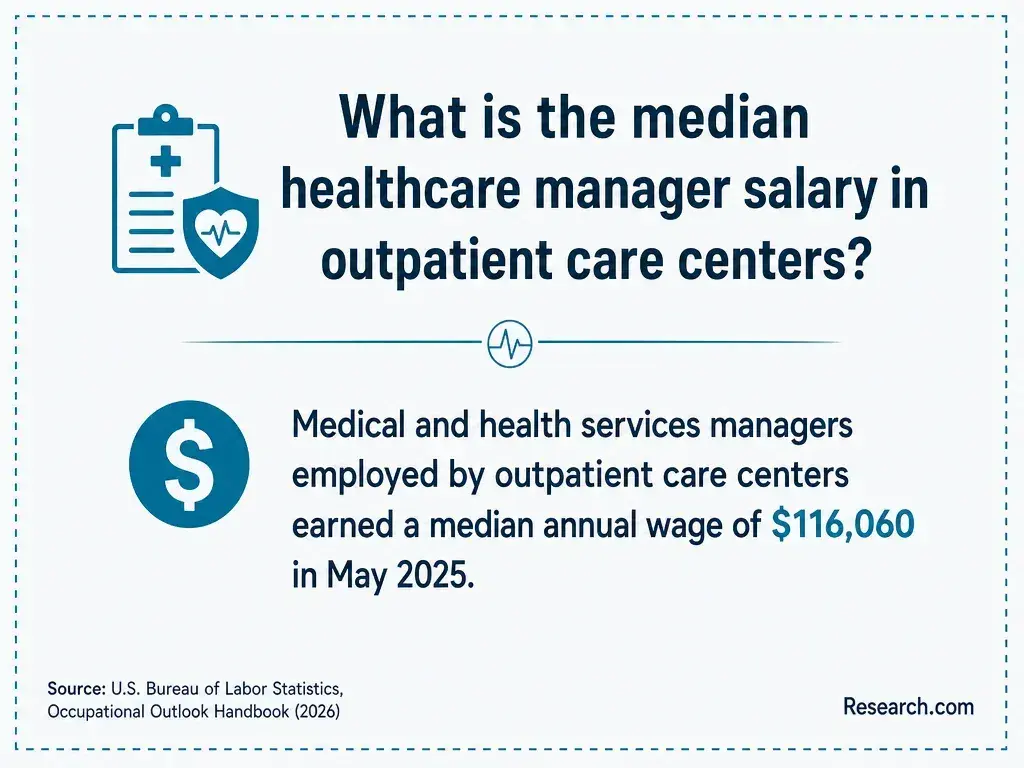
Healthcare administration spans entry-level support work through experienced management, so one salary figure cannot represent all graduates. The U.S. Bureau of Labor Statistics reports a $126,520 median annual wage for management occupations in May 2025. That is a broad occupational figure - not the starting salary for healthcare administration bachelor's graduates - and many management jobs require experience beyond the degree.
BLS projects management occupations overall to grow faster than the average for all occupations from 2025 to 2035. That projection does not establish demand for a particular healthcare administration job in your area. For a practical earnings estimate, compare local postings that match your current experience, note their stated pay and requirements, and weigh any likely increase against tuition, childcare, forgone wages, and borrowing costs.
The same caution applies to later credentials: a higher-level degree does not by itself establish a salary return. Even when exploring affordable online doctorates in healthcare administration, evaluate the actual role and experience needed rather than assuming the credential will raise your pay.
Other Things You Should Know About Healthcare Administration
Possibly, if your program approves the site, duties, and supervisor in advance. Your usual job tasks may not meet its learning objectives.
Policies vary. Some schools arrange placements; others expect students to find a site for approval. Ask who is responsible before you enroll, especially if your travel area is limited.
Contact the site and your program promptly. Ask in advance how missed hours are made up and whether placement deadlines can be extended; policies differ.
Yes. Depending on the site and role, onboarding may include a background check or health documentation. Obtain the site's requirements early so they do not delay your start.
- Child Care Access Means Parents in School Program (84.335A) | U.S. Department of Education http://www.ed.gov/grants-and-programs/grants-special-populations/grants-economically-disadvantaged-students/child-care-access-means-parents-school-program-84335a
- Oregon Student Child Care Grant | Oregon Student Aid https://oregonstudentaid.gov/grants/oregon-student-child-care-grant/
- Child Care & Early Learning Program | texas.gov https://www.twc.texas.gov/programs/child-care
- National Database of Childcare Prices | dol.gov https://www.dol.gov/agencies/wb/topics/featured-childcare
- Types of Financial Aid: Grants, Work-Study, and Loans | studentaid.gov https://studentaid.gov/understand-aid/types
- Child Care for College Students | Austin Community College District https://students.austincc.edu/essential-resources/child-care-for-college-students/
- Bachelor of Science in Health Care Administration | California State University Long Beach https://www.csulb.edu/college-of-health-human-services/health-care-management/bachelor-of-science-health-care
- Internship Requirements - Health Care Management Program https://hcm.appstate.edu/academic-programs/bachelor-science-health-care-management/internship-requirements
- Internship guidelines for employers - Career Services https://www.uwb.edu/career-services/employers/employer-resources/internship-guidelines-for-employers
- Internships - Compensation - UW Career & Internship Center https://careers.uw.edu/resources/internships-compensation/