
2027 Choosing Healthcare Administration BS Coursework for Work in Public Hospital Systems

Co-Founder and Chief Data Scientist
A healthcare administration bachelor's degree can prepare you for hospital operations, but a public hospital needs more than general business skills. Its staff must work within public budgets, procurement rules, community obligations, and layers of accountability.
This guide is for students and working adults choosing a BS program with city, county, state, or other public hospital systems in mind. It identifies the coursework and experience worth prioritizing, explains how to compare programs and costs, and sets realistic expectations for entry-level work and advancement.
Key Things You Should Know
- Prioritize healthcare finance, operations, data, policy, and an applied project or internship; public budgeting and procurement content can make a general healthcare administration BS more relevant to public hospitals.
- Check institutional accreditation and whether an online program can arrange experience near you. A bachelor's degree can support entry-level administrative work, but supervisory hiring usually also depends on experience.
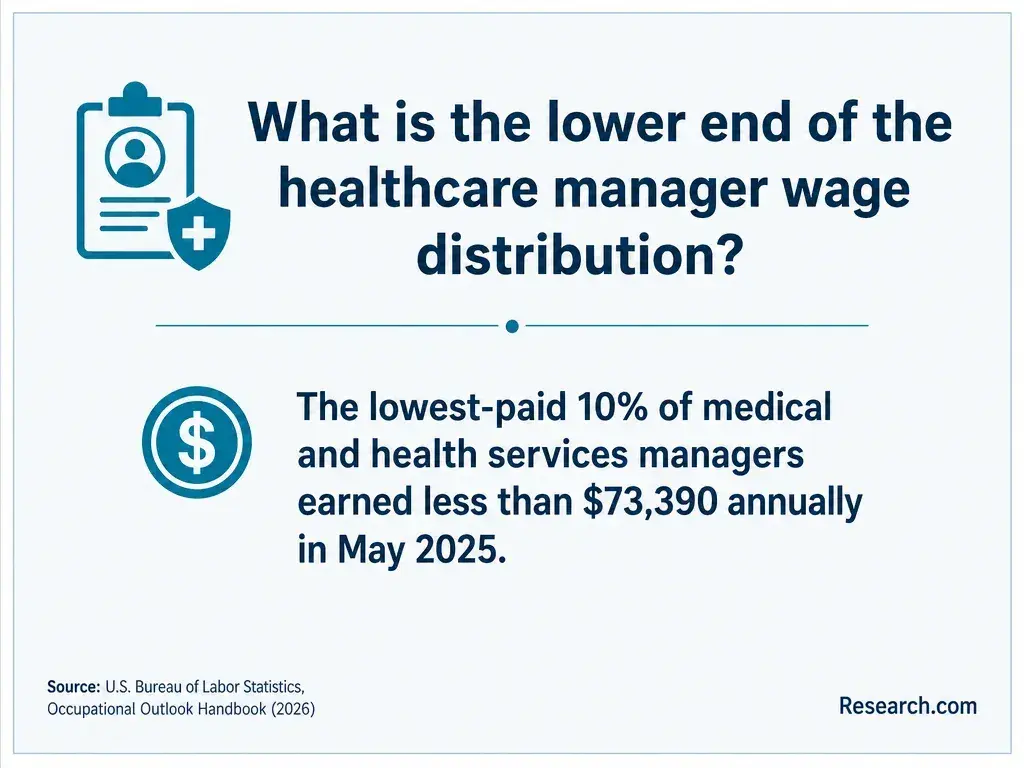
- The Bureau of Labor Statistics reports a $126,520 median annual wage for all management occupations in May 2025 - not a starting salary for healthcare administration graduates or a public hospital pay estimate.
What Is a Healthcare Administration Bachelor's Degree for Public Hospitals?
A healthcare administration BS combines business and management subjects with the organization of healthcare services. It prepares students to support decisions about staffing, budgets, patient access, quality, and daily operations. It does not train someone to practice medicine or confer authority to manage a hospital upon graduation.
Public hospitals may be operated by government entities or public hospital districts. Their administrators must account for community needs and public oversight alongside financial performance.
When comparing majors, look beyond the degree title: a program with health policy, government finance, and a public-system internship may fit this goal better than one focused chiefly on private-practice marketing. If your interest is primarily medical records, coding, or health data governance, review how healthcare administration differs from an HIM degree before choosing a major.
What Coursework Prepares Students for Public Hospital Administration?
The strongest course mix connects hospital operations to the rules and funding that shape public service. Course names vary, so compare descriptions and assignments rather than counting courses with "healthcare" in the title.
| Coursework to look for | Public hospital application | Useful evidence of learning |
| Accounting, healthcare finance, and budgeting | Explaining costs, reimbursement, and resource trade-offs | A service-line budget or financial analysis |
| Operations, quality, and patient safety | Improving scheduling, patient flow, and service reliability | A process-improvement project |
| Health policy, law, and ethics | Working within oversight, privacy, and community-service obligations | A policy analysis grounded in a hospital scenario |
| Statistics and health information systems | Interpreting performance measures without confusing correlation with results | A dashboard or evaluated data project |
| Human resources and organizational behavior | Supporting multidisciplinary teams and labor-sensitive decisions | A staffing or change-management case |
Ask whether the program teaches public procurement, Medicaid and Medicare financing, or community health assessment, and whether an internship can be completed in a public or safety-net organization. These are differentiators, not universal BS requirements. Advanced leadership or policy study can come later; review graduate options leading to an MHA only after identifying a career goal that calls for them.
How Does Accreditation Affect Healthcare Administration Degree Quality?
First, verify that the institution holds recognized institutional accreditation and that its status covers the school awarding the degree. This matters for degree recognition and potential access to federal student aid; it does not, by itself, establish that the healthcare administration curriculum fits public hospitals.
Next, evaluate program-level claims carefully. Accreditation held by a business school or a graduate healthcare administration program does not automatically apply to its undergraduate healthcare administration major. Ask the school exactly which degree is covered, then inspect course syllabi, internship arrangements, faculty backgrounds, and graduate outcomes.
This distinction remains important if you later consider choosing between healthcare management doctoral study routes: recognition and accreditation should be checked for the specific institution and program under consideration.
A new graduate is more likely to enter a coordinator, analyst-support, or administrative specialist role than to become a hospital administrator immediately. Public-system openings may sit in centralized departments as well as individual hospitals.
These pathways differ in the work experience they reward. An operations coordinator may track patient flow or scheduling; a finance or procurement assistant may support budgets and purchasing; a quality coordinator may assemble performance reports. Patient-access and community-program roles can provide exposure to service delivery. Compare the responsibilities in local postings with job pathways for healthcare administration graduates, but do not assume every listed role is entry-level.
For advancement, seek projects with measurable responsibilities and learn the hiring system used by your target employer. Government positions may have formal job classifications and experience thresholds. A BS builds useful knowledge; it does not replace the work history required for a supervisor or director position.
Delivery format matters most when it affects access to hospital experience. Online courses may allow a working student to stay employed, while campus programs may make local internships and faculty introductions easier. Neither advantage is automatic.
| Feature | Online option: verify | Campus option: verify |
| Scheduling | Whether classes are asynchronous and when live meetings occur | Whether required classes fit work and commuting hours |
| Applied experience | Who finds and approves a local placement | Which public hospitals actually host students |
| Career support | Whether remote students can use advising and employer events | Whether recruiting includes public hospital systems |
Ask for the internship handbook before enrolling, particularly if you live far from campus. Also check group-project schedules and any required visits. Even if you later compare accelerated doctorates in healthcare leadership, their online scheduling and placement arrangements will not tell you how a particular bachelor's program works.
Bachelor's admission requirements depend on the institution and whether you apply as a first-year or transfer student. Schools commonly review prior academic records; some majors also require admission after foundational coursework. Do not assume that an advertised online pathway has the same entry point or prerequisites as its campus counterpart.
Before applying, ask which prior credits satisfy general education and major requirements, whether prerequisite grades or a separate major application are required, and when internship eligibility is determined. These questions are especially important for career changers bringing substantial prior coursework.
A later master's application is a separate decision: MHA programs that consider applicants without healthcare experience may offer a route to further study, but that does not change a bachelor's program's admission rules or substitute for relevant job experience.
A traditional full-time bachelor's path is commonly planned around four academic years. Your timeline can change substantially with accepted transfer credit, part-time enrollment, course availability, and internship sequencing. Request a term-by-term plan showing which required courses are offered when - not just an advertised fastest completion time.
Compare the total cost to finish: tuition under your residency and enrollment status, mandatory fees, books and software, travel or placement expenses, and borrowing costs. Published per-credit tuition alone cannot establish the final bill. Ask each school for a degree audit and individualized cost estimate, then compare those figures with affordable bachelor's pathways in healthcare administration.
A less expensive program may still cost more overall if it accepts fewer of your credits or delays a required internship.
Most general hospital administrative jobs do not require a healthcare administrator license simply because the employer is a hospital. Requirements depend on the position and jurisdiction: certain regulated facility leadership roles, including nursing home administration, have different rules. Read the exact job posting and consult the relevant state licensing authority before treating a credential as necessary.
Optional certifications can demonstrate knowledge in areas such as project management, quality, or healthcare finance, but employers may expect experience as well. An MHA is an academic degree, not a license; even 12-month health administration graduate degree options should be evaluated for curriculum and career fit rather than mistaken for automatic professional eligibility.
There is no single dependable starting salary for graduates entering public hospital administration. Pay depends on the job classification, location, employer, and prior experience. Public employers may publish salary bands, which are more useful for an immediate job decision than a nationwide management figure.
For context, the Bureau of Labor Statistics reports that all management occupations had a median annual wage of $126,520 in May 2025. That broad group includes experienced managers across industries; it is neither a public hospital estimate nor a forecast of what a new BS graduate will earn.
Compare local postings at the level for which you qualify, including benefits and advancement rules. The same caution applies to expensive later study: financial planning for a healthcare administration doctoral degree should rest on a realistic target role, not that broad median.
What Is the Job Outlook for Healthcare Administration Careers?
The Bureau of Labor Statistics projects overall employment in management occupations to grow faster than average from 2025 to 2035. That is a broad labor-market signal, not a projection for entry-level public hospital jobs. Local government budgets, openings, and internal hiring practices will have a more direct effect on your first opportunity.
Build a pathway that does not depend on an immediate management vacancy: target an administrative or operations role, document results, and apply for higher classifications when you meet their requirements.
If cost is the main barrier to starting, investigate community college pathways into healthcare administration bachelor's programs and confirm transfer equivalencies before enrolling. The best BS choice is the one that lets you complete relevant coursework and gain credible hospital experience at a manageable cost.
Other Things You Should Know About Healthcare Administration
It may, if the employer qualifies and you meet the federal program's loan, repayment, and employment rules. Confirm the legal employer and current federal requirements; working inside a public hospital does not establish eligibility by itself.
Some government hospital systems use exams or formal eligibility lists for particular positions; others use different hiring processes. Check the employer's job classification and application instructions.
Sometimes, but the degree program may need to approve the site and establish an agreement first. Ask both parties about supervision, deadlines, and clearance requirements before relying on a placement.
No. Federal positions may have citizenship, background-screening, or other job-specific conditions. Check the individual vacancy rather than assuming a US bachelor's degree establishes eligibility.
- The role of accreditation in 21st century health professions education: report of an International Consensus Group https://pmc.ncbi.nlm.nih.gov/articles/PMC7520947/
- Summary of the HIPAA Privacy Rule | hhs.gov https://www.hhs.gov/hipaa/for-professionals/privacy/laws-regulations/index.html
- Internships and Other Placements | Public Health Department https://health.alamedacountyca.gov/work-with-us-ph/internshipsandotherplacements/
- Healthcare Administrators in Public Health: Career Guide [2026] | SUU https://online.suu.edu/degrees/business/mba/healthcare-administration/healthcare-administrators-in-public-health/
- Online Healthcare Administration Degree: What to Look for in a Program | CSP Global Concordia University, ST. Paul https://online.csp.edu/resources/article/online-healthcare-administration-degree/
- Internship Opportunities | Health Policy Management https://health-sciences.providence.edu/internships/
- Public Health Bachelor's Degree vs. Health Administration Bachelor's Degree | American Military University (AMU) https://www.amu.apus.edu/area-of-study/health-sciences/resources/public-health-bachelors-degree-vs-health-administration-bachelors-degree/
- Field Experience and Internships - Zilber College of Public Health | Academic Affairs https://uwm.edu/publichealth/students/field-experience/
- Healthcare Administrator Career Guide & Degree Paths | News & Updates from the Antioch University Community https://commonthread.antioch.edu/healthcare-administrator-career-guide-degree-paths/


