2027 Mapping RHIT Coursework to a Healthcare Administration Degree Audit

Co-Founder and Chief Data Scientist
An RHIT credential can strengthen an application to a healthcare administration program, but it does not tell you how many degree requirements are already complete.
That distinction matters if you are moving from health information work toward operations or management: a course that transfers as elective credit may not replace a required administration course.
This guide shows RHIT professionals how to read a degree audit, identify likely credit matches, and compare completion pathways before committing time or tuition.
Key Things You Should Know
- RHIT certification is not itself a block of college credit. The receiving school decides how documented coursework applies to its degree requirements.
- Transferred credits and fulfilled requirements are different. Ask for an audit that separates general education, major requirements, electives, and credits that cannot be applied.
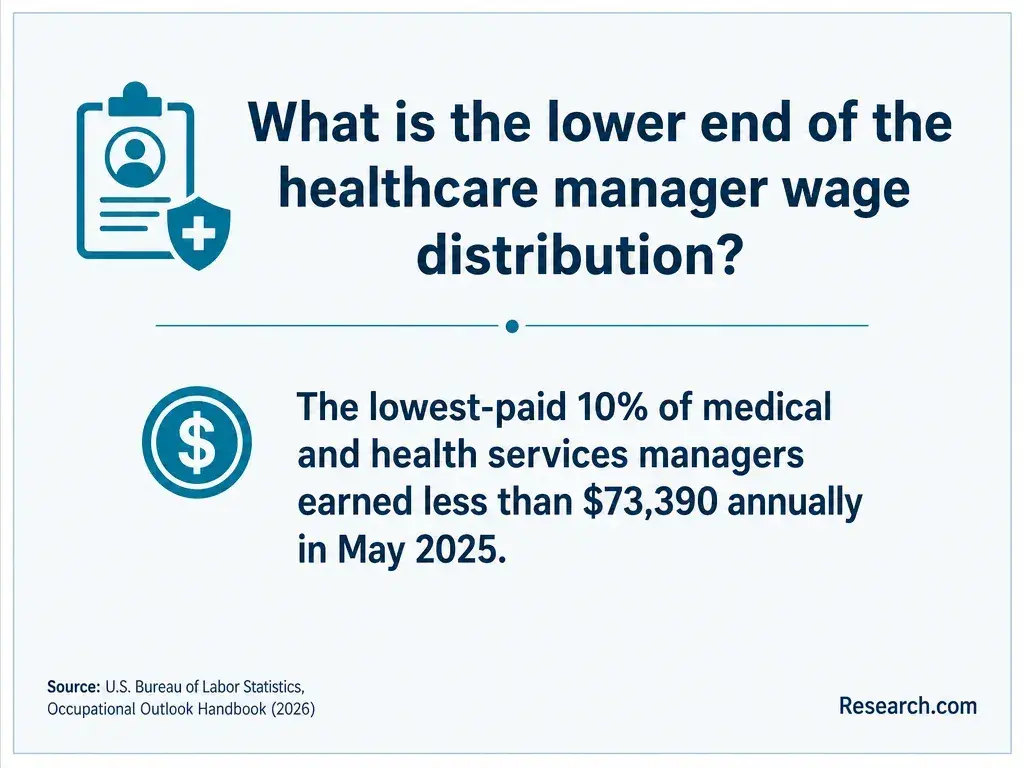
- Career pay figures need context. The U.S. Bureau of Labor Statistics reports a $126,520 median annual wage for management occupations in May 2025; that is not an RHIT-to-administration graduate salary or a likely starting wage.
What Is an RHIT-to-Healthcare Administration Degree Audit?
An RHIT-to-healthcare administration degree audit is a school's accounting of how a student's prior credits fit a specific healthcare administration degree. R
HIT means Registered Health Information Technician, a professional credential associated with health information work. The audit concerns the college courses behind that background, not an automatic credit award for holding the credential.
A useful audit distinguishes credits accepted by the institution from credits that actually satisfy general education, healthcare administration major, elective, and graduation requirements.
It should also show unmet requirements and any minimum credits that must be completed at the awarding school. A general transfer-credit total alone cannot tell you how close you are to graduation.
If you hold an associate degree, start with the receiving school's rules for moving from an associate degree to a healthcare administration bachelor's. An articulation agreement or degree-completion pathway may produce a more predictable result than an informal estimate, but the written audit for your chosen program remains decisive.
Which RHIT Courses May Transfer Into a Healthcare Administration Degree?
Course titles alone rarely settle equivalency. Schools may examine credits, level, learning outcomes, grades, and whether the course fits an open requirement. The comparison below shows where common health information coursework might land; it is not a promise of credit:
| Prior coursework | Possible place in the audit | Common limitation |
| Medical terminology and healthcare systems | Healthcare foundations or electives | May not replace an upper-division administration course |
| Health information law, privacy, or compliance | Related major requirement or elective | May not cover the management and policy outcomes of the required course |
| Statistics, accounting, or communications | General education or business foundation | Equivalency depends on course content and program rules |
| Coding, reimbursement, and health data courses | Health information electives | Technical depth does not necessarily satisfy leadership or finance requirements |
| Practicum or professional experience course | Experiential requirement or elective, if permitted | A management internship may require different duties and supervision |
That last distinction is important for RHIT professionals. Expertise in documentation, coding, and data quality is valuable to healthcare organizations, but an administration major may require broader responsibility for people, budgets, and operations.
Comparing management and information-focused healthcare degrees can help you decide whether the apparent "unmatched" courses signal an audit problem or a genuine change in academic focus.
Does an RHIT Credential Meet Healthcare Administration Degree Requirements?
Usually, no - not by itself. RHIT certification demonstrates a professional qualification; a bachelor's program awards academic credit under its own policies.
A school may consider certification in a prior-learning assessment, but it may require an examination, portfolio, or other evidence, and any award may count only as elective credit. Confirm the policy in writing before treating credential-based credit as part of your graduation plan.
The credential can still matter outside the credit calculation. RHIT work may support an application, make a healthcare information course more familiar, or help you pursue roles connecting data and operations.
If your goal is to advance chiefly within health information rather than move into broader administration, compare online CAHIIM-accredited programs for health information careers before choosing a degree with fewer courses in your specialty.
Check three different questions rather than treating "accredited" as a single transfer rule. Institutional accreditation concerns the college awarding your prior credits and the college you plan to attend. CAHIIM programmatic accreditation concerns health information education and is relevant to RHIT educational eligibility.
CAHME programmatic accreditation applies to qualifying graduate healthcare management programs; it does not determine whether an undergraduate healthcare administration program must accept an RHIT course.
Accreditation can establish important context, but it does not compel a receiving institution to accept every course or count it toward a particular major. Confirm each institution's status through its accreditor's directory and ask the receiving school whether it has additional source-school, grade, or course-age rules.
If an MHA is your eventual goal, online CAHME-accredited MHA programs are a separate comparison to make after establishing your bachelor's pathway.
RHIT coursework often covers healthcare information more deeply than organizational management. Depending on the audit, remaining requirements may include healthcare finance and budgeting, human resources, organizational behavior, operations, policy, strategic planning, and an administration-focused capstone or internship.
General education and upper-division requirements can also remain even when most associate-level courses transfer.
Pay particular attention to course sequencing. An introductory finance requirement might be a prerequisite for a later administration course, while a capstone may be available only near graduation. Ask for a term-by-term plan, not just a list of missing courses.
If your intended destination is graduate leadership study, selecting an online master's in health administration is a later decision; an RHIT credential alone does not replace the bachelor's degree normally needed for graduate admission.
Delivery format does not establish a transfer policy. An online and a campus version of the same degree may use the same institutional rules, while different universities may reach different equivalency decisions on the same transcript.
Program-specific requirements, including an internship, capstone, or minimum in-residence credits, can still change the result.
For a working RHIT, scheduling matters as much as the credit total. Verify whether required courses are offered online every term, whether live meetings or site-based experiences are mandatory, and whether transferred courses satisfy prerequisites for the next available classes.
Do not mistake a faster course calendar for a shorter remaining degree plan. The same caution applies if you later compare online healthcare management master's programs with faster schedules: published speed depends on eligibility, course load, and sequencing.
Request a formal review early enough to compare offers before enrollment. Schools set their own documentation rules, but the following materials can help an evaluator assess both the amount and the applicability of prior learning:
- Official transcripts from every college attended, including institutions that supplied transferred courses to your associate program.
- Catalog descriptions or syllabi for courses proposed as equivalents, especially health law, statistics, accounting, and practicum courses.
- Proof of RHIT certification if requesting credential-based prior-learning credit or applying to a program that asks for professional credentials.
- Documentation of an applicable articulation agreement, plus any materials the school requests for a portfolio or credit appeal.
Ask the school to identify which materials are needed for an official audit rather than a preliminary estimate. Keep copies of transcripts and syllabi for future applications, too; admission and prerequisite reviews for lower-tuition master's pathways in health administration are separate from the bachelor's transfer review.
There is no reliable completion time or total price based on RHIT status alone. The controlling inputs are credits that fulfill requirements, remaining course sequence, enrollment pace, tuition charged for the remaining courses, mandatory fees, and any travel or placement costs.
An associate degree may transfer substantial credit yet leave a student facing several terms of upper-division major courses.
Compare schools using the same calculation: remaining required credits multiplied by the applicable tuition rate, then add mandatory fees and foreseeable expenses.
Ask whether prior-learning assessment carries a fee, whether online students pay different rates, and whether employer tuition assistance applies. Budgeting for an online healthcare administration bachelor's is most useful after you have a written audit; advertised tuition is not your personal completion cost.
The most direct transition is often from health information work into a role that coordinates information, compliance, or process improvement across a department.
Potential paths include health information supervisor, revenue-cycle operations coordinator, quality improvement coordinator, and, after relevant experience, broader healthcare operations management. Duties differ by employer, and a bachelor's degree does not confer a management position.
Your RHIT background can distinguish you where data quality, documentation, privacy, and reimbursement affect operations. To compete for broader leadership roles, seek evidence of budgeting, staff supervision, cross-functional projects, and measurable process improvement.
The Bureau of Labor Statistics' management-occupation wage figure describes an entire occupational group, not these specific jobs or the earnings attributable to a healthcare administration degree. Use career planning for aspiring healthcare managers to compare role requirements before selecting electives or pursuing a promotion.
Which Certifications and Licenses Apply After Degree Completion?
RHIT remains a separate professional credential after graduation; maintain it under the certifying organization's current rules if it supports your work.
A healthcare administration bachelor's does not automatically grant RHIA eligibility, another health information certification, or a clinical license. Check each credential's education and examination requirements rather than inferring eligibility from a degree title.
Most general healthcare administration roles do not have one universal administrator license. Some positions, particularly nursing home administrator roles, are subject to state-specific licensure rules. Confirm requirements with the relevant state board before choosing courses or accepting a position.
Further graduate or doctoral education is another decision, not a substitute for required licensure; if considering that route, review fast-track claims for healthcare administration doctorates against the actual curriculum and eligibility rules.
Other Things You Should Know About Healthcare Administration
Often, yes. Ask whether the school offers a preliminary review, then request an updated official audit once final grades and the degree appear on your transcript.
Many schools have a review process. Ask for the reason a course was denied or assigned as an elective, and submit its syllabus or learning outcomes if an appeal is available.
The receiving school converts them under its credit policy. Check both the converted total and whether each course satisfies a requirement; those are separate decisions.
An MBA is generally a graduate option for someone who already has a qualifying bachelor's degree. If you currently hold an RHIT and an associate degree, establish a bachelor's completion plan first, then compare graduate options against your career goal.
- RHIA Certification Exam Success Factors - PMC - NIH https://pmc.ncbi.nlm.nih.gov/articles/PMC8649700/
- RHIT vs. RHIA Certification: Which Is Right for You? | UW Online Collaboratives https://uwex.wisconsin.edu/stories-news/rhit-vs-rhia-certification/
- Understanding Your Degree Audit | University College Online Degree Programs https://basbls.uc.uiowa.edu/advising/degree-planning/understanding-your-degree-audit
- Degree Audit | Office of the Registrar | Illinois https://www.registrar.illinois.edu/academic-records/dars-audit/
- Degree Audit | Office of the Registrar | UCR https://registrar.ucr.edu/graduation-guide/degree-audit
- Registered Health Information Technician (RHIT) | AHIMA https://www.ahima.org/certification-careers/certifications-overview/rhit/