2027 Patient Access Director: Preparing to Lead Across Locations

Co-Founder and Chief Data Scientist
Leading patient access at one hospital is different from leading it across hospitals and clinics. A multi-location director must make registration, scheduling, financial clearance, and patient communication work consistently while adapting to each site's staffing and patient needs. This guide is for patient access managers and healthcare professionals considering that next step. It explains the experience employers may value, how to choose among healthcare administration degrees, and when a certification or targeted training may be a better investment than graduate school.
Key Things You Should Know
- Multi-location patient access directors need evidence that they can improve workflows and lead managers across sites; a degree alone does not establish that experience.
- An MHA offers healthcare-specific management study, while an MBA offers broader business training. The better choice depends on the gaps between your current responsibilities and the director role you want.
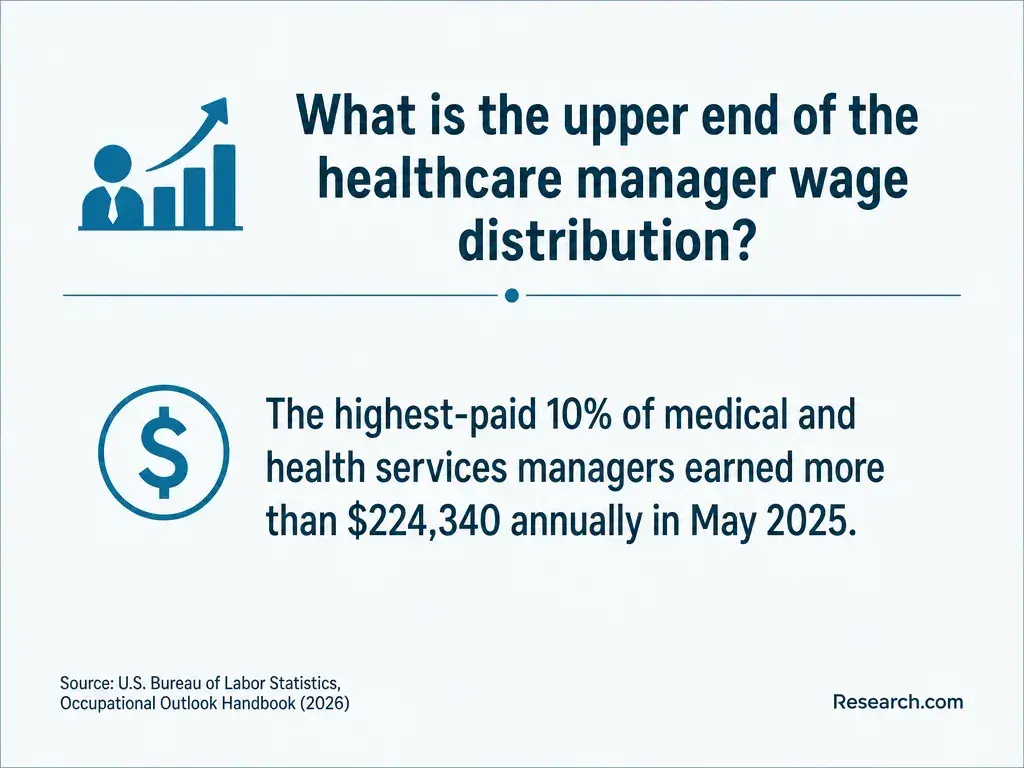
- The $126,520 median annual wage reported by the Bureau of Labor Statistics for all management occupations in May 2025 is not a patient access director salary benchmark; compare actual director postings in your market before paying for another degree.
What does a patient access director do across multiple healthcare locations?
A patient access director oversees how patients enter the care system: appointment scheduling, preregistration, insurance verification, estimates, registration, and related financial-clearance processes. Across multiple locations, the job shifts from supervising a front desk to setting shared standards, coaching site managers, and resolving differences between hospital departments, ambulatory clinics, and centralized teams.
The director also works with revenue cycle, clinical operations, compliance, information technology, and patient-experience leaders. Useful measures may include appointment availability, registration accuracy, verification completion, avoidable denials, and patient complaints. No single measure tells the whole story: a faster check-in process that creates coverage errors or impedes language access is not necessarily an improvement.
Scope matters when comparing titles. One employer's director may lead several clinics; another's may own access strategy for a health system. Review reporting lines, locations, staffing authority, and budget responsibility rather than relying on the title alone. You can compare responsibilities across healthcare administration careers to distinguish patient access leadership from adjacent operations roles.
What education and experience are required to become a patient access director?
Requirements vary by employer, but director candidates typically need substantial patient access, revenue cycle, or healthcare operations experience and a record of managing people or processes. A bachelor's degree is a common educational starting point; some employers prefer a master's degree for broader system leadership. Neither an MBA nor an MHA replaces demonstrated experience with registration workflows, payer requirements, staffing, and cross-functional change.
If you already manage one site, seek a project that crosses locations: standardize a workflow, train supervisors, document a measurable service improvement, and explain how you handled site-specific exceptions. If your background is primarily clinical or technical, first establish direct exposure to access operations and the teams you hope to lead.
A doctorate is generally not the next credential to pursue solely to qualify for a patient access director position. Evaluating advertised fast healthcare administration doctorates may be relevant later for a distinct executive, teaching, or research goal, but a short advertised timeline does not establish director-role value.
Which healthcare administration degree prepares you for patient access leadership?
Choose a degree for the capability you lack, not simply for the credential's name. The comparison below shows how common paths align with patient access work; actual curricula and employer preferences vary.
| Degree path | Potential value for access leadership | Important limitation |
| Bachelor's in healthcare administration | Builds a foundation in healthcare organizations, operations, and management | May not provide the depth or leadership experience expected for a multi-location director |
| Master of Health Administration (MHA) | Focuses graduate management study on healthcare finance, policy, quality, and operations | Program coursework may not cover patient access workflows in depth |
| Master of Business Administration (MBA) | Develops broader finance, analytics, operations, and organizational leadership skills | A general MBA may require you to supply the healthcare context through work or relevant electives |
| Health information management (HIM) degree | Develops expertise in health information, data governance, and related workflows | Is more directly aligned with information management than overall patient access leadership |
For an experienced access manager aiming to oversee several sites, an MHA may fit a healthcare-specific knowledge gap; an MBA may fit a broader budget, strategy, or enterprise-management gap. A professional without healthcare experience can explore MHA options before gaining healthcare experience, but admission to a program should not be confused with readiness for a director job.
Delivery format affects whether you can keep building the experience a director role requires while studying. This comparison highlights scheduling and practical-learning questions to resolve with each program rather than assuming all online or campus programs work alike.
| Consideration | Online program | Campus program |
| Schedule | May reduce commuting, but can still require live classes and group meetings | Usually requires attendance at set locations and times |
| Application to work | May allow employed students to use workplace problems in assignments, subject to program rules | May offer in-person projects or employer engagement, depending on the school |
| Geographic fit | Can widen school choice without relocation | May make local networking easier where the student intends to work |
Ask for the actual course schedule, required visits, group-project expectations, and policies for changing pace. If travel between healthcare sites already makes your week unpredictable, asynchronous coursework may help - but only if assessments and team obligations are also manageable. Compare those requirements alongside affordable online healthcare administration degrees; a lower advertised tuition rate does not by itself establish the lowest total cost or the best format.
Look for courses that help you manage the connection between access, patient experience, and financial performance. Healthcare operations and process improvement can support workflow design across sites; managerial finance and accounting help with staffing and budgets; analytics helps you assess variation without reducing patients to a single metric. Organizational behavior, employment management, quality, healthcare law, and ethics matter when implementing changes through site managers.
An MBA's management core is not the same as a formal healthcare concentration, and a healthcare elective is not proof that a program offers one. Likewise, a health information management curriculum may address data integrity more deeply while spending less time on systemwide access operations. The healthcare administration and health information management program comparison can help if your intended role sits between these functions.
Before enrolling, examine course descriptions and applied-project options. A useful project might test a scheduling or registration improvement across sites, with attention to patient access, staff workload, and error rates - not merely report that one number improved.
Requirements depend on the degree and institution. Bachelor's programs typically evaluate prior academic work and transfer eligibility. Graduate programs commonly request evidence of a completed bachelor's degree, transcripts, and application materials explaining professional goals; individual schools set their own policies on work experience, recommendations, tests, prerequisites, and interviews. Do not assume an MBA requires a business bachelor's degree or that every MHA requires prior healthcare employment.
If you are completing a bachelor's degree first, confirm how existing coursework will count before committing to a school. Understanding healthcare administration articulation and transfer options can help frame questions about accepted credits, remaining requirements, and time to completion.
For graduate applications, use your work history to show increasing responsibility: whom you supervised, which locations or functions you supported, what problem you addressed, and how you evaluated the result. Ask each program whether applicants need accounting or quantitative preparation, and distinguish recommended preparation from an official admission requirement.
A bachelor's degree generally involves a multi-year course of study, although accepted transfer credits can change the remaining time. A master's may take less time at a full-time pace and longer while working. Published completion estimates may assume a particular course load, so request a term-by-term plan that reflects your job and any required fieldwork or campus visits.
Compare programs using the total credits you must complete, tuition charged for those credits, mandatory fees, materials, travel, and potential financing costs. Also check whether your employer reimburses coursework and whether a slower pace changes fees or eligibility for assistance. Without a specific school's current charges and your transfer-credit evaluation, a reliable personal total cannot be stated.
If you are considering advanced education beyond a master's, compare its cost against the role you actually seek. Affordable online doctorates in healthcare administration may warrant investigation for a separate long-term goal; they are not an automatic next step toward patient access directorship.
Start by confirming that the institution holds recognized institutional accreditation. Then check whether any program-level accreditation is relevant to the degree. For MHA and related healthcare management programs, the Commission on Accreditation of Healthcare Management Education (CAHME) is a specialized accreditor. A school's institutional accreditation and an MHA program's CAHME accreditation are different claims; neither should be inferred from marketing language.
Accreditation is one screening factor, not proof that a curriculum covers patient access or fits your schedule. Confirm the status of the specific program and delivery format directly with the accreditor and school. If an MHA is on your shortlist, evaluating online MHA programs through CAHME accreditation is a useful starting point, followed by verification of current status and curriculum.
Certifications can demonstrate focused knowledge, but they do not substitute for managing teams and improving operations. The National Association of Healthcare Access Management offers patient access credentials, including the Certified Healthcare Access Associate and Certified Healthcare Access Manager. Revenue cycle credentials, such as those offered by the Healthcare Financial Management Association, may be relevant when a role heavily emphasizes financial clearance or denials. Check each credential provider's current eligibility, exam content, fees, and renewal rules before applying.
Match the credential to the job description: a patient access certification may be more direct for access supervision, while a broader revenue cycle credential may help when responsibilities extend into reimbursement operations. Health information management is another distinct path; choosing an online CAHIIM-accredited HIM program is more pertinent if your goal is an HIM-focused role than if you primarily want to direct scheduling and registration.
What salary and job outlook can patient access directors expect?
There is no single national pay figure here that accurately represents patient access directors across employers and locations. Compensation depends on system size, scope of responsibility, geography, and whether the role includes broader revenue cycle functions. For context, the Bureau of Labor Statistics reports a $126,520 median annual wage for all management occupations in May 2025. That broad group includes many jobs unrelated to patient access, so it should not be treated as a director salary estimate or an MBA outcome.
The BLS projects about 1.1 million openings per year, on average, across management occupations from 2025 to 2035, reflecting growth and replacement needs. That figure does not predict openings for patient access directors. For a useful local comparison, examine current postings with similar location counts and reporting authority, then compare their stated pay ranges with your present compensation and the full cost of additional education.
A master's degree may be worthwhile if it addresses a documented promotion barrier or skill gap and the cost fits your likely opportunities. If you already meet degree expectations, leading a cross-site initiative may offer more direct evidence of readiness. Online doctoral education for healthcare management professionals is a separate decision; do not assume that a director salary will justify it without a specific career objective and a realistic cost comparison.
Other Things You Should Know About Healthcare Administration
Describe how you set expectations, review site-level results, coach local managers, and identify when a common process needs a justified exception. Bring an example that shows both an operational result and how you maintained staff and patient trust.
Usually not. Standardize essential controls, definitions, and reporting, then allow documented differences for patient populations, service lines, staffing, or physical layout. Review exceptions regularly rather than letting them become unexamined workarounds.
Technology decisions are typically shared with information technology, clinical, revenue cycle, privacy, and operations teams. A director should define the workflow problem, test effects on staff and patients, and help evaluate results rather than select software in isolation.
Ask which sites and functions the role controls, how site managers report to the director, what changes are already underway, and which access problems leadership expects the new director to address. The answers reveal whether the authority matches the accountability.
- Nondiscrimination in Health Programs and Activities | Federal Register https://www.federalregister.gov/documents/2024/05/06/2024-08711/nondiscrimination-in-health-programs-and-activities
- Improving Patient Outcomes Through Effective Hospital... - PMC https://pmc.ncbi.nlm.nih.gov/articles/PMC10676194/
- eCFR:: 45 CFR Part 92 -- Nondiscrimination in Health Programs or Activities https://www.ecfr.gov/current/title-45/subtitle-A/subchapter-A/part-92
- consensus from a Delphi panel of US health system leaders | springer.com https://link.springer.com/article/10.1186/s12913-025-12561-8
- What Have We Learned About Measuring Health System Performance? | RAND https://www.rand.org/health/centers/health-system-performance/what-have-we-learned/measuring-performance.html
- A full guide to insurance eligibility verification | Phreesia https://www.phreesia.com/blog-a-full-guide-to-insurance-eligibility-verification/
- What Does a Patient Access Manager Do? (With Skills) | indeed.com https://www.indeed.com/career-advice/finding-a-job/what-does-patient-access-manager-do
- 29-2099.08 - Patient Representatives https://www.onetonline.org/link/summary/29-2099.08
- ACMA: Scope of Services https://www.acmaweb.org/section.aspx
- 5 Key Components of an Effective Patient Access Strategy | coniferhealth.com https://coniferhealth.com/knowledge-center/5-key-components-of-an-effective-patient-access-strategy/